

Construction IT Built to Hold Under Deadline Pressure
When job sites, bids, inspections, and job costing depend on technology, system failure becomes operational exposure you cannot delegate.
Most IT providers measure ticket speed. Construction firms measure whether systems hold under pressure.
- Keep job sites working during peak activity
- Prevent bid, inspection, and change order delays
- Protect job costing accuracy when leadership decisions depend on it
Supporting construction firms across Texas, including San Antonio, Austin, Dallas, and Houston.
If your systems failed during a bid or inspection tomorrow, who answers for it?

Trusted by 21 Construction Firms Across Texas





Construction Managed IT Services Explained
Construction managed IT services are the design, management, and oversight of technology systems that support job sites, field teams, office staff, and financial reporting as one connected operation.
Construction IT is different from general business IT because it must support mobile job sites, unstable connectivity, large plan files, and deadline-driven workflows.
Construction companies require workflow-aligned IT environments so project management systems, file access, and job costing stay available during peak load.
Well-designed construction IT reduces operational and financial risk by preventing downtime, rework, reporting gaps, and accountability escalation.
Whether supporting multi-site general contractors managing concurrent bids or specialty trades operating from job trailers and equipment yards, construction IT must hold under distributed, deadline-driven pressure.






Why Construction Companies Experience IT Downtime

The Business Impact of Construction IT Failure
One stalled bid or delayed inspection can cost more than an annual managed IT agreement. Reactive IT failures create unplanned expenses that rarely show up in the original project budget. The financial impact of outages extends beyond lost hours; see a breakdown of the true cost of IT downtime for mid-sized businesses.
- Idle crews and rework quietly erode margin while labor and equipment costs continue.
- Missed inspection windows push schedules, trigger client scrutiny, and compress downstream trades.
- Incomplete or delayed records increase exposure during insurance claims, bonding reviews, and audits.
- Client confidence weakens when project momentum is interrupted by preventable system failures.
- Owners, COOs, and CFOs absorb accountability when lenders, boards, or partners ask why work stalled.
- Predictable IT spend replaces reactive emergency expenses tied to downtime.
Most construction firms do not change IT providers until something breaks. By then, the cost is already paid.
Firms looking to reduce reactive disruption often explore structured approaches to eliminating IT downtime before failure forces action.
Say Goodbye To Stalled Job Sites And Protect Your Project Margins

3 Easy Steps To A Predictable Process for Construction IT Management:
- Assess Construction IT Risk and Performance
We assess how job site connectivity, construction project management systems, and job costing systems perform during active project conditions. - Prioritize Construction Workflow Failures
We identify where downtime, access failure, or workflow breakdown would halt crews, delay inspections, or distort financial data. - Execute Construction-Aligned IT Improvements
We align Microsoft 365 for construction, project systems, and financial systems so workflows hold under peak pressure.

How Construction IT Support Must Be Designed Differently
- Managed IT services for construction must be designed around job site, office, and accounting workflows—not generic office assumptions.
- Construction IT support must keep construction project management systems stable during bid deadlines, inspections, and closeout.
- Drawings, RFIs, change orders, payroll, and job costing systems must operate as one coordinated workflow.
- Leadership requires plain-language visibility into where technology failure would stop work or distort financial reporting.
- A US-based service desk with an average 20-minute human response time supports construction urgency and accountability.
- IT costs are structured and visible instead of reactive and unpredictable.
Our IT service desk is staffed in the U.S. and aligned to construction urgency.
We design field connectivity models that account for unstable job site internet, cloud-based project management systems, and synchronized job costing platforms so that failure in one area does not cascade into estimating, accounting, or inspection delays.
This includes secure cloud-based infrastructure and cloud services aligned to mobile construction workflows.

What Stability Looks Like at 4 PM Before a Bid
- Estimators are revising numbers while field teams upload updated drawings.
- Accounting validates cost assumptions.
- Executives review final pricing.
- Shared files must open instantly across office and job sites.
- Submission systems must not stall under load.
This pressure multiplies for multi-site general contractors managing simultaneous bids or specialty trades coordinating subcontractor access across job trailers and equipment yards.
Whether you are a commercial GC, a precast manufacturer, or a specialty trade contractor, stability means none of those systems slow down, disconnect, or require emergency intervention during that window.
With an average 27-minute resolution time for critical issues and 80% of tickets resolved the same day, disruptions are contained before they roll into the next workday.
Performance & Accountability in Construction IT Support
14 Years
Supporting operationally complex organizations since 2012.
76 Companies
Supported across Texas with multi-location operations.
21 Construction Clients
Across general contracting, specialty trades, civil firms, and multi-site commercial builders.
20-Minute
Average human response time during business hours.
27-Minute
Rapid resolutions to critical issues.
80%
Service tickets resolved the same business day reducing workflow disruption.
2.95 Hours
Average issue resolution time across all tickets.
98.2%
Average customer satisfaction rating.
94%
Average client retention rate.
100%
Ransomware attack prevention rate across all managed cybersecurity clients since 2019.
Following a 2019 ransomware event that reshaped our operating model, we built a dedicated Managed Security Services Provider (MSSP) program and in-house Security Operations Center (SOC). Since that shift, no managed security client has experienced an operational shutdown due to ransomware.
That transformation was featured by ChannelPro Network.
Metrics reflect rolling 12-month averages across managed clients unless otherwise stated.

Construction Compliance & Insurance Alignment
Construction firms pursuing regulated or government-funded work must demonstrate control maturity, not just intent.
- Support for CMMC 2.0 compliance preparation, with ownership remaining inside your organization.
- Access to vetted CMMC compliance partners to accelerate readiness timelines while maintaining contractor accountability
- Alignment of documented controls to FTC Safeguards Rule, NIST 800-171 and related contractor data protection expectations
- Review of cybersecurity insurance requirements alongside implemented controls to reduce claim denial risk
- Structured documentation to support underwriting and bonding reviews
- SOC monitoring and logging to support audit defensibility
- Virtual CISO support for firms requiring board-level security governance
Construction Systems Stabilized Under Active Project Conditions

Their Speed and Efficiency Is Tantamount to an Internal, On-Site Employee
“The speed in responses to tickets and professionalism of the staff ranks #1 in what GFC staff appreciate. As manager of IT for GFC, I have appreciated the diagnoses of system shortcomings, suggestions for resolution and system efficiency and immediate steps to correct. Having worked with a number of Managed IT companies previously, I can say without hesitation that 7tech lives up to its reputation of blending into the company infrastructure.”
ROBERT NOCITO, IT Manager, Gomez Floor Covering (San Antonio, TX)

They Made the Transition Very Smooth
As a construction company in the fastest growing city in the United States (San Antonio, TX) we are very busy meeting our project deadlines. We had some downtime due to viruses with our previous IT company, so we were concerned about the transition to a new provider.
We decided to trust the 7tech team and they made the transition very smooth; they are very responsive. The technical knowledge of their team is fantastic. Their staff takes the extra effort to communicate in laymen’s terms, so they explain things in a way that non-techie people can understand.
PAUL BRENNAN, CFO, NAPCO Precast (San Antonio, TX)
In construction, stability is measured by whether crews can access plans, accounting can close periods accurately, and inspections proceed without delay.
What This Means for Construction Executives
- Fewer workflow interruptions
- Reduced exposure to compliance and data risk
- Greater predictability during peak project load
- Clearer operational accountability

Case Study – Gomez Floor Coverings
Commercial Flooring & General Contractor – San Antonio, TX
The Situation
Gomez Floor Covering needed to strengthen its cybersecurity posture after experiencing data compromises. As a contractor managing sensitive project information and financial data, continued exposure created operational and reputational risk.
The Challenge
Their existing security controls were not preventing repeated compromises. Leadership needed a solution that reduced risk without disrupting active projects.
The Approach
We implemented upgraded, next-generation cybersecurity protections designed to harden their environment against further compromise. The focus was on stabilizing their security posture quickly and reducing exposure without slowing operations.
The Result
Since implementing the enhanced cybersecurity controls, Gomez Floor Covering has not experienced additional data compromises, moving from repeated exposure to controlled, monitored access without interrupting active projects. Since partnering with 7tech in October 2019, the organization has not experienced another data breach or ransomware compromise, eliminating repeat downtime events that previously disrupted active construction projects.
Operational continuity restored after repeated ransomware disruptions.

Case Study – O’Haver Contractors
General Contractor – San Antonio, TX
The Situation
O’Haver Contractors relied on aging server infrastructure that was limiting performance and affecting operational efficiency.
The Challenge
Server inefficiencies created bottlenecks that slowed internal processes and reduced overall productivity. Leadership needed improvement without disrupting project execution.
The Approach
We optimized their server infrastructure to improve performance, reliability, and resource utilization. The work focused on strengthening core systems that support daily construction workflows.
The Result
Server bottlenecks that slowed internal processes were removed to operate without infrastructure-related interruption. The organization gained a stronger infrastructure foundation to support ongoing construction activity.
Leadership no longer carries the risk that aging infrastructure will stall estimating, accounting, or project execution.

Case Study – Triun, LLC
General Contractor & Civil Engineering Firm – San Antonio, TX
The Situation
Triun, LLC manages complex projects including new construction, renovations, wastewater treatment facilities, and civil works. With multiple stakeholders and project files in circulation, file access controls required review.
The Challenge
File permissions were not tightly aligned with user roles, increasing the risk of unauthorized access to sensitive project information.
The Approach
We conducted a detailed audit of file permissions and adjusted access controls to ensure only authorized personnel could view or modify critical files.
The Result
File access was aligned with operational roles so project documentation remained secure without slowing collaboration across active jobs.
Each engagement focused on stabilizing systems construction teams rely on daily — not chasing IT metrics, but protecting operational continuity.

Reducing Risk When Changing Construction IT Providers
Stability is not proven when systems are calm. It is proven when they are stressed.
- Critical systems are stabilized before changes are made to live workflows.
- Transitions are planned around active jobs, inspections, and bid deadlines to avoid workflow disruption.
- Changes are phased by system and priority so field connectivity, project management, and job costing remain stable.
- In the first 30 days, you receive a written risk map and prioritized action plan.
- Days 31–60 focus on stabilizing the highest-impact systems first.
- Scope, ownership, and deliverables are defined before execution begins.
- Internal IT teams retain visibility and authority while gaining structured support.
- 80% of service tickets are resolved the same day, reducing disruption during transition.
Transition control remains visible, documented, and owned from day one.
Schedule An Executive IT Scorecard Review for Construction Companies
Simply enter your contact details below and a member of our team will be in touch.
Executive IT Scorecard Review for Construction Companies
What you get:
- Time commitment: 60 minutes. No preparation required.
- Attendees: Owner, COO, CFO, or IT lead.
- Deliverables: A one-page executive risk summary and a prioritized stabilization roadmap. Includes a review of current IT spend patterns and areas of hidden cost exposure.
For executives evaluating provider performance more broadly, see our guide on how to evaluate IT performance.
No pressure and no obligation.
- Identify where construction IT failure would stop work, delay revenue, or distort reporting.
- Get a clear view of job site connectivity, construction IT support, and financial system performance under pressure.
- 60-minute working session with leadership and IT
- Clear written summary of operational risk and exposure
- No obligation or pressure to proceed
Company Information
7tech
San Antonio, Texas (Headquarters)
Supporting construction firms across Texas and select U.S. markets
(855) 701-6777
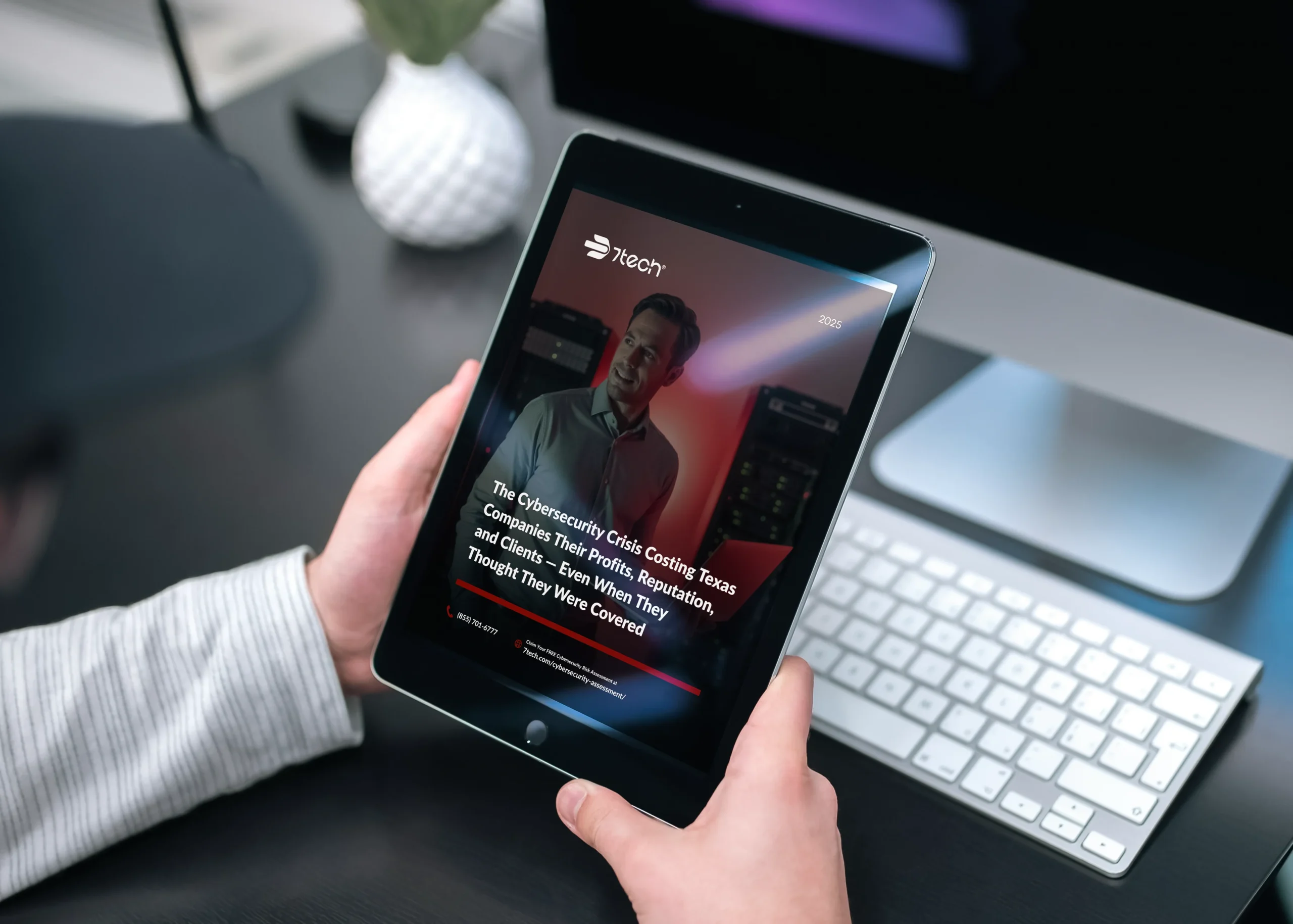
The Cybersecurity Crisis Costing Texas Companies Their Profits, Reputation, and Clients
Discover The 5 Ways That Your Portfolio Companies Can Be Damaged By Cybercrime
Cybercriminals, ransomware, and AI-powered attacks are more advanced than ever. CEOs can no longer ignore it or foolishly think, “That won’t happen to us.”
Construction IT Services FAQ
What are managed IT services for construction companies?
Managed IT services for construction companies cover the design, support, and oversight of systems that keep job sites, field teams, offices, and accounting connected.
This includes job site connectivity, construction project management systems, Microsoft 365 for construction, and job costing systems.
The goal is to prevent downtime, rework, and reporting gaps during active projects.
What is construction IT support?
Construction IT support focuses on keeping technology usable under field conditions, unstable connectivity, and deadline pressure.
It differs from general IT support by prioritizing job site access, plan availability, and inspection readiness.
Support is measured by how well work continues, not ticket volume.
How do construction companies prevent job site downtime?
Job site downtime is reduced by designing IT environments that account for mobile crews, variable internet, and peak usage.
Systems must be stabilized so drawings, RFIs, and safety documents remain accessible during work hours.
Prevention focuses on workflow alignment, not reactive fixes.
What construction software must an IT provider support?
Construction IT must support widely used systems such as Procore, PlanGrid, Autodesk Construction Cloud, Bluebeam, and accounting tools like Sage or QuickBooks.
Support must ensure these systems work together instead of operating in isolation.
Compatibility alone is not enough; performance under load matters.
How does IT affect job costing accuracy in construction?
Job costing depends on timely, accurate data flowing from the field to accounting systems.
When IT systems lag or fail, costs are delayed, duplicated, or missed.
Reliable construction IT keeps financial reporting accurate during active work.
How does managed IT reduce risk in construction?
Managed IT reduces risk by preventing downtime, rework, and reporting failures before they escalate.
It provides leadership with visibility into where systems could stop work or distort numbers.
Risk is controlled through design and oversight, not emergency response.
Firms still operating in reactive models often benefit from understanding the difference between managed service and break-fix IT approaches.
What is the difference between general IT support and construction IT support?
General IT support is built for offices with stable connectivity and predictable usage.
Construction IT support is built for job sites, deadlines, inspections, and financial accountability.
The difference becomes clear when systems are stressed and work must continue.
How do construction firms secure project data?
Construction cybersecurity focuses on protecting project data while keeping it accessible to field and office teams.
Security must support collaboration on drawings, RFIs, and change orders without blocking work.
Effective construction cybersecurity balances access, control, and accountability.
Do you replace internal IT teams?
Construction managed IT services do not automatically replace internal IT teams, and many firms use external construction IT support to strengthen job site connectivity, cybersecurity, and job costing systems while internal staff focus on daily operations.
The goal is clear ownership and workflow alignment across field and office, not removing institutional knowledge.
For firms weighing external support against internal staffing, review our comparison of MSP vs in-house IT models.
What happens in the first 30–60 days after switching?
The first 30–60 days focus on stabilizing job site connectivity, validating access to construction project management systems, and confirming job costing accuracy under real project conditions.
Active bids, inspections, RFIs, payroll, and accounting workflows are reviewed and prioritized to prevent disruption while leadership gains clear visibility into performance.
Reviewed by Neal Juern, Founder & CEO
14+ years leading IT and cybersecurity strategy for operationally complex organizations, including construction firms across Texas.
