Executive IT Oversight for Small and Medium-Sized Business Leaders
IT oversight for small business is the executive responsibility of ensuring technology supports growth, manages risk, and protects the organization, not just keeping systems running. For small and mid-sized businesses (SMBs), effective IT oversight means leadership-level visibility into cybersecurity risk, downtime exposure, compliance readiness, and IT performance. It is not a technical function. It is a business discipline directly tied to profitability, resilience, and long-term value.
What Executive IT Oversight for Small Business Means
Executive IT oversight is the structured, leadership-driven approach to governing how technology supports business objectives while controlling risk through IT governance. It focuses on outcomes, accountability, and decision-making, not tools, tickets, or technical configurations.
For SMBs, IT oversight is often confused with IT management or IT support. They are not the same.
-
IT support fixes problems when they occur.
-
IT management maintains systems and infrastructure.
-
IT oversight ensures technology decisions align with business priorities, risk tolerance, and financial goals.
This distinction matters because SMBs operate with less margin for error. A single prolonged outage, security incident, or compliance failure can materially impact revenue, reputation, or insurability.
Unlike large enterprises with layered IT departments, SMB IT oversight must be simpler but stricter. Fewer systems. Clearer accountability. Less tolerance for blind spots. Executives do not need more dashboards. They need clear answers to a small set of critical questions:
-
Where are we exposed?
-
Is IT helping or hurting profitability?
-
Who is accountable for outcomes?
If you cannot answer these questions with confidence, you are the default owner of the risk.
When leadership cannot confidently answer those questions, the business is operating without visibility. That is risk.
How Executive IT Oversight Works in Practice
Executive IT oversight follows a repeatable rhythm that keeps leaders informed without pulling them into daily IT tasks.
-
Set a review cadence
Leadership reviews IT performance, security posture, and risk on a monthly or quarterly basis. -
Use a scorecard for visibility
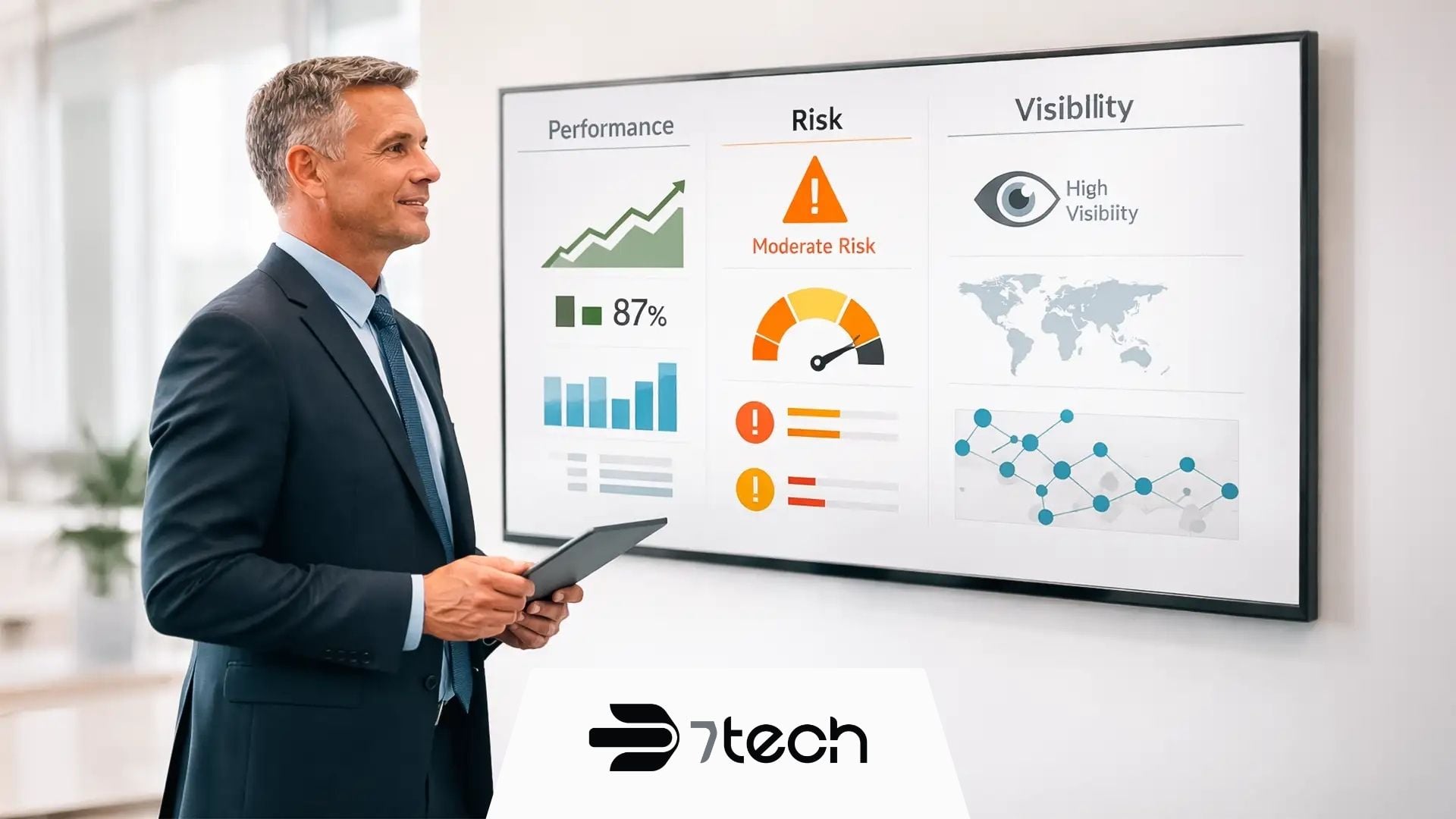
Key metrics show uptime, security events, compliance gaps, and service quality at a glance. -
Maintain a live risk register
Known risks are documented, prioritized, and tracked until they are resolved. -
Document decisions and ownership
Every major IT decision has a clear owner and a recorded business reason. -
Hold vendors accountable
Internal teams and outside providers are measured against agreed business outcomes.
This approach gives executives clarity, control, and defensible accountability.
Common Misconceptions About IT Oversight
-
Myth: IT oversight means sitting in technical meetings
Reality: Oversight focuses on outcomes, risk, and accountability, not configurations. -
Myth: Small businesses do not need formal IT oversight
Reality: Smaller teams face higher risk because they have less margin for error. -
Myth: An IT provider automatically delivers oversight
Reality: Oversight requires governance, reporting, and executive context. -
Myth: Oversight slows the business down
Reality: Clear ownership and visibility reduce delays and surprises.
Why IT Oversight for Small Business Matters Now
For years, many SMB leaders treated IT oversight as something they could revisit later, after growth, after hiring, after things got more complex. That window has closed.
Today, technology touches every revenue stream, every employee, and every customer interaction. At the same time, external pressure has increased. Threats are more frequent, downtime is more expensive, and expectations around security and compliance are higher than ever.
This is why IT oversight for small business matters now, not eventually.
Below are the three forces making executive IT oversight a current, not future, responsibility.
Cyber Risks
Cyber risk is no longer limited to large enterprises. According to CrowdStrike, 60% of small businesses say cybersecurity threats are a top business concern. SMBs are frequently targeted because attackers expect weaker oversight and slower response.
A single ransomware or email compromise incident can interrupt operations, expose data, and divert leadership attention overnight. These events quickly become revenue and reputation issues, not just IT problems.
Without executive IT oversight, cybersecurity decisions tend to be reactive, inconsistent, and fragmented. That gap is where risk grows.
IT Downtime
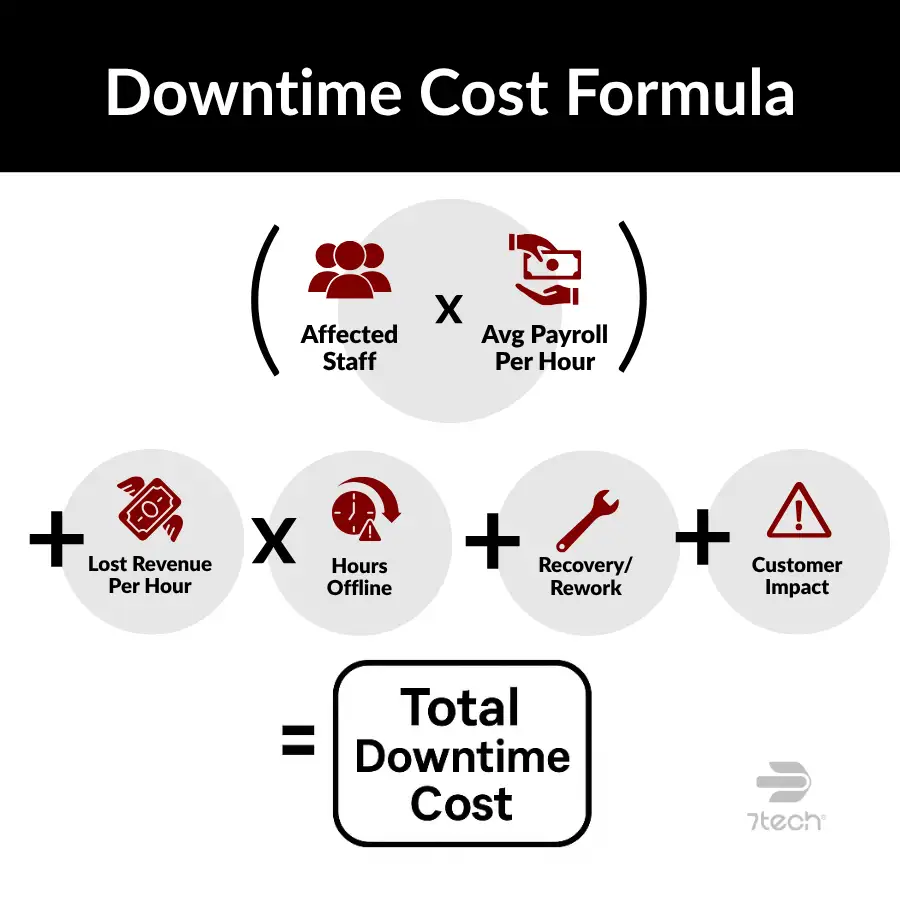
Downtime is not an inconvenience. It is lost money.
When systems go down, productivity stalls, revenue is delayed, and customers feel the impact. For SMBs, even brief outages can have outsized consequences due to limited redundancy.
Most executives underestimate this exposure because it is not calculated in business terms. Understanding the true cost of IT downtime turns IT discussions into financial decisions.
See how to calculate your true cost of IT downtime here.
Compliance and Insurance Pressure Is Increasing
Compliance expectations and cyber insurance requirements are tightening. Insurers and partners now expect documented controls, written IT policies, and evidence of governance.
Practices that once felt good enough now introduce measurable risk. Without executive oversight, gaps often remain invisible until an audit, claim, or incident exposes them.
How Executives Should Think About IT as a Profit and Risk Lever
High-performing leadership teams do not view IT as a necessary expense.
They treat it as both a profit lever and a risk control mechanism.
Profit Perspective: How IT Supports Growth and Margin
From a profit standpoint, IT exists to protect and extend revenue while improving efficiency.
Effective IT oversight helps executives:
-
Protect revenue by keeping systems available, secure, and reliable
-
Reduce disruption through stable network support and dependable IT services
-
Improve productivity by eliminating friction and manual work
-
Scale operations with IT solutions that support growth, not bottlenecks
When IT services fail, revenue feels it immediately. When it works well, the business moves faster with fewer constraints.
Risk Perspective: How IT Controls Business Exposure
From a risk standpoint, IT functions as a core business control system.
Strong executive IT oversight:
-
Limits cyber exposure through consistent security practices
-
Reduces downtime risk with resilient infrastructure and backups
-
Enforces accountability through clear IT policies and ownership
-
Aligns controls with priorities, rather than reacting after incidents
The most expensive IT model is reactive IT.
When leadership engages technology only after something breaks, costs rise, downtime lasts longer, and strategic opportunities are delayed.
Strategic IT oversight compounds value. Reactive IT compounds cost.
A High-Level Framework That Enables Executive IT Oversight for Small Business
Executives don’t need more technical data. They need decision-ready insight that shows how to evaluate IT performance.
Most IT reporting fails because it is tool-centric instead of outcome-centric IT governance. Dashboards filled with technical metrics may look impressive, but they rarely answer executive questions about risk, performance, or accountability.
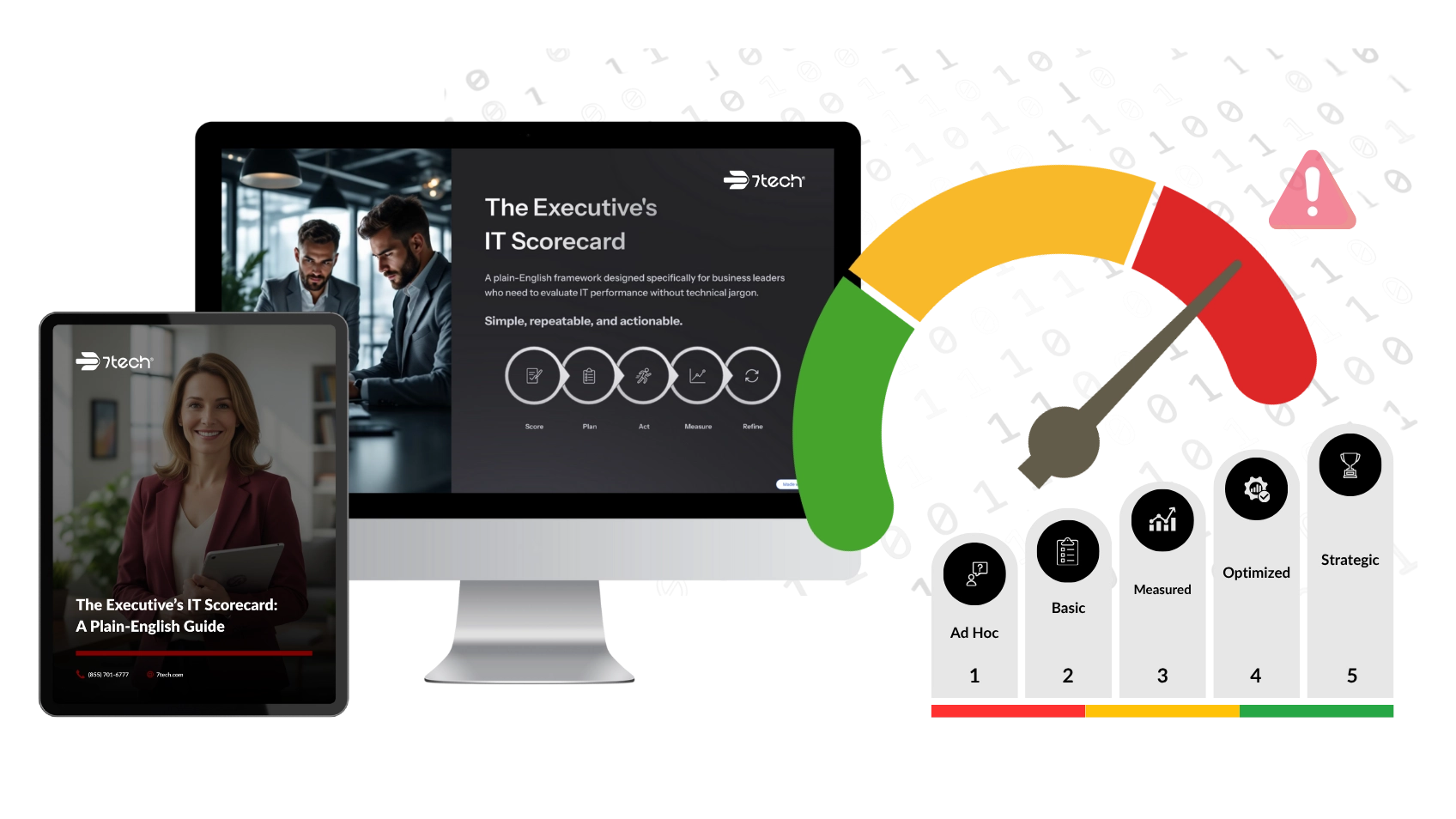
That is why we created the Executive IT Scorecard.
The IT Scorecard Framework
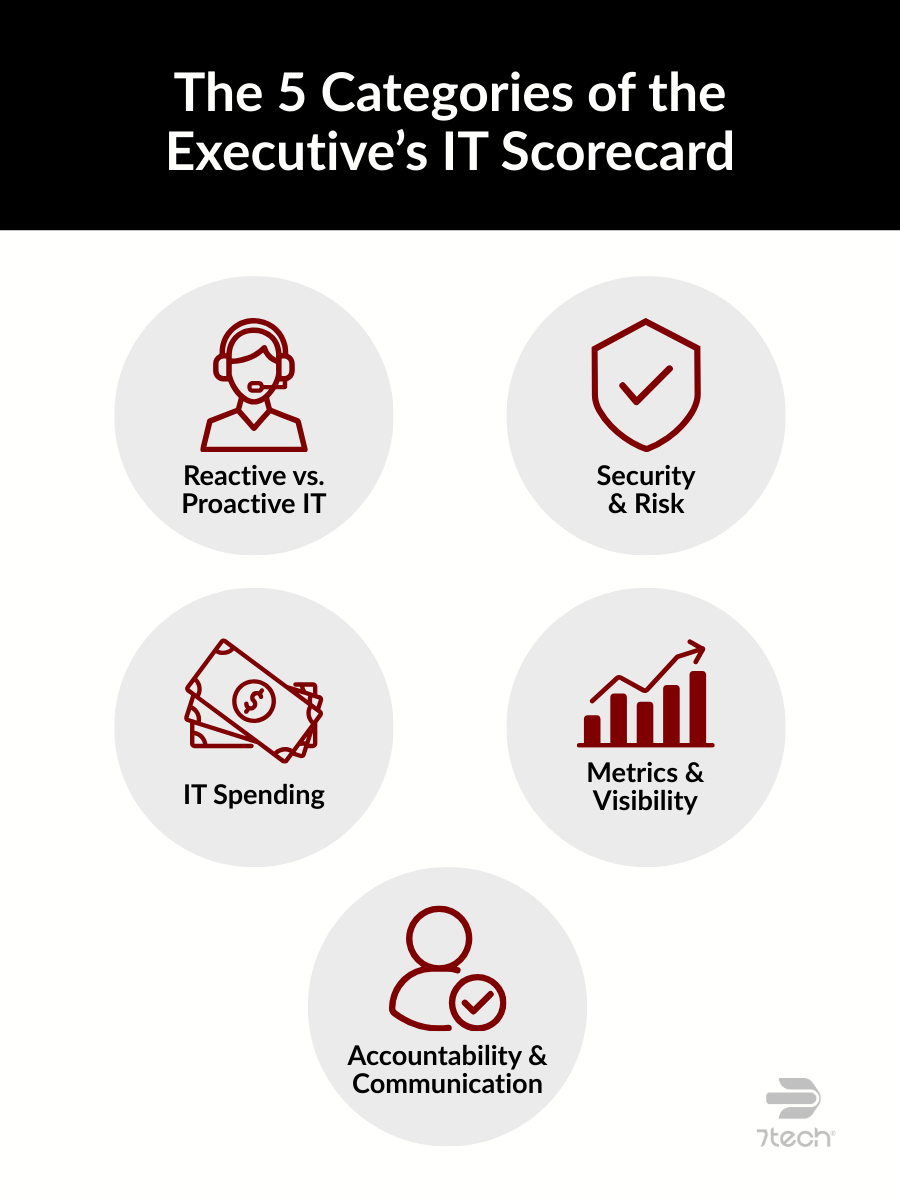
The Executive IT Scorecard is a plain-English framework that gives business leaders a clear, high-level view of how IT is performing, without requiring technical detail or day-to-day involvement.
Instead of dashboards full of noise, the scorecard focuses on the areas that most directly affect risk, cost, and accountability.
At a glance, the Executive IT Scorecard helps leaders evaluate whether IT is holding them back through 5 categories:
-
Reactive vs Proactive IT
-
Security & Risk
-
IT Spending
-
Metrics & Visibility
-
Accountability & Communication
Each area is scored simply, making it easy to spot strengths, identify gaps, and prioritize where attention is needed most.
Just as importantly, the scorecard avoids what executives do not need:
-
Tool-level technical metrics
-
Vendor-specific jargon
-
Ticket counts without business context
The result is a repeatable, executive-friendly way to oversee IT performance and risk, without micromanaging technology.
Learn more about the Executive IT Scorecard approach here.
When and How to Bring in a Strategic MSP or vCIO
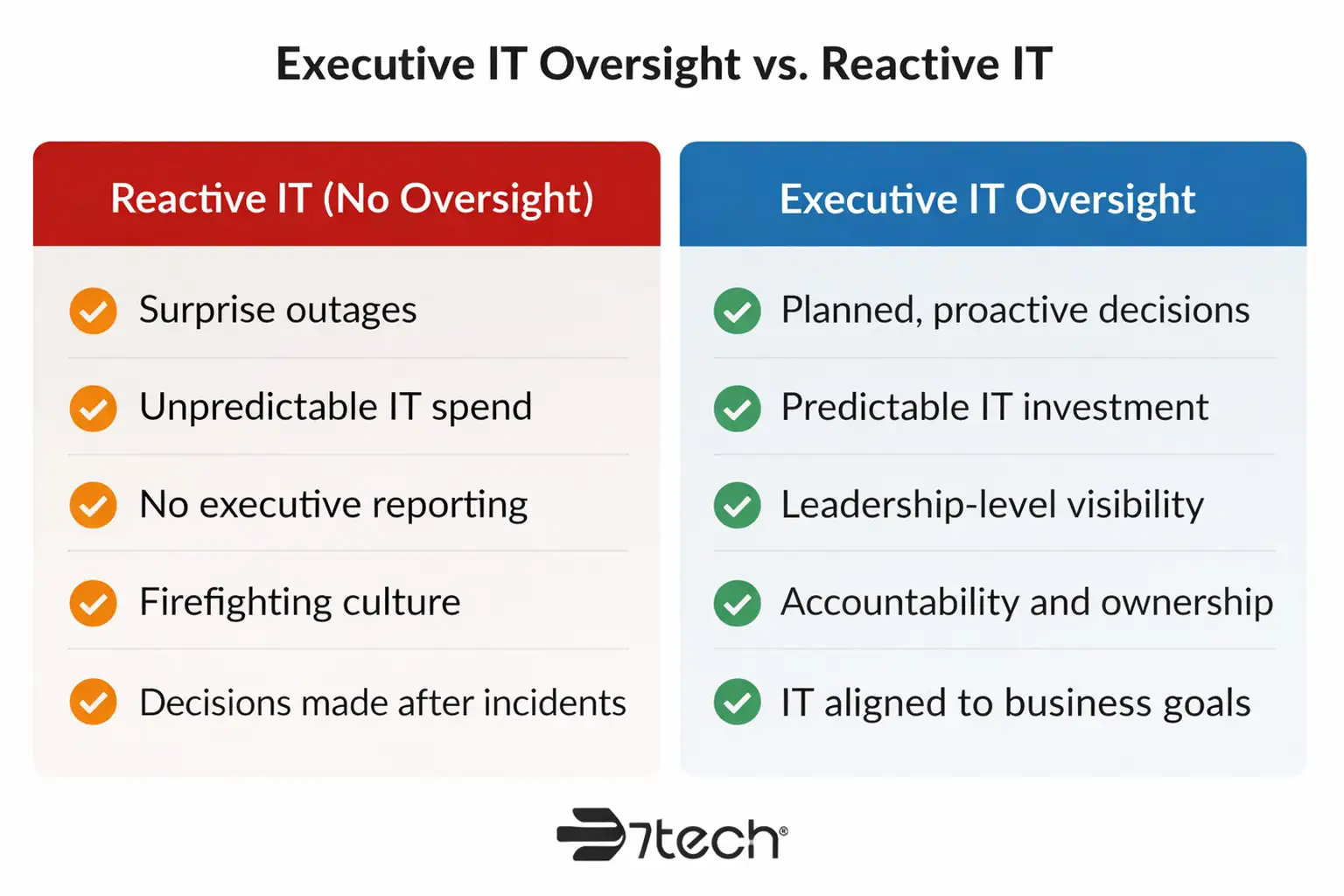
There is a point where internal IT, or break and fix support, stops scaling. That point often shows up as recurring issues, unclear accountability, or rising costs without corresponding improvement.
A strategic Managed IT Services provider (MSP) or virtual CIO (vCIO) exists to support executive IT oversight, not just to close tickets.
When to consider IT outsourcing:
-
IT decisions feel reactive instead of planned
-
Leadership lacks visibility into risk and performance
-
Internal IT is stretched thin or purely tactical
-
Technology spending feels unpredictable
Importantly, IT outsourcing does not mean losing control. When done correctly, it increases executive control by introducing structure, reporting, and accountability that most SMBs struggle to build internally.
What executives should expect from a strategic MSP:
-
Business-aligned reporting
-
Proactive risk management
-
Strategic planning and budgeting support
-
Clear ownership and accountability
This is where managed IT services shift from support to leadership enablement.
Signs Your Small Business Lacks Proper IT Oversight
If any of the following sound familiar, oversight gaps likely exist:
-
No written IT policies or governance standards
-
No executive-level IT reporting
-
Surprise outages or security incidents
-
Reactive, unpredictable IT spending
These are not technical failures. They are leadership visibility failures.
A Real-World Example of Executive IT Oversight for Small Business in Action
For many business leaders, the challenge with IT is not the technology itself. It is the lack of visibility, accountability, and confidence in how IT decisions are being made.
That was the situation facing STARRY, a Texas-based nonprofit organization, before working with 7tech.
As CEO Richard Singleton described it, IT had become one of the organization’s biggest headaches. Issues were reactive. Communication was unclear. Leadership felt ignored and forced to spend time translating technical explanations instead of focusing on the mission of the organization.
What changed was not a single tool or project. It was executive IT oversight.
By introducing clearer governance, plain-English communication, and leadership-level accountability, STARRY’s IT environment shifted from a constant source of stress to a dependable business function. Leadership gained visibility into risks, priorities, and next steps without needing to manage technical details.
As Singleton put it:
“Taking care of us is clearly their #1 priority. We feel respected, informed, and confident that our IT is being handled the right way.”
The outcome was not just better IT performance. It was executive confidence. With clear oversight in place, leadership could step out of day-to-day IT concerns and focus on strategy, growth, and impact.
This is what effective IT oversight for small business looks like in practice. Not more dashboards. Not more noise. Just clarity, accountability, and trust at the leadership level.
IT Oversight for Small Businesses in Texas
Texas-based small and mid-sized businesses operate in a fast-moving environment. Growth, distributed teams, and rising cyber and compliance pressure make IT oversight more complex across San Antonio, Austin, Dallas, Houston, and surrounding areas.
This is where 7tech’s approach stands apart, as a Texas-based IT company.
We do not believe executives should have to translate IT or chase answers to understand how technology is impacting their business.
Since 2019, 7tech has maintained a 100 percent ransomware prevention record across all managed cybersecurity clients. Clients experience an average of 78 percent faster response and resolution times compared to prior IT providers.
7tech supports organizations with 25 to 300 employees across regulated industries, including nonprofits, manufacturing, finance, and professional services. All support is delivered by a U.S.-based team with a 98.2 percent customer satisfaction score.
Why Leaders Choose 7tech for IT Oversight For Small Business
-
We explain IT in plain English, not technical jargon or geek speak.
-
Our U.S.-based team provides real-time, human response when you need it.
-
We focus on executive visibility and accountability, not just IT support tickets.
-
We emphasize proactive IT oversight instead of constant firefighting.
-
We provide clear ownership, so you always know who is responsible.
-
We design our services specifically for growing Texas-based SMBs.
Frequently Asked Questions About IT Oversight for Small Business
What does IT oversight for small business actually mean?
IT oversight means executives actively govern how technology supports business goals, manages risk, and delivers value, without managing technical details.
Who is responsible for IT oversight for small business owners?
Executive leadership ultimately owns IT oversight. IT teams and vendors support it, but accountability rests with leadership.
Is IT oversight the same as IT management?
No. IT management handles systems and operations. IT oversight focuses on governance, risk, performance, and alignment with business strategy.
When should a business consider IT outsourcing?
When leadership lacks visibility, internal IT becomes reactive, or risk exposure increases, IT outsourcing can restore structure and accountability.
How often should executives review IT performance?
At minimum, executives should review IT performance quarterly using a consistent framework like an IT Scorecard.
Final Thoughts: IT Oversight for Small Business Starts With Leadership
Technology now underpins nearly every business function. Delegating IT oversight entirely is no longer realistic or responsible.
Strong IT oversight for small business protects revenue, reduces risk, and supports sustainable growth. It replaces reaction with intention and uncertainty with clarity.
For SMB leaders, the goal is not to become technical.
The goal is to lead with visibility, accountability, and confidence.
Ready to Get Clear on Your IT?
Before making changes to your IT strategy, start with visibility.
The Executive IT Scorecard video shows business leaders how to evaluate IT performance, risk, and accountability, without getting technical.
Watch the Executive IT Scorecard Video here, to get started.

Neal Juern, CEO of 7tech, helps business leaders take control of their IT and strengthen cybersecurity without the complexity. Known for his straight-talk, business-first approach, Neal has guided hundreds of executives toward smarter, safer operations through Managed IT Services and Managed Security Services that make sense to people outside the IT department.