


Types of managed services refer to the outsourced IT functions that keep modern organizations secure, compliant, efficient, and operationally resilient. As technology complexity increases and cyber threats rise, executives are under greater pressure to stabilize costs, ensure uptime, protect sensitive data, and maintain compliance, all without expanding internal headcount. Managed services solve these challenges by delivering proactive monitoring, expert support, and predictable IT operations.
Today, leaders don’t worry about server logs or network configurations. They worry about missed revenue, reputational harm, staff downtime, and the financial impact of technology failures. Managed services eliminate these risks by creating a stable, secure IT foundation that scales with the business.
This shift is also tied to a larger industry trend: as AI-driven threats accelerate and compliance requirements tighten, most internal IT teams can no longer keep pace with the tools, specialization, and 24/7 vigilance required to protect modern environments. While internal IT remains valuable, the capability gap is widening. More organizations are turning to fully managed IT because external MSPs now deliver an operational scale and level of protection that would be cost-prohibitive to reproduce in-house. For a deeper comparison, see the MSP vs. In-House IT breakdown.
This guide explores the essential types of managed services, why they matter, and how they strengthen productivity, security, and long-term growth.
Don’t Let IT Slow Your Business Down
Leverage 24/7 US-based support and Zero Compromise Cybersecurity to stay ahead of threats.
What Are Managed Services?
Managed services are outsourced IT and cybersecurity functions delivered by a specialized provider responsible for maintaining, securing, and optimizing an organization’s technology.
Rather than reacting to issues, managed services rely on proactive monitoring, automation, and round-the-clock oversight to prevent disruptions.
A modern managed services program typically includes:
- Device and network monitoring
- Threat detection and security controls
- Backup and cloud management
- IT strategy and compliance support
- Helpdesk and user support
- Business continuity systems
This model gives executives predictable monthly costs, stronger security posture, and the confidence that operations remain stable, even as threats and technology challenges evolve. It also provides access to enterprise-grade tools and cybersecurity talent that internal IT teams simply can’t replicate affordably.
Why Managed Services Matter for Today’s Organizations
Modern businesses face environmental pressures far beyond what traditional internal IT teams were built to manage. Systems must be available 24/7, cybersecurity regulations have tightened, hybrid work adds operational strain, and digital transformation is no longer optional.
This is where the MSP vs. in-house dilemma becomes clear: internal teams weren’t designed for continuous monitoring, Zero Trust enforcement, or modern cyber defense. Most operate reactively because they lack the personnel, specialized security expertise, and enterprise tools necessary to stay ahead. Managed services close this gap immediately.
Managed services help organizations:
Reduce Downtime and Operational Disruption
Downtime causes significant financial loss, reputational damage, and employee frustration.
Managed services prevent outages through real-time monitoring, rapid detection, and
proactive remediation,reinforcing findings such as network outages account for 4.2% of all IT downtime incidents.
Achieve Predictable and Controllable IT Costs
Unexpected IT failures and emergency repairs can destabilize budgets. Managed services replace “break/fix” unpredictability with consistent monthly costs and strategic technology planning.
Strengthen Cybersecurity and Reduce Risk
Cyber threats are continuous, automated, and increasingly AI-driven. Managed services deliver enterprise-grade security tools, SOC oversight, and Zero Trust frameworks that most in-house teams cannot build or staff.
As IBM outlines in its model of Zero Trust security, continuous verification and least-privilege access are now mandatory for modern defense.
Support Hybrid and Remote Teams
Employees work from multiple locations and devices. Managed services ensure seamless access, secure collaboration, and reliable user support, something internal teams often struggle to manage at scale.
Maintain Regulatory Compliance
Regulations such as HIPAA, CMMC, and FTC Safeguards demand strict, ongoing enforcement. MSPs embed compliance into daily operations, reducing internal workload and eliminating audit fire drills.
For a deeper breakdown, you can reference the CMMC guide and checklist.
The result is a stable, modern IT environment that supports growth instead of slowing it down.
Managed IT Services
Managed IT services form the backbone of most managed service offerings. They focus on keeping systems available, employees productive, and technical issues resolved quickly. For In many organizations, this is the key to operational consistency.
Helpdesk & User Support
A U.S.-based helpdesk ensures employees receive immediate assistance for access issues, device problems, and application troubleshooting. Faster issue resolution eliminates staff downtime and increases productivity across the entire organization, demonstrated in 7tech’s Managed IT Services model.
Network & System Monitoring
Real-time monitoring detects anomalies — latency, hardware failure, misconfigurations — before they escalate. Proactive action prevents outages and protects revenue-producing operations.
Endpoint Management & Protection
Every device represents a security risk. Managed IT ensures endpoints are patched, monitored, secure, and compliant at all times.
Operational Benefits for Leaders
Managed IT reduces operational friction and creates a stable technology foundation:
- Consistent performance across all systems
- Predictable monthly IT costs
- Significant reduction in downtime
- Improved staff satisfaction and efficiency
- Access to advanced diagnostic and automation tools
This is also why many organizations eventually outsource entirely: maintaining these capabilities in-house requires multiple full-time staff, enterprise tooling, and 24/7 coverage— a cost structure that most internal teams cannot justify long-term.
Executives gain a partner that keeps the business running while internal teams focus on strategic work.
For organizations in Texas:
Co-Managed IT Services
Co-managed IT augments internal IT departments by providing additional capacity, specialized skills, and 24/7 monitoring support. This model is ideal for organizations with an IT team that is stretched thin or needs senior-level guidance.
Why Co-Managed IT Is Growing in Popularity
Internal IT teams cannot be experts in every domain — cybersecurity, cloud migrations, compliance frameworks, network engineering, and automation all require specialized expertise. Co-managed IT provides:
- Enterprise-level tools the internal team can’t acquire affordably
- Coverage during staff vacations, turnover, or after-hours gaps
- A second line of defense for cybersecurity
- Strategic guidance and project leadership
- A partner to manage workloads during growth or M&A events
Organizations evaluating a hybrid approach can explore 7tech’s Co-Managed IT Services for deeper structure and benefits.
However, even co-managed IT has limits. As AI-driven threats accelerate and compliance becomes more demanding, many organizations find that the internal/external hybrid model is a transitional step, not a permanent end state.
This is why 7tech’s position remains: fully outsourced MSP/MSSP models will deliver the highest long-term
security, scalability, and cost efficiency as the capability gap grows through 2026 and beyond.
Co-managed IT ensures internal teams don’t burn out and organizations remain protected and scalable.
Managed Cybersecurity Services
Cybersecurity is the most critical component of modern IT management. Threats are more sophisticated, regulatory expectations have expanded, and businesses face severe consequences for breaches.
Managed cybersecurity services include:
- 24/7 SOC Monitoring: A Security Operations Center identifies and investigates suspicious activities in real time, blocking attacks before they escalate.
- Threat Detection & Automated Containment: Machine learning and behavioral analytics identify ransomware, malware, and credential attacks instantly.
- Advanced Email & Anti-Phishing Security: Since most breaches begin with a single malicious email, phishing protection and user identity controls are essential.
- Zero Trust Architecture: Zero Trust ensures users, devices, and applications are continuously verified, preventing lateral movement inside your systems.
Compliance Alignment
Cybersecurity controls are mapped to compliance frameworks like:
- HIPAA
- CMMC
- FTC Safeguards
- PCI DSS
Organizations dramatically reduce legal exposure, audit risk, and financial liability. For deeper foundational principles, see the seven layers of business cybersecurity.
Why Executives Prioritize Cybersecurity Services
A breach affects:
- Revenue
- Client trust
- Insurance rates
- Legal exposure
- Compliance standing
- Executive accountability
Internal IT teams are not structured to perform 24/7 monitoring, threat hunting, forensic response, or automated containment.** This is one of the core reasons the industry is shifting toward fully outsourced MSSP services as the default model.
Organizations needing a fully managed security program can review Managed Security Services for deeper details.
Managed Cloud Services
Cloud systems are now central to productivity, collaboration, business continuity, and remote work. Managed cloud services ensure these environments perform reliably and securely.
To frame the scale of adoption, 94% of businesses now rely on cloud technology, reinforcing why cloud management is no longer optional.
- Cloud Backups & Data Protection: Automated versioned backups prevent catastrophic data loss and support fast recovery after ransomware or system failure.
- Microsoft 365 & SharePoint Administration: Most organizations underutilize Microsoft’s ecosystem. Managed cloud services optimize licensing, security, collaboration features, and data governance.
- Cloud Migrations: Migrating email, servers, or applications requires expertise to avoid downtime. Managed migration ensures a seamless transition.
- Virtual Desktops (VDI): Employees gain secure access to desktops from any location, enabling flexible and hybrid work without compromising security.
- Hybrid Cloud Optimization: Combining private and public cloud systems improves scalability, cost control, and availability.
Business Outcomes With managed cloud services, organizations gain:
- Reliable remote access
- Consistent performance
- Reduced reliance on on-premise infrastructure
- Built-in resilience and continuity
- Stronger data security
Organizations looking to modernize infrastructure can explore 7tech’s Cloud Services
Network & Infrastructure Management
A strong network is the backbone of operational performance. Even minor outages can halt operations, delay production, or prevent customer service teams from functioning.
As reported, network outages account for 4.2% of all IT downtime incidents, emphasizing the need for continuous oversight.
Managed network services include:
- VPN & Secure Remote Access: Ensures staff can safely connect to business systems from anywhere.
- Network Cabling & Infrastructure Maintenance: Well-designed physical infrastructure eliminates intermittent drops and improves performance.
- Enterprise Wi-Fi Design & Management: Strong signal coverage, minimal interference, and predictable performance support modern workspaces.
NOC Monitoring
A Network Operations Center monitors bandwidth, device performance, and system health around the clock.
Why It Matters
- Slower networks destroy productivity
- Outages halt operations
- Poor infrastructure increases cybersecurity exposure
- Old hardware introduces unpredictable risk
IT Consulting, vCISO, and Strategic Technology Services
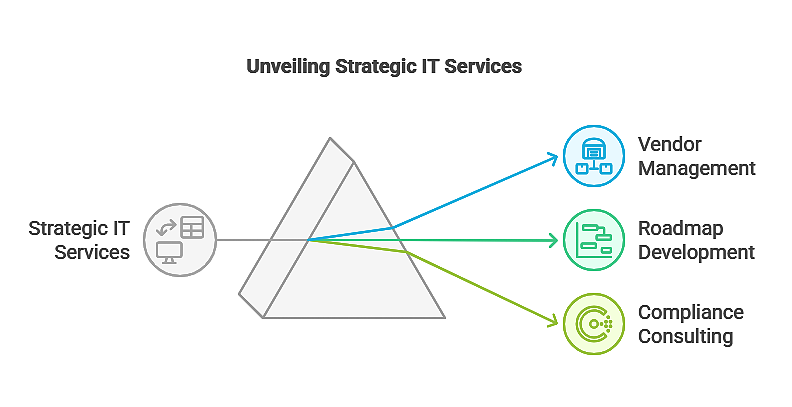
Beyond day-to-day IT operations, businesses increasingly need strategic planning, compliance oversight, and cybersecurity leadership.
Strategic services include:
- Technology Roadmaps: Annual and multi-year plans align IT investments with business objectives.
- vCISO Services: Provides governance, risk management, and compliance expertise without hiring a full-time executive.
- Vendor Management: Consolidates vendor relationships, reduces cost creep, and simplifies renewals.
- Audit & Compliance Preparation: Ensures systems meet industry standards before audits, assessments, or insurance renewals.
Learn more about strategic advantages in the benefits of IT consulting.
Why It Matters for Executives
Without a strategy, IT becomes reactive and expensive.
With strategy, IT becomes:
- Predictable
- Scalable
- Budget-aligned
- Compliance-ready
- Competitive
Specialized Industry Services
Regulated and high-risk industries require more tailored solutions. Generic IT management is not sufficient for sectors with strict operational, privacy, or uptime requirements.
Healthcare IT Services
- HIPAA compliance
- PHI protection
- Secure EHR environments
- MFA controls and audit-ready reporting
Financial Services IT
- Secure handling of sensitive financial data
- FTC Safeguards enforcement
- Encryption, access control, and audit logs
Manufacturing & Industrial IT
- High-availability networks
- Support for production systems
- OT/IT convergence security controls
Industry-specific managed services reduce operational risk and ensure mandatory compliance. Organizations exploring structured compliance support can review 7tech’s Compliance Services.
Comparison Overview
| Managed Service Type | Core Features | Primary Benefits | Best Fit |
| Managed IT | Helpdesk, monitoring, endpoint mgmt | Reduced downtime, predictable costs | All industries |
| Cybersecurity | SOC, threat detection, Zero Trust | Strong security, compliance | Healthcare, finance, legal |
| Cloud Services | Backup, migration, VDI | Scalability, continuity | SMBs, multi-location orgs |
| Network Management | Wi-Fi, VPN, NOC | Reliability, uptime | Manufacturing, office settings |
| IT Consulting | Roadmaps, vCISO, audits | Strategy + compliance | Growing and regulated orgs |
FAQ: Types of Managed Services
What are the most important managed services for modern businesses?
The most essential managed services include managed IT, cybersecurity, cloud management, network management, and IT consulting. Together, they reduce downtime, improve security, support hybrid work, and give executives predictable operational performance.
Why do businesses outsource IT instead of using in-house teams?
Outsourcing provides 24/7 monitoring, enterprise-grade cybersecurity, and specialized expertise that in-house teams typically cannot staff or afford. MSPs also deliver predictable costs and stronger compliance management, reducing operational and financial risk.
How do managed services improve cybersecurity?
Managed services provide SOC monitoring, threat detection, Zero Trust enforcement, and advanced identity protection tools. These reduce the likelihood of breaches, limit lateral movement, and ensure ongoing compliance with frameworks like HIPAA, FTC Safeguards, and CMMC.
What is the difference between managed IT and co-managed IT?
Managed IT fully outsources IT operations to an MSP, while co-managed IT supports an existing internal team with extra capacity, tools, and cybersecurity coverage. Co-managed IT is ideal for overloaded teams but may still fall short of full 24/7 protection.
How do managed cloud services support business growth?
Managed cloud services optimize Microsoft 365, improve data protection, streamline migrations, and ensure consistent remote access. This increases scalability, boosts collaboration, and strengthens disaster recovery, enabling teams to work securely from anywhere.
Which industries benefit most from specialized managed services?
Healthcare, finance, legal, and manufacturing organizations gain the most value because they operate under strict compliance requirements and uptime demands. Industry-specific managed services reduce operational risk while ensuring regulatory alignment.
How do managed services help control IT costs?
MSPs replace unpredictable break/fix spending with fixed monthly pricing, strategic planning, and proactive maintenance. This stabilizes budgets, prevents expensive downtime, and ensures technology investments directly support business goals.
Optimize Your Operations with 7tech
7tech provides managed IT, cybersecurity, cloud, and compliance services to more than 3,000 end users. With award-winning cybersecurity expertise, rapid response times, and a commitment to operational excellence, 7tech helps organizations protect data, reduce risk, and modernize their IT infrastructure.
Schedule a technology assessment and gain a clear, actionable path toward secure, stable, modern IT.Cloud Services Management

Neal Juern, Founder and CEO of 7tech, helps business leaders take control of their IT and strengthen cybersecurity without the complexity. Since founding 7tech in 2012, he’s built it into a 5X MSP 501 winner and guided hundreds of executives toward smarter, safer operations through Managed IT Services and Managed Security Services that make sense to people outside the IT department. He speaks regularly to executive and nonprofit audiences across Texas.