

How to Reduce Manufacturing Downtime Caused by IT and Network Issues
To reduce downtime from IT and network issues in manufacturing, identify every production-critical technology dependency, monitor it before failure reaches the floor, add redundancy where outages hurt most, and define clear escalation and recovery procedures. Many production stoppages are not caused by machines alone. They begin with preventable Wi-Fi, switching, scanner, server, application, or vendor-coordination failures that quietly interrupt labels, visibility, and throughput.
For executives, the issue is not whether a switch, printer, or application failed. It is whether the business had enough visibility, accountability, and recovery discipline to keep a small issue from turning into a plant-level disruption. That is where a more structured approach can make a measurable operational difference.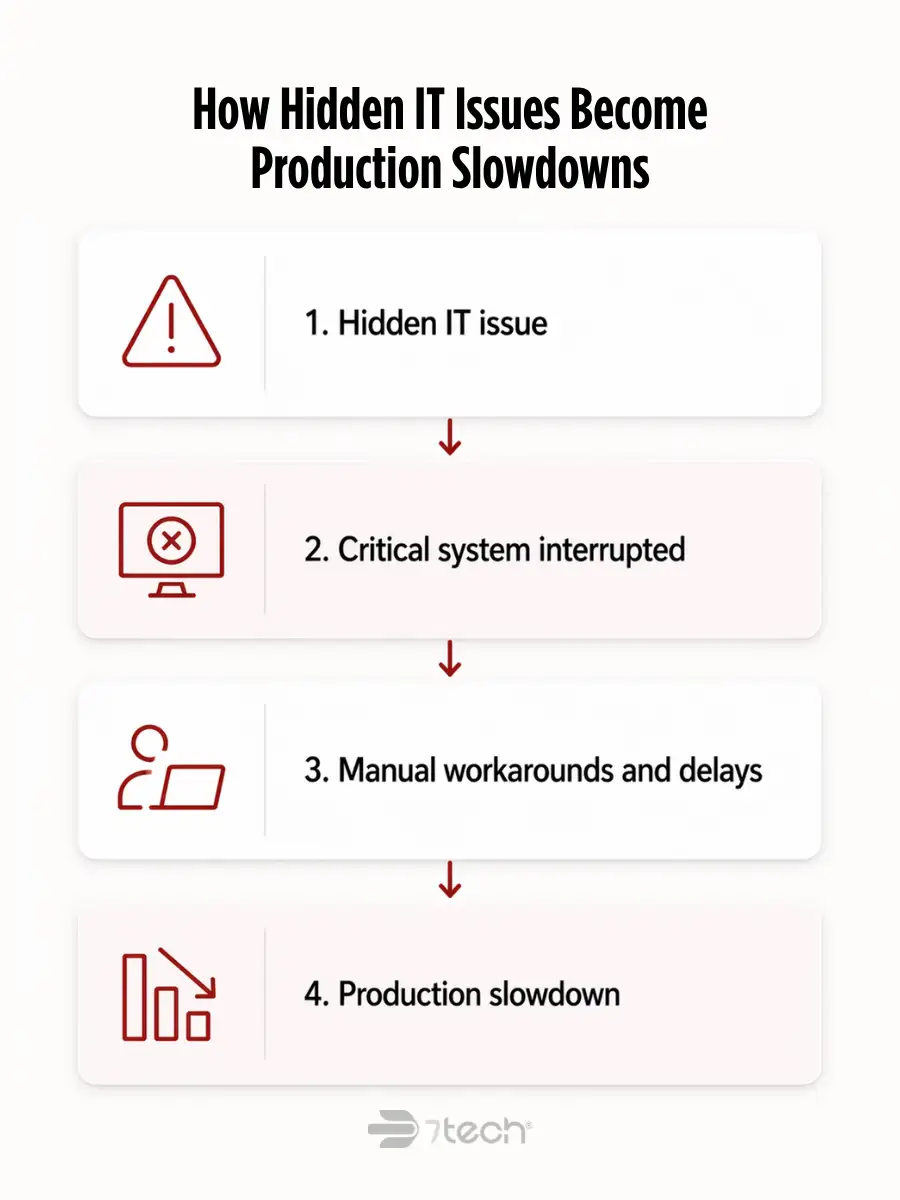
If you are evaluating manufacturing IT services, this guide focuses on one specific problem: how hidden IT and network dependencies interrupt production and what leaders can do to reduce that risk.
Why small IT and network issues can stop production
In a manufacturing environment, minor technology failures rarely stay minor for long. A brief Wi-Fi drop can disconnect handheld scanners. An unstable switch can interrupt communication between workstations, printers, and line supervisors. A print queue issue can stop label output. A short ISP interruption can cut off cloud applications, vendor portals, or remote support tools that production teams rely on.
Each of those failures may look small in isolation. On the floor, they are not. They can delay shipments, halt label printing, reduce inventory visibility, create manual workarounds, and leave people waiting on instructions instead of moving product.
That is why manufacturing downtime from network issues often feels confusing to operations leaders. The machine may still be running, but the process around it is no longer supported. Once labels, scanners, ERP access, or shared files go down, production flow slows or stops.
Manufacturers that want stronger resilience should also understand how technology and operational dependencies intersect. CISA critical manufacturing resources provide useful context for thinking about continuity and sector resilience without turning every issue into a cybersecurity discussion.
The most common technology-related failure points in manufacturing
Most production-impacting IT failures come from a relatively short list of dependencies. The value for leadership is not memorizing technical details. It is knowing where hidden fragility usually lives.
In many facilities, plant network issues are not constant outages. They are recurring weak points that create intermittent production friction. That can be more damaging over time because teams normalize the disruption instead of removing the cause.
For manufacturing leaders working across IT and operational environments, securing OT and plant operations is closely related to uptime because architecture, segmentation, visibility, and ownership all affect resilience.
Why manufacturing downtime is often misdiagnosed as an operations problem
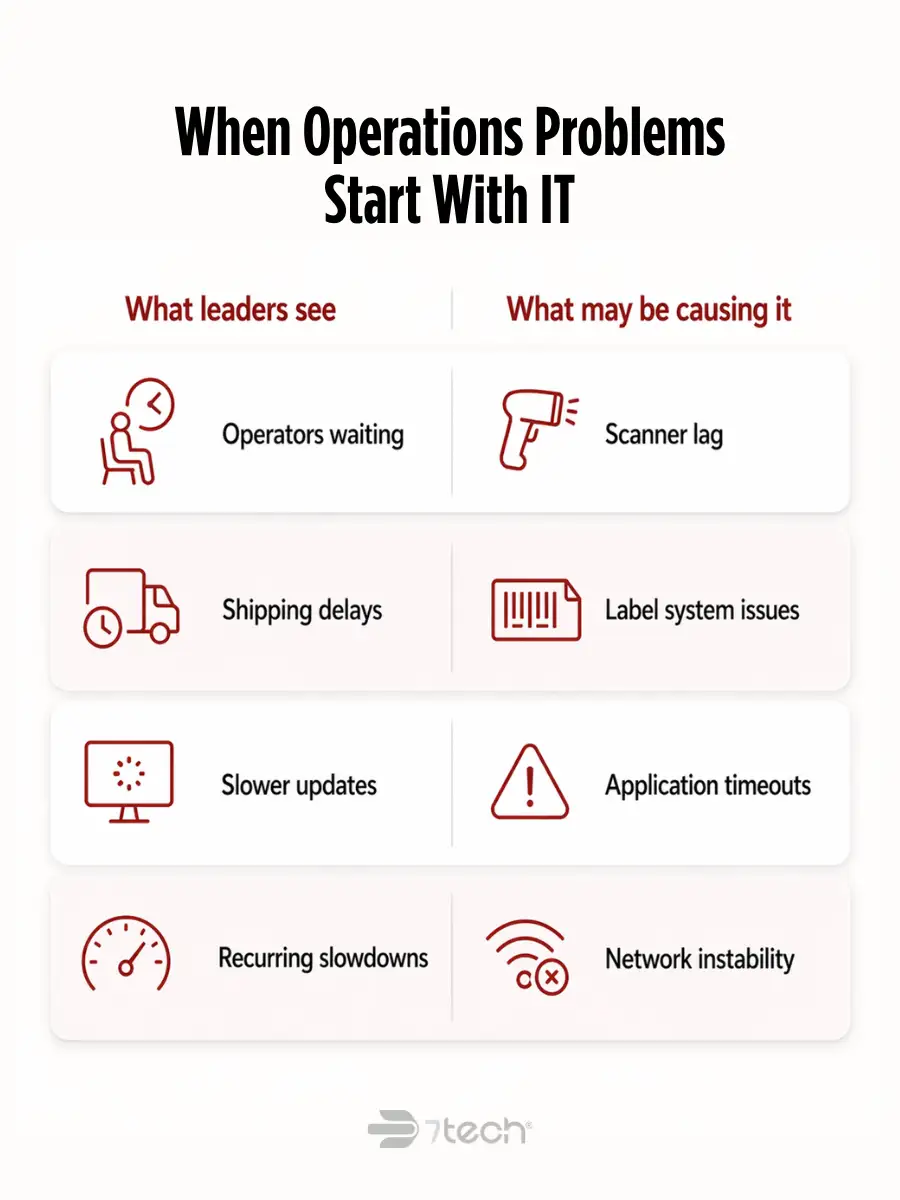
Downtime often gets blamed on staffing, process inconsistency, equipment behavior, or operator error because those issues are visible first. The underlying network or application dependency usually is not.
For example, a line may appear to be slowing down because operators are waiting too long between tasks. The real cause may be scanner lag from unstable roaming. Shipping may seem disorganized when the actual issue is a label-printing dependency tied to an application timeout. A recurring afternoon slowdown may trace back to switch saturation, print server issues, or an overloaded shared resource.
Signs that the real cause is technology-related include:
- The same slowdown appears across different teams or shifts
- Problems cluster around scanning, labeling, file access, or status updates
- Users report intermittent issues instead of full outages
- Production resumes quickly once a device, server, or network path is reset
- Multiple vendors are involved, but no one clearly owns the incident
This is where executives need better visibility. If the organization treats manufacturing IT downtime as a series of isolated tickets, the pattern stays hidden. If it treats those incidents as operational risk signals, leadership can prioritize the right fixes.
How to reduce manufacturing downtime from IT and network issues
The most practical way to reduce downtime from IT and network issues is to use a simple operational framework. The goal is not to make every system perfect. It is to make critical dependencies visible, manageable, and recoverable.
1. Identify every production-critical dependency
Map the systems that production depends on to keep moving. Include Wi-Fi coverage, switches, firewalls, scanners, handhelds, label printers, ERP, MES, shared files, internet circuits, and vendor access points. If a failure can stop shipments, traceability, or floor visibility, it belongs on the list.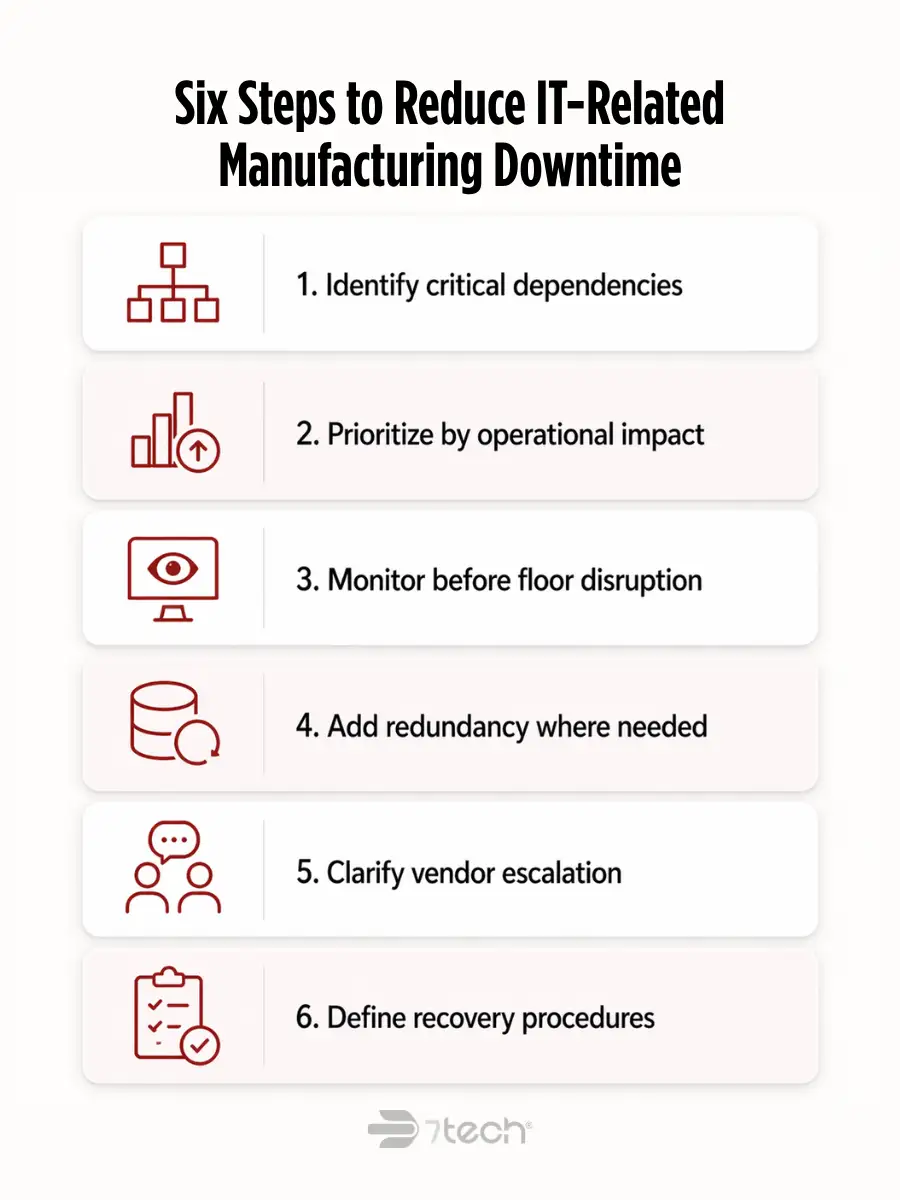
2. Prioritize failure points by operational impact
Not every issue deserves the same investment. Focus first on the dependencies that can stop a line, delay shipments, block labeling, or remove visibility from supervisors. This gives leadership a business-first view of manufacturing network reliability instead of a purely technical backlog.
3. Add monitoring before failure becomes visible to the floor
By the time users start calling, the business is already absorbing downtime. Monitoring should alert on switch health, circuit issues, server performance, storage pressure, application availability, and device failures before operators start improvising around them.
4. Build redundancy where downtime is most expensive
Not every system needs duplicate everything. But when one internet circuit, one switch stack, one print dependency, or one server can stop a critical process, redundancy becomes an operations decision, not just an IT preference. This is where backup internet for business continuity can be especially relevant.
5. Clarify who owns escalation across vendors
Manufacturing outages often drag on because the ISP blames the firewall, the software vendor blames the network, the machine vendor blames the application, and internal teams are left translating. Define one point of coordination and a documented escalation chain before the next outage happens.
6. Define recovery procedures for common failure scenarios
Have a plain-language runbook for common incidents: internet loss, switch failure, scanner outage, print failure, application timeout, and server unavailability. Recovery gets faster when the team already knows the first call, the fallback option, and the communication standard.
Manufacturers looking for broader context on prevention can also review IT solutions that reduce downtime to see how resilience practices fit into day-to-day support and continuity planning.
The support, monitoring, and redundancy practices that reduce downtime
Prevention is rarely one big project. It is usually a set of operating disciplines applied consistently.
- Proactive network monitoring: Watch switches, firewalls, circuits, access points, and server health continuously rather than waiting for user reports.
- Application availability alerting: Monitor the systems that support shipping, labeling, work orders, and production visibility.
- Documented failover paths: If the primary path fails, teams should know what happens next and who validates that the fallback is working.
- Backup connectivity: A secondary internet path can reduce exposure to single-circuit outages.
- Maintenance discipline: Patching and infrastructure work should be scheduled to avoid interrupting plant operations.
- After-hours support expectations: Production environments often need real response outside standard office hours.
- Vendor coordination: Someone should own the conversation across ISP, software, machine, and IT providers.
These practices matter even more where IT and plant environments overlap. NIST guidance on OT security and resilience reinforces the importance of segmentation, visibility, resilience planning, and dependency awareness in operational environments.
For executive teams, the practical question is simple: are recurring issues being prevented, or merely closed? If the answer is mostly “closed,” the business may still be carrying unnecessary production risk. That is why many organizations invest in proactive IT support designed to eliminate recurring failure patterns, not just react to them.
How to improve recovery speed when systems fail
Even mature environments still have incidents. What separates a manageable disruption from a painful outage is recovery speed.
Recovery improves when incidents are triaged by business impact, not just ticket order. A production-impacting outage should never be treated like a routine support request. If scanners are down on the floor or labels are not printing, the response needs to reflect operational urgency.
Faster recovery usually depends on five things:
- Impact-based triage so plant-critical issues rise immediately
- Clear ownership so everyone knows who is coordinating the response
- Known-good rollback options when a change or update causes disruption
- Replacement readiness for critical hardware where spares are justified
- Plain-language communication so leaders know status, risk, and next steps without translating technical detail
Structured incident management also benefits from clear playbooks. CISA incident response playbooks are useful for reinforcing ownership, escalation, and communication discipline during high-impact events.
When organizations want a broader resilience model, zero-downtime IT services is a useful way to frame expectations around planning, failover, and recovery readiness without assuming any environment is immune to disruption.
What executives should expect from IT support in a production environment
Manufacturing leadership should expect more than ticket closure. In a production environment, competent support should provide:
- Fast human response when the floor is affected
- Plain-language updates without “geekspeak”
- Clear accountability during outages
- Prioritization based on production impact
- One point of coordination across vendors
- Reporting that shows recurring root causes, not just closed incidents
That expectation aligns with what many executives actually value most: clarity, speed, and calm communication when the business is under pressure. It is also why fast IT support matters so much in a production setting, where delays can quickly become operational problems rather than routine IT inconveniences.
7tech reports a 20-minute human response time standard and a 97.4% customer satisfaction rating. In manufacturing environments, those kinds of service expectations matter because leaders need responsive support and executive-ready communication when production is affected.
“Since working with them, everything feels more competent and our day-to-day workflow runs smoother and more reliably. That level of responsiveness has made a real impact for us.”
A simple way to assess your current downtime risk
If you want a quick executive check, start here. If any answer is unclear, there may be more downtime exposure than your reporting currently shows.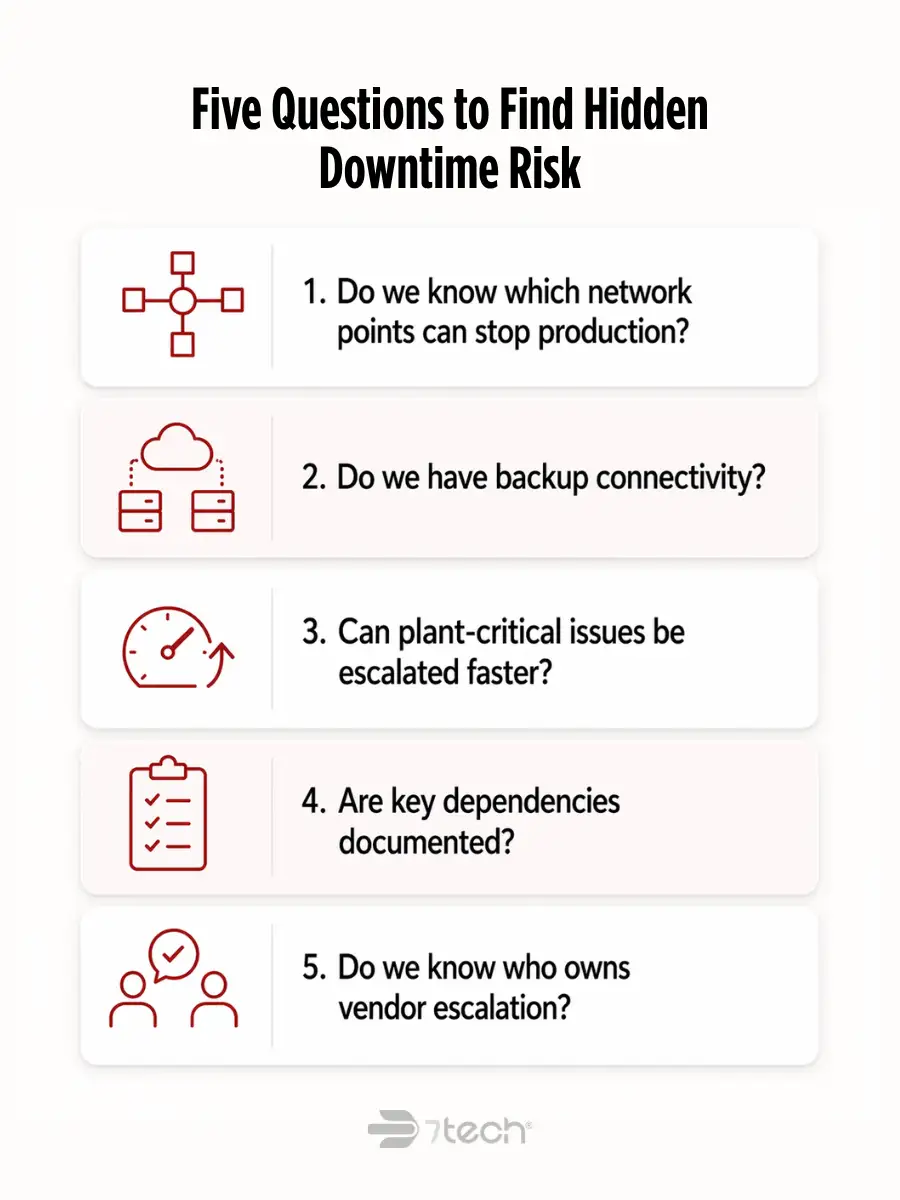
- Do we know which network points can stop production?
- Do we have backup connectivity for critical operations?
- Can our IT partner triage plant-critical incidents differently from routine tickets?
- Are scanner, printer, server, and application dependencies documented?
- Do we know who owns escalation across ISP, software, machine, and IT vendors?
This kind of review is especially helpful for CEOs, COOs, CFOs, CIOs, and IT Directors who are accountable for uptime but do not want to discover hidden dependencies during a live outage.
Reducing Manufacturing Downtime FAQ
What IT issues most often cause manufacturing downtime?
Common causes include unstable Wi-Fi, aging switches, scanner failures, label printer dependencies, application timeouts, server issues, and internet outages. Vendor handoff confusion can also extend downtime when no one clearly owns escalation.
How do network problems stop production?
Network problems interrupt the systems around production, including scanners, labels, ERP access, file sharing, and line visibility. Even when machinery is available, those dependencies can slow or stop throughput.
What is the best way to reduce manufacturing downtime from IT and network issues?
The best approach is to identify critical dependencies, monitor them proactively, add redundancy where outages are expensive, define vendor escalation, and document recovery procedures for common failure scenarios.
How fast should IT support respond to production-impacting outages?
Response should be fast enough to reflect business impact, not routine ticket order. In manufacturing, support should provide prompt human engagement, clear ownership, and plain-language updates throughout the incident.
Do backup internet and network redundancy really matter in manufacturing?
Yes. If a single circuit, switch, or server issue can interrupt labels, visibility, or shipment workflows, redundancy helps contain the disruption and shorten recovery time.
Get a clearer view of your downtime risk
If you want a practical next step, download the Manufacturing Operational Stability Scorecard. It is designed to help executives get a clearer view of the IT and network weak points most likely to interrupt production.
Get the Manufacturing Operational Stability Scorecard

Neal Juern, Founder and CEO of 7tech, helps business leaders take control of their IT and strengthen cybersecurity without the complexity. Since founding 7tech in 2012, he’s built it into a 5X MSP 501 winner and guided hundreds of executives toward smarter, safer operations through Managed IT Services and Managed Security Services that make sense to people outside the IT department. He speaks regularly to executive and nonprofit audiences across Texas.