


Why ERP Does Not Match the Shop Floor
ERP often does not match the shop floor because the system is only as accurate as the transactions feeding it. When production updates are delayed, missed, duplicated, re-entered later, or captured through unreliable devices and workflows, ERP falls behind reality. In most manufacturing environments, ERP not matching the shop floor is not “just the ERP.” It is a visibility problem between planning and execution.
That gap is well recognized in manufacturing. The ISA-95 standard exists in part because enterprise systems and plant-floor operations do not naturally stay aligned without disciplined handoffs, timing, and process design.
Executive summary
- What the mismatch usually means: planning data and floor activity are no longer moving at the same pace.
- Why it matters: leaders start making production, inventory, purchasing, and reporting decisions from numbers people do not fully trust.
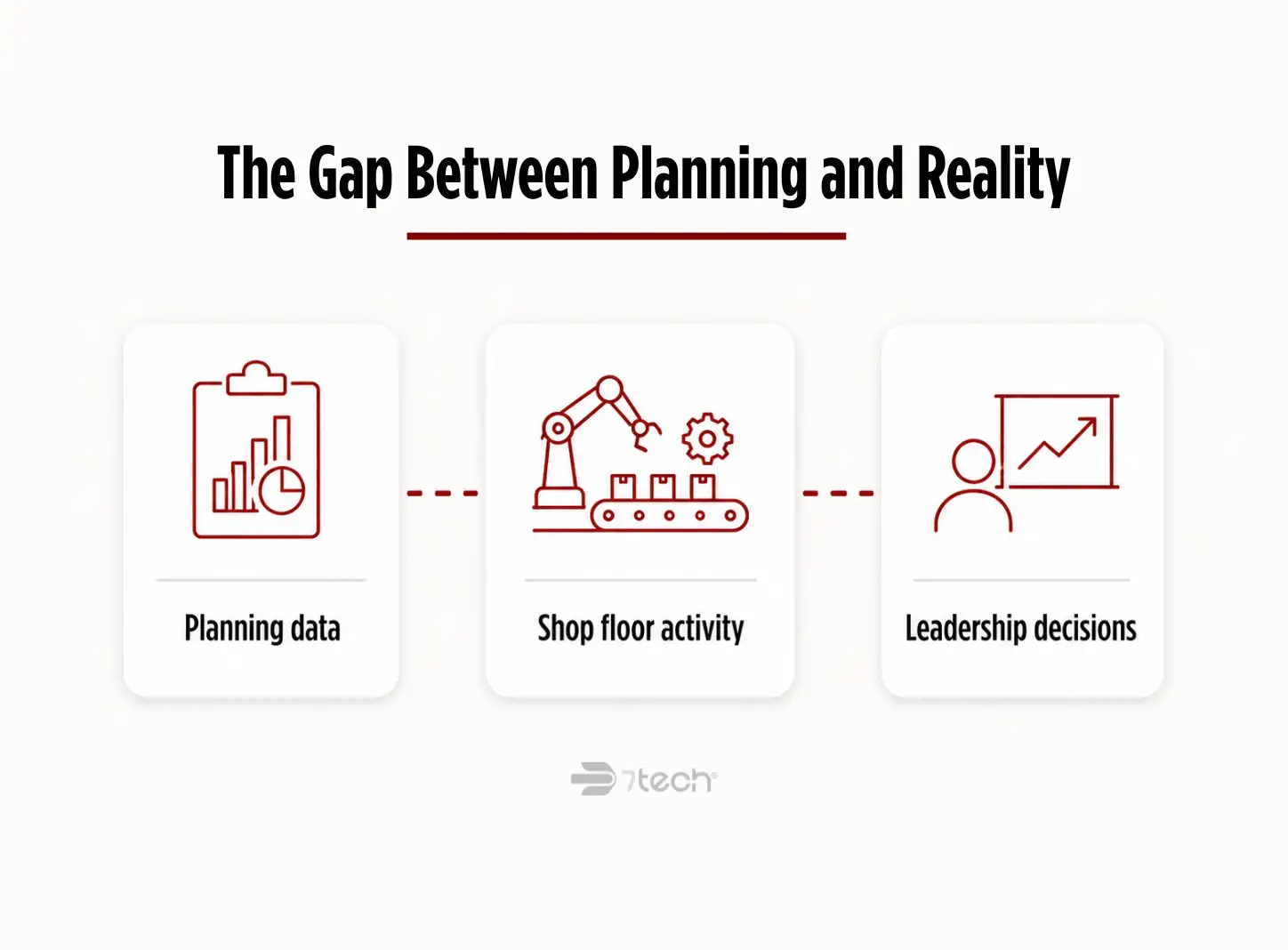
- What to check first: where data is captured, when it is posted, who owns it, and what happens when normal workflow breaks.
What ERP not matching the shop floor looks like in a real manufacturing operation
Most executives notice ERP not matching the shop floor long before anyone gives it a formal name.
It often shows up in morning meetings where the numbers are available, but no one wants to lean on them too hard. Supervisors say output looks different from what the ERP shows. Inventory appears available in the system but is not actually usable on the floor. Work in process is hard to pin down. Completed work is waiting to be posted. Finance, planning, and operations are each looking at a different version of reality.
When that happens, unofficial workarounds usually appear fast:
- whiteboards that operators trust more than the dashboard
- spreadsheet trackers maintained by a single department
- handwritten notes used to bridge missing updates
- verbal shift handoffs that never make it back into the system
- end-of-shift or end-of-day updates entered after the fact
These are not small signs. They are evidence that the planning system is no longer keeping up with execution.
Why ERP truth breaks down between planning and execution
ERP is reliable only when transactions are timely, complete, and tied to how work actually happens. Planning assumes clean handoffs. The shop floor runs on labor availability, machine conditions, quality holds, shift changes, partial completions, rework, exceptions, and practical workarounds.
That is why shop floor execution vs ERP planning can drift apart so easily. The system may be technically working, but the operating conditions around it are messy. When reality moves faster than capture, ERP becomes a lagging indicator instead of a trustworthy operating view.
This is also why ISA-95 remains relevant. It reinforces that enterprise planning layers and manufacturing execution or control layers are distinct. Alignment has to be designed and maintained. It does not happen automatically because software is installed.
The most common reasons ERP does not match the shop floor
Bad or late transactions
Many manufacturing ERP data mismatch problems begin with small transaction failures that compound through the day.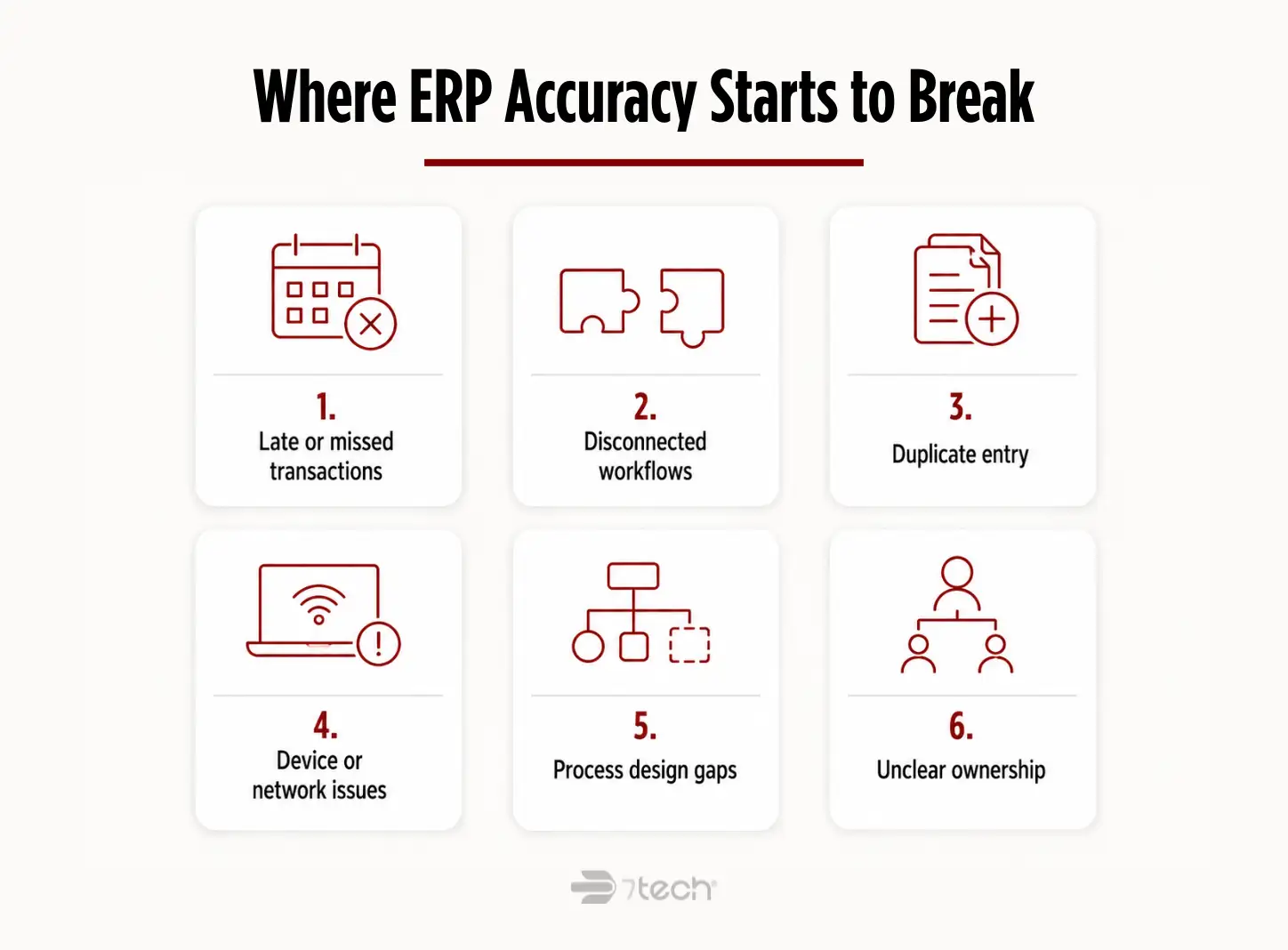
- missed scans
- delayed posting after work is complete
- backfilled entries entered from memory
- wrong quantities
- incorrect status updates
- partial completions posted as full completions
These seem minor in isolation. In practice, they distort production counts, inventory, and WIP visibility. Point-of-activity capture matters because every delayed or inaccurate transaction weakens the ERP’s view of the floor. GS1 DataMatrix guidance is useful context here because standardized identification and scanning practices help reduce avoidable capture errors at the point of work.
Stale data from disconnected workflows
Stale ERP data in manufacturing often comes from workflows that are technically connected but operationally delayed. One team records activity later. Another assumes the update already happened. A batch process posts after the decision window has already passed.
The result is familiar: the ERP is “updated,” but it is still behind the real state of production.
Duplicate entry and manual workarounds
Duplicate entry is one of the fastest ways to break system trust. Production gets noted on paper, then entered into a spreadsheet, then keyed into ERP later. Sometimes data is entered twice. Sometimes it is entered differently each time.
This is how manufacturing duplicate data entry creates confusion:
- shadow systems start competing with the ERP
- rekeying introduces quantity and timing errors
- the “real” number becomes whoever updated last
- people stop trusting official reports
Once teams believe the system is always a little late or a little wrong, workarounds become self-reinforcing. Consistent barcode and identification standards can also help reduce manual re-entry, improve traceability, and make point-of-work capture more dependable.
Scanner, tablet, workstation, or network issues
Sometimes the data problem starts with infrastructure, not process theory. If scanners fail, tablets are slow, shared workstations create bottlenecks, or operators lose plant connectivity, updates get skipped or postponed.
That does not mean every ERP mismatch is a network issue. It does mean plant-floor accuracy depends on capture conditions people can rely on. NIST guidance on industrial wireless deployments reflects that industrial environments have real connectivity constraints that affect operational systems in the field.
When device friction is high, people do what people always do under pressure: they keep production moving and plan to update the system later.
If recurring infrastructure instability is affecting floor visibility, it can also contribute to the broader problems discussed in reduce manufacturing downtime from IT and network issues.
Process design that ignores how the floor actually works
Some workflows look clean in SOPs and break down under real shift pressure. A transaction may be scheduled at the wrong point in the process. Exception handling may be unclear. Operators may be expected to stop at impractical times to enter data.
When transaction timing does not match actual work, compliance with the process drops. That is not a character flaw. It is a design problem.
Ownership gaps
Manufacturing system trust falls apart when no one owns data integrity across operations, IT, and finance. Operations may believe IT owns the system. IT may believe operations owns the data. Finance may discover the mismatch only after reports are questioned.
If everyone touches the problem but nobody owns the standard, the mismatch persists.
The operational cost of bad system alignment
When ERP inventory is not accurate on the shop floor, the cost is not limited to reporting inconvenience. It affects daily decisions.
- production decisions get made from questionable counts
- purchasing reacts to inventory that is not actually usable
- schedules become unstable when actuals trail the plan
- downtime or idle time becomes harder to explain
- margin leaks through avoidable admin effort and bad handoffs
- leadership time gets consumed reconciling instead of deciding
For executive teams, this is where a planning vs actuals manufacturing issue becomes a business issue. It affects cost control, throughput, confidence, and speed of decision-making.
It can also raise the hidden cost of IT downtime when unreliable systems, weak capture points, or delayed updates create avoidable operational drag.
Why this becomes a leadership problem fast
Once the dashboard loses credibility, the issue moves beyond data accuracy.
Operations leaders start relying on side conversations. Finance questions what is being reported. Plant leadership spends more time validating numbers than acting on them. Executives remain accountable for output, cost, and reporting quality without having a clear line of sight into what is actually happening.
That is why this becomes a credibility problem as much as a systems problem. If leadership cannot move from a trusted common view, decision speed slows and confidence erodes.
How to diagnose where the disconnect starts
The best way to diagnose ERP not matching the shop floor is to find the first unreliable handoff, not the loudest symptom.
In practical terms, that means:
- compare planned transaction points to actual floor behavior
- trace when manual workarounds begin
- separate process issues from device or connectivity issues
- look for repeated mismatch patterns by shift or station
- review whether exceptions have a clear path back into the system
This kind of review is often more useful than debating whether the ERP is good or bad. It shows where visibility breaks down in the real environment.
For leadership teams that want a broader lens on accountability and operational reporting, it can also help to review how to evaluate IT performance in terms executives can actually use.
What better alignment looks like across the plant
Better alignment is usually not dramatic. It is disciplined.
- transactions are entered closer to the point of work
- manual handoffs are reduced
- devices and connectivity are dependable enough to support real usage
- data quality ownership is clear
- workflows reflect actual plant behavior, including exceptions
- daily numbers become easier to trust
- morning meetings involve less debate and faster decisions
That kind of consistency supports operations, finance, and leadership at the same time. It also strengthens the case for a more intentional manufacturing IT strategy that supports visibility, uptime, and defensible decision-making.
When the issue is not the ERP itself
Many manufacturers assume the software is the core problem because that is where the mismatch becomes visible. Often, the real cause sits elsewhere: workflow design, device reliability, plant connectivity, transaction timing, governance, or change discipline.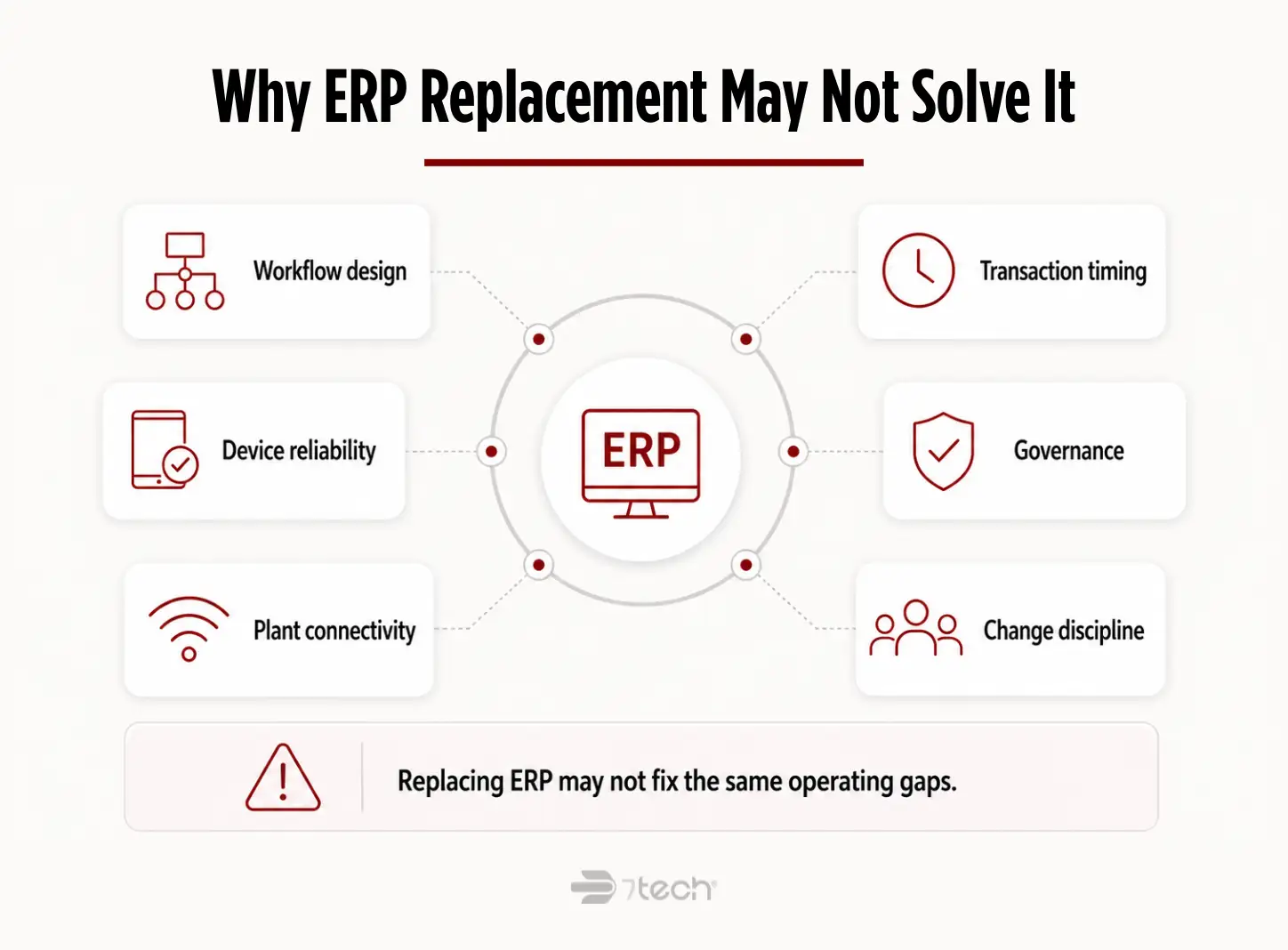
That is why replacing the ERP alone may not solve the trust problem. If the same operational conditions remain, the new system can inherit the same visibility gaps.
The more mature view is this: ERP reflects the quality of the operating system around it.
If security and reliability risks are also part of the environment, manufacturers may need adjacent support to secure OT and plant operations or protect your manufacturing plant from ransomware. Those are related concerns, but separate from diagnosing day-to-day ERP mismatch.
FAQs
Why does ERP not match the shop floor?
Usually, ERP not matching the shop floor happens because transactions are delayed, incomplete, duplicated, or captured through workflows that do not match real production activity.
Is this usually an ERP problem or a process problem?
More often, it is a process-and-visibility problem. ERP may expose the mismatch, but the root cause is often workflow timing, capture discipline, device reliability, or unclear ownership.
How do scanner and device issues affect ERP accuracy?
If scanners, tablets, terminals, or plant connectivity are unreliable, operators postpone updates or bypass them. That creates stale records and weakens trust in production and inventory data.
Why do morning meeting numbers lose trust?
They lose trust when leaders know the system is lagging floor reality. Once people start validating numbers through side conversations, the dashboard stops functioning as the shared source of truth.
What causes stale data in manufacturing systems?
Common causes include batch posting, end-of-shift entry, missed scans, assumed handoffs, and delayed exception handling. The system may be updated eventually, but too late for real-time decisions.
Can duplicate entry create ERP mismatches?
Yes. Double entry through spreadsheets, paper notes, or rekeying creates timing conflicts and quantity errors. It also encourages shadow systems that compete with the ERP.
What should manufacturers check first?
Start with where data is captured, when it is captured, who owns it, and what happens when normal workflow breaks. The first unreliable handoff usually reveals the real source of the disconnect.
Get a clearer view of where the disconnect starts
If your team is spending too much time debating counts, reconciling inventory, or questioning daily reports, the next step is not necessarily a software replacement. It is clarity on where operational visibility is breaking down and where trust in the workflow starts to slip.
7tech helps executive teams identify why ERP not matching the shop floor is creating risk, delay, or confusion so they can improve operational visibility and make more defensible decisions. A practical place to start is the Executive IT Scorecard.

Neal Juern, Founder and CEO of 7tech, helps business leaders take control of their IT and strengthen cybersecurity without the complexity. Since founding 7tech in 2012, he’s built it into a 5X MSP 501 winner and guided hundreds of executives toward smarter, safer operations through Managed IT Services and Managed Security Services that make sense to people outside the IT department. He speaks regularly to executive and nonprofit audiences across Texas.