5 Preparedness Questions Every Construction Leadership Team Should Ask
The questions construction leaders should ask about preparedness start with a practical concern: if one of your critical systems stopped working tomorrow morning, how long would it take before a job felt the impact?
For a general contractor or subcontractor, disruption rarely stays confined to the office. A superintendent may lose access to current drawings. An estimator may be unable to reach bid files. A foreman may be waiting on an approval. A project manager may suddenly be coordinating between the internet provider, software vendor and IT company while a crew waits for an answer.
That is when a technology problem becomes an operational problem.
September is National Preparedness Month, making this a useful time for construction leadership teams to ask a direct question:
If something stopped your operation tomorrow, would your leadership team know what to restore first, who has authority and how work would keep moving?
You do not need an all-day planning session to find out.
Start with 15 minutes, bring together the right leaders and work through these five questions construction leaders should ask about preparedness.
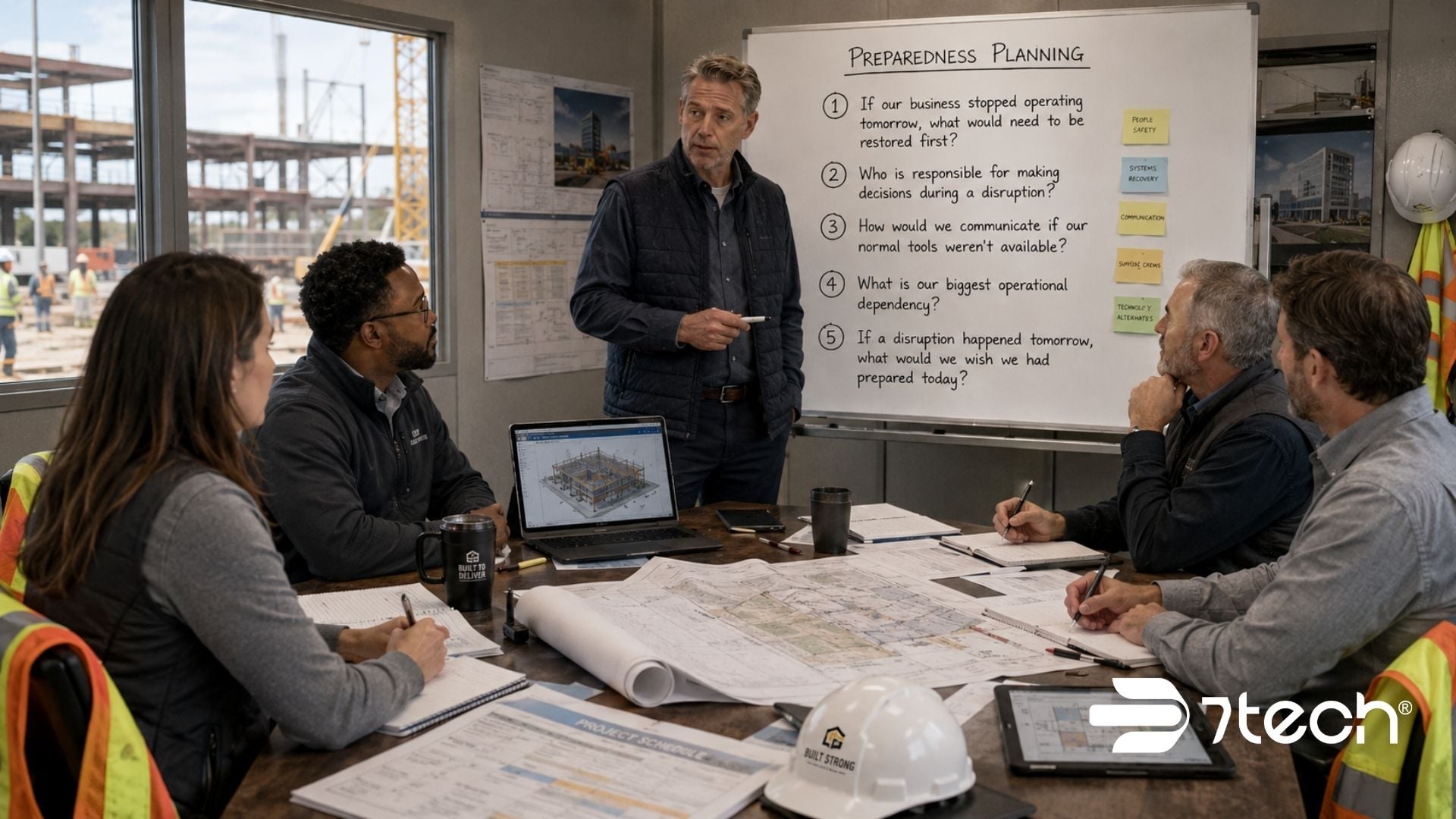
1. If Our Systems Went Down Tomorrow, What Would Have to Come Back First?
Trying to restore everything at once is not much of a recovery plan.
The better question is:
What does the work depend on first?
For your company, that might include:
- Access to drawings, specifications and project files
- Procore or another project management platform
- Email and Microsoft 365
- Estimating and bid documents
- Accounting or payroll systems
- Remote access between the office and field
- Jobsite or trailer connectivity
- Shared files containing RFIs, submittals, contracts or change orders
A general contractor coordinating several active projects may have different recovery priorities than a specialty subcontractor trying to keep foremen, project managers, estimators and field crews connected across multiple GCs.
The important part is knowing the order before something goes down.
Leadership should also understand how long each critical function can realistically remain unavailable before the disruption begins affecting schedules, crews, customer commitments or revenue. That is why companies evaluating zero downtime IT services should start by identifying the systems where extended interruption creates the greatest operational consequence.
When leadership has already agreed on what needs to be restored first, the team can focus on protecting the schedule instead of debating priorities in the middle of a disruption.
Think through the chain.
If the project platform is unavailable, can field teams still reach current information?
If file access fails, can estimators keep working?
If the network goes down, can the office still support the field?
If jobsite connectivity disappears, can supervisors still communicate and retrieve what they need?
A good recovery plan establishes those priorities before the pressure starts.
The connection between technology and project information is visible in 7tech’s construction client experience as well. At Sure Seal, a commercial waterproofing contractor, estimators and field superintendents use cloud and collaboration tools to coordinate specifications, plans and project takeoffs. The company also identified improved network reliability as a positive outcome of its work with 7tech.
That experience provides a practical example of why both network reliability and access to digital project information matter to day-to-day construction operations.
Preparedness takeaway: Restore systems according to their effect on active work, not simply according to which technical issue gets noticed first.
2. Who Owns the Response When Work Is Being Interrupted?
Construction companies are used to accountability.
When something goes wrong on a project, somebody needs to own the next step.
Technology should be no different.
If a superintendent cannot access current drawings, who makes the call on what happens next?
If a jobsite loses connectivity, who coordinates with the internet provider?
If a project platform, phone system or cloud service stops working, who communicates with affected teams?
And if the problem involves several vendors, who is responsible for driving the issue until it is resolved?
This matters because technology problems can quickly turn into vendor finger-pointing.
The ISP says the circuit is fine. The software provider says it is an IT issue. IT says it is the application. Meanwhile, the field is still waiting.
Your leadership team should know:
- Who starts the response
- Who has authority to make operational decisions
- Who communicates with affected project teams
- Who coordinates outside vendors
- Who keeps leadership informed
- Who serves as the backup decision-maker if the primary owner is unavailable
You do not need a complicated chain of command.
You need clear ownership when the work cannot wait.
For executives, this also creates accountability. Leadership knows who owns each part of the response instead of discovering gaps after jobs are already being affected.
Preparedness takeaway: Every critical response responsibility should have a primary owner and a backup.
3. How Would the Office and Field Communicate if Normal Tools Were Unavailable?
Construction companies depend on communication across a moving environment.
People may be working from the main office, a project trailer, the field, a vehicle or another company’s jobsite.
That works well until the usual communication channel disappears.
What happens if employees cannot get into email?
How does a superintendent reach the office if the trailer connection is down?
Where does leadership communicate updates if Microsoft Teams or another collaboration platform is unavailable?
How do project managers get instructions to foremen and crews?
How do you communicate with GCs, subcontractors, owners or other project partners when the normal system is unavailable?
A backup communication plan does not have to be sophisticated.
It should identify:
- Alternate phone numbers
- Emergency contact lists
- Personal mobile numbers for designated leaders
- Vendor escalation contacts
- An approved out-of-band communication method
- Who is responsible for project, employee and customer updates
The important question is simple:
Where does everyone turn when the normal way of communicating stops working?
That clarity can keep a manageable disruption from becoming a full day of unnecessary confusion.
It is especially important when office and field teams depend on the same underlying systems. One outage can affect several locations, crews and projects at the same time.
Preparedness takeaway: Alternate communication should already be documented and understood before primary systems fail.
4. What Single Dependency Could Slow Down Several Jobs at Once?
Every contractor has dependencies that become almost invisible because they work every day.
Of the five questions construction leaders should ask about preparedness, this one can reveal some of the most consequential operational dependencies.
Until they do not.
It might be:
- One internet connection supporting a critical location
- One cloud platform used across multiple projects
- One shared file location
- One person who understands an important process
- One vendor responsible for a key system
- One login or access method employees depend on in the field
- One server or application supporting estimating, accounting or project operations
7tech has seen this issue firsthand in construction technology assessments. Among 20 independently assessed construction organizations where WAN redundancy and failover were evaluated, 18 had a below-satisfactory result.
That does not mean those organizations experienced an outage or that work stopped. It does show how easily an externally delivered service such as internet connectivity can remain an important point of dependency when adequate failover is not in place.
That dependency is not unique to construction. According to Uptime Institute research, networking and connectivity were the most commonly reported cause of IT service outages, cited by 30% of respondents.
That is why backup internet matters for construction businesses that depend on cloud platforms, project files, communications and remote access across offices and jobsites. A second path to connectivity can reduce the risk that one carrier issue affects several teams at once.
The concern is not that every dependency will fail.
The concern is not knowing what the operational impact would be if one did.
For example, losing access to a project management system for ten minutes may be an inconvenience.
Losing access to drawings, RFIs and project information across several active jobsites can quickly become something else.
Crews wait.
Approvals slow down.
Project managers start creating workarounds.
People begin sending files through whatever channel still works.
And leadership gets pulled into a problem that should have been anticipated.
Identifying those dependencies helps your team determine where documentation, redundancy, testing, connectivity or stronger vendor coordination could reduce avoidable disruption.
Preparedness takeaway: Find the dependency that could affect multiple jobs at once, then determine how the company would operate without it.
5. If Something Stopped Tomorrow, What Would We Wish We Had Handled Today?
This may be the most useful question in the meeting because it forces leadership to think from inside the disruption.
Imagine it is tomorrow morning and one of your important systems is unavailable.
A superintendent cannot retrieve current information.
An estimator is working against a deadline.
A jobsite has lost connectivity.
Project managers are calling vendors for answers.
What would your team immediately wish had already been done?
Maybe you would wish you had:
- Tested the backup before you needed it
- Documented who owns the response
- Updated vendor contact information
- Confirmed an alternate way for a jobsite to connect
- Organized critical project files more clearly
- Made sure the right people could access what they needed
- Documented an important process that currently lives in one person’s head
- Established which systems need to come back online first
- Tested recovery procedures instead of assuming they would work
None of those activities feels urgent during a normal week.
That is exactly why they are easy to postpone.
Preparedness means working through these questions construction leaders should ask about preparedness while the schedule is still moving normally, not while a superintendent, estimator or project manager is waiting on the answer.
It also means validating assumptions. A backup that has never been restored, a failover connection that has never been tested or a critical process that exists only in one employee’s head may provide less resilience than leadership believes.
Preparedness takeaway: The work you would regret postponing during a project delay is the work worth addressing before one occurs.
Preparedness Supports More Predictable Construction Operations
Construction leaders rarely think about disaster recovery in isolation.
They think about whether jobs will stay on schedule.
Whether field teams have what they need.
Whether estimators can hit deadlines.
Whether customers will receive answers.
Whether project managers spend their day coordinating work or chasing technology problems.
Technology preparedness supports all of those outcomes.
A well-designed backup and disaster recovery strategy connects data protection with the realities of construction operations: which systems must return first, how restoration is validated, what dependencies exist and what employees need to keep projects moving after a disruption.
For a contractor operating across offices, trailers, jobsites, mobile devices and cloud platforms, recovery is not only about restoring data.
It is about restoring access to the information and systems people need to do the work.
Reliable systems, tested backups, resilient connectivity, clear recovery priorities and defined ownership help reduce the chance that one technical problem turns into delays across multiple projects.
The objective is not to eliminate every possible disruption.
It is to make the business harder to surprise and faster to recover.
Where a Technology Partner Fits
After working through these questions construction leaders should ask about preparedness, your leadership team will probably notice something.
Some answers will be immediate.
Others will begin with:
“I think…”
“Usually…”
“That vendor handles it…”
or
“We would probably…”
Those are the answers worth examining.
They are also the kinds of questions to ask your IT provider when determining whether your technology partner understands the operational consequences of downtime, not simply the systems behind it.
A construction-focused provider of managed IT services can help turn those assumptions into a practical plan by identifying important dependencies, verifying backups, testing recovery processes, documenting systems, coordinating vendors and helping make sure the technology supporting your projects can hold up when something unexpected happens.
For a general contractor or subcontractor, that requires understanding more than servers, computers and support tickets.
It means understanding how the company actually operates across offices, jobsites, trailers, mobile devices, cloud platforms and outside vendors.
The goal is not to turn construction leadership into IT experts.
It is to make sure technology does not become the reason work slows down.
Put This 15-Minute Preparedness Meeting on the Calendar
Bring together leadership, operations and IT and work through these questions construction leaders should ask about preparedness:
- What must be restored first?
- Who owns the response during a disruption?
- How will the office and field communicate if normal systems are unavailable?
- What is our biggest operational dependency?
- What would we wish we had prepared today?
If the answers are clear and supported by documented, tested processes, that is useful confirmation.
If some answers depend on assumptions, unclear ownership or one person knowing what to do, you have found something worth addressing before it affects a job.
Because when systems fail, the real cost is rarely the technology itself.
It is the superintendent waiting on information.
The estimator fighting a deadline.
The foreman trying to keep a crew productive.
The project manager chasing vendors.
And the construction leader who ultimately has to answer for the delay.
Frequently Asked Questions About Construction Preparedness
What should a construction disaster recovery plan prioritize?
A construction recovery plan should prioritize the systems that affect active projects, field communication, scheduling, estimating, payroll and access to drawings or project information. Recovery order should be based on operational impact rather than technical complexity.
Why is backup internet important for construction companies?
Contractors increasingly depend on cloud applications, Microsoft 365, project management systems and remote access. Backup connectivity can reduce the risk that one internet outage cuts off office or field teams from critical project information.
What is the difference between backups and disaster recovery?
Backups preserve copies of data. Disaster recovery defines how systems, connectivity, applications and data are restored so employees can resume work. A successful backup does not automatically mean project operations can recover quickly.
What are common technology single points of failure in construction?
Common dependencies include one internet circuit, a shared file location, a cloud platform, an aging server, one critical vendor, one access method or one employee who holds undocumented knowledge about an important process.
Why should construction executives be involved in preparedness planning?
Executives determine project priorities, acceptable downtime, customer commitments and operational risk. IT can execute technical recovery, but leadership must decide which functions need to be restored first to protect schedules and revenue.
How often should construction companies test recovery processes?
Recovery procedures should be tested regularly and whenever critical systems, vendors, locations or workflows change. Testing verifies that backups, failover methods and documented recovery steps actually work when needed.
How can an IT provider improve construction business continuity?
An IT provider can document critical systems, test backups, strengthen connectivity, coordinate technology vendors, identify operational dependencies and align recovery priorities with how office and field teams actually work.
Turn Construction Preparedness Into a Defensible Recovery Plan
Construction leadership should not have to discover its recovery strategy while crews, estimators or project managers are already waiting.
7tech helps general contractors and subcontractors identify where technology could interrupt the work, validate backup and recovery processes and build a practical plan around the systems, people and information active projects depend on.
Start with the five questions construction leaders should ask about preparedness above. Then determine whether the answers are documented, tested and strong enough to hold up when your operation actually has to rely on them.
Want a clearer view of where your operation may be exposed to unnecessary disruption? Start a conversation with 7tech.
Call (844) 701-6777 or visit 7tech.com.

Neal Juern, Founder and CEO of 7tech, helps business leaders take control of their IT and strengthen cybersecurity without the complexity. Since founding 7tech in 2012, he’s built it into a 5X MSP 501 winner and guided hundreds of executives toward smarter, safer operations through Managed IT Services and Managed Security Services that make sense to people outside the IT department. He speaks regularly to executive and nonprofit audiences across Texas.