


Table of Contents
-
Staff Augmentation Vs Managed Services For Overloaded Internal Teams
-
Managed Services Vs Staff Augmentation In Day To Day Accountability
-
Staff Augmentation And Managed Services For Security Maturity
-
Managed Services And Staff Augmentation For Compliance Driven Growth
-
Choosing Between Staff Augmentation Or Managed Services Without Disrupting Work
Internal IT strain shows up in ordinary work first: delayed access requests for new hires, support tickets aging in queues, compliance evidence missing from shared folders, project deadlines slipping, and executives asking who owns technology risk. With 83% of executives citing workforce limitations as a major barrier to sustaining a secure posture, the pressure is harder to ignore. The choice between staff augmentation vs managed services affects growth, cost control, security ownership, and how much focus your internal team keeps for the business.
Steven Simon, Director of Security Operations at 7tech, notes: “The right support model should make ownership clear enough that a ticket, alert, or audit request never sits waiting for someone to figure out who’s responsible.”
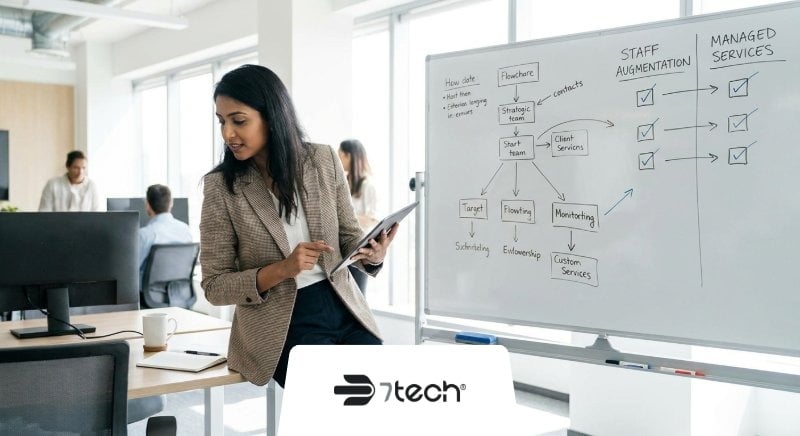
Staff Augmentation Vs Managed Services For Overloaded Internal Teams
Before adding tools, licenses, or headcount, leaders need to compare how work will actually move, especially when four out of five businesses report struggling to recruit the talent they need.
-
Short-term skill coverage: Staff augmentation helps when a migration, firewall cleanup, ERP rollout, or temporary skill gap needs extra pros for a defined window, and 70% expect demand for technical contributors to rise.
-
Ongoing operational ownership: Managed services fit recurring work like monitoring, ticket triage, compliance documentation, patching, backup checks, and predictable coverage.
-
Clear handoff responsibility: Blurry ownership creates duplicate tickets, missed endpoint alerts, slow access approvals, and follow-up work that falls back on overloaded internal teams.
-
Less internal friction: Co-managed IT lets internal teams retain control while we add SOC resources, advanced toolsets, compliance reporting, and 24/7 coverage where they need more depth.
|
Decision Signal |
Best-fit Operating Model |
Operational Example |
Primary Owner |
|---|---|---|---|
|
Backlog is tied to a defined project deadline |
Staff augmentation |
Add a cloud migration engineer for a 12-week Azure tenant consolidation while internal IT keeps change approvals and production cutovers. |
Internal IT manager |
|
Coverage gaps occur after hours or during weekends |
Managed services or co-managed IT |
Route Microsoft Defender alerts to a SOC queue overnight, with escalation to the client’s infrastructure lead for containment decisions. |
Service delivery manager and client IT lead |
|
Compliance evidence is inconsistent across systems |
Managed services |
Collect MFA reports, endpoint encryption status, ticket histories, and patch records monthly for SOC 2 or HIPAA audit preparation. |
Compliance coordinator |
|
Approvals stall between finance, operations, and IT |
Hybrid model with defined RACI |
Set spending thresholds for license changes in ServiceNow so routine requests are preapproved while exceptions go to the CFO. |
Operations director |
|
Internal team needs advanced tools without losing control |
Co-managed IT |
Use our EDR, SIEM, and vulnerability scanning platforms while the client’s IT director retains roadmap and policy authority. |
Client IT director |
Managed Services Vs Staff Augmentation In Day To Day Accountability
Contract help can add capacity, and 60% are turning to contract professionals to meet skills needs. The harder question is who owns recurring outcomes: ticket queues, endpoint protection, onboarding, offboarding, patching, backup checks, vendor follow-up, risk reviews, and executive reporting.
What this looks like in practice: A construction firm adds a project engineer, but the jobsite tablet access request sits between HR, IT, and the project manager while a superintendent waits to upload daily reports. With our US-based Service Desk averaging a 20-minute human response time for support requests and resolving 85% of tickets the same day, that request has a clearer intake path, escalation route, and completion record.
That same accountability matters when a private, US-based SOC alert needs business context fast.

Staff Augmentation And Managed Services For Security Maturity
🧭 How can growing teams protect revenue while keeping approvals, field work, and client handoffs moving?
Security maturity needs endpoint protection, identity access, employee training, and incident response ownership, especially when two in three organizations face moderate-to-critical skills shortages.
Extra hands help with projects, but continuous visibility catches the small issues that disrupt work later: an unusual login, a risky device setting, a missed patch, or a phishing email that reaches accounting before invoice approvals. Our private, US-based Security Operations Center is internally operated, so monitoring, threat hunting, and incident response stay under our control rather than being handed to third-party vendors or overseas contractors.
Our triple-layered Zero Trust approach keeps this practical: detect suspicious behavior, prevent spread through endpoint containment, and respond with clear remediation steps. That includes phishing training, access reviews, and confirmed ownership when an alert touches payroll, production, or client files.
Explore IT Ownership And Outsourcing
Managed Services And Staff Augmentation For Compliance Driven Growth
Compliance work affects everyday operations, including approvals, evidence collection, policy updates, vendor reviews, training records, and audit timelines, while 53% of leaders cite a lack of qualified candidates as a high-impact challenge.
-
Clear evidence collection ownership: Screenshots, logs, access reviews, training records, and policy updates need assigned owners before audit week arrives.
-
Fewer leadership visibility gaps: vCISO guidance helps leaders understand security priorities, compliance exposure, and budget tradeoffs without technical translation.
-
Better internal team support: Co-managed IT gives internal teams access to SOC resources, compliance reporting, and advanced toolsets while they keep control of daily business relationships.
-
More predictable technology spending: Flat-rate managed services can make planning easier than open-ended project hours, while staff support still fits defined needs like migrations, deployments, or workload spikes.
-
Stronger audit and risk readiness: Gap analyses, continuous monitoring, documentation, and executive-level cybersecurity guidance support preparation for CMMC 2.0, HIPAA, FTC Safeguards Rule, PCI, or GLBA.
Get More IT Support For What You Pay
20-minute response times, same-day resolutions, and services most providers charge extra for, all under flexible, predictable pricing.
Choosing Between Staff Augmentation Or Managed Services Without Disrupting Work
Changing IT support models affects people’s routines, budgets, approvals, and trust in existing processes, especially when 71% are most concerned with finding qualified talent with the necessary skills.
-
Map ticket patterns: Review password resets, access delays, stalled projects, recurring device issues, and vendor dependencies against actual ticket history.
-
Assign continuous risks: Name who owns endpoint protection, identity access, backup checks, patching, SOC monitoring, and compliance evidence before urgent user requests take over.
-
Protect internal control: Decide what internal IT keeps controlling, then use co-managed IT for added coverage, security depth, or reporting support where extra help reduces strain.
-
Compare operating expectations: Review flat-rate pricing, response expectations, escalation paths, executive reporting, and cost-effective support. If predictability matters, our 60-day satisfaction guarantee can also reduce the risk of changing providers.
Treat the choice as an operating model decision, not a vendor checklist, as market growth toward $835.45 billion by 2033 reflects how many organizations are rethinking support capacity.
Talk Through The Right IT Support Model With 7tech
The right model gives your team cleaner ticket ownership, faster support paths, stronger security coverage, better audit readiness, and less strain on internal IT, especially as 40% of manufacturers reported using contract or contingent labor to supplement capabilities in the near term.
Talk with us at 7tech about whether staff support, co-managed IT, managed IT services, cybersecurity support, cloud planning, or compliance guidance fits your nonprofit, construction, manufacturing, finance, legal, private equity, or healthcare environment.
We’ll keep the conversation plain-English and workflow-focused, including how our private, US-based SOC and co-managed IT support add security depth, reporting, and coverage while your team keeps control-whether the starting point is a backed-up ticket queue, audit evidence gaps, or unclear ownership after an alert.
Trusted Managed IT Services Near You

Neal Juern, Founder and CEO of 7tech, helps business leaders take control of their IT and strengthen cybersecurity without the complexity. Since founding 7tech in 2012, he’s built it into a 5X MSP 501 winner and guided hundreds of executives toward smarter, safer operations through Managed IT Services and Managed Security Services that make sense to people outside the IT department. He speaks regularly to executive and nonprofit audiences across Texas.