
5 Preparedness Questions Every Manufacturing Leadership Team Should Ask
The questions manufacturing leaders should ask about preparedness start with a practical concern: if a critical system went down tomorrow morning, how long would it take before production felt the impact?
Five minutes? An hour? Half a shift?
For manufacturers, business disruption rarely stays confined to IT for long. A network outage can become a line stoppage. An ERP problem can affect scheduling and inventory. A failed scanner, label printer, EDI connection or file server can slow receiving, production or shipping.
Once production starts waiting, the costs begin stacking up through idle labor, overtime, missed schedules, premium freight and uncomfortable conversations with customers.
September is National Preparedness Month, making this a useful time for manufacturing leadership teams to ask a direct question:
If something stopped your operation tomorrow, would your leadership team know exactly what to restore, who has authority and how the plant would keep moving?
You do not need an all-day disaster recovery workshop to find out.
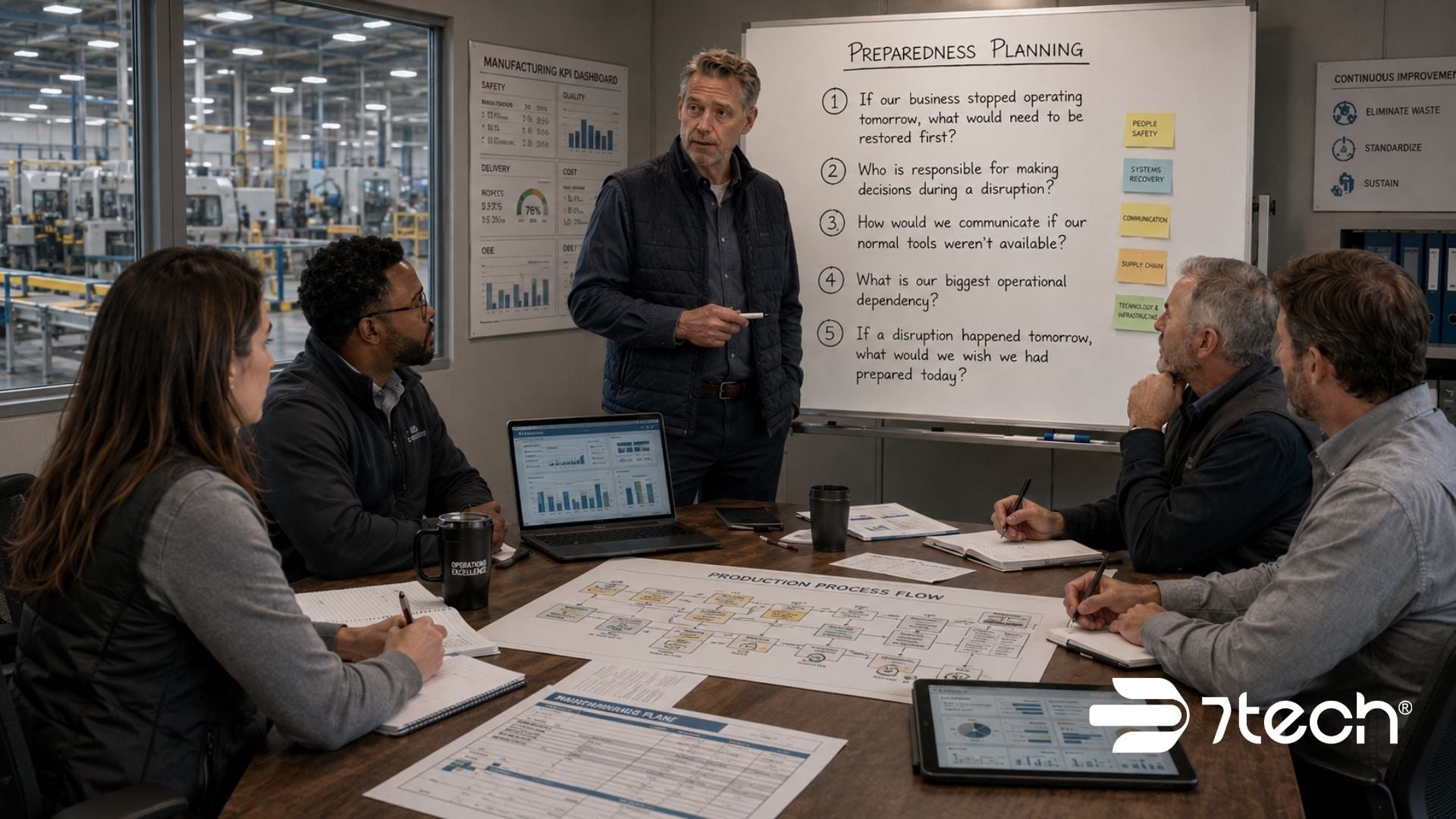
Start with 15 minutes, bring together the right leaders and work through these five questions manufacturing leaders should ask about preparedness.
1. If Production Stopped Tomorrow, What Would We Restore First?
Most manufacturers know which systems are important.
The harder question is which systems are important first.
If your operation suddenly went offline, would your first priority be:
- ERP or MRP access
- Plant connectivity
- Production scheduling
- MES or shop-floor systems
- CAD or engineering files
- Barcode scanners and label printing
- Shipping, EDI or customer portals
- Quality and traceability records
Trying to recover everything at the same time can create more confusion. Leadership should instead understand which systems directly protect production, customer commitments and revenue.
Think through the operational chain.
If the ERP is unavailable, can planning still release work?
If the network goes down, can operators continue producing?
If shipping systems fail, can finished goods still leave the building?
If engineering files are unavailable, does production stop?
Executives should also understand how long each critical function can remain unavailable before downtime materially affects output, labor or customer commitments. That is why manufacturers evaluating zero downtime IT services should focus first on the systems where interruption creates the greatest operational consequence.
A good recovery plan establishes priorities before the pressure starts.
During an outage, the question is not simply, “What is broken?”
It is:
“What has to come back first to keep the operation moving?”
7tech has seen how those operational dependencies can extend beyond a single system. At Watco Tanks, a Texas manufacturer, technology issues affecting operations included server failures and network instability. Improvements involved not only backups and network infrastructure, but also domain-related issues, wired connectivity throughout the office and wireless connectivity between buildings.
The experience illustrates why preparedness should look beyond one application or server and consider the supporting technology, infrastructure and connectivity the operation depends on.
Preparedness takeaway: Restore systems according to production impact, not simply according to which technical problem gets noticed first.
2. Who Has Authority When the Normal Process Breaks Down?
Manufacturing runs on clear ownership.
Disruptions should be no different.
When nobody knows who can make a decision, valuable time disappears into emails, side conversations, approval requests and duplicated work.
Your leadership team should know:
- Who declares an incident?
- Who decides whether production continues, slows or stops?
- Who coordinates IT, operations, maintenance and outside vendors?
- Who communicates with employees and supervisors?
- Who updates customers if delivery commitments may be affected?
- Who works with technology providers and equipment vendors?
- Who communicates with cyber insurance providers, legal counsel or regulators when necessary?
Just as important, every critical responsibility should have a backup owner.
If the person normally responsible for a decision is unavailable, someone else should already understand the process and have the authority to act.
This does not require a complicated incident command structure. It requires enough clarity that employees are not waiting for several leaders to reach the same conclusion independently.
For executives, defined authority creates something just as important as speed: accountability.
Leadership can see who owns the response instead of discovering gaps after production has already been affected.
One of the most expensive phrases during an operational disruption is:
“I thought someone else was handling it.”
Decide who owns what before the plant is waiting.
Preparedness takeaway: Every critical response decision should have a designated owner and a backup.
3. How Would We Communicate if Our Normal Systems Were Unavailable?
Email and Microsoft Teams feel dependable until employees cannot access them.
The same applies to your phone system, cloud applications and internal network.
If a cyber incident, connectivity failure or technology outage affected normal communications, how would leadership reach supervisors and employees?
How would a plant manager receive instructions?
How would employees know whether to report to work?
How would sales communicate with a customer whose shipment may be delayed?
How would your team coordinate with IT providers, equipment vendors, internet providers or other partners?
Leadership teams should be able to answer those questions without needing access to the systems that may be unavailable.
A backup communication plan might include:
- Alternate business phone numbers
- Emergency contact lists
- Personal mobile numbers for designated leaders
- Vendor escalation information stored outside the primary network
- An approved out-of-band communication method
- Defined responsibility for employee and customer updates
The plan does not need to be sophisticated.
It needs to be known, accessible and tested.
The objective is straightforward: when normal communication tools stop working, employees should not have to invent a communication process while they are already managing a disruption.
Customer communication matters too. A technical outage can quickly become a customer relationship problem when shipment delays occur and nobody can provide reliable information.
Preparedness takeaway: Your alternate communication method should be established before your primary communication systems become unavailable.
4. What Is the Single Dependency That Could Hurt Us Most?
Every plant has them.
Of the five questions manufacturing leaders should ask about preparedness, this one can reveal some of the most consequential operational dependencies.
The system everyone depends on.
The vendor nobody has challenged.
The server nobody wants to touch.
The internet circuit with no practical backup.
The employee who knows how three different systems were patched together ten years ago.
During normal operations, these dependencies fade into the background.
During an outage, they become painfully visible.
For manufacturers, common single points of failure include:
Connectivity deserves particular attention because a manufacturer may have working servers, applications and backups while employees still cannot reach the systems they depend on.
According to Uptime Institute research, networking and connectivity were the most commonly reported cause of IT service outages, cited by 30% of respondents.
A properly designed backup internet strategy can reduce dependence on one circuit by giving critical operations another path online when the primary connection becomes unavailable.
Ask your team:
“If this disappeared tomorrow, what would happen to production?”
If the answer is, “We’re not sure,” you have found something worth investigating.
Reducing key-person, system and infrastructure dependencies creates something manufacturers value deeply: predictability.
Fewer surprises.
Faster recovery.
Less reliance on heroics.
That also means evaluating dependencies together rather than assuming one safeguard protects the entire recovery path. A reliable backup does not solve a connectivity failure. A redundant internet connection does not help if the application employees need cannot be restored.
Preparedness takeaway: Look for the dependency that could stop multiple workflows at once, then determine how you would operate without it.
5. If We Had a Major Disruption Tomorrow, What Would We Wish We Had Done Today?
This may be the most useful question in the meeting because it forces leaders to think from inside the disruption.
Imagine it is 10:15 tomorrow morning.
Production is waiting.
Planning cannot access a critical system.
Shipping is starting to back up.
Customers are asking for updates.
Leadership wants to know when operations will be restored.
What would you wish your team had already done?
Maybe you would wish you had:
- Tested your backups
- Documented the recovery sequence
- Updated vendor contact information
- Created an inventory of critical systems
- Documented network dependencies
- Established recovery time expectations
- Identified alternate communication methods
- Tested your cyber incident response plan
- Cross-trained employees on critical processes
- Confirmed who has decision-making authority
None of those activities feels urgent during a normal production week.
That is exactly why they are easy to postpone.
Preparedness means working through these questions manufacturing leaders should ask about preparedness while the plant is running, not after it stops.
It also means determining whether your assumptions have been validated. A backup that has never been restored, a failover connection that has never been tested or a recovery process that exists only in one person’s head may provide less protection than leadership assumes.
Preparedness takeaway: The work you would regret postponing during a line stoppage is the work worth prioritizing before one occurs.
Manufacturing Preparedness Is Really About Operational Predictability
Manufacturing leaders rarely wake up thinking about disaster recovery plans.
They think about whether the operation will hit plan.
Whether production will stay on schedule.
Whether customers will receive what they were promised.
Whether overtime or premium freight will eat into margin.
Whether an outage will turn into a full-day fire drill.
Technology preparedness supports all of those outcomes.
A well-designed backup and disaster recovery strategy connects data protection with the operational realities behind recovery: which systems come back first, how restoration is validated, what dependencies exist and what employees need in order to resume work.
That connection between technology and the operation also appears in 7tech’s manufacturing client experience. Across two independent manufacturing clients, Watco Tanks and Prytime Medical Devices, the value of technology was described in operational terms: whether it helped create smoother, more reliable operations and supported the way employees actually worked.
Watco reported greater IT stability and less concern about technology disrupting production after improvements to its environment. Prytime Medical Devices similarly reported smoother day-to-day workflows after gaining technology and IT support that better fit its operational needs.
These experiences do not establish what every manufacturer will encounter. They reinforce a practical preparedness principle: technology is most useful when it is evaluated in the context of the operation it supports.
Reliable systems, tested backups, clear recovery priorities, resilient connectivity and defined ownership reduce the chance that one technical problem turns into a plant-wide operational problem.
The objective is not perfection.
No system can eliminate every disruption.
The goal is to make your business harder to surprise and faster to recover.
Where the Right IT Partner Comes In
After your leadership team works through these questions manufacturing leaders should ask about preparedness, pay attention to answers that begin with:
“I think…”
“Probably…”
“We should have…”
or
“You’d have to ask Bob.”
Those responses often indicate that recovery depends on assumptions rather than documented, tested processes.
They are also the kinds of questions to ask your IT provider when evaluating whether your technology partner understands the operational consequences of downtime, not simply the technical systems behind it.
A manufacturing-focused provider of managed IT services can help identify critical dependencies, document systems, verify backup and recovery processes, strengthen cybersecurity, coordinate technology vendors and build a recovery strategy around the way the operation actually runs.
At 7tech, technology preparedness is evaluated through the same lens manufacturing leadership uses:
Will the operation keep moving?
The objective is to reduce avoidable disruption, improve recovery readiness and give leadership clearer visibility into the technology risks that could affect production.
Your team still runs the business.
Your IT strategy should make it easier to keep running it.
A 15-Minute Preparedness Review for Manufacturing Leaders
Do not wait for an outage to discover what your recovery plan is missing.
Bring together leadership, operations and IT and work through these questions manufacturing leaders should ask about preparedness:
- What must be restored first?
- Who has authority during a disruption?
- How will we communicate if normal systems are unavailable?
- What is our biggest operational dependency?
- What would we wish we had prepared today?
If your team can answer all five clearly, with documented and tested processes behind those answers, you are starting from a stronger position.
If the conversation exposes uncertainty, that is valuable too.
You have identified risk while production is still running, which is considerably less disruptive than discovering it during a line stoppage.
Frequently Asked Questions About Manufacturing Preparedness
What should a manufacturing disaster recovery plan prioritize?
A manufacturing recovery plan should prioritize systems according to their effect on production, safety, shipping, customer commitments and revenue. ERP, MES, plant connectivity, engineering files, quality systems and shipping platforms often require different recovery priorities.
How are backups different from disaster recovery in manufacturing?
Backups preserve copies of data. Disaster recovery defines how applications, systems, connectivity and data are restored so production can resume. A successful backup alone does not confirm that the plant can recover within an acceptable timeframe.
Why should manufacturing executives participate in IT preparedness planning?
Executives determine production priorities, acceptable downtime, customer commitments and financial risk. IT teams can execute technical recovery, but leadership must decide which business functions require the fastest restoration.
What are common single points of failure in manufacturing IT?
Common dependencies include one internet circuit, aging servers, undocumented ERP or MES integrations, single-person knowledge, unsupported systems, untested backups and vendors that cannot respond quickly when production is interrupted.
How often should manufacturers test backup and disaster recovery processes?
Testing should occur regularly and whenever critical infrastructure, applications, vendors or production processes change. The purpose is to verify that systems can actually be restored, not simply confirm that backup jobs completed.
Why is internet redundancy important for manufacturers?
Plants increasingly depend on cloud applications, ERP access, vendor portals, communications and remote support. If the primary internet connection fails, redundant connectivity can help prevent one carrier outage from cutting off multiple business functions.
How can an IT provider support manufacturing business continuity?
An IT provider can document critical systems, test restoration, monitor infrastructure, strengthen cybersecurity, coordinate vendors, identify dependencies and help align technology recovery priorities with production and business requirements.
Turn Manufacturing Preparedness Into a Defensible Recovery Plan
Manufacturing leadership should not have to discover the recovery strategy while production is already waiting.
7tech helps Texas manufacturers evaluate the technology behind business continuity, identify operational dependencies, validate backup and recovery processes and improve visibility into the systems that could affect production.
Start with the five questions manufacturing leaders should ask about preparedness above. Then determine whether the answers are documented, tested and strong enough to hold up when the plant actually has to rely on them.
Schedule a preparedness and recovery discussion with 7tech to identify technology dependencies that could threaten production, strengthen recovery readiness and build a more resilient manufacturing operation.
Call (844) 701-6777 or visit 7tech.com.

Neal Juern, Founder and CEO of 7tech, helps business leaders take control of their IT and strengthen cybersecurity without the complexity. Since founding 7tech in 2012, he’s built it into a 5X MSP 501 winner and guided hundreds of executives toward smarter, safer operations through Managed IT Services and Managed Security Services that make sense to people outside the IT department. He speaks regularly to executive and nonprofit audiences across Texas.