
What Is a Security Stack Assessment and Why Does It Matter for Manufacturers?
Your manufacturing operation depends on more than machines, materials, and skilled people. It also depends on technology working reliably behind the scenes.
Your ERP system keeps production orders moving. Your manufacturing execution system (MES) tracks work on the shop floor. Your network connects people, machines, and business systems. Your cybersecurity tools are supposed to protect all of it.
But here’s a question worth asking:
Do you know whether your cybersecurity tools actually work together to protect production, or are you simply paying for a collection of security products?
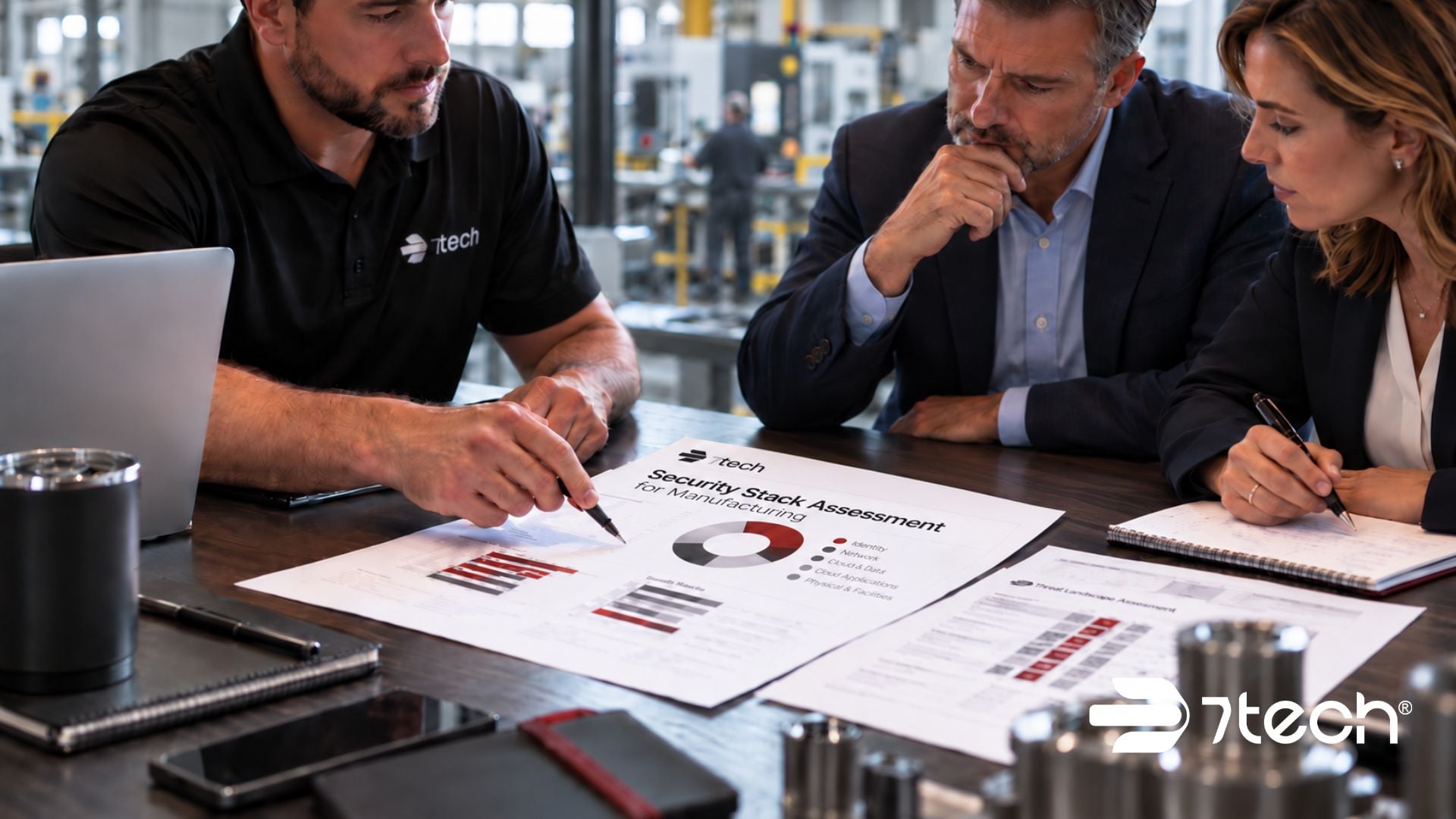
A security stack assessment for manufacturing evaluates how your cybersecurity tools, controls, monitoring, and response processes work together to protect the systems your operation depends on.
It identifies security gaps, overlapping products, weak configurations, and unclear responsibilities that could leave your business exposed.
For manufacturing executives, the objective isn’t simply better cybersecurity. It’s understanding whether your security investments are helping protect:
- Production uptime: Reducing the risk that a cyber incident disrupts manufacturing operations.
- Schedule adherence: Protecting the systems needed to execute the production plan.
- On-time, in-full delivery (OTIF): Reducing technology-related disruptions that can affect customer commitments.
- Profit margins: Avoiding unnecessary security spending and reducing exposure to recovery costs, overtime, and premium freight.
- Customer relationships: Protecting proprietary designs, production data, and the trust you’ve built with customers.
- Compliance readiness: Identifying gaps that could affect contractual requirements, cyber insurance, or CMMC obligations.
The NIST Cybersecurity Framework 2.0 provides a useful foundation. It organizes cybersecurity risk management around six functions: Govern, Identify, Protect, Detect, Respond, and Recover.
A meaningful manufacturing security assessment evaluates these functions together, with particular attention to the systems and processes that keep production running.
Because having cybersecurity tools installed doesn’t necessarily mean your manufacturing operation is adequately protected.
What Does a Manufacturing Security Stack Assessment Actually Review?
A manufacturing security stack assessment evaluates the technologies, controls, and operational processes used to protect your business.
Unlike a general office environment, a manufacturer may have two interconnected technology worlds.
The first is information technology (IT): your ERP system, Microsoft 365, servers, financial applications, business networks, and employee devices.
The second is operational technology (OT): industrial controllers, connected production equipment, supervisory systems, and other technology involved in monitoring or controlling manufacturing processes.
These environments increasingly exchange information.
A production line may depend on an ERP transaction. A machine monitoring platform may communicate with a cloud application. A vendor may access equipment remotely for troubleshooting.
Each connection can create a useful operational capability, but it can also introduce security dependencies that aren’t immediately visible to leadership.
That’s why a manufacturing security stack assessment needs to look beyond traditional office cybersecurity.
The 10 Critical Areas of a Manufacturing Security Stack
| Security area | What the assessment should determine |
|---|---|
| Endpoint protection | Are workstations, engineering computers, servers, and applicable production-support devices consistently protected and monitored? |
| Email security | Can phishing, malicious attachments, and account compromise threaten purchasing, finance, engineering, or production planning? |
| Identity and access | Are MFA, privileged access, vendor accounts, and employee permissions properly controlled? |
| IT/OT network security | Are business and production networks appropriately segmented, and are connections between them understood and controlled? |
| Cloud and ERP security | Are Microsoft 365, ERP, engineering files, and connected cloud services configured and protected appropriately? |
| Backup and recovery | Can critical applications, configurations, and business data be restored within operational recovery requirements? |
| Security monitoring | Are important security events detected, investigated, and escalated to the people who can act? |
| Vulnerability management | Are weaknesses prioritized according to their potential impact on production and safety, with changes coordinated around operating constraints? |
| Incident response | Does the company have documented procedures for coordinating IT, security, operations, and outside providers during an incident? |
| Compliance and governance | Do security controls and supporting evidence align with relevant customer, contractual, regulatory, and insurance requirements? |
The key is evaluating how these protections work together.
For example, your company might have advanced endpoint protection on every office computer but limited visibility into the engineering workstation used to transfer programs to production equipment.
Or your ERP database might be backed up every night, while nobody has verified how long it would take to restore the application and reconnect its critical integrations.
Both situations deserve attention because the consequences of a security failure may extend well beyond the affected computer.
A useful security controls assessment answers three questions:
- Coverage: Are the systems, users, data, and connections critical to manufacturing adequately protected?
- Effectiveness: Are the controls configured, maintained, monitored, and tested appropriately?
- Accountability: Who is responsible for investigating problems, coordinating corrective action, and restoring operations?
These answers help determine whether your cybersecurity stack functions as a coordinated defense or simply a collection of purchased tools.
Why Should Manufacturing Executives Request a Security Stack Assessment?
Manufacturing leaders rarely request a cybersecurity review because they want more technology.
They want fewer operational surprises.
A CEO wants to protect customer commitments and growth. A COO wants production to run according to plan. A CFO wants to protect margin and eliminate unnecessary spending.
Meanwhile, the CIO or IT director wants to know whether their team has the capabilities required to support an increasingly complex operation.
A security stack assessment helps leadership address all four concerns.
1. Security Blind Spots Can Turn Into Production Stoppages
Imagine arriving at the plant on Monday morning to discover that your ERP system is unavailable.
Production supervisors can’t access current work orders. Purchasing can’t confirm material requirements. Shipping can’t complete normal transactions.
Machines may still be operational, but the business systems required to coordinate production aren’t.
What began as a cybersecurity or IT problem has become an operations problem.
Depending on the plant’s processes and contingency procedures, disruptions can lead to:
- Idle labor and lost production time
- Missed production schedules
- Overtime to recover lost output
- Premium freight to meet customer deadlines
- Delayed shipments and customer dissatisfaction
A firewall may be configured correctly while weaknesses elsewhere in the environment remain unaddressed.
Understanding common network security threats and vulnerabilities is useful, but a broader security stack assessment determines how those risks relate to the systems your manufacturing operation depends on.
It also examines whether leadership understands which systems create the greatest operational exposure.
2. Disconnected Security Tools Can Leave Gaps Between IT and the Shop Floor
Many manufacturers have invested in firewalls, endpoint security, Microsoft 365 protection, backup systems, and security monitoring.
Individual products may perform their jobs correctly.
But the overall security environment can still have gaps.
Consider a manufacturer where internal IT manages office systems, the equipment vendor maintains industrial controllers, and a third party monitors network security.
Who owns security at the connections between these environments?
Who approves remote vendor access?
Who investigates suspicious traffic between a business network and a production system?
Who coordinates the response if an affected workstation supports a production process?
Without clear answers, even a well-equipped company can have important blind spots.
A good assessment examines these shared responsibilities and identifies where additional coordination or specialized OT security evaluation is needed.
3. Overlapping Security Products Can Drain Margins
Most manufacturers operate under constant pressure to manage costs.
Material expenses, labor, utilities, equipment maintenance, and supply chain disruptions all compete for budget.
Cybersecurity shouldn’t become another source of waste.
Yet security environments often grow one purchasing decision at a time.
A new vendor recommends another endpoint product. A software provider adds an optional protection service. A compliance initiative introduces another monitoring platform.
Eventually, the manufacturer may be paying for multiple tools that perform similar functions.
Meanwhile, critical monitoring or response responsibilities may remain underfunded.
A security stack assessment helps distinguish valuable layered protection from unnecessary duplication.
The goal isn’t to eliminate security tools simply to lower costs. It’s to make sure every investment contributes to a meaningful risk-management outcome.
4. Customer Requirements and Cyber Insurance Demand Evidence
Manufacturers increasingly encounter cybersecurity requirements through customers, contracts, supplier reviews, and insurance applications.
A defense manufacturer handling Controlled Unclassified Information (CUI), for example, may face obligations under NIST SP 800-171 and the Cybersecurity Maturity Model Certification (CMMC) program.
Other manufacturers may face customer-specific security requirements even when CMMC doesn’t apply.
Cyber insurers may also request evidence that particular security safeguards are implemented and maintained.
For companies meeting cyber insurance requirements, a security stack assessment can help identify weaknesses in access controls, monitoring, backup procedures, and supporting documentation.
In either case, purchasing security software is not proof that the required controls are functioning.
A manufacturer may need documented access procedures, operating evidence, security policies, incident response processes, and other records.
A security stack assessment can identify weaknesses in existing controls and highlight where further compliance evaluation is necessary.
It does not replace a formal CMMC assessment, certification process, or other required audit. Nor does it guarantee insurance coverage or approval.
For manufacturers preparing for customer or regulatory reviews, 7tech’s compliance services can help connect technical findings with a structured readiness plan.
This approach also aligns with NIST’s guidance on integrating cybersecurity with enterprise risk management.
Cybersecurity findings should support business priorities, investment decisions, and executive accountability rather than remaining isolated in technical reports.
What Are the Signs Your Manufacturing Security Stack Needs an Assessment?
You don’t have to wait for a ransomware attack or an unexpected production outage to evaluate your cybersecurity.
In fact, the best time to identify a serious weakness is before it interrupts production.
Here are eight warning signs.
1. Your Operation Has Grown, but Your Security Model Hasn’t
You’ve added employees, machines, applications, or facilities.
Yet your cybersecurity processes still resemble those used when the business was much smaller.
An operating model designed for one location and a few dozen users may struggle to support a multi-site manufacturing company.
2. Your ERP, MES, and Shop-Floor Systems Are Becoming More Connected
Greater integration can improve efficiency and visibility.
But every new connection introduces dependencies that must be understood and protected.
If nobody has reviewed how these systems exchange information or which security controls apply, the organization may have exposure it doesn’t fully recognize.
3. Multiple Vendors Share Responsibility for Technology
Your ERP provider handles the business application. An automation vendor supports equipment. Internal IT manages the network. A security provider monitors alerts.
Each party knows its own assignment.
But does anyone own the security of the overall environment?
Fragmented accountability can slow incident response and recovery.
4. Your IT Team Is Stretched Across Too Many Disciplines
A capable internal IT team may already handle user support, infrastructure, ERP coordination, cloud administration, connectivity, and vendor management.
Adding advanced threat detection, continuous monitoring, compliance documentation, and incident response can exceed the team’s available capacity.
That’s not necessarily a problem with the people.
It’s a sign that the company’s technology requirements may have outgrown its operating model.
5. You Don’t Know How Long Recovery Would Take
Your backup dashboard reports successful backups.
That’s encouraging, but it doesn’t answer the COO’s most important question:
If our critical systems went down tomorrow, when could we resume production?
Recovery depends on more than having backup files. Applications, configurations, connectivity, dependencies, and restoration procedures also matter.
6. Security Alerts Arrive, but Ownership Is Unclear
An automated system identifies suspicious activity.
Who investigates?
Who determines whether the incident affects production?
Who contacts the plant manager?
Who has authority to isolate a system, and how will that action be coordinated with operations?
If these questions haven’t been answered, your response process needs attention.
7. Customers or Insurers Are Asking Questions You Can’t Easily Answer
A customer asks about MFA, access controls, incident response, or business continuity.
Your cyber insurer requests evidence of security safeguards.
Your team has to contact several vendors and search through old documents to find the answers.
That scramble often signals a visibility or governance problem.
8. You’re Planning a Major Technology Investment
Before expanding automation, connecting another facility, replacing ERP, or introducing new cloud systems, it’s worth assessing the cybersecurity foundation those investments will depend on.
New technology can deliver substantial value.
But adding more complexity to an operating model that’s already struggling to keep up can create new problems.
The CISA Cybersecurity Performance Goals can provide a useful reference for baseline safeguards, including access security, asset visibility, vulnerability management, and incident readiness.
If leadership cannot confidently explain how critical manufacturing systems are protected and who is accountable when something goes wrong, a structured security review is warranted.
What Should a Manufacturing Security Stack Assessment Find?
A useful assessment should deliver more than a technical inventory.
It should identify weaknesses, explain their operational significance, and establish a plan for improvement.
1. Gaps That Threaten Production Continuity
The assessment should identify important systems or processes that lack appropriate security coverage.
Examples might include:
- Unmanaged engineering workstations
- Inconsistent MFA enforcement
- Unnecessary remote access permissions
- Inadequate separation between business and production networks
- Missing monitoring on critical servers
- Untested recovery procedures for ERP or production-support systems
Each finding should be evaluated according to its potential impact.
For example, a security gap on a production-critical server may require more urgent attention than a comparable weakness on a low-impact office computer.
2. Unnecessary Security Spending
Some overlapping security controls are intentional.
Others add administrative burden without delivering meaningful additional protection.
The assessment should identify unused capabilities, redundant products, unnecessary licensing, and opportunities to improve existing investments.
For CFOs, the output should be a clearer understanding of security spending and the reasons behind recommended changes.
3. Poorly Integrated or Misconfigured Tools
You may already own the right security capabilities but not be receiving their full value.
A monitoring platform might be missing important log sources.
A security feature might be included in a Microsoft 365 license but remain incorrectly configured.
Alerts may be visible in a dashboard without being assigned to a response process.
Correcting these problems may improve protection without adding another security product.
4. Weak Monitoring and Incident Response
Detecting suspicious activity is only useful when the organization can evaluate and respond to it.
A security stack assessment should evaluate both threat monitoring and detection and the processes needed for effective threat detection and response.
For manufacturers, that coordination is especially important when a technical action could affect production.
Disconnecting an industrial system or changing a production network configuration without understanding its operational and safety implications can create problems of its own.
A manufacturing security assessment should clarify who makes decisions, how incidents are escalated, and when qualified plant or OT personnel need to participate.
Security monitoring, alert investigation, decision-making authority, and response execution must work together.
5. Backup and Recovery Gaps
A backup system should be evaluated against the recovery needs of the business.
Ask whether critical systems have documented recovery objectives and whether restoration testing demonstrates that those objectives are realistic.
Consider the dependencies between ERP, MES, databases, identity services, network connectivity, and production workflows.
For example, restoring a database doesn’t necessarily mean manufacturing can resume if required integrations remain unavailable.
A strong assessment identifies these dependencies and helps leadership determine where recovery testing or planning should improve.
6. Compliance and Customer-Audit Exposure
Security safeguards may exist without adequate documentation.
Likewise, written policies may describe controls that aren’t consistently operating.
The assessment should identify where implementation, evidence, procedures, or ownership are incomplete.
For companies pursuing CMMC readiness, these findings can inform a separate, scoped compliance effort involving applicable requirements and the systems that process, store, or transmit regulated information.
7. Unclear Responsibility Across Teams and Vendors
Not every improvement requires new technology.
Sometimes the most valuable change is determining who owns a particular responsibility.
A useful findings report should include:
- The security or operational weakness
- The affected business systems or processes
- The potential impact on production, revenue, or compliance
- The recommended corrective action
- The responsible person or provider
- The remediation priority
- The method for verifying completion
If a recommendation has no accountable owner, it’s not yet an actionable improvement plan.
Security Stack Assessment vs. Cybersecurity Checklist vs. Penetration Test
These three approaches can support manufacturing cybersecurity, but they serve different purposes.
| Evaluation | Primary purpose | What manufacturing leadership learns |
|---|---|---|
| Security stack assessment | Evaluate how existing security tools, controls, and processes work together | Where gaps, overlapping tools, poor integrations, and accountability weaknesses could affect operations |
| Cybersecurity checklist | Review the presence of selected baseline safeguards | Which foundational controls appear to be implemented or missing |
| Penetration test | Conduct authorized, controlled testing to identify exploitable weaknesses | Which vulnerabilities may be exploited and how they should be remediated |
A cybersecurity checklist can help determine whether foundational safeguards exist.
But confirming that a security control exists doesn’t prove that it is effective, properly configured, or integrated with other protective measures.
Similarly, a penetration test can identify exploitable vulnerabilities, but it doesn’t replace a broader review of monitoring, responsibilities, backup readiness, and security spending.
For manufacturers, these evaluations should be coordinated with operational requirements. Testing involving production networks or equipment requires careful authorization, appropriate expertise, and safeguards against disrupting operations.
CISA’s Cyber Security Evaluation Tool (CSET) also provides a structured approach for assessing cybersecurity practices, including in industrial environments.
A security stack assessment is particularly valuable when the question isn’t just “Are we vulnerable?” but “Does our security operating model adequately protect the business we’re running?”
How Should Manufacturing Executives Evaluate Assessment Results?
A manufacturing executive shouldn’t have to interpret dozens of security dashboards to understand whether the company’s protection is adequate.
The assessment should translate cybersecurity findings into decisions that affect business performance.
Here are six questions leadership should ask.
1. Which Weaknesses Could Disrupt Production?
Look beyond the technical severity rating.
Consider whether a weakness affects ERP, manufacturing data, connectivity, remote access, or other systems critical to the production process.
Risks should be evaluated using their likelihood, potential impact, existing safeguards, and operational importance.
2. How Could These Risks Affect Our Manufacturing KPIs?
Cybersecurity doesn’t directly determine every manufacturing performance metric.
But disruptions to critical technology can affect the operating conditions those metrics depend on.
| Manufacturing KPI | Potential impact of a technology or cybersecurity disruption |
|---|---|
| Overall Equipment Effectiveness (OEE) | Reduced availability when production is stopped or constrained by affected systems |
| Schedule adherence | Missed production targets caused by unavailable planning or execution systems |
| On-Time, In-Full (OTIF) | Delayed shipments resulting from ERP, shipping, or other system outages |
| Mean Time to Repair/Restore (MTTR) | Longer recovery when incident ownership and recovery procedures are unclear |
| Gross margin | Overtime, premium freight, lost output, and emergency recovery expenses |
| Inventory accuracy | Transaction errors or delayed updates when connected systems are unavailable |
An assessment won’t guarantee better OEE or OTIF.
It can, however, identify technology risks that threaten operational reliability and establish priorities for reducing that exposure.
3. Are We Paying for Protection We Don’t Need?
A CFO should understand whether the business is funding redundant security tools, unused licenses, or overlapping vendor services.
The recommendation should distinguish wasteful duplication from intentionally layered defenses.
4. Can We Improve What We Already Own?
Sometimes better configuration, monitoring, or integration creates more value than another purchase.
Ask which findings require new technology and which can be corrected through improved execution.
5. Who Is Responsible for Fixing Each Problem?
Corrective actions should have named owners.
These may include internal IT, cybersecurity specialists, plant operations, an equipment vendor, or an application provider.
Shared accountability must still have a clear decision-making structure.
6. What Should We Fix Now, Next, and Later?
A practical assessment should convert technical findings into a prioritized roadmap.
| Priority | Manufacturing objective | Example |
|---|---|---|
| Now | Address material exposure affecting critical operations | Restore monitoring coverage for a production-critical server or close a high-risk access gap |
| Next | Improve reliability and response coordination | Test ERP recovery and document escalation procedures involving IT and plant operations |
| Later | Improve efficiency and scalability | Consolidate genuinely redundant security products or standardize controls across facilities |
These priorities are illustrative, not fixed deadlines. Actual timing should be based on risk, safety, operating constraints, and contractual obligations.
For manufacturing leaders, the result should be clear: which risks matter, what they could cost the business, what needs to change, and who’s responsible.
When Should a Manufacturer Bring in an MSSP or vCISO?
Many mid-sized manufacturers have capable internal IT teams.
Those teams know the business, understand its applications, and have developed relationships with employees and vendors.
But supporting a modern manufacturing operation is becoming more complex.
Internal IT may be expected to manage everything from workstations and Microsoft 365 to ERP infrastructure, vendor connectivity, security monitoring, and compliance.
That’s a broad assignment.
A security stack assessment may reveal that the problem isn’t a lack of effort or technical ability.
It’s a gap between the capabilities the operation requires and the resources available to deliver them.
A managed security service provider (MSSP) or virtual Chief Information Security Officer (vCISO) can help address specific parts of that gap.
Internal IT generally handles day-to-day technology operations, user support, business applications, and infrastructure management.
An MSSP provides specialized cybersecurity capabilities such as security monitoring, threat detection, investigation, and response services within an agreed scope.
A vCISO helps leadership establish cybersecurity priorities, governance practices, reporting, and risk-management direction.
These functions can complement one another.
For example, a manufacturer may have a strong IT team that understands ERP operations and the plant’s technical dependencies.
But that team might lack the capacity to investigate security events around the clock or maintain a specialized security operations function.
Adding MSSP capabilities can strengthen the operating model without assuming that existing personnel must be replaced.
How 7tech Helps Texas Manufacturers Close the Capability Gap
At 7tech, we understand that growing manufacturers need more than another collection of security tools.
They need technology and cybersecurity capabilities that can keep pace with the business they’re building.
Since 2012, we’ve provided managed IT and security services to organizations that depend on reliable technology.
Our approach combines:
- A private, U.S.-based Security Operations Center for specialized security monitoring and response capabilities
- Managed and co-managed IT services to support existing teams or provide outsourced IT operations
- 24/7 support capabilities to address technology issues beyond traditional business hours
- Cloud-first expertise for Microsoft 365, infrastructure, and connected business systems
- Backup and disaster recovery services to help organizations plan for and recover from disruptions
- Compliance readiness support for applicable contractual and regulatory requirements, including separately scoped CMMC consulting
- Executive-level guidance to translate technical risks into practical business decisions
We also work with internal teams and relevant third-party specialists where manufacturing environments require expertise outside traditional IT, including plant-specific industrial systems.
Our objective isn’t to tell you that every existing tool or provider needs to be replaced.
It’s to help you understand the capabilities you have, the gaps that matter, and the operating model needed to support your business.
Because adding more technology doesn’t automatically mean you’ve added more capability.
What Should Your Manufacturing Company Do After a Security Stack Assessment?
The value of a security stack assessment comes from what happens next.
A report that sits in a folder won’t reduce operational risk.
Leadership needs a plan.
Step 1: Map Your Critical Technology Dependencies
Identify the systems, people, facilities, vendors, and connections your operation relies on.
Determine how a failure in one system could affect another.
Include ERP, MES, plant connectivity, cloud applications, engineering systems, and other relevant dependencies.
Step 2: Prioritize the Capability Gaps
Translate technical findings into business priorities.
Determine which weaknesses threaten production continuity, customer commitments, sensitive information, or compliance obligations.
Identify which improvements can be made with existing resources and where specialized expertise is required.
Step 3: Build a More Proactive Operating Model
Establish clear responsibilities for security monitoring, incident response, maintenance, vendor coordination, and recovery.
Determine whether existing internal teams have the resources and capabilities to sustain those responsibilities.
Where appropriate, use managed or co-managed services to extend the organization’s operational capacity.
Step 4: Verify Improvements
A corrective action shouldn’t be considered complete simply because a product was installed or a setting was changed.
Verify the intended outcome.
For example, confirm that monitoring receives the necessary events, that security alerts reach an accountable responder, and that recovery procedures work during controlled testing.
Step 5: Review as the Operation Changes
Manufacturing operations don’t stand still.
New production lines, facilities, customers, vendors, applications, and automation systems can introduce additional technology dependencies.
An annual security stack review can serve as a starting point, with additional evaluations after significant changes or incidents.
The goal is a repeatable process that maintains visibility as your operation grows.
Frequently Asked Questions About Manufacturing Security Stack Assessments
What is a security stack assessment for manufacturing?
A manufacturing security stack assessment evaluates whether cybersecurity tools, controls, monitoring, and response processes provide coordinated protection for a manufacturer’s technology environment. It considers business systems, critical production dependencies, IT/OT connections, recovery readiness, and operational responsibilities.
Why is a security stack assessment important for manufacturers?
Manufacturers depend on interconnected technology to plan production, execute work orders, manage inventory, and ship products. A security weakness or incident affecting those systems can interrupt operations. An assessment helps identify protection gaps and prioritize improvements that support operational resilience.
Does a security stack assessment include operational technology?
It should consider relevant OT dependencies, remote access paths, network boundaries, and responsibilities. However, detailed technical evaluation of industrial controllers or other specialized equipment may require a separate OT security assessment performed by qualified personnel.
How often should a manufacturing company assess its security stack?
An annual assessment is a reasonable starting point for many organizations. Additional reviews may be necessary after major ERP changes, new facility openings, network redesigns, security incidents, acquisitions, or changes in customer and regulatory requirements.
Can a security stack assessment help with CMMC compliance?
Yes. It can identify security control weaknesses and areas where monitoring, access management, documentation, or other safeguards need attention.
However, it is not the same as a formal CMMC readiness assessment or certification. Applicability depends on the manufacturer’s contracts, information handled, and applicable requirements.
Can an internal IT team conduct the assessment?
Yes, if the team has sufficient expertise, visibility, resources, and time. Outside specialists may provide additional cybersecurity depth, independent evaluation, or support for areas that exceed the team’s available capabilities.
What is the difference between a cybersecurity risk assessment and a security stack assessment?
A cybersecurity risk assessment considers threats, vulnerabilities, and their potential impact on the organization. A security stack assessment focuses on whether the existing security tools, controls, integrations, and operational processes provide effective, coordinated protection.
The two evaluations complement each other.
Will a security stack assessment reduce manufacturing downtime?
An assessment alone won’t prevent downtime. It can identify cybersecurity and recovery weaknesses that might contribute to production disruptions. Correcting those weaknesses may reduce incident exposure and improve the organization’s ability to respond and recover.
Your Manufacturing Operation Has Evolved. Has Your Cybersecurity Kept Up?
Your manufacturing business probably looks different today than it did five years ago.
You’ve added technology.
Maybe you’ve introduced automation, expanded your ERP environment, connected more equipment, opened another location, or taken on customers with stricter security requirements.
Each change has helped your operation grow more capable.
But has your cybersecurity operating model grown with it?
You shouldn’t have to run tomorrow’s manufacturing business on yesterday’s IT and security model.
You need confidence that critical systems are appropriately protected, security threats receive meaningful attention, and responsibilities are clear when problems arise.
You also need to know whether your security investments are delivering value or simply adding cost and complexity.
That’s where 7tech can help.
Get Clear on Your Manufacturing Cybersecurity Risks
7tech helps Texas manufacturing leaders assess their technology environment, understand security capability gaps, and identify practical priorities for improvement.
We start with the operation you’re running, not a predetermined list of products to sell.
A free IT Network Assessment provides an opportunity to begin discussing your organization’s technology environment and security concerns. A comprehensive security stack assessment may require a separately scoped, more detailed review.
Schedule Your Free IT Network Assessment
Prefer to discuss your needs first? Schedule a Free 15-Minute Discovery Call to explore which type of evaluation is appropriate.
Your operation evolved. Your IT operating model should too.

Neal Juern, Founder and CEO of 7tech, helps business leaders take control of their IT and strengthen cybersecurity without the complexity. Since founding 7tech in 2012, he’s built it into a 5X MSP 501 winner and guided hundreds of executives toward smarter, safer operations through Managed IT Services and Managed Security Services that make sense to people outside the IT department. He speaks regularly to executive and nonprofit audiences across Texas.