
7 Questions to Ask Before Hiring a Construction IT Provider
Last updated: August 14, 2026
Before hiring, start with a clear list of questions to ask a construction IT provider: how they will support your real workflows, respond when technology disrupts active work, prevent repeat problems, protect sensitive systems and project information, communicate with non-technical leaders, manage onboarding without derailing projects, and clarify compliance obligations that may apply. The strongest provider can connect office IT, field operations, project platforms, jobsite access, cybersecurity, and accountability in one operating model.
For general contractors and subcontractors, this is more than a vendor screening exercise. The decision can affect project continuity, cybersecurity risk, client commitments, and leadership’s ability to understand who owns a problem when something goes wrong. In practice, these are questions construction companies should ask before they commit to a long-term provider relationship, and part of how to evaluate an IT provider for a construction company before that decision affects day-to-day operations.
If you are comparing providers, start with a construction-specific view of construction managed IT services rather than relying only on a generic MSP checklist.
What Should Construction Leaders Ask an IT Provider?
Construction leaders should ask seven core questions before choosing an IT provider. These questions to ask a construction IT provider help frame a more practical conversation about support, accountability, and fit.
The questions matter, but the specificity of the answers matters more. A capable construction IT provider should be able to explain its process in the context of project delivery, field mobility, vendor access, deadlines, and the difference between a routine support request and an issue that can stop work. In other words, these are not just IT provider questions for construction companies. They are business-fit questions. You could also think of them as practical construction IT provider questions that help leaders compare providers on more than sales language.
1. How Will You Support the Way Our Construction Company Actually Operates?
A construction company should look for an IT provider that understands more than standard office technology. Reliable construction company IT support should start with your workflows, applications, devices, locations, project dependencies, and user roles before recommending changes. This is one of the most important questions to ask a construction IT provider because it reveals whether the provider starts with your operations or with a generic service model.
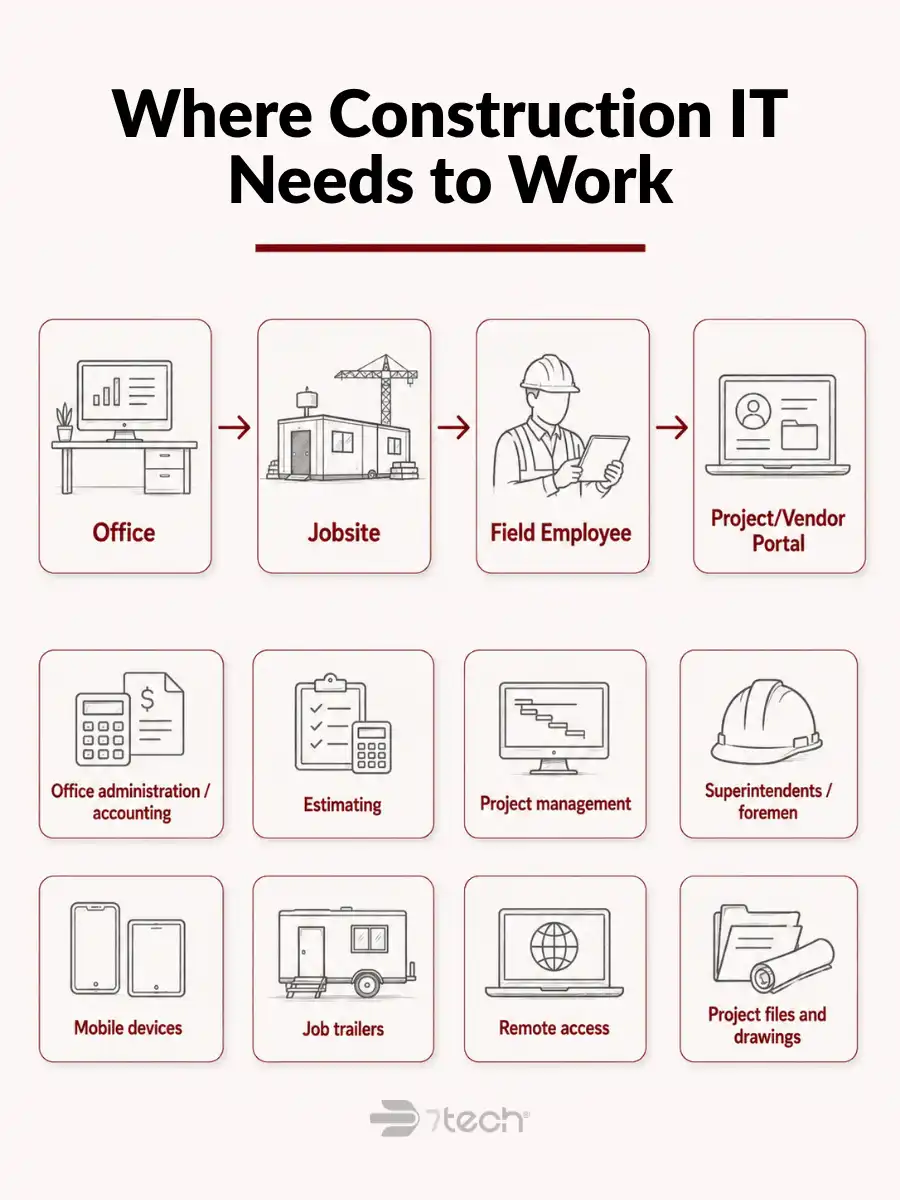
A useful answer should account for different parts of the business, including office administration, estimating, accounting, project management, superintendents, foremen, and field crews.
It should also recognize that a general contractor coordinating multiple stakeholders and platforms may have different technology requirements than a subcontractor working inside other companies’ portals, project schedules, and security requirements.
Ask questions such as:
- How do you assess our office and field workflows?
- How do you account for mobile devices, job trailers, remote access, and changing jobsites?
- How do you support project systems, drawing access, file sharing, and portal dependencies?
- How do you limit and secure vendor or remote access when outside parties need access to our systems?
A provider should be able to discuss secure access in practical terms. The FTC guidance on vendor security and secure remote access provides a useful benchmark for thinking about access discipline, vendor oversight, and basic cybersecurity responsibilities.
What to listen for: a provider that asks about your business before prescribing technology. If you are deciding what to look for in a construction IT provider, this is one of the clearest early signals. It is also where you can start to tell whether the provider offers real construction IT support for jobsites, not just office-based help desk coverage.
7tech has seen this firsthand with Sure Seal, where estimators and field superintendents rely on cloud and collaboration tools to coordinate specifications, plans, and project takeoffs. That kind of environment shows why a provider needs to understand office and field technology dependencies before recommending support models, access changes, or workflow decisions.
If the conversation immediately turns into a list of products without first understanding how your people and projects operate, you may not yet have enough information to determine whether the provider is a good operational fit.
2. What Happens When an IT Problem Interrupts Our Work?
Construction leaders need to understand what happens from the moment someone reports an issue until work is back on track.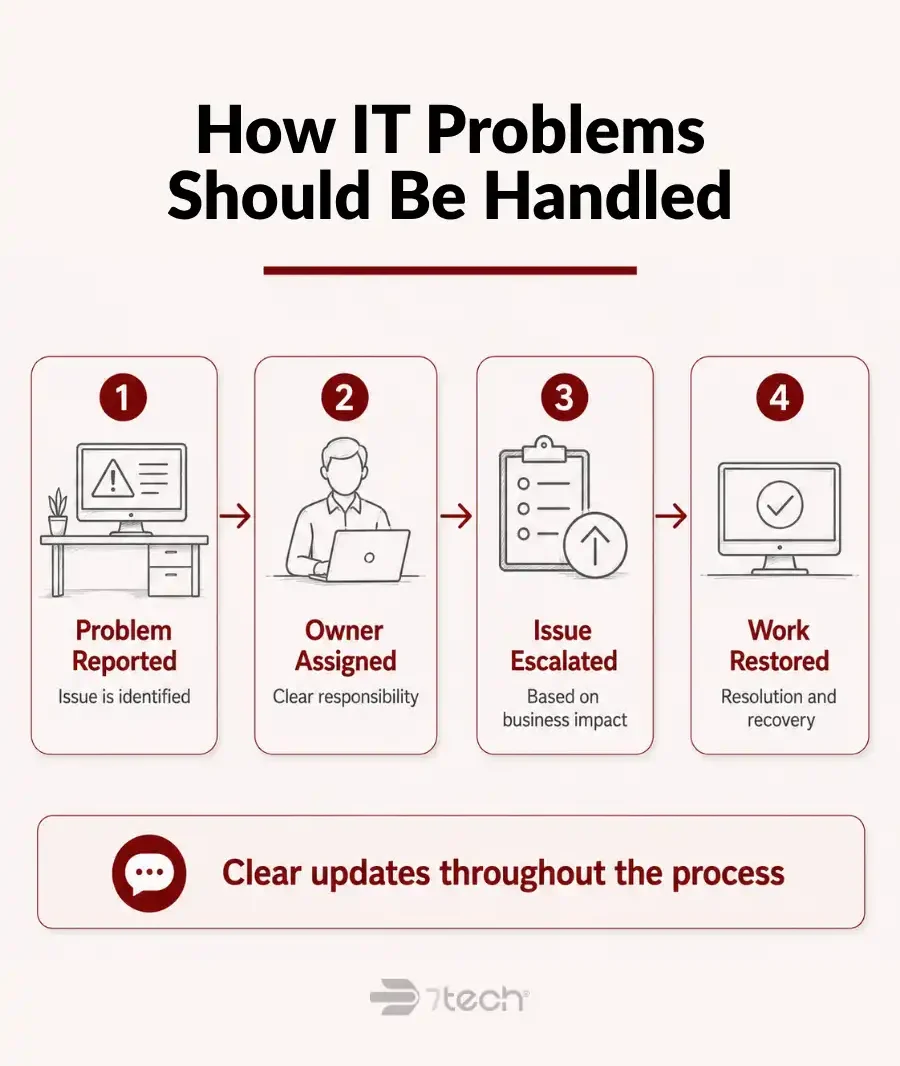
Ask how support requests are acknowledged, who takes ownership, how escalation works, how users receive updates, and how priorities change when a technology problem starts affecting a deadline or active project. These are practical questions to ask an IT provider for a construction company, especially when downtime can directly affect bids, drawings, inspections, and schedules.
A fast acknowledgment is useful, but acknowledgment and ownership are not the same thing.
A project manager who cannot reach a bid file, a superintendent who loses access to drawings, or a team that cannot enter a critical project portal does not just need confirmation that a ticket exists. They need a clear owner, an escalation path, and understandable updates.
Ask:
- How do you distinguish between acknowledging a ticket and owning the issue through resolution?
- How do you prioritize requests based on business impact?
- What happens when an issue affects an active bid, inspection, deadline, or jobsite?
- Who coordinates the response if another software company, carrier, or vendor is involved?
- How do you handle incidents affecting multiple users, locations, or workflows?
A mature provider should be able to explain its process for preparation, response, escalation, and recovery. The NIST Cybersecurity Framework small business quick-start guide provides additional context for thinking beyond one-off troubleshooting and toward broader operational resilience.
7tech has seen this operational pressure firsthand with NAPCO Precast, where virus-related downtime affected employees working against construction project deadlines. While that example does not document a specific missed deadline or quantified loss, it does reinforce how quickly an IT issue can become a business issue when time-sensitive work is already in motion.
For executives, the practical question is simple: When technology interferes with the business, who owns getting the situation under control?
3. How Do You Help Prevent IT Problems From Becoming Operational Disruptions?
This question helps distinguish proactive managed services from a primarily reactive break-fix relationship. It is also central to how to evaluate a construction IT provider if your goal is fewer repeat issues and better long-term support. It also clarifies what to ask a managed IT provider about monitoring, maintenance, and recurring problems.
Ask how the construction IT provider monitors systems, handles maintenance, reviews recurring issues, oversees backups, identifies vulnerabilities, and determines whether repeated support tickets point to a larger underlying problem.
Construction environments can create recurring pressure points:
- Temporary jobsites and changing connectivity
- Aging or frequently relocated field devices
- Remote access dependencies
- Employees moving between projects
- Software and portal access managed by outside organizations
- Office and field teams relying on the same files and systems
Ask the provider how it identifies those patterns before they become larger disruptions. This section often tells you a great deal about construction IT provider evaluation because it shows whether the provider thinks beyond isolated tickets.
Strong answers should address areas such as:
- Monitoring of critical systems and network health
- Software patching and maintenance
- Backup monitoring and recovery readiness
- Repeat-ticket analysis
- Root-cause investigation
- Recommendations based on trends rather than isolated problems
If you want a broader explanation of this service model, 7tech’s comparison of managed IT services vs break-fix provides additional context.
For a construction company, the goal is not simply getting a problem fixed eventually. It is reducing the number of preventable technology problems that interrupt projects in the first place.
4. How Will You Protect Our Systems and Company Information?
You do not need to turn a provider interview into a cybersecurity certification exam. You do need to understand what is being protected, who is monitoring it, who responds to suspicious activity, and how leadership receives visibility into material risk.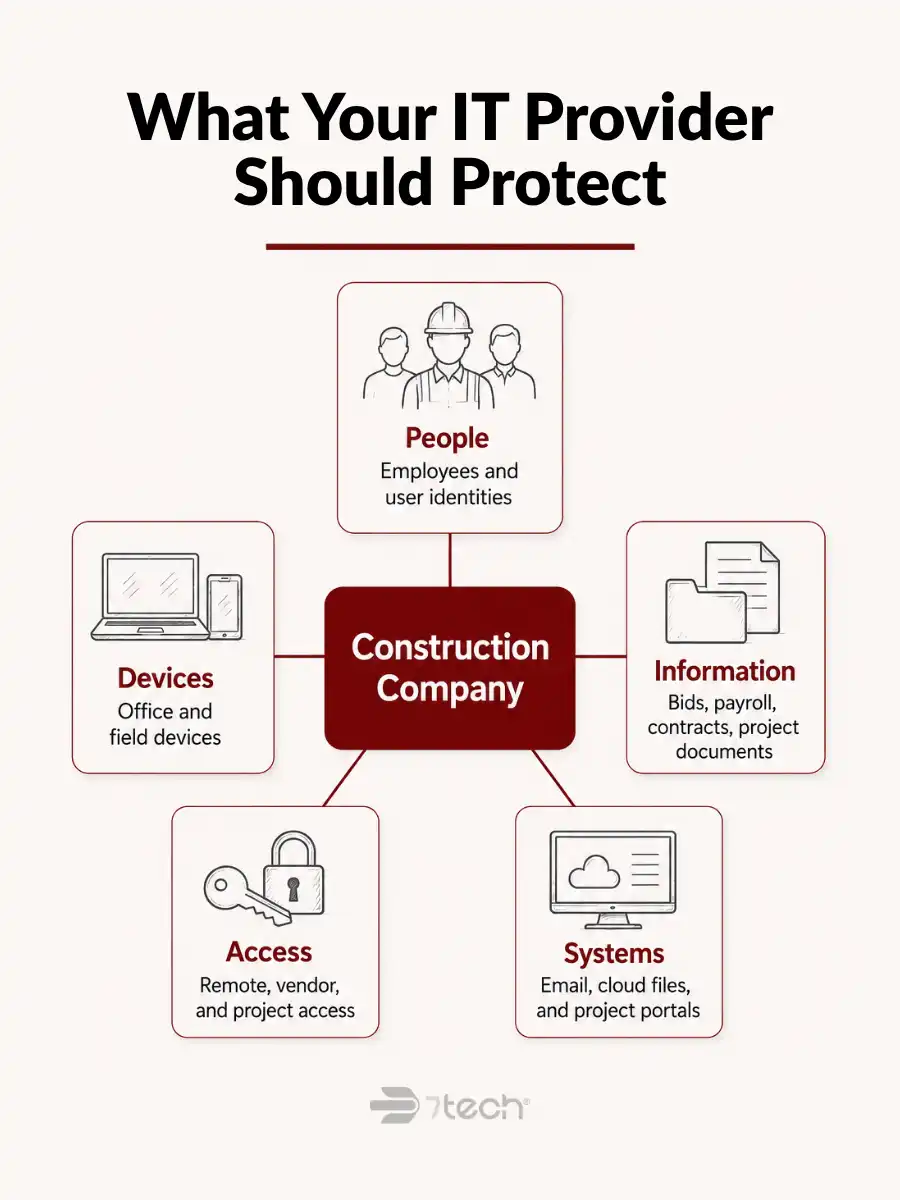
Construction companies can depend on a wide range of sensitive information and systems, including:
- Bids and estimates
- Payroll and employee information
- Contracts
- Client communications
- Project documents
- RFIs and submittals
- Change orders
- Email accounts
- Cloud file systems
- Vendor and project portals
- Access associated with current and completed projects
Ask the provider:
- What systems, identities, devices, and access points do you monitor?
- How do you approach role-based access for office employees, project teams, and field users?
- How do you manage employee onboarding and offboarding?
- How is vendor access approved, limited, reviewed, and removed?
- What changes at project closeout?
- Who responds when suspicious activity is detected?
- How is leadership informed when a security issue requires attention or a business decision?
The purpose is not to see how many technical acronyms a provider can use. It is to determine whether they can connect cybersecurity controls to business continuity, responsibility, and executive decision-making. If you are considering what to ask a construction IT provider about security, this is where accountability matters more than jargon. It is also where a provider starts to show whether it can act as a credible construction cybersecurity provider, not just a general support vendor.
7tech has seen this concern firsthand with Lambda Construction after the company encountered multiple fraudulent attempts. In that context, leadership emphasized the importance of knowing the network was being actively monitored and protected, which is exactly the kind of reassurance construction leaders should look for when evaluating how a provider manages security responsibility.
For a deeper look at industry-specific exposure, review 7tech’s guide to construction cybersecurity risks.
What to listen for: clear accountability. If a security event occurs, you should understand who investigates it, who coordinates the response, and who keeps your leadership team informed.
5. How Will You Communicate With People Who Aren’t IT Experts?
Executives and operations leaders should not need an IT degree to understand an issue that could affect their business.
Ask who communicates during significant incidents, what information leadership receives, how frequently updates are provided, and whether the provider can explain business impact without burying the answer in technical terminology.
A strong provider should be able to brief an owner, CFO, COO, project executive, or operations leader in plain language:
- What happened?
- What is affected?
- What is being done now?
- What is the current business impact?
- Does leadership need to make a decision?
- What happens next?
- When should we expect another update?
That communication becomes especially important when several organizations are involved. A construction company’s technology issue may involve an internet carrier, project software vendor, cloud platform, internal employee, client system, or outside partner.
Leadership should not have to determine which vendor to chase.
Clear communication is therefore not a soft skill. It is part of operational accountability. For many teams, this becomes one of the most revealing questions to ask a construction IT provider because it shows whether leaders will get clarity or confusion during a disruption.
7tech has seen the value of that firsthand with NAPCO Precast, where CFO Paul Brennan specifically appreciated technical staff communicating in “laymen’s terms.” That kind of feedback is a practical reminder that executive communication is not just about being available; it is about making technical issues understandable enough for nontechnical leaders to act on them.
If you are developing a broader comparison framework, review these additional questions to ask your IT provider and apply them to the realities of your construction business. They can also help if you are comparing more general providers and building a list of questions to ask an MSP for construction companies.
6. What Would Switching to Your IT Services Actually Look Like?
For a construction company, changing IT providers is not simply a technology project.
A poorly coordinated transition can touch active bids, project mobilizations, field communication, employee access, vendor coordination, project applications, and deadlines that do not stop because an onboarding project is underway. This is why questions construction companies ask IT providers should include transition planning, not just day-to-day support. It is also why firms thinking about switching IT providers for construction companies should look closely at onboarding discipline and change management.
Ask exactly how the transition will be managed.
Questions should include:
- Who leads discovery, documentation, and onboarding?
- What information do you need from us before making changes?
- How do you coordinate with our current IT provider?
- How do you work with carriers, software providers, and other vendors?
- How do you identify systems and applications that cannot tolerate disruption?
- How do you verify accounts, permissions, devices, and critical applications before major changes?
- How do you sequence the transition around active projects?
- What will our office and field employees experience during onboarding?
- How do you confirm the transition is complete?
The strongest answers tend to sound deliberate rather than dramatic. They include discovery, documentation, verification, communication, access review, sequencing, and clearly assigned responsibilities. If you are building a construction IT provider checklist, the transition process deserves a place on it.
You should also hear how the provider handles unknowns. Construction environments often contain systems, accounts, vendors, and workflows that accumulated over time. A disciplined onboarding process should identify those dependencies before unnecessary changes are made.
If your current IT relationship no longer matches the complexity of your operations, review the signs that indicate when a construction company outgrows its IT provider.
7. Can You Help Us Understand Compliance Requirements That Apply to Our Work?
Not every construction company has the same cybersecurity or compliance obligations. A useful construction IT provider should help determine what applies to your business rather than treating every company as though it faces the same requirements.
Depending on your contracts and clients, relevant considerations may include:
- Client security requirements
- Cyber insurance requirements
- Access-control expectations
- Documentation requirements
- Data-handling obligations
- Requirements passed down through a contract or subcontract
- Government contracting requirements
For construction companies participating in certain Department of Defense supply chains, CMMC requirements may become relevant based on the contract and the type of Federal Contract Information or Controlled Unclassified Information involved. The CMMC Program is established in 32 CFR Part 170, which defines its applicability to defense contractors and subcontractors.
The DoD CMMC program requirements in 32 CFR Part 170 are the appropriate authority to consult when determining that scope.
Ask a prospective provider:
- How do you determine which requirements are actually relevant to us?
- Can you help us identify gaps and responsibilities?
- Will you translate requirements into practical technology priorities?
- Where does your role end if an outside assessor, legal adviser, or other specialist is required?
What you want to hear is not simply, “We do compliance.”
You want to know whether the provider can help leadership understand what applies, why it matters, who owns each requirement, and what needs to happen next without overstating certainty. When leaders ask what to ask a construction IT provider in regulated or contract-sensitive environments, this is the area where restraint matters.
7tech has also seen this need for translation and structure firsthand with EudaCorp and SWECS, both of which struggled to navigate CMMC-related requirements before receiving clearer guidance. Those examples reinforce why construction leaders should ask whether a provider can make complex obligations understandable, actionable, and appropriately scoped rather than simply claiming broad compliance expertise.
What Should Construction Leaders Listen for in the Answers?
The strongest provider answers tend to share four characteristics: specificity, ownership, construction awareness, and clear communication.
Use this framework when comparing responses:
A provider does not need to give you the answer you expected to every question.
They should, however, be able to explain how they think, how they take ownership, and how they would handle the situation in your environment. Taken together, these answers form a practical construction IT provider evaluation framework.
Questions to Bring to Your Next IT Provider Conversation
Bring these seven questions into your next construction IT provider discussion. If you are still deciding how to evaluate a construction IT provider, use this list as a starting point. If your team is earlier in the process and still working through how to choose a construction IT provider, the same list can help keep the conversation grounded in business impact instead of generic sales language.
- How will you support the way our construction company actually operates?
- What happens when an IT problem interrupts our work?
- How do you help prevent IT problems from becoming operational disruptions?
- How will you protect our systems and company information?
- How will you communicate with people who are not IT experts?
- What would switching to your services actually look like?
- Can you help us understand compliance requirements that apply to our work?
These are also strong questions to ask a construction IT provider when you need a more structured comparison between firms.
It also helps to provide a short overview of your operating environment:
- Whether you primarily operate as a general contractor or subcontractor
- How many active projects you typically support
- How office and field teams communicate
- Which cloud systems, project apps, portals, and document platforms are critical
- Which technology problems cause the most disruption today
- Whether clients or contracts impose specific security requirements
That context helps you evaluate whether the provider is listening to your actual business or applying the same standard response to every prospect.
For a broader provider-selection framework, 7tech’s guide on how to choose a managed services provider can help structure the rest of your evaluation.
What These Questions Reveal About IT Provider Fit
The right construction IT provider is not necessarily the company with the longest service list.
A better fit is the provider that can demonstrate how its support model aligns with your workflows, projects, security requirements, leadership expectations, and tolerance for disruption. In that sense, the article functions as both a buyer guide and a practical construction IT provider checklist.
By the end of a provider conversation, leadership should have a clearer understanding of:
- Who owns problems when they occur
- How issues are prioritized by business impact
- How recurring problems are identified and reduced
- How office and field access is protected
- How executives receive meaningful visibility
- How an IT transition would be controlled
- How relevant compliance requirements would be addressed
That is what makes these questions more useful than a generic IT vendor checklist. They help construction leaders evaluate fit in terms of project delivery, accountability, business continuity, and risk rather than technical sales language.
Frequently Asked Questions
What should a construction company ask an IT provider first?
Ask how the provider will support the way your company actually operates. Their answer should address office and field workflows, project systems, jobsites, mobile access, employee roles, and the operational impact of technology problems.
How is a construction IT provider different from a general MSP?
A construction-focused provider should understand how technology affects bids, schedules, field communication, drawing access, project portals, and jobsite operations. The differentiator is not simply technical capability. It is the provider’s ability to connect IT support to project delivery.
Should a construction company choose an MSP with cybersecurity experience?
Yes. Ask how the provider manages identities, devices, remote access, vendor access, monitoring, and incident response. Leadership should also understand who owns the response when suspicious activity affects business operations.
What should we ask about switching IT providers during active projects?
Ask who owns onboarding, how critical systems are documented, how access is verified, how vendors are coordinated, and how changes are sequenced around active bids and projects. The transition plan should prioritize continuity and clear communication.
Does every construction company need compliance support from its IT provider?
No. Requirements depend on the company’s clients, contracts, information, insurance obligations, and regulatory exposure. The provider should help determine what applies rather than treating every framework as relevant to every construction business.
How do we know whether an IT provider understands field operations?
Listen to the questions they ask. A provider familiar with construction should naturally ask about jobsites, connectivity, mobile devices, project portals, field-to-office workflows, access changes, and the applications employees depend on away from headquarters.
Can we use these questions to evaluate our current construction IT provider?
Yes. The same questions can be used for an incumbent review. Compare the provider’s stated process with your actual experience around response, ownership, recurring problems, communication, security, project support, and strategic guidance. They are also useful questions to ask a construction IT provider during a formal review.
Book a Clarity-First Conversation About Your Construction IT Needs
If you are comparing construction IT providers in Texas, the next step does not need to be a sales presentation.
Start by getting clear on how your office and field teams work, where technology creates unnecessary friction, how responsibilities are currently divided, and what you expect a provider to own. That will also help clarify what to look for in a construction IT provider before you move forward.
7tech can help you evaluate those needs in the context of your projects, security requirements, and operating priorities. For many firms, that conversation is also about deciding whether they have found the right construction company technology partner.
Book a Free Discovery Call to Talk About Your Construction IT Needs

Neal Juern, Founder and CEO of 7tech, helps business leaders take control of their IT and strengthen cybersecurity without the complexity. Since founding 7tech in 2012, he’s built it into a 5X MSP 501 winner and guided hundreds of executives toward smarter, safer operations through Managed IT Services and Managed Security Services that make sense to people outside the IT department. He speaks regularly to executive and nonprofit audiences across Texas.