
Cybersecurity Risks in Construction Every Leader Should Understand
Last updated: July 16, 2026
Cybersecurity risks in construction become business risks when they interrupt projects, delay payments, expose client information, or prevent teams from accessing critical systems. The most significant threats include business email compromise, ransomware, unmanaged third-party access, and compromised field devices. Construction leaders should focus on financial controls, access governance, recovery readiness, and clear accountability (not technical tools alone).
For executives, cybersecurity is primarily a business continuity, cash flow, governance, and client confidence issue. The central question is not whether the company has security software. It is whether practical controls can prevent one compromised account, device, or vendor connection from disrupting the business.
As construction managed IT services become more closely connected to field operations, cybersecurity must protect more than office computers. It must support project schedules, payment workflows, remote collaboration, document access, and leadership visibility.
Executive summary
-
- Business email compromise can redirect vendor payments by manipulating familiar invoice, approval, and bank-change workflows.
- Ransomware can block access to drawings, schedules, email, shared files, accounting systems, and project applications.
- Third-party access creates exposure when vendor accounts are too broad, poorly monitored, or left active after a project ends.
- Field devices and remote access increase risk when devices are unmanaged or critical accounts lack multi-factor authentication.
- Recovery readiness depends on protected backups, tested restoration procedures, defined decision authority, and alternative communication methods.
The strongest approach to cybersecurity risks in construction combines technical safeguards with disciplined financial approvals, access governance, field-device standards, tested recovery processes, and clear executive accountability.
Why are cybersecurity risks in construction different?
Construction companies operate across offices, jobsites, cloud platforms, mobile devices, temporary project teams, and outside organizations. Access requirements may change every time a project begins, expands, changes scope, or closes.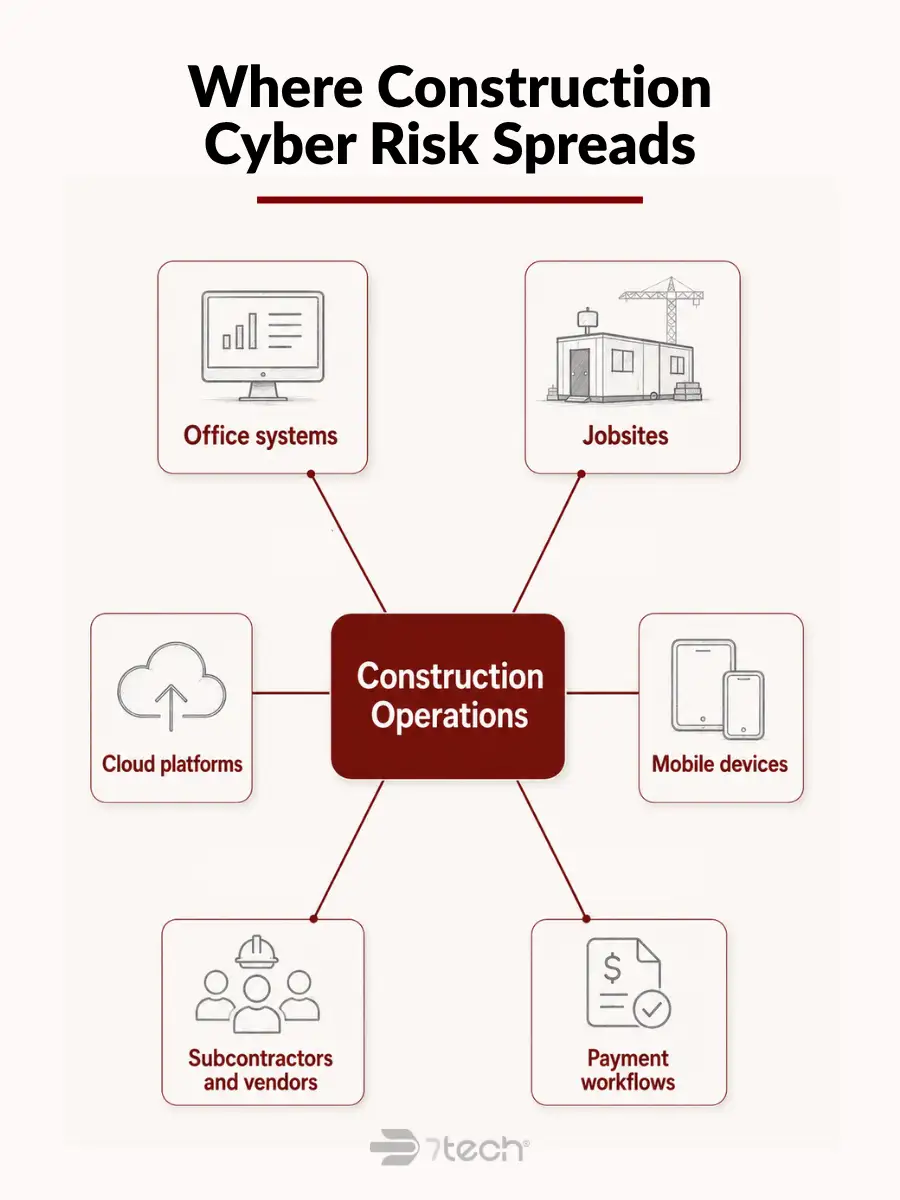
Subcontractors, consultants, equipment partners, software vendors, and support providers may all interact with company systems or project information. Each legitimate connection helps work move faster, but it also creates another identity, device, or access path that must be managed.
Construction payment activity adds another layer of exposure. Firms regularly process invoices, change orders, bank-detail updates, vendor approvals, and payment instructions. Because many of these transactions begin through email, a convincing impersonation attempt can blend into routine business communication.
Field operations create additional complexity. Employees may access drawings, schedules, shared documents, email, and financial information from phones, tablets, laptops, or temporary networks. A lost device or compromised account can therefore affect more than one employee.
Cybersecurity in construction is a shared business responsibility:
- Finance determines how payment changes are verified.
- Operations defines who needs access to projects and systems.
- Project managers report staffing, subcontractor, and scope changes.
- Executives assign accountability and continuity priorities.
- IT teams or service providers implement, monitor, and maintain the controls.
This distributed operating model is why government guidance emphasizes the need to secure remote access and vendor-administered tools. Remote connectivity may be necessary for operations, but it should never remain undocumented or uncontrolled.
When does a cyber incident become a construction problem?
A cyber incident becomes a construction problem the moment it affects schedules, payments, access, coordination, or leadership visibility. The impact rarely stays confined to one employee or computer.
| Cyber event | Construction impact | Executive concern |
|---|---|---|
| Email or collaboration outage | Project communication, approvals, and coordination slow down | Can teams continue working without their normal communication channels? |
| Compromised payment request | Funds are sent to a fraudulent account | Were independent verification and approval controls followed? |
| Ransomware | Files, drawings, schedules, or applications become unavailable | How quickly can critical operations be restored? |
| Vendor account compromise | External access is used to reach internal systems or information | Who approved the access, and when was it last reviewed? |
| Lost or compromised field device | Company email, files, or cloud platforms may remain accessible | Can the device and its active sessions be disabled immediately? |
Construction cyber risk should therefore be evaluated through a business continuity lens, not only a security lens. NIST guidance addressing third-party risk, backups, and incident response reinforces this management-level view by connecting cybersecurity with resilience, accountability, and recovery.
What are the biggest cybersecurity risks in construction?
The biggest cybersecurity risks in construction are business email compromise, ransomware, unmanaged third-party access, and compromised field devices or remote accounts. These threats deserve executive attention because they can directly affect cash flow, project delivery, operational continuity, and client trust. 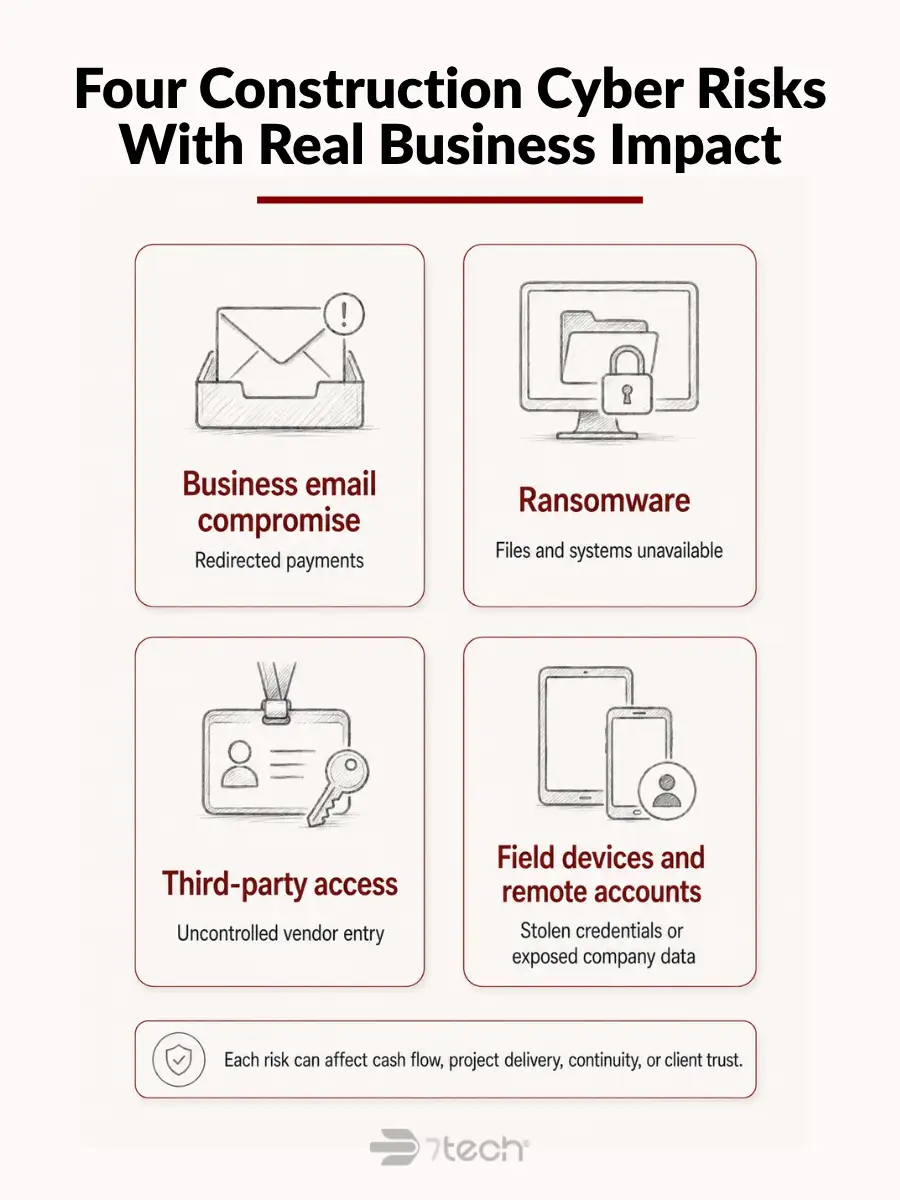
Business email compromise and payment fraud
Business email compromise occurs when an attacker impersonates or gains control of a trusted email account. The message may appear to come from a subcontractor, supplier, executive, controller, project manager, or long-standing business contact.
The request often appears routine:
- Update a vendor’s bank account details.
- Resend an invoice to a different contact.
- Approve an urgent payment exception.
- Change where project funds should be transferred.
- Send sensitive financial or employee information.
Construction companies are exposed to this type of fraud because billing, purchasing, and vendor communication happen continuously. An attacker does not need to invent an unusual scenario. The attacker only needs to imitate a normal workflow at the right moment.
The weakness is often broader than the compromised inbox. It may be an approval process that treats email as the only source of verification.
The Federal Trade Commission recommends that businesses verify invoices, payment instructions, and impersonation-based requests through trusted channels before transferring money.
Executive takeaway: If bank-detail changes can be approved through email alone, the organization has a financial-control gap as well as a cybersecurity gap.
Ransomware and operational downtime
Ransomware can encrypt files, disable systems, or block access to the applications employees need to work. In a construction environment, affected resources may include:
- Email and collaboration platforms
- Project plans and shared documentation
- Estimating and scheduling tools
- Accounting and payroll systems
- Customer, vendor, and employee records
- Cloud file storage and remote-access platforms
For leadership, the most useful question is not whether the company owns antivirus software. The better question is:
How long can active projects continue if employees lose access to essential systems and information?
That answer depends on prevention, containment, and recovery. Backups must be protected from the same event affecting production systems. They must also be recoverable within a timeframe that matches the company’s operational needs.
When reviewing broader ransomware prevention strategies, construction leaders should evaluate the consequences of losing drawings, schedules, approvals, shared communication, or financial data—not simply compare product lists.
Executive takeaway: Ransomware readiness is measured by recoverability and continuity, not by the number of security tools included in a proposal.
Third-party and supply chain access
Construction companies depend on subcontractors, consultants, software vendors, equipment partners, and external support providers. Some of these organizations need legitimate access to systems, cloud platforms, files, or project workflows.
Risk increases when:
- Credentials are shared between users.
- Permissions exceed the person’s actual role.
- Vendor accounts remain active after a project ends.
- Remote access is not documented or reviewed.
- No internal owner is accountable for approving access.
- Access reviews do not follow project, personnel, or contract changes.
- External accounts are exempt from normal security requirements.
Third parties are not inherently unsafe. The problem is unmanaged access.
Every external account should have:
- A defined business owner
- A documented purpose
- The minimum permissions necessary
- Multi-factor authentication where supported
- A review or expiration date
- A removal process when the relationship changes
Executive takeaway: Outside access should operate like a controlled project resource, not a permanent open door.
Compromised field devices and remote access
Phones, tablets, and laptops are essential to modern construction operations. They allow employees to communicate from jobsites, access project information, submit documentation, approve work, and connect to cloud platforms.
Those benefits create exposure when devices are unmanaged, passwords are reused, accounts lack multi-factor authentication, or lost equipment remains connected to company information.
Remote access creates a related risk. A single compromised login may provide access to multiple systems, especially when permissions are broad or older remote desktop configurations remain active after the business has outgrown them.
CISA advises businesses to require multi-factor authentication for email and remote access. This control is especially important for construction firms because mobile work and remote connectivity are normal operating requirements.
Executive takeaway: Mobility should improve productivity without allowing one lost device or stolen password to become a company-wide event.
A Real Lesson From Construction Security Incidents
Recurring cyber incidents often indicate a structural weakness rather than a series of unrelated problems. The environment may contain outdated remote access, excessive permissions, inconsistent backup practices, unmanaged devices, or systems that were not designed for the way the company now operates.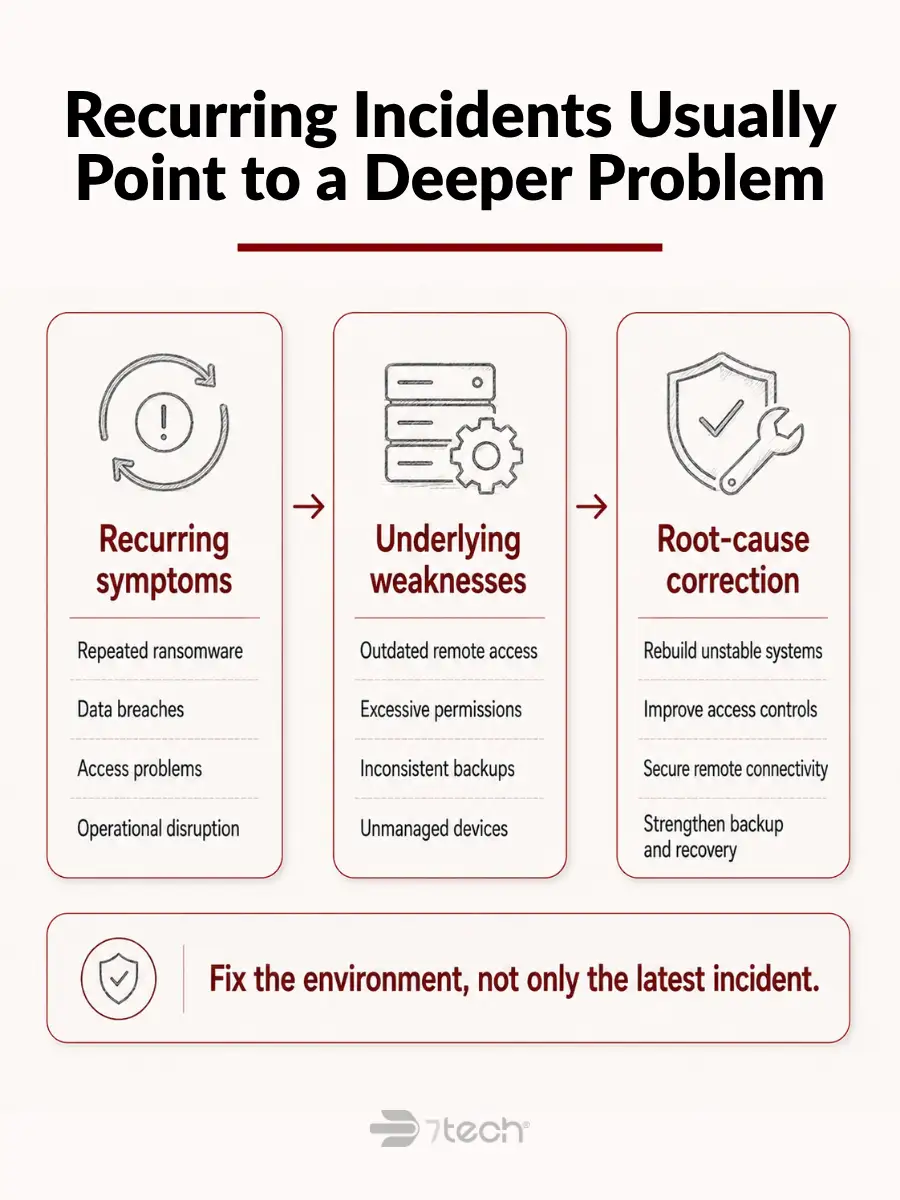
Gomez Floor Coverings, a 7tech construction client, had experienced repeated data breaches and ransomware incidents before engaging 7tech. Previous providers had addressed individual issues without correcting the underlying environment. You can read the full case study here.
The company’s infrastructure included an unnecessary remote desktop setup that contributed to security exposure and operational inefficiency. The environment was rebuilt, central file access was moved to the cloud, Microsoft 365 access was improved, daily backup devices were installed, and remote connectivity was configured with more appropriate controls.
Since those changes were implemented, the company has not reported a repeat of the earlier breach and ransomware pattern described in the engagement.
The lesson for executives is straightforward: repeated incidents call for root-cause correction. Adding another isolated product to an unstable environment may reduce one symptom without improving governance, resilience, or recovery.
A mature review should examine how systems, identities, devices, vendors, and business processes interact. The goal is to remove the conditions that allow the same problem to return in a different form.
How can construction companies reduce cybersecurity risk?
Construction companies can reduce cybersecurity risk by strengthening payment verification, identity security, access governance, device management, backup recovery, and incident-response ownership. The most effective approach combines technical safeguards with repeatable business procedures.
1. Verify payment changes outside of email
Any request involving new bank details, redirected payments, urgent invoice exceptions, or unusual financial instructions should be confirmed through a separate, trusted channel. 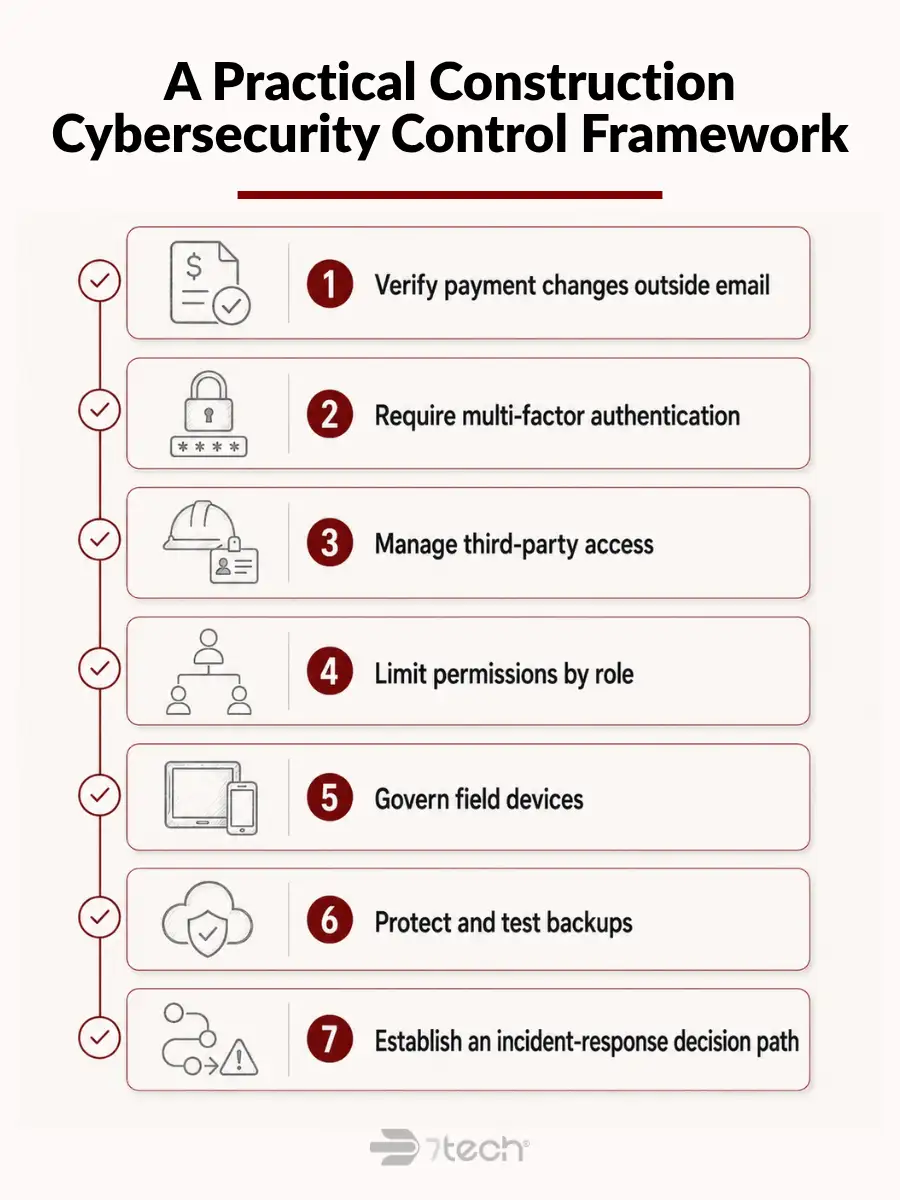
Effective controls may include:
- Calling a known contact at a previously verified phone number.
- Requiring approval from a second authorized employee.
- Using a controlled vendor portal instead of accepting changes by email.
- Documenting who approved the change and how it was verified.
- Escalating unusual requests instead of responding to artificial urgency.
- Separating the ability to request, approve, and execute payment changes.
You will know this control is working when: Employees can explain exactly how a payment change is verified, and no one person can alter critical payment information without independent confirmation.
2. Require multi-factor authentication
Multi-factor authentication adds another verification step beyond a password. It should be prioritized for:
- Email accounts
- Remote-access systems
- Financial applications
- Administrative accounts
- Cloud storage and collaboration platforms
- Project-management systems containing sensitive information
Email deserves immediate attention because it often supports communication, approvals, password resets, and account recovery. A compromised mailbox can give an attacker several ways to expand access.
Multi-factor authentication does not eliminate account risk, but it makes a stolen password significantly less useful.
You will know this control is working when: Critical accounts cannot be accessed with a password alone, and any exceptions are documented, limited, and reviewed.
3. Manage third-party access throughout the project lifecycle
Vendor and subcontractor access should be approved, limited, reviewed, and removed. Project milestones, personnel changes, contract endings, and support-provider changes should automatically trigger an access review.
A useful access record should identify:
- Who has access
- Which systems or files they can reach
- Why the access is required
- Who approved it
- Whether multi-factor authentication is enabled
- When the access will be reviewed or removed
Broad or poorly documented vendor access can indicate that a company’s technology environment is no longer being governed effectively. Leaders may want to review the broader signs your construction company has outgrown its IT provider, especially when access ownership, documentation, or removal processes remain unclear.
You will know this control is working when: Leadership can identify active external accounts and remove unnecessary access without searching through multiple systems or contacting several vendors.
4. Limit user permissions by role
Employees should receive the access required for their responsibilities, not every permission that might be convenient. Administrative rights should be restricted, and sensitive financial or operational systems should have clear role boundaries.
Role-based access reduces the potential impact of:
- A compromised account
- An employee mistake
- A malicious action
- A lost or stolen device
- An incomplete offboarding process
It also makes audits, investigations, and employee departures easier to manage.
You will know this control is working when: Managers can identify who has access to critical systems, and employee departures do not trigger a scramble to discover unknown accounts.
5. Govern field devices consistently
Field devices should follow a consistent security standard, whether they are company-owned or approved personal devices.
That standard should address:
- Screen locks and password requirements
- Device encryption
- Supported operating systems and software updates
- Remote lock or wipe capabilities
- Approved applications and cloud-storage locations
- Separation of company and personal information where appropriate
- Removal of company access when employment or project assignments end
Device governance should also account for active cloud sessions. Changing a password may not automatically terminate every session on a lost device.
You will know this control is working when: A lost phone, tablet, or laptop can be identified, restricted, and removed from company systems without depending on the employee to recover it.
6. Protect and test backups
Backups are only valuable when they can be restored within a usable timeframe. Construction leaders should know:
- Which systems and data are backed up
- How frequently backups occur
- Where backup copies are stored
- How backup access is protected
- When restoration was last tested
- How long critical recovery is expected to take
A meaningful recovery test confirms more than the existence of files. It validates that the organization can restore the systems, permissions, applications, and information required to resume work.
Recovery priorities should reflect business impact. Restoring an archive is different from restoring the accounting, project-management, communication, and file systems required for active operations.
You will know this control is working when: Leadership can review documented recovery results instead of relying on verbal assurances that backups are running.
7. Establish an incident-response decision path
Every construction company should know who makes decisions during a cybersecurity incident, how leaders will communicate if normal systems are unavailable, and which actions occur first when fraud, ransomware, or unauthorized access is suspected.
The plan should define:
- Executive decision authority
- Technical containment and recovery ownership
- Financial escalation procedures
- Internal and external communication responsibilities
- Legal, insurance, regulatory, and client-notification considerations
- Alternative communication channels
- Documentation requirements
Leaders do not need to direct the technical response. They do need enough visibility and authority to make timely business decisions.
A practical cybersecurity assessment checklist can help identify gaps in ownership, controls, and recovery planning before those gaps are tested by an incident.
You will know this control is working when: Leaders can identify the decision-makers, communication channels, and first actions without creating the plan during the incident.
How can executives evaluate construction cybersecurity readiness?
When evaluating cybersecurity risks in construction, executives do not need to review every technical configuration. They need clear answers to the questions that reveal whether financial, operational, and recovery controls are working.
| Executive question | What a prepared company should know |
|---|---|
| Would we catch a fraudulent payment request before money moves? | The company has independent verification and dual approval for sensitive financial changes. |
| Can we remove access for a vendor or former employee immediately? | Access is documented, centrally managed, and linked to onboarding, offboarding, and project changes. |
| If email became unavailable today, how would operations continue? | Teams have documented alternative communication and escalation procedures. |
| When were our backups last restored successfully? | Recovery tests are documented, reviewed, and connected to business recovery objectives. |
| Who owns business decisions during an incident? | Executive, technical, financial, legal, and communication responsibilities are assigned in advance. |
| Are field devices governed consistently? | Approved devices follow minimum security standards and can be remotely restricted or wiped. |
| Which third parties can access our systems today? | Leadership can review an accurate list of vendors, permissions, owners, and review dates. |
| Can our provider explain risk in business terms? | Reporting connects technical findings with operational impact, ownership, and required decisions. |
Unclear answers do not automatically mean the company is failing. They indicate where leadership needs greater visibility.
That clarity also supports more disciplined construction IT budgeting. Decision-makers can separate routine technology spending from investments that reduce meaningful operational, financial, or compliance exposure.
Who is responsible for cybersecurity in a construction company?
Cybersecurity responsibility is shared, but accountability must be specific. Executives own business risk and continuity. Finance owns payment-control discipline. Operations and project leaders influence user and vendor access. Employees follow security procedures. IT or an outside provider implements and maintains the controls.
| Role | Primary cybersecurity responsibility |
|---|---|
| Executive leadership | Set risk expectations, assign accountability, and approve continuity priorities. |
| Finance | Verify payment changes and enforce approval controls. |
| Operations and project management | Define legitimate access needs and report project, vendor, or personnel changes. |
| Employees | Follow verification, password, device, and incident-reporting procedures. |
| IT or an outside provider | Implement controls, monitor the environment, support recovery, and provide clear reporting. |
The objective is not to turn every leader into a cybersecurity specialist. It is to ensure that critical responsibilities do not disappear between departments, contractors, and technology providers.
A prepared organization can answer three questions clearly:
- Who owns the decision?
- Who performs the work?
- Who verifies that the control is working?
When those responsibilities are unclear, cybersecurity gaps can remain unresolved even when every department assumes someone else is handling them.
Frequently asked questions about cybersecurity risks in construction
Why are construction companies targeted by cybercriminals?
Construction firms combine frequent payments, distributed teams, mobile devices, remote access, and extensive vendor communication. These conditions give attackers opportunities to impersonate trusted contacts, steal credentials, redirect funds, or interrupt time-sensitive operations.
What is the most common financial cyber risk for construction companies?
Business email compromise is a significant financial risk because attackers can imitate vendors or executives and request payment changes. Independent verification and dual approval make fraudulent instructions harder to move through normal finance workflows.
Does cyber insurance replace construction cybersecurity controls?
No. Cyber insurance may help address certain covered costs, but it does not keep projects operating, restore systems, or stop payment fraud. Insurers may also expect documented controls such as multi-factor authentication, backups, access management, and incident-response planning.
How often should vendor access be reviewed?
Review vendor access whenever a project, contract, role, or support relationship changes. Scheduled reviews should also confirm that every external account still has a legitimate owner, purpose, permission level, and review or expiration date.
How often should construction companies test backups?
Backup restoration should follow a defined schedule based on business impact and recovery requirements. Critical systems deserve more frequent validation. Each test should document what was restored, how long it took, and whether operations could resume.
Should construction companies require multi-factor authentication for every employee?
Multi-factor authentication should cover all supported accounts where practical. Immediate priorities include email, remote access, administrative accounts, financial systems, and cloud platforms containing sensitive operational or client information.
What should executives receive in cybersecurity reporting?
Executive reporting should explain material risks, incidents, recovery readiness, unresolved vulnerabilities, vendor exposure, ownership, and required decisions in business language. Leaders need trends and consequences—not a raw list of technical alerts.
Construction leaders need visibility before an incident
Addressing cybersecurity risks in construction does not require a longer list of security products. It requires a clear view of where exposure exists, who owns each decision, and whether the company can continue operating when a critical system, account, device, or communication channel becomes unavailable.
A useful next step is to review payment controls, third-party access, field-device practices, backup recovery, and incident ownership as one connected business process.
That approach helps construction leaders:
- Protect payment workflows without slowing legitimate business.
- Give employees and vendors the access they need without creating permanent exposure.
- Support field mobility while maintaining device control.
- Connect backup investments with realistic recovery priorities.
- Give executives clear ownership and decision visibility.
The goal is not to create another layer of operational complexity. It is to make cybersecurity easier to govern, easier to explain, and more closely aligned with how the construction business actually operates.
Find out where your construction company may be exposed
7tech’s free, confidential Cybersecurity Risk Assessment reviews key areas of your environment, including firewall configuration, security patching, password practices, vulnerable accounts, device encryption, threat monitoring, and endpoint protection.
You will receive a clearer view of where security gaps may exist and which areas deserve attention before they contribute to ransomware, unauthorized access, or operational disruption.

Neal Juern, Founder and CEO of 7tech, helps business leaders take control of their IT and strengthen cybersecurity without the complexity. Since founding 7tech in 2012, he’s built it into a 5X MSP 501 winner and guided hundreds of executives toward smarter, safer operations through Managed IT Services and Managed Security Services that make sense to people outside the IT department. He speaks regularly to executive and nonprofit audiences across Texas.