
Business Continuity Planning for Manufacturing: Why the Middle of a Crisis Is Too Late to Start
Business continuity planning for manufacturing helps organizations prepare for technology disruptions before they interrupt production, communication, or access to critical systems. It is not simply about backups or cybersecurity tools. Manufacturers also need to understand operational dependencies, know who can respond, and establish the resources needed to keep the business moving before a disruption begins.
When your flight hits turbulence, the last thing you want to hear from the pilot is, “Give me a minute. I’ve never handled this before.”
Flying feels safe not because problems never happen, but because pilots prepare for situations they hope they will never face. When something goes wrong, they are not starting the response from scratch.
The same principle holds across professions where mistakes are costly.
Preparation happens before the emergency. The emergency is when that preparation gets put to use.
Manufacturers need to think about technology disruptions the same way.
Business continuity planning is not simply about having backups, cybersecurity tools, network infrastructure, or reliable systems. Those things matter, but technology alone does not answer every question a manufacturer will face when normal operations are interrupted.
Who needs to be involved? What parts of the operation are affected? What technology does production depend on? Who understands the business priorities? Who can help?
The middle of a crisis is a particularly bad time to start figuring those things out.
When Technology Problems Become Production Problems
Technology disruptions rarely arrive at a convenient time.
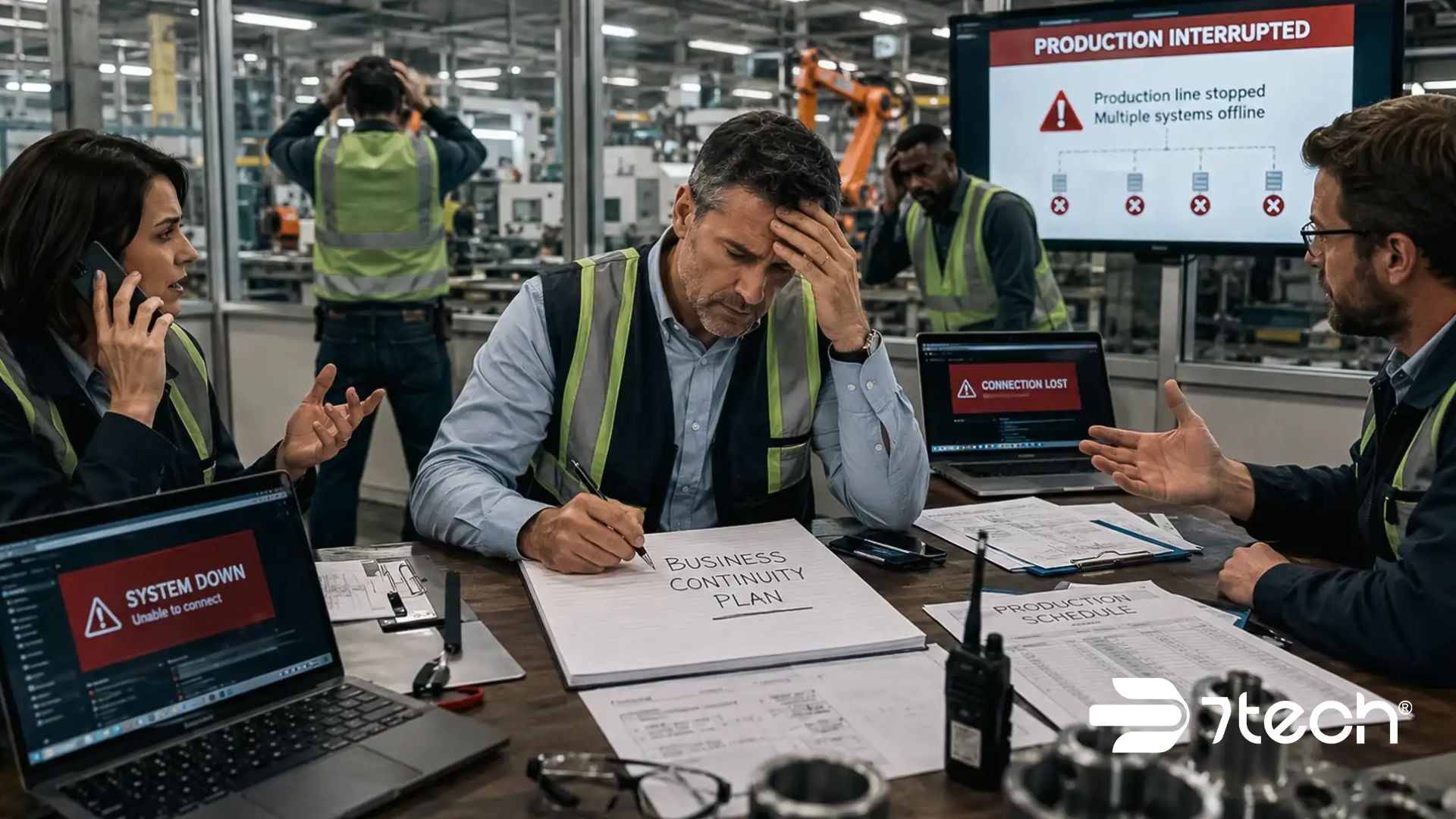
Servers fail. Networks become unstable. Malware can make systems unavailable. Connectivity problems can interfere with communication and access to information.
For a manufacturer, the consequences do not necessarily stay inside the IT environment.
That exposure matters because manufacturing remains a frequent target for cyberattacks. IBM’s 2026 X-Force Threat Intelligence Index found that manufacturing accounted for 27.7% of cybersecurity incidents in 2025, making it the most-targeted industry for the fifth consecutive year.
Cybersecurity is only one source of disruption, but the statistic reinforces a broader continuity issue: when technology supports production, a technology problem can quickly become an operational problem.
That is why the goal behind zero downtime IT services is not to assume every disruption can be eliminated. It is to reduce avoidable interruptions and build greater resilience when something does go wrong.
Watco Tanks experienced the connection between technology and operations firsthand.
Before working with 7tech, the steel tank manufacturer dealt with server failures, viruses, and network instability. According to Systems & Scheduling Manager Garrick Mullen, those IT problems disrupted operations and slowed the company down.
That experience illustrates one of the most important principles behind business continuity planning:
The significance of a technology failure is not just what broke. It is what the business can no longer do because it broke.
For a manufacturer, that makes continuity an operational concern as much as a technology concern.
Why Discovering Weaknesses During a Disruption Creates More Risk
When something fails, restoring the immediate system is obviously important.
But sometimes the disruption also exposes weaknesses in the underlying environment.
The cost of IT downtime is therefore not limited to repairing a failed server or network connection. When employees cannot access systems, production slows, workflows stop, and resources have to be redirected toward recovery, an IT problem can affect the broader operation.
Watco Tanks did not address its technology challenges solely by waiting for individual problems and repairing them as they occurred.
Work also included improvements to backup systems and network infrastructure, along with practical connectivity projects such as Ethernet throughout the office and wireless connectivity between buildings.
According to Mullen, those improvements helped make daily operations smoother and the overall technology environment more stable and reliable.
That distinction matters.
Business continuity planning should not begin and end with asking, “Do we have a backup?”
It should also consider the infrastructure and dependencies employees rely on every day:
- How are systems connected?
- How does information move between locations?
- What happens if an important part of that environment becomes unavailable?
- Are the systems supporting today’s operation still appropriate for the way the business now works?
The middle of an outage is a difficult time to discover the answers.
Why Business Continuity Is More Than Recovery
A business continuity plan matters after something goes wrong, but some of the most valuable continuity work happens before there is anything to recover from.
That includes maintaining reliable backup and disaster recovery services so systems and data can be restored when necessary. But recovery capabilities alone do not address every operational dependency that can affect production.
Watco Tanks’ experience provides evidence of that, too.
Mullen says what stands out is not simply how quickly problems are handled. He also credits a proactive approach in which potential issues are addressed before they have an opportunity to become larger disruptions.
That does not mean every technology problem can be predicted or prevented.
It means the organization is not relying exclusively on failure to reveal what needs attention.
CultureSpace encountered a similar question from the cybersecurity side. Its concern was not recovery from a documented breach. The company wanted greater confidence that its cybersecurity posture was being actively monitored and maintained and that potential risks were being addressed before they became larger problems.
That is an important part of business continuity planning.
Preparation is not only about determining what happens after a system fails. It is also about continually asking what could interrupt the operation and whether anything can be done about it beforehand.
That is where IT solutions that reduce downtime can support a broader continuity strategy. Technology can reduce points of failure and improve resilience, but those solutions are most effective when they reflect how the manufacturing operation actually works.
Reliable Manufacturing Operations Depend on More Than Technology
Technology can create operational friction without causing a dramatic outage.
Prytime Medical Devices experienced this with its previous IT support. According to Supply Chain Director Hugh Goldberg, the support available to the company was limited, and parts of the operation were being slowed down rather than enabled by technology.
After changing its technology support, Prytime reported smoother daily workflows and greater operational reliability.
This experience provides an important continuity lesson:
Operational resilience depends not only on whether systems exist, but on whether the technology environment and the people supporting it allow employees to keep working effectively.
That becomes particularly important when something unexpected happens.
A manufacturer does not want to begin establishing technical context, identifying resources, and determining who can help only after operations have already been affected.
What Can Business Continuity Preparation Change?
Business continuity planning cannot guarantee that a server will not fail, malware will not appear, a network will not become unstable, or an unexpected dependency will not become the real bottleneck during an outage.
Nor can a plan guarantee exactly how long recovery will take.
What preparation can do is reduce the amount the organization has to discover for the first time while operations are already under pressure.
Watco Tanks provides the clearest evidence of what that can look like over time.
The company moved from an environment where server failures, viruses, and network instability were disrupting operations to one its Systems & Scheduling Manager describes as more stable and reliable.
Problems are handled quickly. Potential issues are often addressed before they become larger disruptions. Improvements to backups and network infrastructure have helped day-to-day operations run more smoothly.
His summary of the operational change is straightforward:
“We don’t worry about IT disrupting production anymore.”
That statement should not be turned into a promise that technology can never interrupt manufacturing.
It is evidence of something more useful: the condition of the technology environment can materially change how much operational concern IT creates for a manufacturer.
For manufacturers trying to eliminate IT downtime, that distinction is important. Preventing avoidable problems matters, but so does having the infrastructure, support, and preparation needed when prevention is not enough.
Why Business Continuity Planning Has to Keep Up With Manufacturing Operations
A continuity plan should not be treated as a document that is written once and forgotten.
Manufacturing environments change.
Companies grow. Employees work differently. Systems change. Networks expand. New technology is introduced. Dependencies that once seemed minor can become important to daily operations.
That means preparedness needs to evolve with the business.
The practical questions are not limited to “What do we restore first?”
Manufacturing leaders should also understand what parts of the operation depend on technology, where important dependencies exist, whether backups and infrastructure still meet current requirements, what expertise will be available when something goes wrong, and how technical decisions will connect to operational priorities.
Not every assumption made beforehand will survive a real incident.
That is why business continuity planning should create readiness rather than false certainty.
What Is the Value of Being Ready?
No manufacturer can eliminate every technology risk.
The objective is not to predict every outage or guarantee uninterrupted production.
It is to avoid entering a disruption with less knowledge, capability, and support than the business could have established beforehand.
That means understanding critical technology dependencies.
It means maintaining backups and infrastructure rather than assuming their existence is enough.
It means identifying and addressing potential problems before every issue has to announce itself through failure.
And it means having knowledgeable resources already familiar with the environment when something does go wrong.
The manufacturing experiences we have seen support that distinction.
We have seen server failures, viruses, and network instability disrupt operations.
We have seen technology support itself create day-to-day operational friction.
We have also seen greater stability after underlying infrastructure and backup systems were improved, potential issues addressed proactively, and technology better aligned with how the operation needed to work.
Those experiences do not prove that a formal continuity plan will make every recovery fast or predictable.
They demonstrate why waiting for disruption to reveal every weakness is a poor continuity strategy.
Why Preparation Has to Happen Before It Feels Urgent
One of the challenges with business continuity planning is that the best time to work on it is usually when production is moving and nothing appears to be wrong.
That is also what makes it easy to postpone.
But when systems are functioning, leaders have the opportunity to ask questions without an active disruption forcing the answers:
- What technology does the operation depend on?
- Which systems, networks, and locations depend on one another?
- What happens if employees lose access?
- Are backups and recovery capabilities appropriate for today’s environment?
- Are recurring technology problems revealing a larger weakness?
- Who understands the environment well enough to respond when something changes?
Those questions are easier to work through before operations are waiting for an answer.
Business continuity planning is not about knowing exactly what the next disruption will look like.
It is about making sure the organization is not starting from scratch when it arrives.
Frequently Asked Questions About Business Continuity Planning for Manufacturing
What is business continuity planning for manufacturing?
Business continuity planning prepares a manufacturer to maintain essential operations when technology, systems, networks, or normal workflows are disrupted. It connects recovery planning with the operational dependencies that production relies on.
Why is business continuity planning important for manufacturers?
Manufacturing operations often depend on interconnected technology, networks, systems, and locations. When one dependency fails, the effect can extend beyond IT and interrupt production, communication, or access to critical information.
Are backups enough for manufacturing business continuity?
No. Backups are an important recovery capability, but continuity also depends on infrastructure, connectivity, technical support, operational priorities, communication, and an understanding of how technology supports production.
Can business continuity planning prevent manufacturing downtime?
It cannot eliminate every disruption. The goal is to reduce avoidable problems, identify weaknesses earlier, and make sure the organization has more information and capability available when an interruption occurs.
How often should manufacturers review business continuity planning?
Continuity planning should evolve as operations change. Growth, new systems, network changes, new locations, different workflows, and changing technology dependencies can all make older assumptions less useful.
Know Where Your Manufacturing Operation Stands
When a technology disruption affects your manufacturing operation, decisions will have to be made.
The question is how many of those decisions you want to encounter for the first time after operations have already been affected.
Business continuity planning gives manufacturers the opportunity to understand their technology dependencies, strengthen weak points, and establish response capabilities before the pressure arrives.
Evaluate how prepared your manufacturing operation is to respond, recover, and keep moving when the unexpected happens.

Neal Juern, Founder and CEO of 7tech, helps business leaders take control of their IT and strengthen cybersecurity without the complexity. Since founding 7tech in 2012, he’s built it into a 5X MSP 501 winner and guided hundreds of executives toward smarter, safer operations through Managed IT Services and Managed Security Services that make sense to people outside the IT department. He speaks regularly to executive and nonprofit audiences across Texas.