
Business Continuity Planning for Nonprofits: Why the Middle of a Crisis Is Too Late to Start
Business continuity planning for nonprofits helps organizations prepare for technology disruptions before they interfere with employees, services, communication, or access to critical information. It is not simply about backups or cybersecurity tools. Nonprofits also need to understand what their mission depends on, know who can respond, and establish the resources needed to keep operating before a disruption begins.
When your flight hits turbulence, the last thing you want to hear from the pilot is, “Give me a minute. I’ve never handled this before.”
Flying feels safe not because problems never happen, but because pilots prepare for situations they hope they will never face. When something goes wrong, they are not starting the response from scratch.
The same principle holds across professions where mistakes are costly.
Preparation happens before the emergency. The emergency is when that preparation gets put to use.
Nonprofits need to think about technology disruptions the same way.
Business continuity planning is not simply about having backups, cybersecurity tools, or reliable systems. Those things matter, but technology alone does not answer every question a nonprofit will face when normal operations are interrupted.
Who needs to be involved? Who understands the organization’s priorities? Who can help? How will people communicate? What does the nonprofit need to keep operating and serving its community?
The middle of a crisis is a particularly bad time to start figuring those things out.
When Technology Problems Become Nonprofit Operational Problems
Technology disruptions rarely arrive at a convenient time.
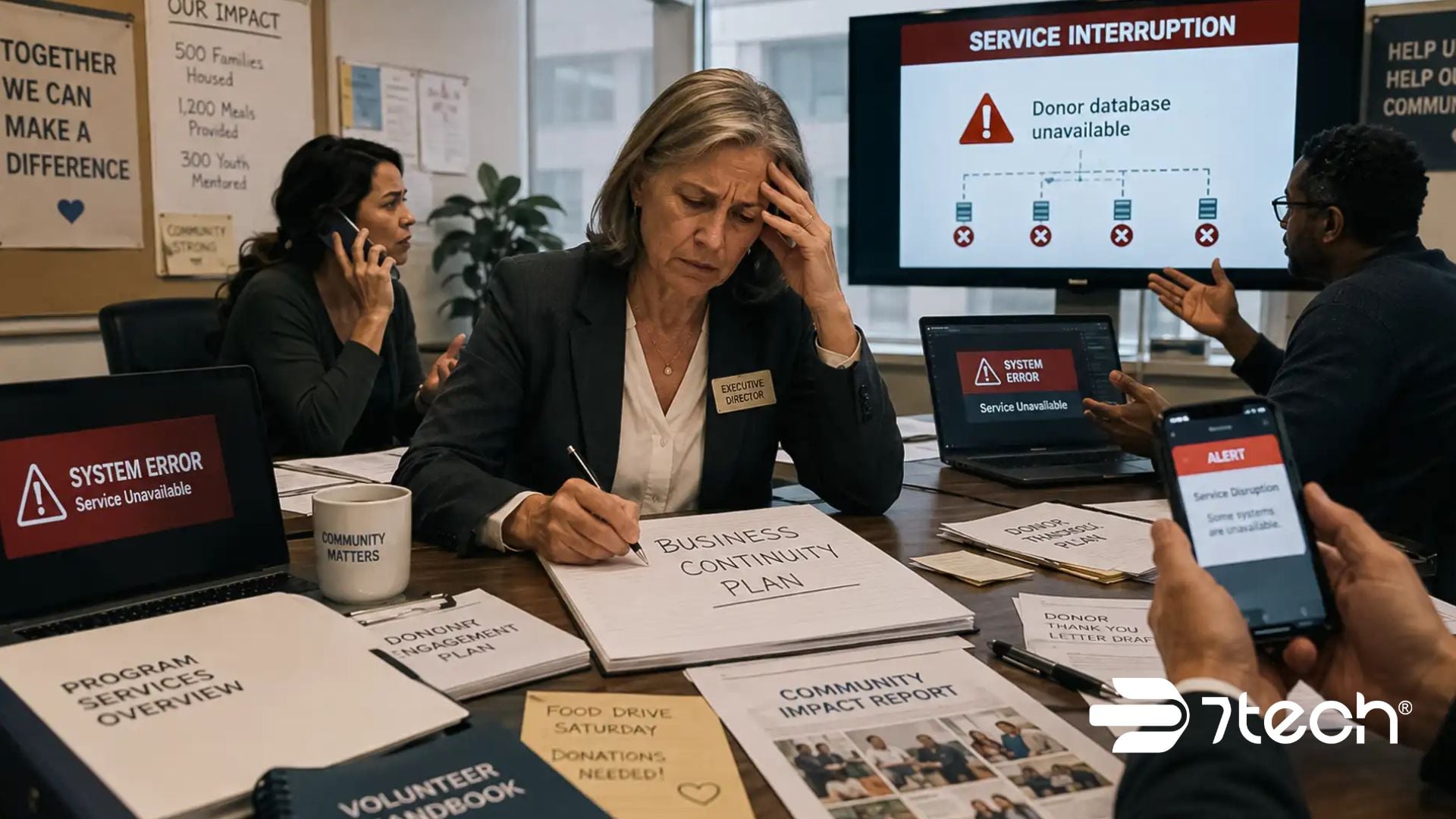
A system can become unavailable. Employees can lose access to information. Internet or network problems can interrupt workflows. A cybersecurity incident can create uncertainty about which systems or data can safely be used.
Those risks are particularly relevant for nonprofits operating with limited resources and sensitive information. NetHope’s 2025 cybersecurity research found that phishing and account compromise affected 94% of surveyed nonprofit organizations, up from 74% the prior year. The survey included 30 global nonprofit member organizations.
Cybersecurity is only one source of disruption, but the finding reinforces a broader continuity issue: a technology incident can quickly become a mission and operations problem.
That is why the goal behind zero downtime IT services is not to assume every disruption can be eliminated. It is to reduce avoidable interruptions and improve resilience when something still goes wrong.
Employees need to know what they can access and how they should continue working. Leaders need enough information to make decisions. The people addressing the technology need to understand what matters to the organization.
And the nonprofit needs access to the people and resources capable of helping.
We have seen the importance of that last point firsthand.
Avid Wealth Partners, for example, operated without a dedicated internal IT department. What the firm valued in its technology relationship was not simply access to technical tools. Its leadership emphasized accessibility, responsiveness, and consistent communication.
Having knowledgeable support available when needed gave the organization confidence that its team would not have to navigate technology concerns alone.
That experience illustrates an important part of continuity planning: knowing where expertise and support will come from before you urgently need it.
Why Discovering Weaknesses During a Crisis Creates More Risk
Every unresolved question becomes harder when normal operations have already been interrupted.
A leader who does not have enough information has to stop and gather it. An employee who does not know what to do has to ask. A technology provider that does not understand the organization first has to learn which systems, workflows, and operational needs matter.
None of those activities is inherently wrong.
The problem is timing.
Time spent establishing basic context during a disruption is time that cannot be spent acting on it.
The cost of IT downtime is therefore not limited to the system that stopped working. When staff cannot access information, services are delayed, communication breaks down, or resources have to be redirected toward recovery, the effects can spread across the organization.
That is why continuity planning should not exist entirely inside the IT function. Restoring technology and restoring the nonprofit’s ability to operate are not always the same question.
Our experience with Valbridge Property Advisors illustrates the distinction.
The organization valued an IT relationship in which its provider listened to what the business needed, collaborated on decisions, and adjusted as those needs changed. The significance was not simply technical competence. Technology decisions could be connected to the realities of the organization.
That principle becomes especially important when normal operations are disrupted.
A technical team may understand what can be fixed. Organizational leadership understands what needs to keep functioning. Effective continuity planning has to connect the two.
Why Business Continuity Is More Than a Backup
Backups are important. So are cybersecurity controls, reliable infrastructure, cloud services, and other technologies designed to reduce disruption.
Reliable backup and disaster recovery services can help restore systems and data when something goes wrong, but preparedness is not a product an organization installs once and considers finished.
It also depends on whether risks are being considered before they become urgent, whether the right expertise is available, whether people can communicate clearly, and whether technology decisions reflect the way the nonprofit actually operates.
ChildSafe’s experience offers a practical example of why the underlying technology matters.
The nonprofit’s file storage had depended on an on-premises server. After its files were moved to SharePoint, employees were no longer tethered to that infrastructure and gained greater flexibility in how and when they could access the information they needed.
The lesson is not that every nonprofit should move every system to the cloud.
It is that business continuity depends partly on understanding what employees depend on to keep working and what happens when access to that dependency is interrupted.
Preparedness therefore requires looking beyond whether data is backed up. Leaders should understand how people access information, where critical dependencies exist, and what alternatives are available if normal access is disrupted.
The same principle applies when evaluating IT solutions that reduce downtime. Technology can strengthen resilience, but those solutions are most effective when they reflect how employees work and which systems the nonprofit actually depends on.
Cybersecurity requires the same forward-looking mindset.
At CultureSpace, the concern was not recovery from a documented breach. The organization wanted greater confidence that its cybersecurity posture was being actively monitored and maintained and that potential risks were being addressed before they became larger problems.
That experience reinforces a simple principle: waiting for an incident should not be the first time an organization looks for weaknesses.
Trinity Real Estate Finance provides another example. Its cybersecurity needs included ongoing due diligence, keeping protections current, meeting customer security requirements, and having support that understood the organization’s individual needs.
Cybersecurity was not treated as something that could simply be configured once and forgotten.
Business continuity planning deserves the same treatment.
Readiness has to reflect the organization as it operates today, not the organization as it operated when a plan, system, or process was first put in place.
What Can Business Continuity Preparation Change?
Preparation cannot eliminate uncertainty.
Even a well-prepared nonprofit can experience an outage, cyber incident, equipment failure, or unexpected complication. Business continuity planning cannot guarantee how quickly every system will return.
But there are situations where careful preparation has produced something very tangible: continuity through a major technology change.
STARRY, Inc., a nonprofit with staff spread across nearly ten locations, needed to move away from an outdated server-based environment while establishing an independent technology infrastructure.
The organization could not simply stop operating while that happened. Employees still needed access to the systems and information supporting their work.
The migration required the new environment, file access, network security, and the needs of a geographically distributed workforce to be considered before the transition took place.
The result was zero network downtime and zero data loss during the migration.
A planned migration is not the same thing as responding to an unexpected outage, and that distinction matters.
But the experience demonstrates something directly relevant to business continuity planning: when dependencies and operational requirements are understood before a high-stakes technology event begins, technical work can be planned around keeping the organization operating.
That is the objective of continuity planning.
Not predicting every possible emergency.
Not assuming nothing unexpected will happen.
And not believing a document by itself guarantees recovery.
The objective is to understand enough about the nonprofit, its technology, its dependencies, and the people supporting it that an unexpected event does not force everyone to begin from zero.
What Is the Value of Being Ready Before a Crisis?
Business continuity planning cannot guarantee that an outage will be short, that a cyber incident will be contained immediately, or that every system will behave as expected.
What it can do is reduce the number of fundamental questions a nonprofit encounters for the first time while already under pressure.
Instead of discovering who can help, that relationship can already exist.
Instead of explaining the organization from the beginning, the people supporting it can already understand its environment and priorities.
Instead of discovering an important technology dependency only when employees lose access to it, the organization can identify critical systems and workflows beforehand.
Instead of treating preparation as a one-time technology project, risks and requirements can be revisited as the organization changes.
And instead of assuming technology alone creates resilience, leaders can think about the combination of systems, people, communication, responsibilities, and outside resources that keeps the organization functioning.
For nonprofits trying to eliminate IT downtime, that distinction matters. Preventing avoidable problems is important, but so is having the support, infrastructure, and preparation required when prevention is not enough.
Across our client experience, responsiveness and communication repeatedly emerge as qualities organizations value in their technology relationships.
ChildSafe’s CEO, for example, emphasized not only how quickly issues were investigated but also technicians’ willingness to communicate throughout the process.
For leadership, that kind of communication provides something technology alone cannot: visibility into what is happening and confidence that someone is actively working on the issue.
Those observations do not mean every disruption will go according to plan.
They point to something more practical: when circumstances become uncertain, nonprofits benefit from not having to establish every capability, relationship, and line of communication from zero.
Why Preparation Has to Happen Before It Feels Urgent
One of the difficulties with business continuity planning is that the work happens when there may be no immediate crisis demanding attention.
Systems are working. Employees are productive. Programs and services are moving forward.
It can be easy to assume that preparedness can wait.
But that is exactly when the important questions are easiest to consider:
- What parts of the nonprofit cannot operate without technology?
- What systems and services do those workflows depend on?
- Who needs to be involved when those capabilities are interrupted?
- What expertise would the organization depend on?
- How would people communicate?
- Are current protections and support arrangements keeping pace as the organization changes?
Not every answer will survive a real disruption exactly as expected.
Business continuity planning is not about predicting every possible failure.
It is about entering the unexpected with more context, capability, and clarity than the organization would have if it waited for the crisis to begin.
Frequently Asked Questions About Business Continuity Planning for Nonprofits
What is business continuity planning for nonprofits?
Business continuity planning prepares a nonprofit to maintain essential operations when technology, systems, connectivity, or normal workflows are disrupted. It connects technology recovery with the people, services, and priorities needed to continue the mission.
Why is business continuity planning important for nonprofits?
Nonprofits often depend on technology to communicate, access information, manage programs, support staff, and serve their communities. When critical systems become unavailable, a technology issue can quickly interfere with mission delivery.
Are backups enough for nonprofit business continuity?
No. Backups help recover data and systems, but continuity also depends on communication, infrastructure, technical support, access to information, business priorities, and an understanding of how employees actually work.
Can business continuity planning prevent every nonprofit technology disruption?
No. The purpose is not to eliminate every outage or cyber incident. It is to reduce avoidable weaknesses and make sure the organization is better prepared to respond when disruption occurs.
When should a nonprofit review its business continuity planning?
Continuity planning should evolve as the organization changes systems, locations, workflows, staff structures, technology providers, or critical dependencies. Plans based on an outdated environment may no longer reflect how the nonprofit operates today.
Know Where Your Nonprofit Stands
When a technology disruption happens, your nonprofit will have decisions to make.
The question is how many of those decisions you want to encounter for the first time while employees are waiting, systems are unavailable, and the people you serve still depend on your organization.
Business continuity planning gives nonprofits the opportunity to understand their technology dependencies, strengthen weak points, and establish response capabilities before the pressure arrives.
Evaluate how prepared your nonprofit is to respond, recover, and keep moving when the unexpected happens.

Neal Juern, Founder and CEO of 7tech, helps business leaders take control of their IT and strengthen cybersecurity without the complexity. Since founding 7tech in 2012, he’s built it into a 5X MSP 501 winner and guided hundreds of executives toward smarter, safer operations through Managed IT Services and Managed Security Services that make sense to people outside the IT department. He speaks regularly to executive and nonprofit audiences across Texas.