

What Managed IT Should Do for San Antonio Contractors
Managed IT for San Antonio contractors should do more than respond to tickets. It should keep technology reliable, access controlled, teams connected, vendors coordinated, and leadership informed as people, projects, jobsites, devices, and requirements change. The executive outcome is straightforward: fewer operational disruptions, clearer accountability, and an IT environment that becomes easier to manage as the business grows.
Contractor IT is rarely static. Projects open and close. Employees move between offices, jobsites, and remote locations. Devices travel. Vendors change. Access requirements shift. Infrastructure expands. Managed IT should absorb that operational movement without forcing leadership to rebuild order every time the business changes.
This article focuses on what managed IT should contribute to contractor operations. It is not a guide to selecting a provider. For broader context on construction managed IT services, the more important operational question is: what should the function actually do for the business?
What Managed IT Means for San Antonio Contractors
For a contractor, managed IT is the ongoing management of the technology supporting people, projects, systems, devices, access, vendors, security, and business continuity. It is not simply a help desk that fixes isolated technical problems after they occur.
That distinction matters because construction and contracting businesses operate across multiple environments. Estimators, project managers, finance teams, executives, field employees, and administrative staff may work from different locations, devices, applications, and networks. The underlying technology still has to function as one coordinated business environment.
As a contractor grows, the amount of technology coordination increases. New jobsites, new employees, departures, equipment changes, vendor relationships, project-specific access, network expansion, and contractual requirements all create work that has to be managed deliberately.
Effective managed IT also establishes clearer ownership across outside providers. Leadership should not have to become the middleman between an internet provider, software vendor, security company, copier company, Microsoft support, and an internal employee every time a problem crosses systems.
In that sense, contractor IT is an operational function. Business performance depends on systems remaining usable, access remaining current, changes being controlled, and issues being resolved without unnecessary disruption. When contractors also face contractual, cybersecurity, or compliance obligations, managed IT should make those responsibilities more structured and understandable rather than adding another layer of complexity.
What San Antonio Contractors Should Expect Managed IT To Do
For San Antonio construction firms, managed IT should produce practical business outcomes that leadership can recognize without needing to understand every technical detail.
This operational framing aligns with the governance, asset, response, and recovery themes described in the NIST Cybersecurity Framework small business quick-start guide. Contractors do not need to become cybersecurity specialists. They need enough structure around technology to keep operations controlled as the business changes.
Managed IT Is Operational Support, Not Just Technical Support
The difference is simple. Basic IT support fixes individual problems after they appear. Operational managed IT also helps the contractor absorb normal business change without allowing every new hire, jobsite, vendor issue, upgrade, or network change to become a separate fire drill.
For contractors, that means reducing technology interference with estimating, scheduling, document access, field-office communication, project management, accounting, administrative work, and infrastructure changes associated with growth.
The goal is not more IT activity. The goal is less business disruption.
Executives should therefore judge managed IT by what happens around the technology, not only by how many tickets get closed.
Does the company spend less time chasing issues? Are users able to work?
Are changes predictable? Is ownership clear?
Can leadership understand where risk exists without translating technical language?
Across documented contractor client cases, that is the more useful pattern. The value is not simply that support exists. The value is that the technology supporting the company becomes easier to operate as the business changes.
If a contractor is trying to determine whether its current problems reflect normal growth, unclear ownership, or a support model that no longer fits, that question is closer to when a construction company outgrows its IT support than to a single unresolved ticket. The operational test remains the same: is technology helping the business move cleanly, or making routine change harder than it should be?
What Managed IT Looks Like in Real Contractor Situations
Everyday reliability keeps project work moving
Sure Seal, a commercial waterproofing and sealant contractor in Hondo, uses cloud and collaboration tools to coordinate specifications, plans, and project takeoffs. That is a practical example of how contractor operations can depend on shared digital systems remaining available and usable. 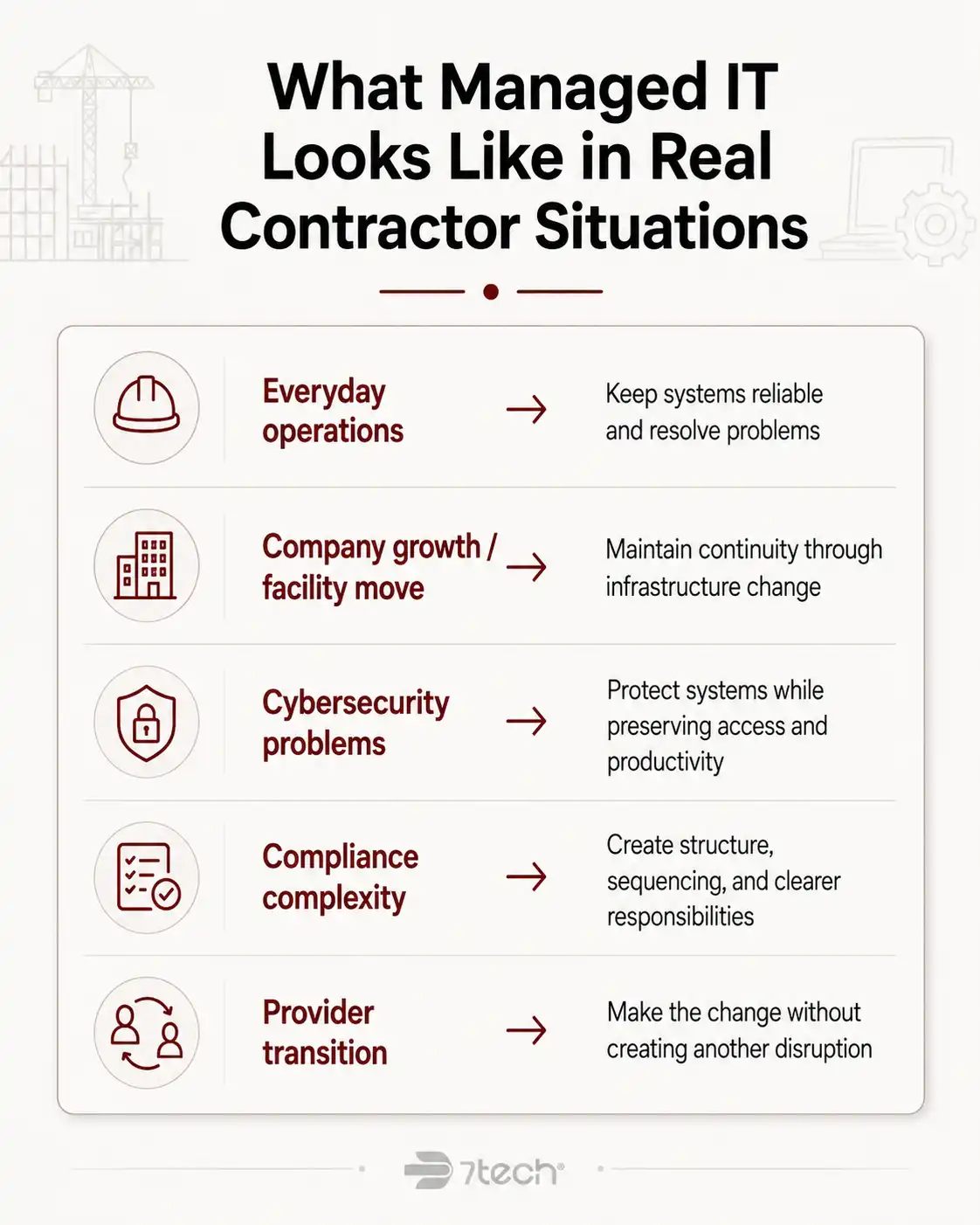
Owner Chris Tovar identified dependable network performance, prompt IT problem resolution, and confidence in data protection as important needs. After working with 7tech, he described improved computer-network reliability and said that, in most cases, reported IT problems were resolved within the same hour.
That is a client-specific result rather than a universal service promise. It does not establish that Sure Seal experienced field-access failures, project delays, or interruptions to particular estimating or takeoff workflows. What it does show is that network reliability and responsive support mattered to a contractor whose work depends on shared digital tools.
The executive takeaway is broader: contractor systems need to remain dependable enough that ordinary technology problems do not become unnecessary operational friction.
Growth requires continuity during infrastructure change
Texas Chiller Systems illustrates the continuity side of managed IT and cybersecurity for contractors. As the company grew, its technology environment struggled to keep pace. The documented case included compatibility problems, unplanned downtime, and a lack of cohesive IT strategy.
Before the company moved into a larger facility, 7tech performed a hardware assessment, identified concerns and gaps, procured equipment, and prepared the new site with wired and wireless networking, servers, switches, and dedicated IT storage.
The migration was executed over a single weekend, and the company was fully online Monday. According to the case, a relocation that could have resulted in days of lost productivity was instead completed while normal weekday operations remained intact.
This is what contractor business continuity IT should accomplish. As a contractor grows, its technology environment has to change with the business. Managed IT should help those changes happen without unnecessary operational disruption rather than simply maintaining the environment that existed yesterday.
Cybersecurity should protect operations, not exist in isolation
Cybersecurity matters to contractors because serious incidents can interrupt access, stop productivity, increase recovery costs, and create leadership exposure.
Gomez Floor Coverings, identified in its case study as a general contracting company, had experienced repeated compromises, including data breaches and ransomware attacks, before its technology environment was rebuilt.
The documented impact extended beyond cybersecurity. Downtime spread across the organization, productivity stalled, and the company was left exposed without a credible path forward.
The remediation effort addressed multiple areas, including security, cloud and data changes, backups, tiered remote access, and redesign of key systems. The case subsequently reported no further data breach or system compromise since the partnership began, along with faster access to needed tools and less unnecessary friction.
That outcome should not be interpreted as a guarantee or proof that one control prevented every future incident. It demonstrates a more important executive point: cybersecurity risks in construction become business problems when they interfere with operations, access, productivity, customer confidence, or the ability to meet commitments.
Good cybersecurity reduces leadership uncertainty
Lambda Construction shows a different kind of value: reducing the amount of executive attention consumed by cybersecurity uncertainty.
Before working with 7tech, the company had encountered multiple fraudulent attempts. Owner Conor Shullanberger described protection of the company’s systems, network, and information as a significant concern.
After receiving managed cybersecurity support centered on active network monitoring and protection, he described the resulting visibility as giving him “a huge sense of relief.” He also said having 7tech as part of the team allowed Lambda to focus on running jobs and growing a profitable construction company rather than stressing about network security.
The case does not quantify incidents prevented, fraudulent attempts reduced, financial losses avoided, or hours of executive time saved. Its value is qualitative but important: managed protection can give leadership greater confidence that significant technology risks are being actively watched and managed.
Compliance responsibilities need structure, not more confusion
Sometimes the contractor’s problem is not downtime. It is complexity.
Southwest Electrical Contracting Services, an electrical contractor headquartered in Converse, Texas, documented that its IT support specialist was unsure where to begin with CMMC because the requirements felt overwhelming.
The reported result was not certification, nor should it be described that way. The value was clearer guidance, better sequencing, and a process that became easier to manage.
EudaCorp, a construction-adjacent cost engineering and project-controls firm supporting government projects, provides a similar example. Its project manager said 7tech helped the company work through the complexity of CMMC with a clear, structured plan while allowing the business to remain focused on its core work.
For contractors with applicable Department of Defense obligations, the DoD CMMC model overview helps explain the framework itself. Managed IT contributes something different: organization, sequencing, and clearer ownership around responsibilities that otherwise become difficult to manage.
Provider transitions should not create another business disruption
NAPCO Precast illustrates another practical expectation. Its CFO connected prior virus-related downtime under a previous IT provider with concern about the disruption that could occur during a provider transition in a deadline-driven business.
The documented sequence matters. Previous virus-related downtime created caution about changing providers. The reported result was that the transition itself went smoothly.
That does not establish that 7tech subsequently reduced NAPCO’s ongoing downtime, prevented future viruses, or protected specific project deadlines. It does support a narrower operational standard for San Antonio construction IT support: even necessary technology changes should be planned so the transition itself does not create a fresh disruption.
When a Security Problem May Be Built Into the IT Environment
After a cybersecurity incident, the natural first question is often: which protection failed, and what security control is missing?
That is an important question. It is not always the only one.
A contractor’s security problem can sometimes be connected to the design of the broader IT environment. Adding another security control without reviewing that environment may leave part of the underlying problem untouched.
Security tools operate inside a larger technology system. If that system contains unnecessary complexity, outdated design choices, excessive access paths, poorly structured systems, or inefficient workarounds, those conditions can increase both operational friction and security exposure.
The Gomez Floor Covering case provides a useful example. In addition to repeated compromises, the documented environment included employees relaying through an unnecessary remote desktop setup simply to access cloud-based services. The case describes that design as creating inefficiency on top of vulnerability.
Remediation included stronger security controls and broader system changes, including removal of the redundant remote desktop environment.
The limits of the case are important. It does not prove that the remote desktop environment caused the ransomware attacks. It does not show that architecture matters more than security controls. It also does not prove that redesign alone produced the later outcome.
What it does demonstrate is narrower and more useful: a contractor experiencing repeated security problems also had an underlying system-design weakness that created both inefficiency and vulnerability, and remediation addressed both the security protections and the surrounding technology environment.
After a serious or recurring incident, executives should therefore expect two questions to be asked:
- What protection is missing? Identify the control, monitoring, access, backup, patching, or security weakness that requires correction.
- Is the IT environment itself contributing to the problem? Review whether unnecessary complexity, access design, outdated architecture, or fragile workflows are increasing risk.
Those questions belong together. This is not an argument against cybersecurity controls. A sound response may require stronger controls and changes to the underlying technology design.
The NIST definition of security architecture provides useful definitional support for viewing cybersecurity at the environment level rather than as a collection of isolated products.
The claim should remain proportional. Architecture is already part of mature cybersecurity practice, and one contractor case does not establish a construction-wide pattern. The documented outcome also followed multiple security and environment changes rather than one isolated fix. Even with those limits, the practical takeaway remains useful: examining only missing controls can be too narrow when the surrounding IT environment also contains weaknesses.
How San Antonio Contractors Can Tell Whether Managed IT Is Supporting Operations Well
Executives do not need to conduct a technical audit to evaluate whether managed IT is doing its job. They can start with operational questions that reveal whether technology is creating control or adding friction. 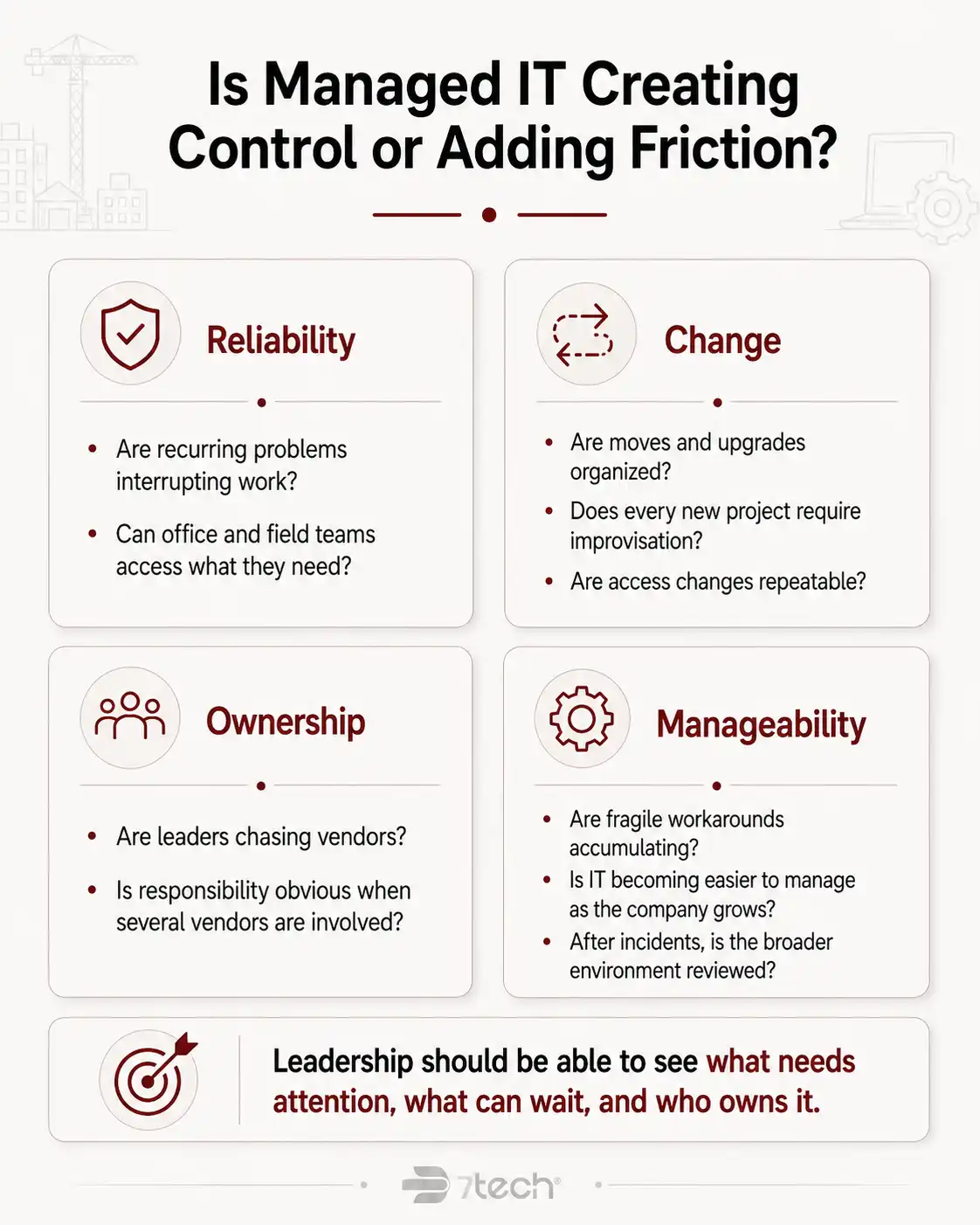
- Are recurring technology problems interrupting work? Repeated incidents usually deserve root-cause attention rather than endless ticket resolution.
- Are leaders spending too much time chasing vendors or technical explanations? Managed IT should create accountability, not another coordination burden.
- Do office and field workflows rely on fragile workarounds? Temporary fixes that become permanent can increase both operational complexity and risk.
- Do infrastructure changes feel risky or disorganized? Moves, upgrades, and expansions should follow a defined technology plan.
- Are employee access changes repeatable? Onboarding, offboarding, and role changes should not depend on one-off exceptions.
- Can office and field teams reliably access the systems they need? Location should not create unnecessary barriers to productive work.
- Does every major project or new location require technology improvisation? Growth should become more standardized over time.
- When multiple vendors are involved, is ownership obvious? Leadership should know who is coordinating the issue and what happens next.
- Is the IT environment becoming more manageable as the company grows? Scale should create better systems and processes, not more accumulated complexity.
- After a security incident, was the surrounding environment reviewed? A mature review looks at both missing controls and structural weaknesses.
Leadership should also be able to get clear answers about what requires attention now, what can wait, who owns major technology responsibilities, and whether recurring problems are actually being eliminated. That kind of visibility is part of operational managed IT because executives remain accountable for the business consequences even when they are not responsible for the technical work.
These questions align with the governance, asset awareness, response readiness, and recovery preparedness themes executives can use when evaluating IT performance without turning the exercise into a technical scorekeeping or provider-comparison project.
What A Contractor Should Walk Away Expecting From Managed IT
A contractor should expect managed IT to provide reliability, continuity, accountable support, coordinated access, clear ownership, stronger security, reduced disruption, and usable executive visibility.
The goal is not to create more technology activity around the business. It is to create a technology model that continues supporting the contractor as people, projects, locations, systems, vendors, customers, and requirements change.
For firms seeking a more local perspective, that is also the standard behind MSP for construction companies in San Antonio conversations. The question is not simply whether support is available. The question is whether the technology model fits the way the contractor actually operates.
The business will keep moving. Managed IT should make the technology behind it feel increasingly controlled, predictable, and accountable rather than increasingly improvised.
Frequently Asked Questions
What is managed IT for a construction company?
Managed IT for a construction company is the ongoing management of users, devices, access, systems, vendors, cybersecurity, and business continuity. It goes beyond break-fix support by helping the technology environment remain controlled as the company changes.
How is managed IT different from basic IT support?
Basic IT support resolves individual problems after they occur. Managed IT also manages recurring risks, users, access, infrastructure, vendors, security, and technology changes so normal business growth creates less disruption.
Why do San Antonio contractors use managed IT services?
Contractors often operate across offices, jobsites, mobile devices, field teams, vendors, and cloud systems. Managed IT helps keep those moving parts coordinated while giving leadership clearer ownership and visibility.
Can managed IT help reduce downtime for contractors?
Managed IT can reduce avoidable disruption through proactive maintenance, faster issue resolution, continuity planning, clearer ownership, and better-managed infrastructure changes. Results vary by environment, so continuity support is more accurate than promising universal downtime reduction.
Does managed IT include cybersecurity for construction companies?
It often does. Cybersecurity may include monitoring, endpoint protection, access controls, patching, backups, awareness training, and response capabilities designed to protect the systems contractors depend on to operate.
When should a contractor review its IT architecture after a security issue?
After a serious or recurring incident, contractors should review both missing security controls and the underlying IT environment to determine whether unnecessary complexity, outdated design, or access structure contributed to the weakness.
Why does construction IT become harder to manage as a contractor grows?
Growth adds users, jobsites, devices, systems, vendors, access requirements, and sometimes contractual obligations. Managed IT should provide a repeatable way to manage those changes instead of treating each one as a separate technology problem.
Can managed IT help contractors manage users and access across multiple jobsites?
Yes. Managed IT should provide repeatable onboarding, offboarding, device, identity, and access processes as employees, responsibilities, projects, and locations change.
Get Clearer Operational Visibility
If you are unsure whether your current technology setup is keeping pace with the way your contractor business actually operates, the next step does not have to be changing providers. Start by getting a clearer view of what is working, what creates risk, and what deserves attention.
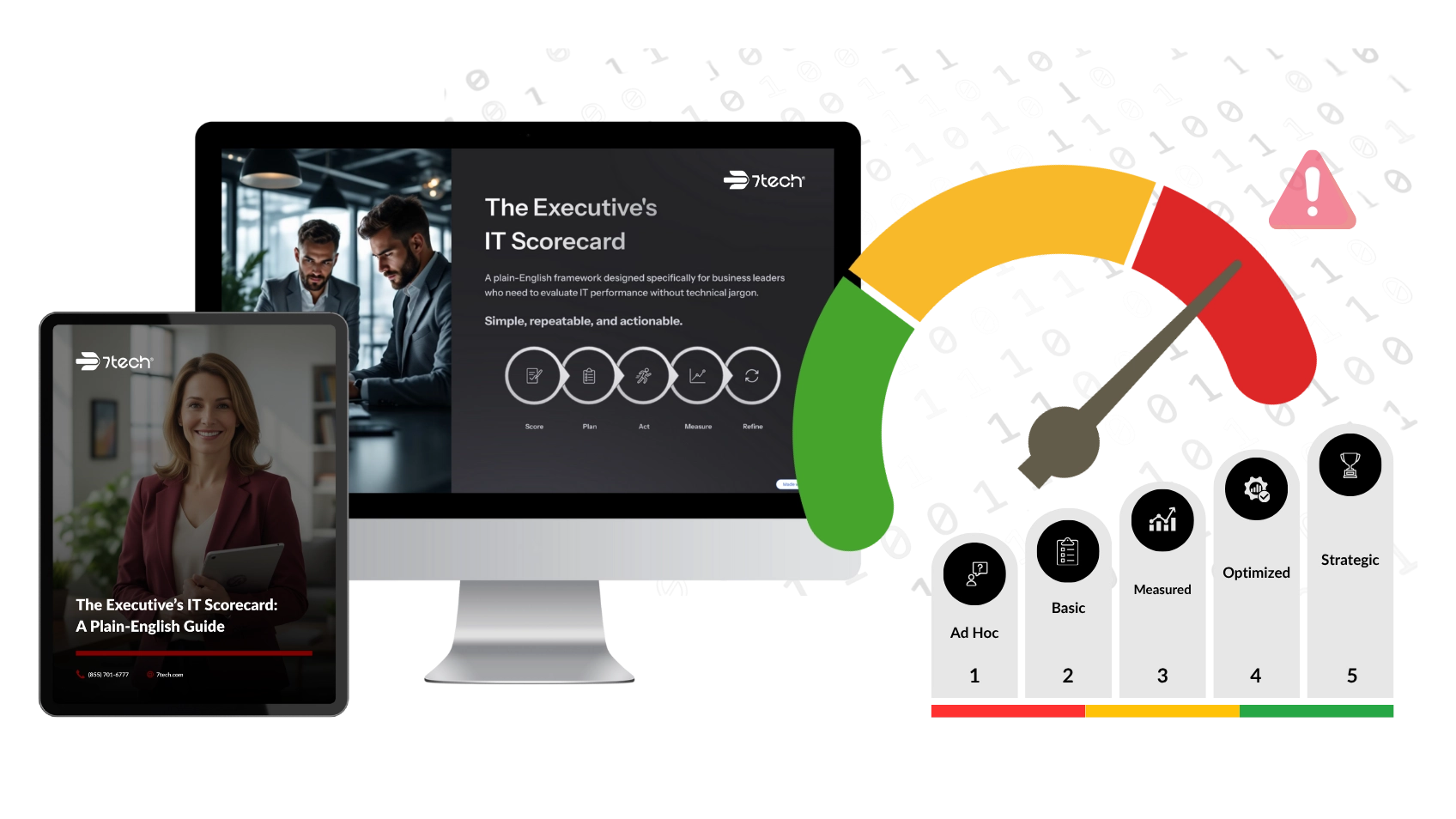
Get an Executive IT Scorecard to evaluate whether your current IT environment supports reliable contractor operations, clear accountability, and controlled growth without vendor pressure.

Neal Juern, Founder and CEO of 7tech, helps business leaders take control of their IT and strengthen cybersecurity without the complexity. Since founding 7tech in 2012, he’s built it into a 5X MSP 501 winner and guided hundreds of executives toward smarter, safer operations through Managed IT Services and Managed Security Services that make sense to people outside the IT department. He speaks regularly to executive and nonprofit audiences across Texas.