
Choosing AI Tools: The Mistake Most Manufacturers Make
Choosing AI tools for manufacturing should start with an operational problem, not a product. The most common mistake manufacturers make is buying AI because of its features, popularity or perceived urgency before defining what it needs to improve. A stronger approach is to identify operational friction first, establish what success looks like, then evaluate AI tools based on fit, security, adoption and measurable value across the plant.
The California Gold Rush of 1848 promised one thing: opportunity.
Hundreds of thousands of people headed west hoping to strike it rich. Some found gold. Many spent months chasing an opportunity that never paid off.
Yet some of the people who built lasting businesses were not chasing gold at all. They were selling the picks, shovels and supplies miners needed.
There is a useful lesson in that story for manufacturers today: opportunity does not create value unless you understand the problem you are trying to solve.
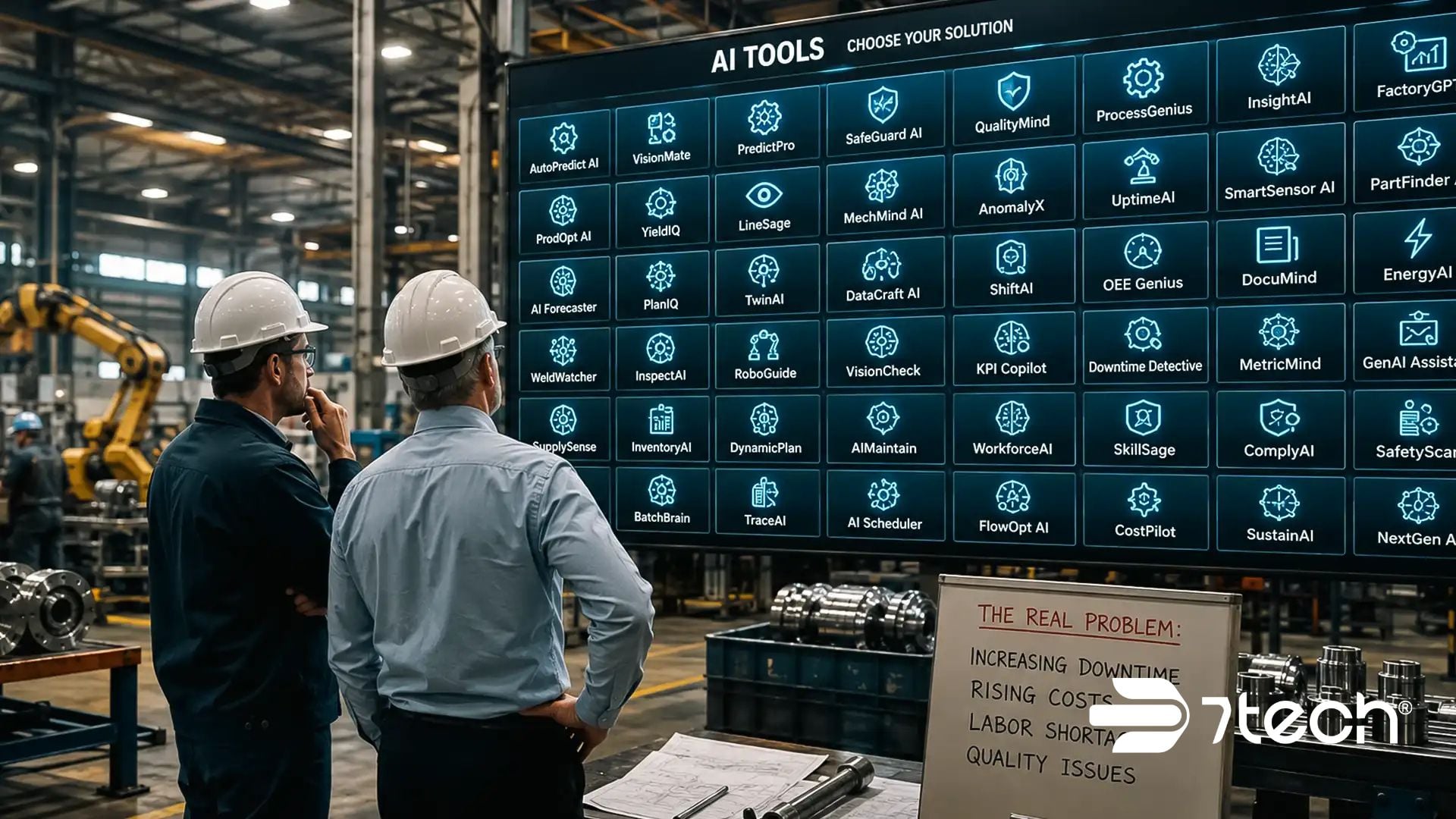
AI is today’s gold rush. New tools appear constantly. Vendors promise faster results, greater productivity and new competitive advantages. Manufacturers are exploring where AI might fit into production, planning, maintenance, quality and customer delivery.
That creates an expensive temptation: find an AI tool, buy it and figure out the operational case later.
Manufacturers should do the opposite.
Why Choosing AI Tools for Manufacturing Should Not Start With the Tool
Most manufacturing leaders have already seen technology investments fail to deliver what was promised.
Maybe it was an ERP module employees never fully adopted. Maybe it was a software subscription that continued renewing while barely being used. Or perhaps a new system simply created more work without eliminating the operational problem it was supposed to solve.
AI can create the same outcome.
The difference is that the pressure to act is greater, the marketing is more aggressive and the range of possibilities can make almost any product sound transformational.
But a new AI tool does not automatically create a better manufacturing process.
It creates value when it solves a defined operational problem, fits the plant’s existing technology environment and produces an outcome leadership can recognize.
That might mean reducing repetitive reporting, helping maintenance teams find information faster, improving access to production data or shortening the time employees spend assembling information across disconnected systems. Manufacturers evaluating these opportunities can also review practical ways to use AI productivity tools before deciding whether a specific application fits their operation.
If leadership cannot clearly explain what should improve after implementing the tool, the organization may not yet have a business case.
The miners who rushed to California had excitement and urgency.
What many did not have was a plan.
Your AI strategy needs one.
Where Can AI Create Real Value in Manufacturing?
The best AI opportunities are often less futuristic than manufacturing leaders expect.
Instead of beginning with questions about what AI might eventually transform, look at the work already slowing employees down today.
Listen for the phrase:
“There has to be a faster way to do this.”
That is often where practical AI use cases begin.
AI does not need to replace experienced employees or redesign the entire plant to create meaningful value. In many cases, its strongest role is reducing repetitive analysis, manual searching and administrative work so skilled employees can spend more time on decisions that require operational knowledge and judgment.
Depending on the manufacturer’s systems, information and processes, practical opportunities may include:
- Shift and production summaries: AI can help turn production notes, downtime reports and shift-handoff information into concise summaries for employees to review.
- Supplier and customer communication: AI can help draft routine supplier follow-ups, order-status updates and internal escalation messages, leaving employees responsible for reviewing the details before anything is sent.
- Finding operating information: AI-powered tools can help employees search approved work instructions, maintenance history, quality records and other documentation without manually searching across as many systems.
- Production and reporting data: AI-assisted workflows may reduce repetitive work involved in compiling production, quality, maintenance or order information for recurring reports and reviews.
- Order and delivery questions: AI can help employees assemble information needed to answer routine order-status and delivery questions when the necessary data is available to the system.
These are examples, not a checklist every manufacturer should implement.
The goal is not to find more places to use AI.
The goal is to identify where the operation is losing time, creating delays or relying on manual workarounds and determine whether AI is an appropriate solution.
Start With Operational Friction, Not AI Features
Before comparing products, ask a more useful question:
Where are we losing time, creating avoidable delays or relying on manual workarounds every day?
The answer may reveal a production report rebuilt every morning from ERP data and spreadsheets. Planners may spend hours reconciling numbers that do not agree. Maintenance history may be difficult to locate when equipment goes down. Or employees may repeatedly check several systems to answer the same order-status questions.
Those are operational problems first.
AI is only one possible response.
Ask employees:
- What tasks consistently take longer than they should?
- What information are people repeatedly copying, reconciling or searching for?
- Which processes create the most frustration?
- Where are bottlenecks slowing production, maintenance, quality, shipping or customer response?
- Which manual tasks become harder to manage as production volume grows?
- Where do employees rely on spreadsheets or workarounds because systems do not communicate well?
Then quantify the friction where possible.
If five employees each spend two hours per week compiling the same type of report, the operation is spending roughly 520 employee hours per year on that activity.
Now leadership has something concrete to evaluate.
Would an AI-enabled process materially reduce those hours? Would the savings justify licensing, integration, training, security review and ongoing ownership?
That is a much stronger decision framework than comparing feature lists.
Once the problem is clear, evaluating technology becomes more focused. You are no longer browsing tools and hoping something fits. You are evaluating potential solutions against an operational need the business has already defined.
That principle extends beyond AI.
Prytime Medical Devices experienced what can happen when technology does not adequately support the operation. According to Supply Chain Director Hugh Goldberg, the company’s previous IT support was limited, and parts of the operation were being slowed down rather than enabled by technology.
After partnering with 7tech, Prytime reported smoother day-to-day workflows, greater operational reliability and more responsive IT support. The company also gained access to modern technology that better supported how its operation worked.
Prytime’s experience was not an AI implementation, and it should not be treated as one. But the lesson applies directly to AI decisions: newer technology is not the objective. Better support for the operation is.
For manufacturers, that broader technology foundation matters. Manufacturing IT services should support production reliability, security and growth rather than becoming another source of operational friction.
How Should Manufacturers Evaluate an AI Tool After Defining the Problem?
Finding the problem narrows the field, but it does not automatically tell you which product to buy.
When choosing AI tools for manufacturing, leadership should evaluate each option against the environment in which it will actually operate.
What Operational Problem Are We Solving?
Define the problem narrowly enough that success can be measured later.
“Improve production” is too vague.
“Reduce the time supervisors spend compiling the daily production report” is measurable.
A clear problem definition also reduces scope creep. It keeps the organization from purchasing additional capabilities simply because they look impressive during a demonstration.
What Should Improve?
Decide what success looks like before implementation.
Depending on the use case, that may mean:
- Fewer employee hours spent on repetitive reporting
- Faster access to maintenance or quality information
- Fewer manual steps
- Less duplicate data entry
- Shorter response times for order-status questions
- Fewer workarounds between disconnected systems
A useful AI investment should change an operational outcome, not simply add another application.
What Information Will the AI Tool Access?
This question should be answered before employees begin using the platform.
Determine what production, customer, employee, supplier or proprietary information may enter the tool, what systems it can access and whether the platform is appropriate for the type of data involved.
This matters especially when the manufacturer handles controlled information, customer specifications, intellectual property, regulated data or sensitive production information.
AI convenience should not create unnecessary governance or cybersecurity exposure.
The NIST AI Risk Management Framework provides a structured approach for organizations to identify and manage risks associated with AI. Manufacturers should consider those risks alongside productivity and operational benefits before deploying AI across important business processes.
A structured approach to adopting AI securely in your business can also help establish expectations around approved tools, data use and employee access before AI becomes embedded in daily workflows.
Where Does the Information Come From?
An AI tool cannot eliminate operational friction if employees still have to manually assemble everything it needs from disconnected systems.
Before buying the platform, determine whether the information is reliable, current and accessible.
If the tool depends on ERP data, maintenance records, production reports or quality documentation, leadership should understand how that information will reach the AI system and who is responsible for keeping it accurate.
Poor inputs can turn an impressive AI demonstration into another manual process.
Who Owns the AI Tool?
Every manufacturing technology investment needs an accountable owner after implementation.
Someone should be responsible for:
- User access
- Approved use cases
- Employee questions
- Adoption
- Vendor management
- Changes to integrations
- Ongoing business value
Without ownership, AI tools can quietly become another category of unmanaged software.
When employees adopt tools independently, shadow AI in business can also leave leadership without a clear view of which platforms are being used or what company information employees are putting into them.
For executives, this is ultimately a governance question:
Who is responsible for knowing how this tool is being used and whether it is still creating value?
Does the Tool Fit the Technology Environment You Already Have?
A powerful AI product can still be the wrong solution if it creates another disconnected system.
Before purchasing it, determine whether the manufacturer already owns similar functionality, whether the new platform integrates with core systems and whether employees will need to create new workarounds to use it.
A tool that saves 30 minutes in one process but creates additional work somewhere else may not represent an improvement.
Manufacturers should also consider whether the platform can scale with production growth without adding unnecessary complexity, additional vendors or unpredictable costs.
Will the People Doing the Work Actually Use It?
A technically impressive AI product has little operational value if employees avoid it.
Adoption often depends on whether the tool fits naturally into the way production, maintenance, quality and administrative teams already work.
Ask the people who will actually use it whether the proposed solution reduces work or simply changes where the work happens.
The best technology is not necessarily the product with the longest feature list.
It is the product that solves the defined problem, fits the operation and gets used consistently.
What Should Manufacturing Executives Measure Before Investing in AI?
Executives do not need to become AI product experts when it comes to choosing AI tools for manufacturing plants. They do need enough visibility to determine whether an investment makes operational and financial sense.
A simple evaluation can begin with four questions:
- What does the current problem cost us?
Estimate employee time, delays, rework, lost productivity or other operational friction. - What measurable improvement do we expect?
Define the target before selecting the tool. - What will implementation really require?
Include licensing, integration, training, cybersecurity review, administration and ongoing ownership. - How will we know whether the investment worked?
Establish a review point and compare the result with the original baseline.
This turns AI from an open-ended technology experiment into an operational decision.
It also gives plant leaders, CFOs and operations executives something more useful than a feature list: visibility into expected value, cost, risk and accountability.
When Technology Friction Becomes Operational Friction
Manufacturers have another reason to think carefully about technology decisions: technology problems do not always remain confined to IT.
Watco Tanks experienced server failures, viruses and network instability that disrupted operations and slowed the company down. After working with 7tech, the manufacturer reported a more stable and reliable technology environment, quicker handling of problems and smoother day-to-day operations following improvements to backups and network infrastructure.
Systems & Scheduling Manager Garrick Mullen summarized the change simply:
“We don’t worry about IT disrupting production anymore.”
Watco was not an AI implementation either.
But its experience reinforces why the operational problem should remain at the center of technology decisions.
The technology itself is not the business outcome.
What happens to the operation is.
The same principle applies when manufacturers are trying to reduce downtime caused by IT and network issues: stabilize the underlying operational problem before adding technology that depends on that environment.
Don’t Chase the Gold. Solve the Problem.
AI creates genuine possibilities for manufacturers.
Possibility, however, is not an operational case.
Before investing, identify where the operation is losing time, where employees rely on repetitive manual work, where information is difficult to find and where existing processes create avoidable delays.
Then determine whether AI is actually the right answer.
That is the conversation we start with at 7tech. Before recommending technology, we work to understand the operation, the existing technology environment and the problems getting in the team’s way.
The objective is not to add more technology.
It is to select technology that solves a defined operational problem without introducing unnecessary complexity, security exposure, surprise costs or another system employees have to work around.
If you’re choosing AI tools for manufacturing, do not begin by asking which AI product everyone else is buying.
Begin with a better question:
What operational problem are we trying to solve?
Once you know the answer, you will have a much better idea of what you are digging for.
Frequently Asked Questions About Choosing AI Tools for Manufacturing
How should a manufacturer choose the right AI tool?
When choosing AI tools for manufacturing plants, start with a specific operational problem and measurable outcome. Then evaluate tools based on integration, data access, security, employee adoption, ownership and total cost rather than choosing based on popularity or the number of features.
What is the biggest mistake manufacturers make when adopting AI?
One of the biggest mistakes is purchasing AI before defining the operational problem it should solve. That can create duplicate systems, more manual work, unnecessary costs and limited adoption without producing a measurable improvement.
What manufacturing processes are good candidates for AI?
Repetitive, information-heavy processes are often worth evaluating. Examples include shift summaries, production reporting, document searches, supplier communication and routine order-status questions. Each use case should still be assessed for data quality, security and operational fit.
How can manufacturers measure ROI from an AI investment?
Establish a baseline for the current process, including employee time, delays or manual steps. Then define the improvement expected from AI and include licensing, implementation, integration, training and administration when evaluating return.
Should AI connect directly to manufacturing systems?
It depends on the use case and risk involved. Manufacturers should understand what systems the tool will access, what permissions it requires and how data will move between platforms before allowing AI to interact with production, ERP, maintenance or quality systems.
Who should own AI tools inside a manufacturing company?
Each AI platform should have a clearly identified owner responsible for access, approved use cases, adoption, vendor management and ongoing value. Security and operational stakeholders should also be involved when the tool touches sensitive production or business information.
Should manufacturers create an AI strategy before buying tools?
Yes. The strategy should identify operational priorities, acceptable use, ownership, security requirements and measurable outcomes. It does not need to be complicated, but it should prevent AI purchases from becoming disconnected experiments across departments.
Find the Right AI Opportunity Before You Invest
You do not need another AI product simply because other manufacturers are buying one.
You need clarity about where technology can remove friction, support production and create an outcome your leadership team can measure.
Schedule a 15-minute discovery call with 7tech to identify where technology, including AI, could create practical value across your operation before you invest in a solution that does not fit.
Call (855) 701-6777 to schedule yours.