
Business Continuity Planning for Construction: Why the Middle of a Crisis Is Too Late to Start
Business continuity planning for construction helps contractors prepare for technology disruptions before they interfere with projects, employees, communication, or access to critical information. It is not simply about backups or cybersecurity tools. Construction businesses also need to understand their technology dependencies, know who can respond, and establish the resources needed to keep work moving before a disruption begins.
When your flight hits turbulence, the last thing you want to hear from the pilot is, “Give me a minute. I’ve never handled this before.”
Flying feels safe not because problems never happen, but because pilots prepare for situations they hope they will never face. When something goes wrong, they are not starting the response from scratch.
The same principle holds across professions where mistakes are costly.
Preparation happens before the emergency. The emergency is when that preparation gets put to use.
Construction businesses need to think about technology disruptions the same way.
Business continuity planning is not simply about having backups, cybersecurity tools, internet connectivity, or reliable systems. Those things matter, but technology alone does not answer every question a contractor will face when normal operations are interrupted.
Who needs to be involved? What parts of the business are affected? Who understands the operational priorities? Who can help? How will employees communicate and access the information they need?
The middle of a crisis is a particularly bad time to start figuring those things out.
When Technology Problems Become Construction Problems
Technology disruptions rarely arrive at a convenient time.
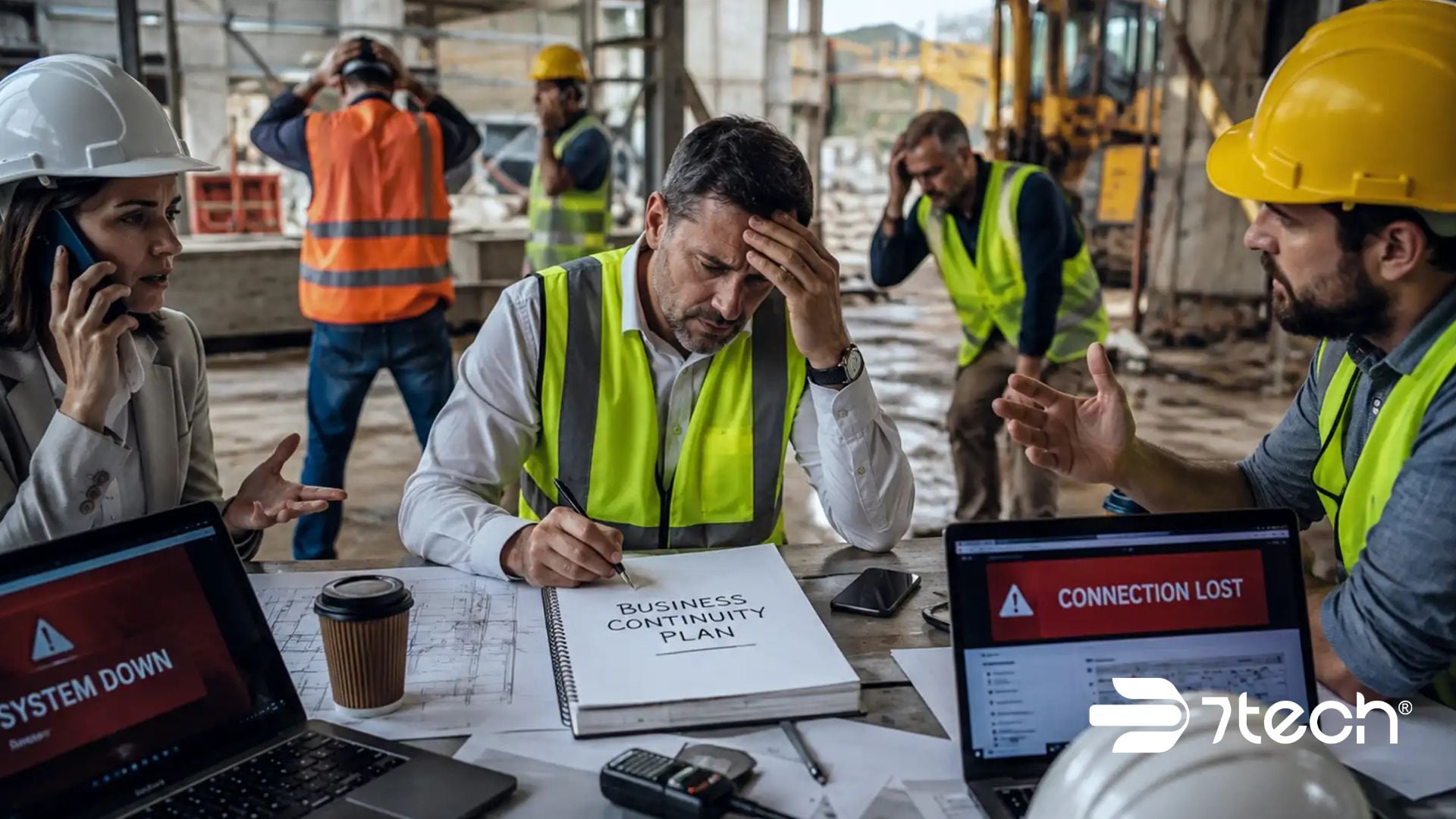
Systems fail. Employees lose access to information. Network problems interrupt workflows. Malware or ransomware can make systems unavailable. Infrastructure or connectivity problems can interfere with the technology employees depend on to keep work moving.
Those risks are becoming harder for contractors to ignore. The Associated General Contractors of America reported in its 2025 Construction Hiring and Business Outlook that 41% of construction firms cited cybersecurity as a top IT challenge.
For a contractor, technology problems rarely remain isolated inside IT.
That is why the goal behind zero downtime IT services is not to assume every disruption can be prevented. It is to reduce avoidable interruptions and improve resilience when something does go wrong.
NAPCO Precast experienced that connection firsthand.
Before changing IT providers, the company had experienced downtime related to computer viruses. Former CFO Paul Brennan did not quantify the duration or financial impact, but he made the operational concern clear: NAPCO was busy meeting construction project deadlines and could not afford unnecessary technology disruptions.
That distinction matters.
A virus may be a technology problem. The downtime it creates while a company is trying to meet project deadlines is a business problem.
Business continuity planning starts with understanding that connection.
Why Discovering Weaknesses During a Crisis Creates More Risk
Sometimes the problem is not simply that a system failed.
It is that the business discovers, after something goes wrong, that the underlying technology environment was more vulnerable or complicated than leadership realized.
The cost of IT downtime therefore extends beyond fixing a failed system. When employees lose access, communication breaks down, productivity stalls, or project work is delayed, a technical disruption can create broader operational consequences.
Gomez Floor Covering provides a particularly stark example.
The general contractor had experienced repeated data breaches and ransomware attacks under previous IT providers. Those incidents were not confined to the IT department. According to the documented case, downtime spread across the company and productivity stalled.
The underlying environment also contained structural problems. Employees were using an unnecessary remote desktop environment to reach cloud-based services, adding inefficiency on top of the company’s security vulnerabilities.
Addressing the situation required more than responding to the next attack.
The technology environment was redesigned. A Zero Trust cybersecurity strategy was implemented. Central data and file access were moved to the cloud, accounting software was handled separately on dedicated drives, daily backup devices were installed, remote access was configured with different security levels, and email was migrated to Microsoft 365.
Since the transition in 2019, Gomez Floor Covering has not experienced another data breach or system compromise.
There is an important boundary to that result: no cybersecurity program can guarantee that a business will never experience another incident.
But the experience illustrates something valuable for business continuity planning:
When recurring disruption exposes weaknesses in the environment, simply recovering from the immediate problem may not be enough. The underlying systems, dependencies, access methods, backups, and security architecture may also need attention.
Why Business Continuity Is More Than a Backup
Backups matter.
So do cybersecurity controls, network infrastructure, connectivity, cloud services, hardware, and responsive technical support.
Reliable backup and disaster recovery services can help restore systems and data when something goes wrong, but preparedness is not a single product a contractor can install and forget.
It requires understanding how those pieces support the business and identifying problems before they become operational interruptions.
Texas Chiller Systems offers a useful example.
As the mechanical and electrical contractor grew, its IT environment struggled to keep pace. The company had dealt with compatibility issues and unplanned downtime and eventually faced another high-stakes technology challenge: moving into a larger facility.
That relocation could not be treated simply as moving computers from one building to another.
Well before the move, the hardware environment was assessed to identify concerns and gaps. Equipment was sourced ahead of time. The new facility was prepared with wired and wireless networking, servers, switches, and dedicated IT storage.
The physical transition was then completed over a single weekend, with the company fully online by Monday morning.
A planned office relocation is not an unexpected outage, and it should not be presented as one.
What it demonstrates is the value of identifying technology requirements and dependencies before a high-stakes event begins.
The work that prevented disruption happened before employees arrived Monday morning, not after they discovered they could not work.
That same principle applies when evaluating IT solutions that reduce downtime. Technology is most useful to continuity when it reflects the actual systems, workflows, locations, and dependencies the construction business relies on.
Business Continuity Does Not Mean Predicting Everything
Business continuity planning cannot predict every failure.
A contractor may still experience an outage, cyber incident, hardware problem, connectivity issue, or complication nobody anticipated.
A plan also does not guarantee that every predetermined priority will remain correct once the real situation becomes clear.
The purpose is not to eliminate uncertainty.
It is to reduce how much the organization has to discover for the first time while already under pressure.
That means understanding which technology the business depends on, how employees access critical information, what backup and recovery capabilities exist, where important dependencies lie, and who has the expertise to respond when something goes wrong.
It also means revisiting those assumptions as the company changes.
Growth itself can create continuity risk.
Texas Chiller Systems’ experience demonstrates that. Years of expansion increased the demands placed on its technology environment. What had supported the business previously was no longer necessarily sufficient for the company it had become.
Business continuity planning therefore should not be something a contractor completes once and files away.
The technology environment changes because the business changes.
Why the Right Capabilities Need to Be in Place Before a Disruption
When something goes wrong, responsiveness matters.
But response is easier when the people addressing the problem already understand the environment.
NAPCO’s experience illustrates this from another direction.
Because the company had previously experienced virus-related downtime, leadership was cautious about changing IT providers. A transition itself can introduce risk through interrupted access, overlooked systems, communication gaps, or problems inherited from the previous environment.
NAPCO therefore needed the change handled without creating another operational setback.
According to its CFO, the transition was “very smooth.” He also highlighted responsiveness and the ability to explain technology in terms nontechnical decision-makers could understand.
That matters to continuity because technical recovery and business decision-making have to connect.
A contractor’s leadership does not necessarily need every technical detail. It does need enough clarity to understand what is happening, what it means for operations, and what decisions may be required.
What Does Construction Experience Teach About Business Continuity?
The construction evidence we have seen does not show that every contractor needs the same recovery sequence or that following a predetermined checklist guarantees a faster recovery.
It shows something more defensible.
We have seen technology failures create downtime while a construction-related business was working against project deadlines.
We have seen repeated ransomware attacks and breaches produce company-wide downtime and stalled productivity.
We have seen growth leave a contractor’s technology environment struggling to keep pace.
And we have seen high-stakes technology transitions completed without the operational interruption leadership feared when dependencies and requirements were addressed beforehand.
Taken together, those experiences point toward a practical lesson:
Business continuity is strongest when a contractor understands the technology its operations depend on, addresses weaknesses before they become urgent, and has the capabilities and expertise in place to respond when conditions change.
For businesses working to eliminate IT downtime, that distinction matters. Preventing avoidable problems is important, but so is being prepared to respond when prevention is not enough.
That does not eliminate disruption.
It means the company does not have to begin every response from zero.
Why Preparation Has to Happen Before It Feels Urgent
One of the challenges with business continuity planning is that the best time to do it is usually when nothing appears to be wrong.
Systems are working. Employees have access. Projects are moving.
That makes continuity work easy to postpone.
But it is also the best time to ask the questions that become much harder during a disruption:
- What technology does the company depend on to keep work moving?
- Which systems and services are connected?
- What happens if employees suddenly lose access?
- Are backups and recovery capabilities appropriate for the way the business operates today?
- Who understands the environment well enough to respond?
- Has growth introduced dependencies or vulnerabilities that were not there when the current systems were put in place?
Those questions are easier to work through before operations are waiting for an answer.
Business continuity planning is not about knowing exactly what the next disruption will look like.
It is about making sure the organization is not starting from scratch when it arrives.
Frequently Asked Questions About Business Continuity Planning for Construction
What is business continuity planning for construction?
Business continuity planning prepares a construction company to maintain essential operations when technology, systems, connectivity, or normal workflows are disrupted. It connects technical recovery with the operational priorities that keep projects and employees moving.
Why is business continuity planning important for contractors?
Contractors increasingly depend on technology for communication, information access, project workflows, and business operations. When those systems become unavailable, a technical issue can quickly affect employees, productivity, and project execution.
Are backups enough for construction business continuity?
No. Backups help restore data and systems, but continuity also depends on connectivity, infrastructure, security, communication, technical expertise, and an understanding of how technology supports the business.
Can business continuity planning prevent all IT downtime?
No. Continuity planning cannot eliminate every outage or technology failure. It helps identify weaknesses earlier and reduces the number of decisions and dependencies a business must discover during an active disruption.
When should a construction company review its business continuity plan?
Continuity planning should be revisited as the company grows or changes systems, locations, workflows, infrastructure, or technology providers. Those changes can create dependencies that did not exist when the original plan was developed.
Know Where Your Construction Business Stands
When a technology disruption happens, your construction business will have decisions to make.
The question is how many of those decisions you want to encounter for the first time while employees are waiting, systems are unavailable, and project deadlines have not stopped.
Business continuity planning gives contractors the opportunity to understand their technology dependencies, strengthen weak points, and establish response capabilities before the pressure arrives.
Evaluate how prepared your construction business is to respond, recover, and keep moving when the unexpected happens.

Neal Juern, Founder and CEO of 7tech, helps business leaders take control of their IT and strengthen cybersecurity without the complexity. Since founding 7tech in 2012, he’s built it into a 5X MSP 501 winner and guided hundreds of executives toward smarter, safer operations through Managed IT Services and Managed Security Services that make sense to people outside the IT department. He speaks regularly to executive and nonprofit audiences across Texas.