5 Ways Construction Companies Can Use AI for Disaster Preparedness
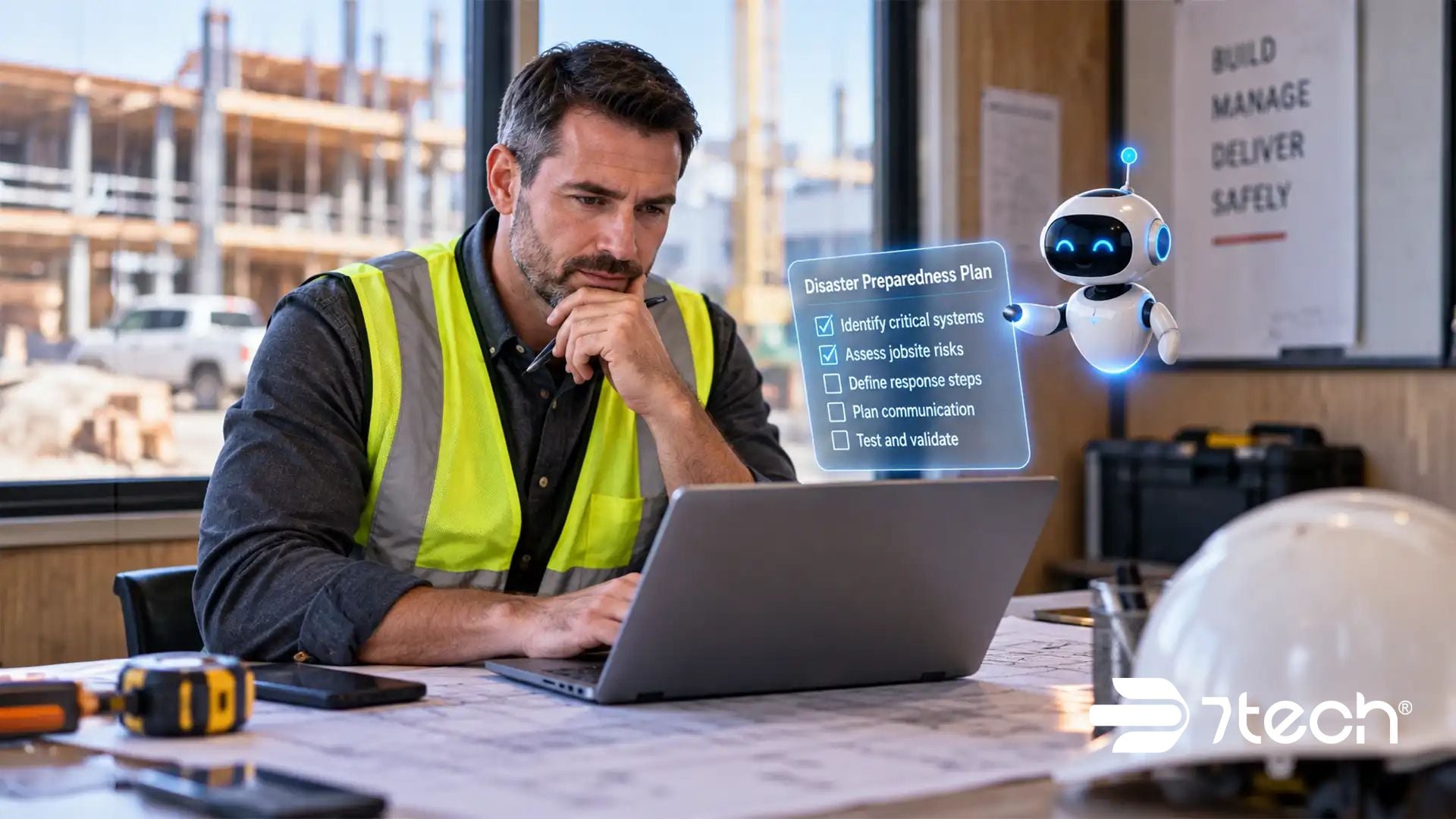
AI for construction disaster preparedness planning can help general contractors and subcontractors document critical processes, build response playbooks, identify operational gaps, simplify technical information, and keep recovery plans current. The value is speed and structure, not replacing leadership judgment, technical testing, or real-world validation.
For construction companies, preparedness is more complicated than protecting one office.
Operations may depend on jobsites, trailers, cloud platforms, mobile devices, project files, field connectivity, vendors, Microsoft 365, and employees working from different locations. A disruption in any one of those areas can affect people who are trying to keep a project moving.
Most construction companies know they should have a disaster recovery or business continuity plan.
Far fewer have one that is current, tested, and built around how the company actually operates.
That is not always because leadership is ignoring the issue. Often, the hardest part is simply getting the first version down.
People are usually better at improving something than starting from a blank page. Give your team a rough draft and they can tell you what is missing, what would not work in the field, and what needs to change.
That is where AI can be useful.
Not as a replacement for leadership judgment or a tested recovery plan, but as a practical tool for getting the planning process moving before a disruption puts a project, deadline, or crew under pressure.
How Can Construction Companies Use AI for Disaster Preparedness?
At a practical level, construction companies can use AI in five areas:
- Document critical processes faster
- Create outage checklists and response playbooks
- Identify dependencies and preparedness gaps
- Translate technical findings into operational terms
- Keep recovery documentation current
Each use can reduce the administrative burden of planning. None eliminates the need for human review, testing, or accountability.
Used carefully, AI disaster preparedness for construction can support planning without turning AI into the final decision-maker. NIST’s framework for trustworthy and responsible AI use provides a useful governance model for organizations adopting AI in risk-sensitive business processes.
1. Document Critical Construction Processes Faster
One of the biggest challenges in preparedness planning is getting important information out of people’s heads and into a format someone else can follow.
For contractors trying to formalize construction disaster recovery planning, construction managed IT services can help connect written procedures to the systems, users, vendors, and field environments those procedures depend on.
That matters in construction because critical operational knowledge can live with one project manager, superintendent, estimator, office manager, or internal IT person.
If that individual is unavailable during an outage, the company may lose valuable time trying to reconstruct a process while the field is already waiting.
AI can help turn rough notes, meeting transcripts, or scattered bullet points into a usable first draft.
For example, a construction company might use AI to organize:
- What to do if a jobsite loses internet access
- Who to contact when a project platform is unavailable
- How field teams regain access to critical files
- Which vendors own or support specific systems
- What steps to follow if email or Microsoft 365 goes down
- How access should be handled if a key employee is unavailable
The draft still needs to be reviewed by the people who understand the work.
AI cannot know whether a written process reflects what actually happens in the field. It can simply make the first version faster to create.
For executives, this process can reveal another risk at the same time: If only one person knows how a critical workflow operates, the company has a continuity problem even before a disaster occurs.
That visibility can also feed into a broader construction IT audit when leadership wants to assess where systems, ownership, or operational dependencies may be exposed.
2. Create Construction Outage Checklists and Response Playbooks
When something goes wrong, people need clear steps.
They do not need a long policy document that must be interpreted while a superintendent, project manager, or office team is already dealing with a disruption.
AI can help create first drafts of checklists and response playbooks for situations such as:
- A jobsite internet outage
- Loss of access to drawings or project files
- A cloud service outage
- A ransomware incident
- A severe weather event
- A key technology vendor going offline
- An office or trailer becoming temporarily inaccessible
For a general contractor or subcontractor, that might include a communications checklist for superintendents and project managers, an alternate-access procedure for project files, or a basic response outline for a critical system outage.
This is where construction outage response planning, a construction disaster preparedness checklist, and AI for incident response planning can work together. AI can organize the response sequence, while leadership determines which actions, roles, and escalation paths are appropriate for the company.
A useful playbook should make several things obvious:
- Who owns the response?
- Who needs to be notified?
- Which systems matter first?
- What workaround is available?
- When should the issue be escalated?
- How will field and office teams receive updates?
AI can organize that first draft.
But it does not automatically understand how your crews work, which projects are under the most pressure, which systems are contractually important, or how long a specific operation can tolerate downtime.
Leadership still has to decide what is realistic.
That is also why business continuity planning for construction needs to extend beyond a single outage scenario and account for the people, technology, vendors, and work processes required to keep projects moving.
Ready.gov recommends organizations test a business continuity plan rather than treating documentation alone as readiness. CISA’s guidance on roles and responsibilities during an incident likewise reinforces the value of defined ownership and communications before an incident occurs.
3. Identify Preparedness Gaps Your Team May Not Have Considered
One of the hardest parts of disaster preparedness is knowing what questions have not been asked.
AI can help leadership challenge assumptions before those assumptions are tested by a real outage.
For example, a construction team could ask:
- What happens if our main office loses internet for eight hours?
- What happens if a project team cannot access current drawings?
- What should we consider if a jobsite trailer loses connectivity?
- What are the biggest single points of failure for a multi-site contractor?
- What happens if a critical cloud platform is unavailable for a full day?
- What information would a superintendent need if normal systems were unavailable?
- Which vendors need to be involved if access to project files stops?
- What happens if the employee who normally manages a critical system is unreachable?
These prompts make AI for construction risk planning useful as a questioning tool. Leadership can also use the preparedness questions construction executives should review to challenge assumptions that may not surface in a routine technology discussion.
AI will not know which risks matter most to your company without accurate context.
What it can do is help leadership look beyond the obvious and identify dependencies, assumptions, and weak spots that deserve closer examination.
That is especially useful in construction, where a technology disruption does not stay confined to IT for long.
A connectivity problem can become a field access problem. A file-access problem can become an approval problem. An application outage can become crews waiting for information they need to continue working.
For multi-site contractors, jobsite connectivity disaster planning should therefore be part of the dependency review, including whether alternative connectivity exists when a trailer, office, or primary internet connection is unavailable.
NIST’s guidance on contingency planning requirements and priorities reinforces the broader principle that recovery planning should account for system dependencies, priorities, and the capabilities needed to restore operations.
The executive question is therefore not simply, “Is the system down?”
It is, “What part of the work stops if this system is unavailable?”
Understanding the cost of IT downtime can help leadership connect that question to project delays, productivity loss, and broader business impact.
4. Translate Technical Information Into Construction Business Impact
Most technical reports are not written for construction leaders.
Backup reports, recovery documentation, security findings, infrastructure notes, and vendor summaries may be accurate without clearly explaining what they mean for a project or the business.
AI can help translate technical information into plain language.
For example, AI can help turn a technical report into a leadership summary explaining:
- What the report is saying
- Which systems appear to be affected
- Whether project files or critical applications may be involved
- What questions leadership should ask
- What could happen operationally if the issue is not addressed
The goal is not to turn an owner, COO, or operations leader into an IT expert.
The goal is to make four questions easier to answer:
What could slow the work down?
What needs attention now?
What can wait?
Who owns the next step?
That is the level of clarity construction leaders need to make defensible decisions about operational risk, recovery priorities, and technology investments.
Those decisions often have a financial component as well. A construction IT budget planning guide can help leadership connect resilience priorities to planned technology spending instead of waiting until a disruption forces an unbudgeted response.
AI can make technical information easier to discuss. The underlying findings still need to be validated by people who understand the systems and the business.
5. Keep Construction Preparedness Documentation Current
Construction environments change constantly.
Projects start and finish.
Employees join and leave.
Vendors change.
New software is introduced.
Jobsites open and close.
Project teams move.
Cloud platforms and workflows evolve.
A disaster recovery plan that was accurate six months ago may no longer reflect how the company works today.
AI can make maintenance easier by helping teams:
- Compare older procedures with newer operational notes
- Update drafts after a vendor change
- Standardize documents written by different people
- Turn recent meeting notes into revised procedures
- Identify sections that may no longer match current operations
- Flag responsibilities assigned to employees who have changed roles
For companies using AI for construction business continuity, this review process can make it easier to keep a construction recovery plan aligned with current projects, people, technology, and vendor relationships.
Again, human ownership still matters.
AI can help keep documentation moving, but leadership still needs to decide what is accurate, approved, and realistic.
A plan that has not been reviewed by the people responsible for the work is still just a document.
Construction companies incorporating AI into these workflows should also establish rules for choosing AI tools for construction and for how employees adopt AI securely in their business, particularly when project, customer, employee, or security information may be involved.
Where AI for Construction Disaster Preparedness Planning Stops
AI is useful for drafting, organizing, summarizing, and asking better questions.
But there is a point where planning becomes validation.
AI cannot:
- Test whether your backups actually restore
- Confirm that crews can reach critical files during an outage
- Verify that your recovery timeline is realistic
- Test whether backup internet works at a specific jobsite
- Coordinate technology vendors during a live disruption
- Confirm that remote access will work when employees need it
- Understand every dependency between office staff, field teams, software, and project partners
- Replace the judgment of experienced construction and operations leaders
These limits do not make AI less useful.
They define its proper role.
AI can help build the plan. Evidence determines whether the plan works.
That boundary also matters when reviewing cybersecurity risks in construction. A planning document may identify a ransomware or access-control scenario, but preventing, detecting, and responding to an active threat requires capabilities beyond AI-generated documentation.
Organizations should also consider how preparedness intersects with construction cyber insurance requirements when insurers expect specific security controls or documented practices to be in place.
A Good Backup Result Only Answers One Question
A working backup matters. Testing recovery is an important part of disaster planning.
But a good backup result answers one question. It does not answer every question about getting your team back to work.
7tech assessment findings show why that distinction matters.
Across three construction assessments, Backup and Disaster Recovery received a satisfactory finding. Yet each company had another technology dependency that still needed attention.
Those findings do not mean the backups failed. They also do not mean those companies would have failed during a disaster.
They show the limit of what a backup finding can prove.
That same distinction is explored in more detail through the backup assumptions construction companies make, especially the assumption that successful data recovery automatically proves full operational recovery.
Your backup may show that important information can be recovered.
Your team may still depend on other technology to reach and use that information.
In construction backup and disaster recovery, the important question is therefore not only whether data comes back, but whether the operational path from restored data to the employee, crew, or project that needs it also works.
Consider a simple example.
A project file may be successfully restored, but the employee who needs it could still depend on:
- Internet connectivity
- Remote access
- A functioning device
- An active user account
- The correct application
- Access permissions
- Cloud or server availability
If one of those dependencies fails, successful data recovery does not necessarily mean successful operational recovery.
Test the Entire Recovery Path
You can examine that difference in your own company.
Pick one important set of project information covered by your backup process.
Then ask two questions:
Can we recover it?
Can the people who need it reach and use it after a disruption?
Do not use the first answer to fill in the second.
Trace the path from the recovered information to the people who need it.
Check each system that path depends on. Then determine what your company has actually tested.
A written procedure is not proof that each component works.
A good result for one control is not proof about another control.
Keep the good backup result. It gives you useful evidence about backup readiness.
Then test the rest of the path.
NIST’s contingency planning requirements and priorities provide a useful framework for thinking beyond individual controls and evaluating the systems, dependencies, and recovery priorities required to restore operations.
The goal is to understand where your evidence stops so leadership knows what to validate next before a project, deadline, or crew depends on it.
Where Does a Technology Partner Fit?
For a general contractor or subcontractor, a useful preparedness plan has to account for more than the main office.
It needs to reflect how information and people move across jobsites, trailers, devices, project platforms, cloud systems, internal teams, and outside vendors.
That is where the right technology partner can help.
A strong partner can help identify dependencies, test recovery processes, validate backup and access assumptions, and determine whether documented procedures work in the real environment.
For companies focused on construction operational resilience, that may also include managed security services that provide monitoring and response capabilities when the disruption involves an active cyber incident rather than a routine technology outage.
That distinction matters because disaster recovery is ultimately about operational capability, not document quality.
AI can help you build the first draft.
The right technology partner helps determine whether the plan will hold up when a job, deadline, client, or crew is depending on it.
Preventive work matters too. Identifying ways to reduce avoidable IT downtime can reduce the number of technology failures that become recovery events in the first place.
Frequently Asked Questions About AI and Construction Disaster Preparedness
Can AI create a complete construction disaster recovery plan?
AI can help create a structured first draft, but leadership and technical teams still need to verify dependencies, responsibilities, recovery procedures, and actual system performance before relying on the plan.
How can AI help a construction company prepare for outages?
AI can organize procedures, generate scenario checklists, identify questions, summarize technical information, and help maintain documentation for outages affecting jobsites, project systems, connectivity, cloud services, and office operations.
Can AI determine whether our backups will work?
No. AI can help document backup procedures or create testing checklists, but actual restoration must be tested against the systems and data the construction company relies on.
What should construction executives focus on during disaster planning?
Executives should focus on business impact, critical dependencies, recovery priorities, accountability, communications, and evidence that recovery processes have actually been tested.
Why is jobsite connectivity part of disaster preparedness?
Many construction workflows depend on access to cloud platforms, files, communication tools, and project information. A connectivity failure can therefore interrupt work even when central systems and backups remain available.
How often should a construction company’s recovery plan be reviewed?
The plan should be reviewed whenever important systems, vendors, projects, locations, employees, or workflows change. Construction environments change frequently, so outdated documentation can quickly create false confidence.
What is the biggest risk of relying on AI for construction disaster planning?
The biggest risk is treating an organized document as proof of readiness. AI can create convincing procedures, but it cannot prove that systems, backups, connectivity, access, and people will perform as expected during a real disruption.
Make Preparedness Part of the Work
September is National Preparedness Month, making it a useful time to examine whether your recovery planning is current, practical, and tested.
AI for construction disaster preparedness planning can help organize the work, document critical processes, and surface questions your team may not have thought to ask.
But knowing where your company really stands takes more than a prompt.
It requires understanding how your projects, people, systems, jobsites, and vendors depend on one another and then testing the assumptions that matter.
That is the core of effective business continuity planning for construction companies: knowing what the work depends on, documenting the response, and validating that the organization can actually recover.
7tech helps general contractors and subcontractors identify where technology could interrupt the work and build practical recovery plans around the systems and information their projects depend on.
If you want a clearer view of where your preparedness plan may have gaps, start a conversation with 7tech.
Call (844) 701-6777 or request a free 15-minute discovery call here.

Neal Juern, Founder and CEO of 7tech, helps business leaders take control of their IT and strengthen cybersecurity without the complexity. Since founding 7tech in 2012, he’s built it into a 5X MSP 501 winner and guided hundreds of executives toward smarter, safer operations through Managed IT Services and Managed Security Services that make sense to people outside the IT department. He speaks regularly to executive and nonprofit audiences across Texas.