
Q4 IT Checklist for Manufacturers: What to Review Before Year-End
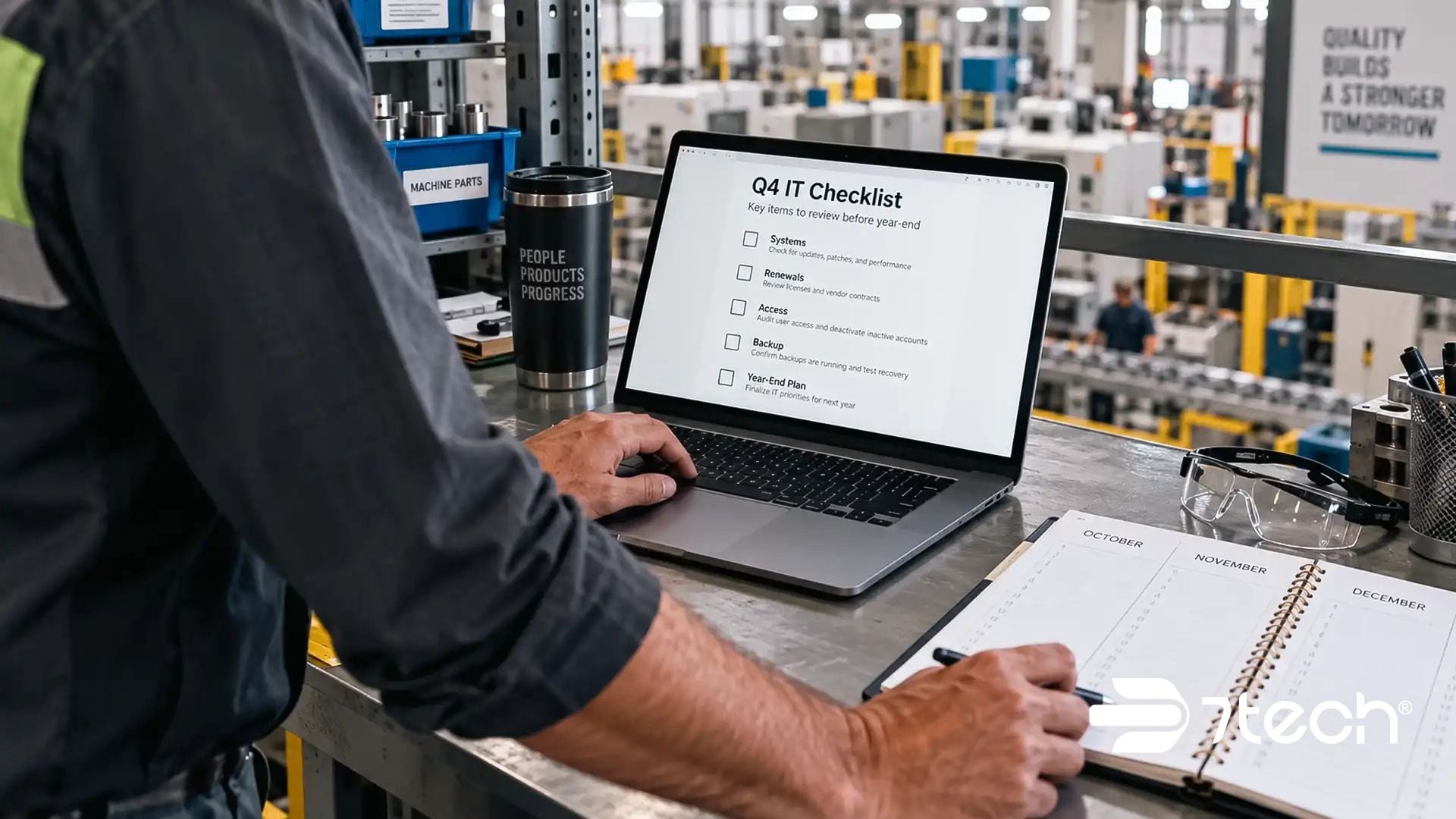
A Q4 IT checklist for manufacturers should answer one practical question: Is your technology ready to support production, shipping, security, customer commitments, and year-end priorities?
Before Q4 gets busy, review the systems your operation depends on, upcoming technology expenses, user access and documentation, backup and recovery readiness, and your year-end IT plans. Addressing these areas early can reduce unexpected costs, avoid preventable disruptions, and give leadership greater confidence heading into the final quarter.
Manufacturers already understand the value of preventive maintenance.
You do not wait for a machine to fail in the middle of a production run before asking whether someone should have inspected it last month. You look for problems while there is still time to address them without blowing up the schedule.
Your technology deserves the same treatment.
As Q4 approaches, production schedules tighten, customer commitments stack up, budgets come under review, and there is less room for an IT problem to become an operational problem.
September gives manufacturing leaders a useful window to look at the systems behind production, planning, shipping, security, and day-to-day operations before year-end pressure builds.
The goal is not to add more technology. It is to make sure the technology underneath the business is capable of supporting where the company is headed next.
That means keeping the plant moving, shipping what you promised, protecting margin, and avoiding preventable surprises.
Executive Q4 IT Checklist for Manufacturers
Before the fourth quarter begins, leadership should be able to answer five questions:
- Can our technology reliably support our Q4 production and shipping priorities?
- Do we know which IT expenses, renewals, and hardware decisions are coming?
- Does employee and vendor access reflect current roles and responsibilities?
- Could we recover critical operations if important systems became unavailable?
- Does our IT partner understand what the business needs to accomplish before year-end?
If any answer is unclear, September is an opportunity to resolve it before uncertainty becomes urgency.
A broader manufacturing IT services strategy can help connect these Q4 questions to year-round production reliability, cybersecurity, infrastructure, support, and technology planning.
1. Make Sure Your Technology Can Support Your Q4 Production Priorities
Start with the operation, not the IT department.
What absolutely has to happen before the end of the year?
Maybe you have aggressive production targets. A major customer order has to ship. A new line is coming online. You are adding people. A customer audit is approaching. Or perhaps the leadership team is pushing to finish the year without another round of overtime, expedites, and recovery work.
Once those priorities are clear, ask a second question:
Can the technology underneath the operation support them?
Look beyond laptops and email.
Think about the ERP, production systems, inventory data, scanners, printers, labeling systems, EDI connections, shipping workflows, cloud applications, network connectivity, remote access, and other systems your people rely on to keep work moving.
As the operation grows, those dependencies tend to multiply. More people, systems, vendors, cloud applications, and security requirements can quietly create more complexity than the original IT model was built to manage.
A production-critical systems review should connect those dependencies to the business processes that rely on them. NIST’s guidance on business impact analysis for critical operations similarly focuses on understanding mission-essential functions and the dependencies that can affect them.
If one of those systems slows down or stops working during a critical production window, what happens next?
Does the problem stay inside IT?
Or does it become idle labor, a missed schedule, premium freight, a late shipment, or an unhappy customer?
For executives, the issue is not simply whether the technology works today. It is whether the technology can support what the operation has committed to delivering tomorrow.
That is why manufacturing downtime prevention should be considered alongside broader manufacturing IT planning. Recurring infrastructure and connectivity problems can be evaluated in terms of reducing manufacturing downtime from IT and network issues rather than being treated only as isolated support tickets.
Q4 is not the best time to discover that a small technology weakness has become a single point of failure.
2. Review Your IT Budget, Renewals, and Aging Technology
Manufacturing leaders can handle planned investment.
What creates problems is surprise spending.
Before Q4 gets crowded, review the technology costs and decisions already heading your way.
Check upcoming software renewals, hardware warranties, licensing changes, cybersecurity investments, backup needs, infrastructure upgrades, and equipment that is becoming harder to support.
A structured approach to manufacturing IT budget planning can help leadership connect those renewals, replacements, and projects to next year’s financial plan before they become urgent purchases.
Then look at the business impact behind each one.
An aging server is not simply an old server if the ERP depends on it.
An unreliable wireless network is not simply an IT annoyance if scanners and shop-floor devices depend on it.
A delayed security project is not just another item on a technology roadmap if customers, insurers, or auditors expect stronger controls.
Support status should also be part of a manufacturing year-end technology review. Microsoft maintains official Microsoft product lifecycle and end-of-support dates that can help organizations identify products approaching or reaching the end of supported lifecycles.
This is also the right time to begin thinking about next year’s budget.
Ask where technology problems are already costing the business through downtime, manual workarounds, overtime, rework, outside support, or lost productivity.
Executives should also understand why significant IT expenses are necessary. Technology spending should connect to a business requirement such as production reliability, productivity, security, compliance, continuity, or growth.
The objective is not simply to spend less. It is to make technology costs more predictable and understand where the business is exposed before an urgent problem makes the spending decision for you.
3. Clean Up Access, Documentation, and Key-Person Risk
Manufacturing operations accumulate workarounds.
Someone changes roles but keeps old system access. A vendor still has credentials from a project completed months ago. A procedure exists only in someone’s notebook. The person who understands a critical system becomes the person everyone calls when something breaks.
For a while, these situations may seem manageable.
Until that person is on vacation, leaves the company, or is unavailable during an outage.
Before Q4, review who has access to critical systems and whether that access still matches their responsibilities.
Look at former employees, contractors, vendors, shared accounts, administrative privileges, and people who have changed roles.
CISA’s guidance on access control and account management best practices reinforces the importance of removing unnecessary accounts, limiting privileges, strengthening remote access, and managing credentials as part of reducing avoidable security exposure.
Then review the documentation behind the operation.
Could someone other than your most experienced IT employee explain how critical systems connect?
Do you know who supports each major application?
Are vendor contacts, recovery procedures, system credentials, network information, and escalation paths current?
Leadership should not discover during an outage that essential information existed only in one employee’s inbox, notebook, or memory.
Manufacturing companies spend years removing single points of failure from production.
Your technology operation deserves the same discipline.
The goal is not to replace the knowledge of good people. It is to make sure the business does not depend entirely on one person, one undocumented process, or one piece of tribal knowledge to keep critical systems running.
Organizations that need a more structured review can use manufacturing IT audits to examine technology dependencies, access, documentation, infrastructure, and other areas where operational risk may be difficult to see day to day.
4. Verify Your Backup and Recovery Readiness
September is National Preparedness Month, making it a natural time to review how the business would respond to an unexpected disruption.
A backup is important, but business recovery requires more than having copies of data.
Imagine your ERP is down.
Or your network becomes unavailable.
Or a cyber incident affects access to critical systems.
What happens during the first hour?
Who makes the decision to escalate? Who contacts vendors? Which systems must come back first? Can production continue in any form? How will shipping, purchasing, customer service, and leadership communicate?
Most importantly, has the recovery process been tested recently enough that you know it works?
Manufacturers should think about recovery in business terms, not just technical terms.
Review your current backup and recovery processes and confirm:
- Critical business data is being backed up as intended.
- Backup systems are being monitored and managed.
- Recovery responsibilities are clearly assigned.
- The recovery plan reflects your current technology environment.
- The people responsible for executing the plan understand their roles.
Effective manufacturing backup and recovery planning should connect technology restoration priorities to broader business continuity planning for manufacturing so leadership understands how critical operations will continue while systems are being recovered.
NIST’s contingency planning and recovery testing guidance also reinforces the importance of defined recovery strategies, testing, and maintaining contingency plans rather than assuming backups alone are sufficient.
The real question is not simply, “Do we have backups?”
It is:
“How quickly can we restore the systems the operation depends on and get people working again?”
A recovery plan should create clarity under pressure. If your team would have to figure out the plan during the disruption, the plan is not ready.
It is also worth challenging the backup assumptions manufacturers make before a real incident reveals a gap between having backup technology and being able to restore production-critical systems.
5. Review Q4 Technology Plans With Your IT Partner
A strategic IT partner should understand more than your open support tickets.
Use September to discuss where the manufacturing operation is going through year-end and what technology needs to make possible.
Talk about your production schedule, growth plans, customer commitments, staffing changes, upcoming audits, security concerns, aging infrastructure, major renewals, and projects planned for the next six months.
Then look at the technology dependencies behind those priorities.
Where could the current environment struggle as complexity grows?
Which risks deserve attention now rather than next year?
Are there systems with weak recovery plans, too much dependence on one employee, recurring support problems, or security gaps that could become operational problems?
A manufacturing cybersecurity checklist can help make those security concerns more concrete. Organizations that need a deeper next step can use a cybersecurity assessment checklist to evaluate security controls separately from the broader Q4 review.
And if you have an internal IT team, ask whether the current operating model gives them enough capacity and specialized support for what is coming.
Capable IT professionals can still be asked to cover more disciplines than one person or a small team can realistically own: support, infrastructure, cloud systems, cybersecurity, compliance, vendors, projects, planning, and everything in between.
When additional capacity or specialization is part of that discussion, leadership can also evaluate the role of IT support for manufacturing companies in supporting internal resources and operational priorities.
It is also worth asking one broader question:
What technology issue could surprise leadership between now and year-end?
That question can reveal risks that do not appear in a help desk report but still matter to production and the business.
The manufacturers that get the most value from an IT partner treat the relationship as part of business planning rather than something they use only when technology fails.
Use This Year’s IT Problems as Evidence
A good Q4 review should look ahead. You should find weak systems and risky connections before they cause trouble.
But your review should also look back.
This year’s IT problems can show where your operation depends on technology. Those clues may deserve another look during your Q4 review.
Watco Tanks shows why.
The manufacturer had server failures, viruses, and network problems. Those problems disrupted operations and slowed the business.
Later, its IT environment became more stable and proactive. Potential problems were addressed before they became larger disruptions.
This does not mean those failures exposed unknown dependencies. The evidence does not tell us that.
It does show that Watco’s technology problems had real operational effects.
That history can be useful evidence.
A standard review may focus on systems, assets, connections, and risks you can see now. That forward-looking work still matters.
But it can leave out another useful question:
What did this year’s actual problems teach you about your operation?
You can test this inside your own business.
List your technology interruptions from this year. Add recurring failures, emergency fixes, and workarounds that would not go away.
Take each item one at a time.
Ask what part of the operation depended on the technology involved.
Then check your Q4 review.
Does it show that dependency? Does it show what else relies on it? Does the problem deserve more study?
If not, investigate before closing your Q4 review.
Do not replace proactive assessment with a list of past problems.
Use both.
Map the risks you can see before failure. Then use your real operating history to test that map.
Your goal is not to prove that your checklist failed.
Your goal is to learn from what actually happened.
When a technology problem affected your operation this year, treat that event as evidence. Trace the dependency behind it and decide whether your Q4 plan addresses it.
Understanding the cost of IT downtime can also help leadership distinguish routine support issues from recurring technology problems that create meaningful operational and financial exposure.
What Manufacturing Executives Should Know Before Q4 Begins
You do not need to personally understand every technical detail in your manufacturing environment. You do need enough visibility to make responsible decisions.
By the start of Q4, leadership should understand what technology the operation depends on, where meaningful risks exist, what major expenses are approaching, and who is accountable when something goes wrong.
That visibility matters because technology problems rarely remain technology problems in manufacturing.
An ERP outage can affect production and shipping. Network problems can interrupt shop-floor workflows. Weak access controls can increase security exposure. Unplanned purchases affect budgets. Poor recovery preparation can turn an interruption into a prolonged operational problem.
A strong Q4 IT review turns those unknowns into decisions that can be made while there is still time to act.
That is the purpose of Q4 technology planning for manufacturers and a year-end IT checklist for manufacturers: giving leadership a clearer view of operational dependencies, technology risks, upcoming costs, and accountability before year-end pressure limits its options.
Leadership teams can also use guidance on how to evaluate IT performance to assess whether current technology operations are delivering the reliability, visibility, and accountability the business needs.
Frequently Asked Questions About a Q4 IT Checklist for Manufacturers
What should manufacturers include in a Q4 IT checklist?
A Q4 IT checklist for manufacturers should cover production-critical systems, upcoming technology expenses and renewals, aging hardware, employee and vendor access, documentation, cybersecurity, backups, recovery plans, and technology priorities that must be completed before year-end.
Together, those areas create a practical manufacturing IT checklist for reviewing operational readiness before Q4 pressure increases.
When should manufacturers complete their Q4 IT review?
September is an ideal time because it gives leadership time to identify and address technology gaps before production deadlines, budget decisions, holidays, customer commitments, and year-end operational demands compete for attention.
Why should manufacturing executives participate in a Q4 IT review?
Executives provide the business context IT teams need. Leadership can identify production priorities, customer commitments, budget constraints, audit requirements, and operational risks so technology decisions support business outcomes rather than being made in isolation.
What technology expenses should manufacturers review before year-end?
Review software and licensing renewals, warranties, aging hardware, infrastructure, vendor contracts, security investments, backup requirements, and planned technology projects. Early visibility makes budgeting easier and reduces the likelihood of unexpected Q4 expenses.
What user access should manufacturers review before Q4?
Confirm that employees and vendors have permissions appropriate to their current responsibilities and that former employees no longer have access. Pay particular attention to shared accounts, administrative privileges, contractors, vendors, and employees who recently changed roles.
How should manufacturers evaluate backup and recovery readiness?
Confirm that critical data is backed up, backups are monitored, and recovery responsibilities are documented. Leadership should also know which production and business systems must be restored first and how operations will continue if normal technology becomes unavailable.
What should manufacturers discuss with their IT provider before year-end?
Discuss Q4 production priorities, unresolved technology risks, upcoming renewals, aging infrastructure, cybersecurity, audit or compliance requirements, backup and recovery readiness, and technology investments required to support next year’s plans.
Q4 Is Coming. Make the Operation Ready.
Manufacturers rarely get into trouble because nobody cared.
Problems usually grow because everyone was busy handling today’s production schedule, today’s customer issue, and today’s priorities.
Technology risks can sit quietly in the background until the timing could not be worse.
A server fails during a production push.
A system outage holds up shipping.
A former employee still has access.
A customer asks for security documentation nobody can find.
A recovery plan turns out to be a document nobody has tested.
None of these problems becomes easier because it happens in November.
That is why the weeks before Q4 matter.
Use them to identify what could interrupt production, delay shipments, create audit headaches, expose the business to unnecessary risk, or force your team into another avoidable fire drill.
A disciplined manufacturing year-end technology review gives leadership the opportunity to address those issues while there is still time to make deliberate decisions instead of emergency ones.
Your operation has evolved.
Your IT operating model should keep pace.
Want a second set of eyes on your Q4 readiness? Schedule a 15-minute discovery call! We’ll help you review what needs attention, identify the technology, security, and operational gaps worth addressing, and get your operation ready for the months ahead.

Neal Juern, Founder and CEO of 7tech, helps business leaders take control of their IT and strengthen cybersecurity without the complexity. Since founding 7tech in 2012, he’s built it into a 5X MSP 501 winner and guided hundreds of executives toward smarter, safer operations through Managed IT Services and Managed Security Services that make sense to people outside the IT department. He speaks regularly to executive and nonprofit audiences across Texas.