
AI Governance for Nonprofits and the Risks Leaders Need to Manage
AI governance for nonprofits is the set of policies, roles, review standards, and safeguards that determine how artificial intelligence can and cannot be used across an organization. It gives leaders clear answers to four critical questions: Which tools are approved? What data is off-limits? When is human review required? Who is accountable when something goes wrong?
Those questions matter because AI adoption rarely waits for a formal strategy. Staff may already be using AI to draft donor communications, summarize policies, prepare board materials, support grant writing, or streamline administrative work.
As the NIST AI Risk Management Framework makes clear, managing AI risk is not a one-time technology decision. It is an ongoing governance discipline.
For nonprofit executives and boards, the issue is no longer whether AI exists inside the organization. The issue is whether its use is visible, bounded, and defensible.
Executive Summary
Effective AI governance gives nonprofit leaders visibility and control without unnecessarily slowing innovation.
At a minimum, leadership should know:
- Which AI tools employees and volunteers are using
- What organizational data may or may not be entered into those tools
- Which AI-generated work requires human review
- Who approves new AI platforms and use cases
- Who is accountable for policy enforcement and exceptions
- How suspected misuse, errors, or data exposure are reported
The goal is not to eliminate AI. It is to prevent leadership from being surprised by AI-related decisions, data exposure, or reputational problems it never had the opportunity to govern.
Your Nonprofit May Already Be Using AI More Than You Realize
Many nonprofits do not start with a formal AI initiative. Adoption happens quietly, one practical task at a time.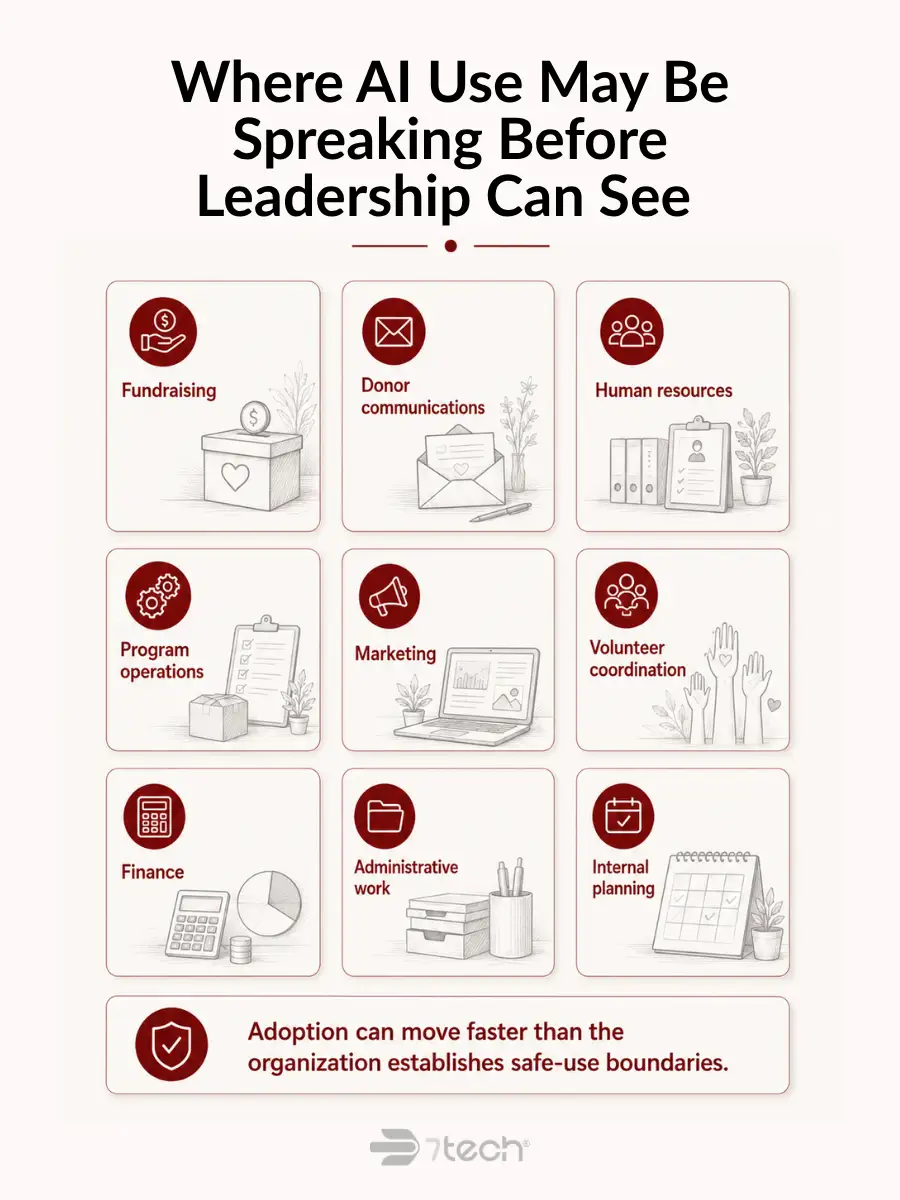
A development professional asks an AI tool to improve a donor email. An HR manager summarizes a policy draft. A program director organizes meeting notes. A fundraiser experiments with grant language. A volunteer coordinator drafts reminder messages.
Individually, these activities may appear harmless. Collectively, they can create an AI environment that leadership cannot fully see.
This is where shadow AI becomes a governance problem.
In nonprofit organizations, shadow AI can appear across fundraising, donor communications, human resources, program operations, marketing, volunteer coordination, finance, administrative work, and internal planning. The concern is usually not malicious behavior. The problem is that adoption can move faster than the organization establishes safe-use boundaries.
An employee may choose a tool without knowing how it stores prompts. A manager may paste internal information into an unapproved platform. AI-generated material may reach a donor, client, funder, or board member without adequate review.
If your leadership team is already discussing hidden AI use at work, AI governance has effectively become an operational issue whether or not a formal policy exists.
The executive risk is straightforward: leadership can remain accountable for AI use even when it has limited visibility into how that use is occurring.
What Is AI Governance for Nonprofits
AI governance for nonprofits is the system of policies, responsibilities, controls, and oversight used to manage artificial intelligence in a way that supports the mission without creating unnecessary security, privacy, compliance, or reputational risk.
Good governance is not anti-AI. It creates the conditions for responsible AI adoption.
A practical nonprofit AI policy should answer questions such as:
- Which tools are approved? Staff should know which AI platforms they may use for organizational work.
- Which data is prohibited? The policy should clearly identify information that cannot be entered into public or unapproved AI systems.
- Which outputs require review? AI-generated work that influences important communications, decisions, or commitments should have appropriate human oversight.
- Who approves new tools? Someone must be responsible for reviewing vendors and proposed use cases.
- Who owns the policy? Leadership should assign clear responsibility for maintaining and enforcing governance standards.
- How are problems reported? Staff need a defined process for reporting questionable outputs, mistakes, inappropriate use, or potential data exposure.
- When are the rules reviewed? Governance must evolve as tools, organizational use cases, contractual obligations, and risks change.
To translate these governance decisions into rules employees can follow, use our practical guide to creating an AI policy for nonprofits, including tool approvals, data classifications, human-review requirements, approval procedures, and incident reporting.
That is why a nonprofit AI governance framework should be treated as a living management process rather than a one-page acceptable-use memo.
The goal is not perfect control over every interaction with AI. The goal is consistent decision-making, clear accountability, and enough visibility for leadership to govern risk responsibly.
Why AI Governance Matters for Nonprofit Leadership
For nonprofit executives, AI governance is fundamentally about trust, accountability, and mission protection.
Nonprofits often manage information that carries significant confidentiality obligations even when it is not described as “high-risk data” in everyday conversations. Depending on the organization, that information may include donor records, employee and volunteer information, confidential program data, financial documents, grant materials, client or case information, credentials, contracts, and board communications.
When AI tools interact with that information, leadership needs a clear standard for acceptable use.
The governance responsibility also extends beyond the IT department.
The National Council of Nonprofits’ guidance on nonprofit board roles and responsibilities emphasizes the board’s broader governance and policy oversight responsibilities, even when management handles day-to-day execution.
AI should be viewed through the same leadership lens.
Executives and boards do not need to understand every model, platform, or technical feature. They do need enough visibility to determine whether the organization is managing AI responsibly.
Effective AI governance can help leaders:
- Protect donor and stakeholder trust by reducing preventable misuse of sensitive information
- Reduce operational blind spots by identifying where and how employees are using AI
- Clarify confidentiality expectations before staff encounter questionable situations
- Support contractual and compliance obligations by aligning AI use with existing governance requirements
- Protect organizational credibility by requiring appropriate review before AI-generated work reaches external audiences
- Create continuity as new AI platforms and capabilities spread across departments
For executives, the value can be summarized simply: fewer surprises, clearer accountability, and more defensible decisions.
Which AI Uses Carry the Most Risk for Nonprofits
Not every AI use case creates the same level of risk.
A better governance model evaluates AI use based on three factors: the sensitivity of the data involved, the impact of the decision or output, and the level of human review before action is taken.
| Risk Level | Typical Nonprofit Use | Leadership Consideration |
|---|---|---|
| Lower risk | Brainstorming, formatting, outlining, and summarizing non-sensitive public information | Generally lower risk when confidential data is excluded and a person reviews the output before use |
| Moderate risk | Drafting donor communications, internal planning documents, policy summaries, or first-pass content | Risk increases when internal context is sensitive or AI-generated material is distributed without appropriate human review |
| Higher risk | Processing donor information, HR records, client or case data, financial information, credentials, or legal and compliance-sensitive material | These uses can create significant confidentiality, accuracy, contractual, compliance, and reputational consequences without approved tools and controls |
The important distinction is that risk does not come from the word “AI” alone.
Risk comes from what information enters the system, how the resulting output is used, what decisions depend on it, and whether a qualified person remains accountable for the final action.
For organizations handling sensitive information, CISA guidance on securing AI data reinforces the importance of incorporating data protection and security controls into AI oversight rather than treating them as separate concerns.
A useful executive rule is this: the more sensitive the data or consequential the decision, the stronger the governance and human oversight should be.
What Can Go Wrong Without AI Governance
Without clear governance, nonprofit leaders can remain responsible for AI-related risk while having very little visibility into what employees are actually doing.
That creates a dangerous accountability gap.
Common problems include:
- Sensitive information entering unapproved tools. Employees may unknowingly expose internal or confidential data by including it in prompts.
- Inaccurate content being treated as fact. AI-generated answers can sound authoritative even when information is incomplete or incorrect.
- Uncontrolled tool sprawl. Different departments may adopt different platforms without centralized vendor review.
- Conflicts with organizational obligations. AI use may contradict grant requirements, contracts, privacy commitments, internal policies, or confidentiality expectations.
- Inconsistent rules across departments. One team may apply strict controls while another operates without meaningful boundaries.
- No escalation process. Staff may not know what to do when an AI tool produces concerning content or when sensitive information may have been exposed.
- Leadership accountability without leadership visibility. Executives and boards may ultimately have to explain decisions they never knew were being made.
None of these risks require panic or an organization-wide AI shutdown.
They require disciplined oversight.
Nonprofits evaluating AI governance should also examine the security controls surrounding the systems and data AI tools may access. Pairing an AI policy review with a broader cybersecurity assessment checklist can help leadership identify gaps involving access controls, authentication, data handling, monitoring, and incident response.
What Nonprofit Boards and Leadership Teams Should Know About AI
A nonprofit board does not need to select AI platforms or review individual prompts to provide meaningful oversight.
It does need enough visibility to understand how AI could affect organizational risk, mission integrity, stakeholder trust, and accountability.
The board’s role is oversight. Management’s role is execution.
Leadership teams should therefore establish clear ownership for policy management, tool approval, employee expectations, incident reporting, and periodic review.
At a minimum, executives should be able to answer six questions:
- Who owns AI governance for our organization?
- Who approves AI tools before employees use them for organizational work?
- Which categories of data are prohibited from AI platforms?
- Which AI-assisted activities require human review before release or action?
- How do employees report mistakes, exceptions, or suspected data exposure?
- How often will leadership reassess the policy as AI use changes?
An inability to answer these questions does not necessarily mean the organization has an immediate crisis. It does indicate a governance gap.
For many nonprofits, AI oversight can be incorporated into existing risk, technology, security, and governance processes rather than creating an entirely separate administrative structure.
Organizations without internal security leadership may also connect AI oversight with broader board-level security oversight through virtual CISO services, particularly when AI adoption intersects with cybersecurity, vendor risk, sensitive data, and compliance responsibilities.
What a Nonprofit AI Governance Framework Should Include
A useful nonprofit AI governance framework does not need to become a hundred-page policy manual.
It does need enough specificity that employees, managers, executives, and board members understand what responsible use means in practice.
A strong framework should address the following areas. 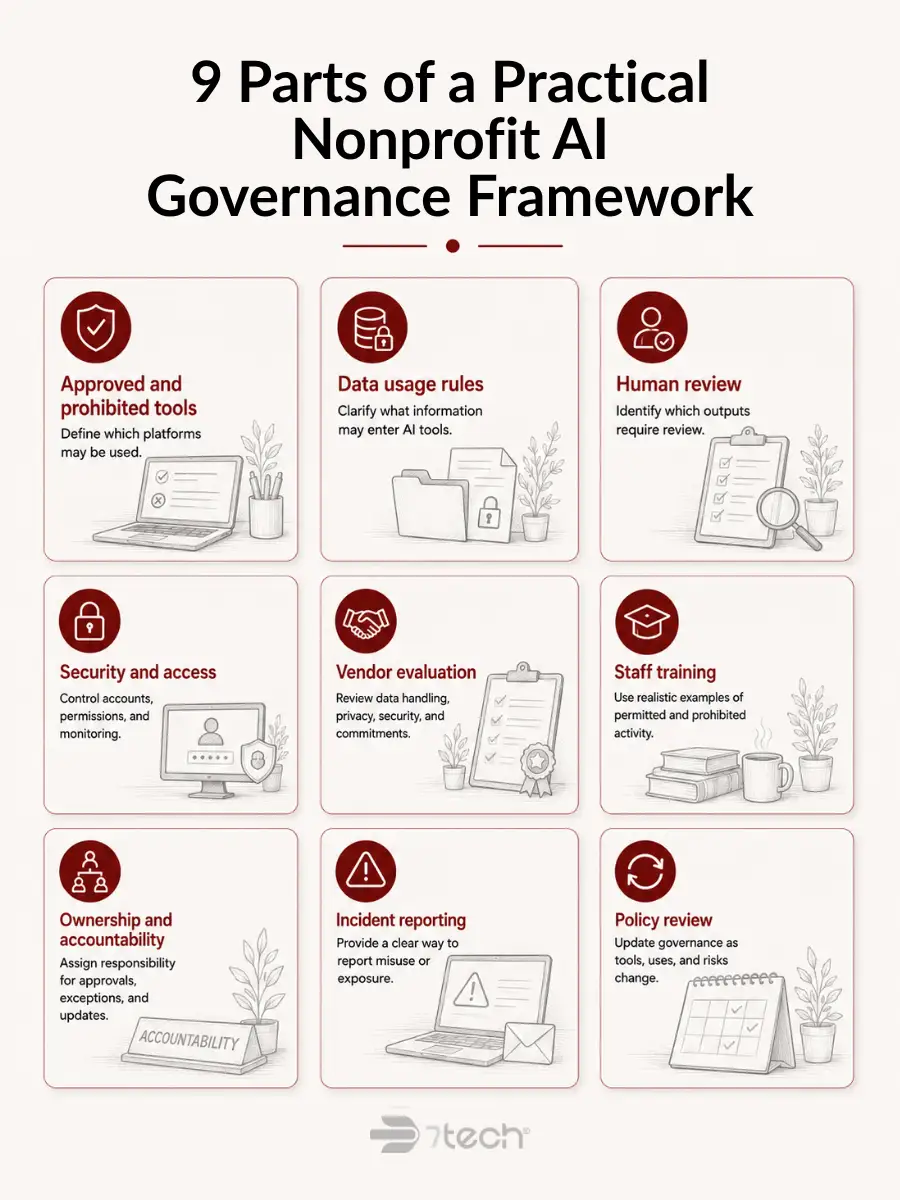
Approved and Prohibited AI Tools
Define which AI platforms are approved for organizational use, which are restricted to specific use cases, and which are prohibited.
Do not assume staff will know the difference between a consumer AI tool and an organization-approved platform.
Data Classification and Usage Rules
Define what information may be entered into approved systems and what must remain outside AI tools.
Rules should account for donor data, employee records, volunteer information, client or case data, financial information, credentials, legal documents, confidential program information, and other sensitive records relevant to the nonprofit.
Human Review Requirements
Specify which AI-generated outputs require review before they are shared, published, submitted, or used to make decisions.
Human accountability should become more rigorous as the potential impact of an error increases.
Security and Access Controls
Establish expectations for authentication, account ownership, permissions, administrative access, and monitoring.
An approved AI platform can still create risk if access to the platform or connected data is poorly controlled.
Vendor Evaluation Criteria
Review the provider’s data handling practices, privacy terms, retention policies, administrative controls, security capabilities, and contractual commitments.
Vendor approval should reflect the information and workflows the organization intends to place into the system.
Staff and Manager Training
Train employees on realistic scenarios rather than relying only on policy language.
Staff should understand what is permitted, what is prohibited, when human review is required, and whom to contact when a situation is unclear.
Documentation and Accountability
Assign specific responsibility for policy ownership, tool approvals, exceptions, training, and updates.
A policy without an accountable owner can become outdated quickly.
Incident and Exception Reporting
Create a simple process for reporting suspected misuse, inaccurate high-impact outputs, unintended data exposure, or requests for policy exceptions.
Employees should know that reporting a concern early is preferable to hiding a mistake.
Policy Review Cadence
Review governance standards regularly as AI capabilities, organizational use cases, contractual obligations, and risks evolve.
For nonprofits expanding digital operations, AI governance should align with existing cybersecurity, vendor-management, risk-management, and compliance readiness support rather than becoming an isolated policy that no one uses.
How Nonprofits Can Use AI Without Creating Unnecessary Risk
Nonprofits do not need to solve every possible AI governance issue before allowing responsible adoption.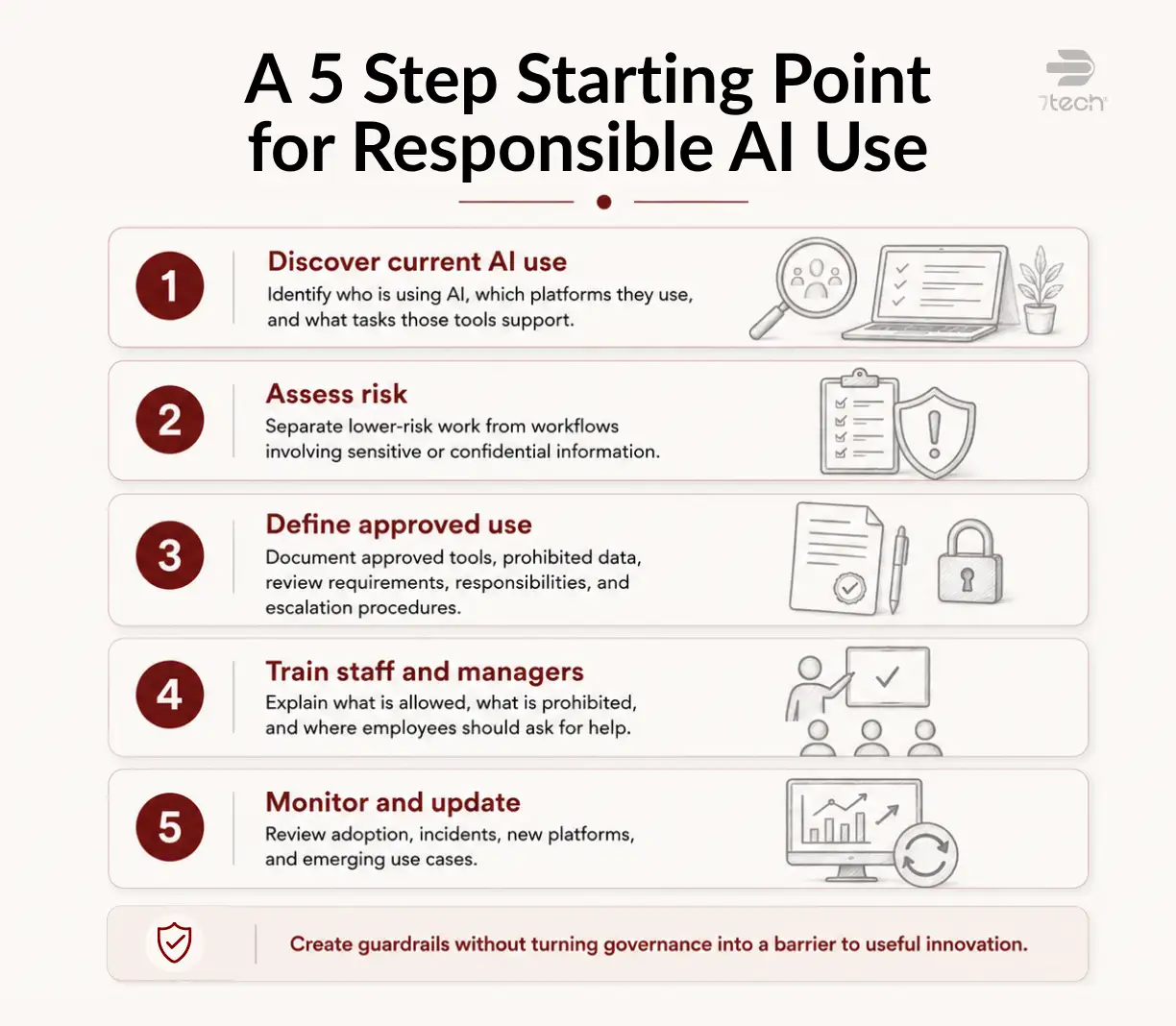
A structured five-step approach gives leadership a practical place to start.
- Discover current AI use.
Identify which employees and departments are using AI, which platforms they use, and what tasks those platforms support. You cannot govern what leadership cannot see. - Assess risk by workflow and data type.
Separate low-risk brainstorming and formatting activities from higher-risk workflows involving donor, HR, client, program, financial, legal, or confidential information. - Define approved use and accountability.
Document approved tools, prohibited data, human-review requirements, vendor-approval responsibilities, and escalation procedures. - Train staff and managers.
Translate policy into practical examples. Employees should know what they can do, what they cannot do, and where to ask for help when the answer is unclear. - Monitor use and update governance.
Review adoption patterns, incidents, new platforms, and emerging use cases so the policy evolves with the organization.
This approach creates guardrails without turning governance into a barrier to useful innovation.
Leadership teams developing an AI strategy can connect these steps with broader efforts to adopt AI securely across the organization.
Nonprofits that also need help implementing policies through access controls, security standards, employee support, and consistent technology management can explore 7tech’s IT support for nonprofit organizations.
Common Misconceptions About AI Governance for Nonprofits
Governance Means Banning AI
It does not.
Effective governance allows an organization to capture the benefits of AI while establishing clear boundaries around sensitive information, tool approval, accountability, and human review.
The objective is controlled adoption, not automatic prohibition.
Only Large Nonprofits Need AI Governance
Organization size does not eliminate AI risk.
Smaller nonprofits may operate with fewer systems and employees, but they can still manage donor records, employee information, confidential program data, and other trust-sensitive information.
A smaller organization may need a simpler governance structure, but it still needs clarity.
Free AI Tools Do Not Create Vendor Risk
The price of a tool does not determine its risk.
Whether an AI platform is free or paid, leadership still needs to consider how organizational data is handled, whether the platform is approved, what privacy expectations apply, and whether staff understand acceptable-use boundaries.
AI Outputs Are Safe to Use if They Save Time
Efficiency does not guarantee accuracy.
AI-generated material should be reviewed according to the consequences of an error. A brainstorming outline requires a different level of scrutiny than a donor communication, employment document, policy interpretation, or compliance-related decision.
AI Governance Is an IT Responsibility
IT and security teams may help evaluate platforms and implement technical controls, but AI governance is broader than technology.
It involves leadership, operations, privacy, human resources, risk management, policy, and organizational accountability.
Executives own the business consequences even when technical teams manage the systems.
FAQ
What is AI governance for nonprofits?
AI governance for nonprofits defines the policies, roles, safeguards, and review requirements governing AI use. It establishes approved tools, restricted data, human oversight requirements, and accountability for decisions involving artificial intelligence.
Do small and mid-sized nonprofits need an AI policy?
Yes. If employees or volunteers use AI for fundraising, communications, HR, administration, programs, or planning, the organization benefits from clear rules governing approved tools, sensitive data, and human review.
Who should own AI governance in a nonprofit?
Executive leadership should assign a clear policy owner, supported by IT, security, operations, HR, legal, or compliance stakeholders as appropriate. Management typically handles implementation while the board maintains appropriate governance oversight.
Can nonprofit staff use public AI tools safely?
Yes, for certain approved low-risk activities. Organizations should establish boundaries before use. Confidential donor, employee, client, financial, or program information should not enter public AI tools unless the platform and use case have been explicitly approved.
What data should nonprofits restrict from AI tools?
Restrictions commonly include donor records, employee and volunteer information, client or case data, credentials, financial records, legal materials, and confidential program information unless leadership has approved a governed tool and specific use case.
Does a nonprofit board need to approve AI governance?
Approval practices vary, but boards should understand the organization’s AI risk, governance model, and accountability structure. Board-level visibility becomes especially important when AI use affects confidential information, organizational policy, fiduciary responsibilities, or significant operational decisions.
What to Do Next if Your Nonprofit Is Evaluating AI Governance
AI governance for nonprofits is not about slowing innovation. It is about giving leadership enough visibility and control to adopt AI without creating risks the organization cannot explain or defend.
The first priority is clarity.
Leaders should understand where AI is already being used, what information could be exposed, which uses carry meaningful risk, who approves new platforms, and who remains accountable for the outcome.
When governance is handled well, employees gain clearer guidance. Managers make more consistent decisions. Boards have better visibility. Leadership is less likely to be blindsided by avoidable problems.
For mission-driven organizations, that creates a practical advantage: the ability to pursue innovation while protecting the trust, credibility, and accountability the mission depends on.
Schedule an AI Governance Briefing
Your nonprofit does not need another technology pitch. It needs a clear view of where AI is already being used, where meaningful risk may exist, and which governance decisions deserve leadership attention first.
A non-technical AI governance review can help your team evaluate policy ownership, acceptable-use boundaries, sensitive-data risks, human-review requirements, and practical next steps.
Schedule an AI Governance Briefing to gain clearer visibility into your organization’s AI use and build a more defensible approach to responsible adoption.

Neal Juern, Founder and CEO of 7tech, helps business leaders take control of their IT and strengthen cybersecurity without the complexity. Since founding 7tech in 2012, he’s built it into a 5X MSP 501 winner and guided hundreds of executives toward smarter, safer operations through Managed IT Services and Managed Security Services that make sense to people outside the IT department. He speaks regularly to executive and nonprofit audiences across Texas.