
Cybersecurity Myth Busters: 6 Common Myths That Put Businesses at Risk
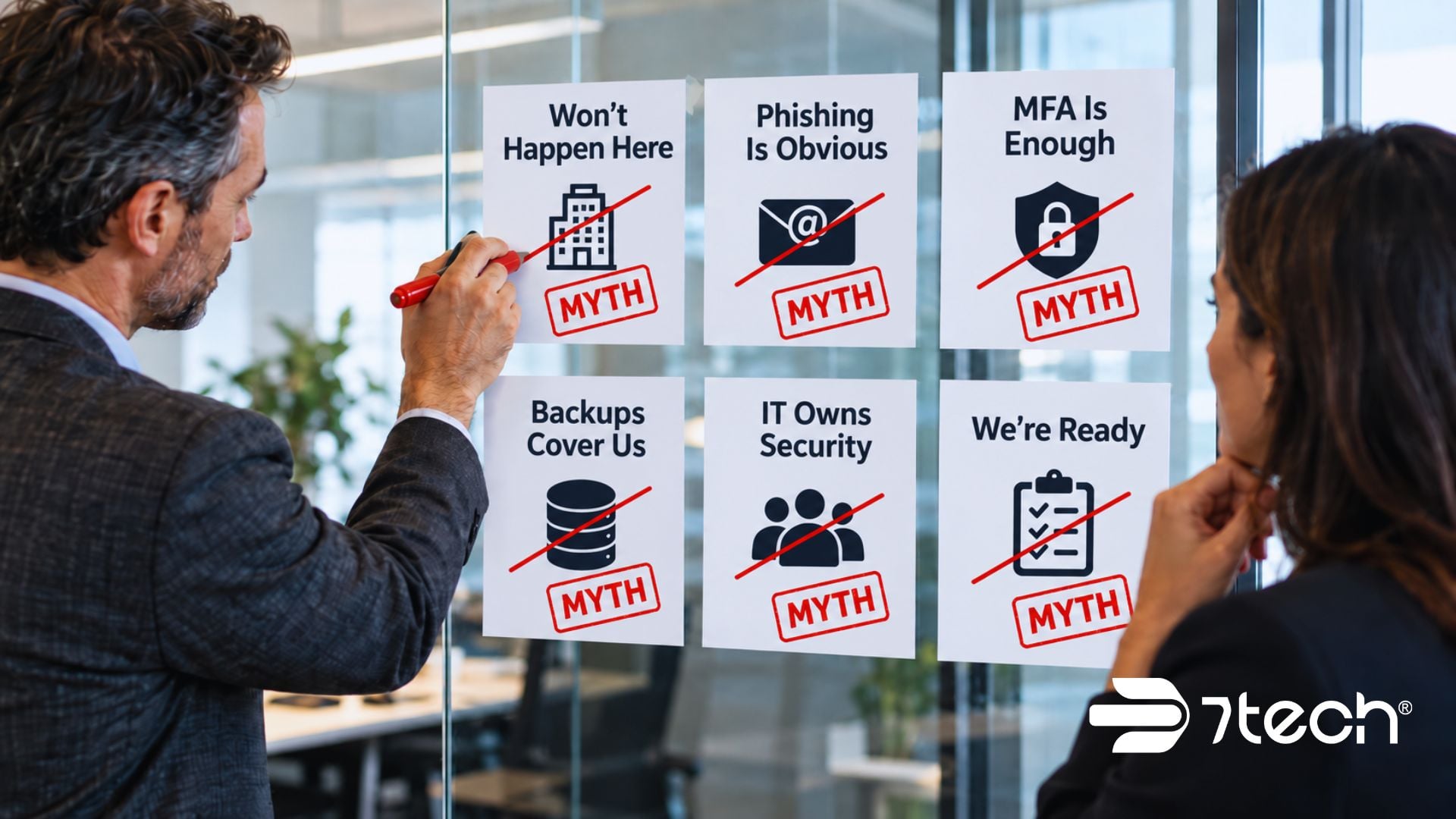
Cybersecurity myths can create a false sense of security by convincing business leaders that risks are already under control. The most dangerous assumptions involve who gets targeted, whether employees can recognize phishing, what MFA actually protects, whether backups guarantee recovery, who owns cybersecurity, and how prepared the business is for an incident.
October is Cybersecurity Awareness Month, making it a useful time to separate cybersecurity myths and facts. The goal is not to make every executive a security expert. It is to make sure the assumptions behind your risk decisions are accurate.
For business leaders, the real question is straightforward: Are your cybersecurity controls proven, or do they simply feel reassuring?
Why Are Cybersecurity Myths Dangerous for Businesses?
Common cybersecurity myths create blind spots. A company may have security tools, backups, an IT provider, employee training, or cyber insurance and still have significant gaps because leadership assumes those measures provide more protection than they actually do.
That distinction affects more than IT. A security incident can disrupt operations, expose sensitive information, create unexpected recovery costs, complicate compliance obligations, and force executives to explain what happened to customers, employees, insurers, auditors, or a board.
Effective cybersecurity therefore depends on layers of protection rather than one product or precaution. For businesses that need continuous monitoring and response beyond basic IT controls, managed security services can provide the layered cybersecurity support needed to prevent, detect, contain, and respond to threats across the environment.
The U.S. Cybersecurity and Infrastructure Security Agency also emphasizes this broader approach in its CISA guidance for small businesses, which addresses areas such as MFA, backups, employee preparedness, and incident response as parts of a larger cybersecurity program.
Here are six common business cybersecurity myths worth challenging.
Myth 1: “That Won’t Happen to Us”
It is easy to think of a cyberattack as something that happens to a larger organization with more money, more data, or a recognizable brand.
That assumption overlooks how many attacks work.
Cybercriminals do not need a personal reason to target a company. Many attacks exploit available credentials, unpatched vulnerabilities, poorly secured accounts, exposed systems, or employees who can be manipulated.
Your business may also possess more value than you realize: financial accounts, employee information, customer data, intellectual property, credentials, or trusted connections to customers and vendors. The FTC’s cybersecurity guidance reinforces that cybercriminals target companies of all sizes.
Business leaders should understand where their organization is exposed and which safeguards would detect, contain, and respond to an attack.
That means understanding your actual exposure across endpoints, identities, email, cloud applications, networks, vendors, and data. A structured cybersecurity assessment checklist can help leadership identify gaps before an attacker finds them.
Fact: No organization should assume it is off a cybercriminal’s radar.
Myth 2: “Employees Will Recognize a Phishing Email”
One of the most persistent phishing myths is that a fraudulent email will look fraudulent.
That is increasingly unreliable.
Modern phishing messages can be polished, personalized, and designed to imitate executives, vendors, financial institutions, coworkers, and other trusted sources. AI can make those messages even more convincing, which makes judging an email by writing quality alone increasingly unreliable.
Instead, employees should evaluate the request itself. Ask whether the supposed sender would normally:
- Make an unusual or urgent request
- Change payment or banking instructions
- Request sensitive information
- Send an unexpected login link or attachment
- Ask an employee to bypass a normal approval process
NIST’s phishing guidance for small businesses recommends independently verifying suspicious requests rather than relying on contact information contained in the message.
Technology can filter many threats, but employees still need practical cybersecurity awareness training and a simple process for reporting suspicious messages. Businesses can reinforce those habits with ongoing phishing email scam prevention guidance rather than relying on an annual training exercise.
Fact: A convincing email can still be a scam.
Myth 3: “MFA Fully Protects Our Accounts”
Multi-factor authentication (MFA) is one of the most important account-security controls a business can implement. But one of the most damaging myths about MFA is that enabling it makes an account invulnerable.
It does not.
MFA creates an additional barrier when credentials are compromised, making unauthorized access significantly harder. However, attackers can use techniques such as MFA fatigue or “prompt bombing,” repeatedly sending authentication requests in the hope that a user eventually approves one.
The type of MFA matters, too. NIST’s guidance explains why organizations should consider phishing-resistant MFA, particularly for sensitive and privileged accounts.
That is why MFA should operate within a broader security strategy that includes account monitoring, endpoint protection, identity controls, access management, employee training, and active threat detection and response. A real-world example shows why implementation matters. Espey & Associates had an IT provider, but Outlook MFA was not enabled while users were experiencing risky-user alerts and unexpected credential resets. 7tech enabled MFA and added remote-access security and monitoring. The experience demonstrates an important distinction: having MFA as a security concept is different from having it properly enabled where the business needs it.
Business leaders should ask three questions:
Where is MFA required?
Which authentication methods are being used?
How would we detect suspicious activity even after authentication succeeds?
For a deeper look at the control itself, review the benefits of two-factor authentication.
Fact: MFA is an essential security layer, not a complete cybersecurity strategy.
Myth 4: “Our Backups Have Us Covered”
Among the most costly backup and ransomware myths is the assumption that having a backup means the business can recover quickly.
Ask a more useful question: If ransomware disrupted your systems tomorrow, what could you restore, and how long would restoration take?
A backup only creates business resilience when the organization knows what is protected, how frequently it is backed up, whether critical cloud data is included, whether attackers can reach the backups, and whether restoration has actually been tested.
This is where backup and recovery become executive issues. The difference between restoring operations quickly and discovering during an incident that critical systems cannot be recovered can translate directly into lost productivity, delayed customer service, revenue disruption, and reputational damage.
7tech assessment data shows why recovery should be evaluated system by system. Traditional backup and disaster recovery was rated satisfactory in all 8 companies evaluated for that capability, while 7 of 12 companies evaluated for Microsoft 365 backup received an immediate-attention finding. Strong traditional backup practices do not automatically mean every business system is recoverable.
Understanding how to prevent ransomware attacks should therefore include both prevention and tested recovery.
Fact: Having backups is not the same as being able to recover.
Myth 5: “Cybersecurity Is Only IT’s Responsibility”
IT may manage security systems, but cybersecurity decisions happen throughout the organization.
Finance approves payment changes. HR handles employee information. Executives access sensitive communications. Operations works with vendors. Employees across the company receive email, manage passwords, use cloud applications, and handle data.
That makes employee cybersecurity responsibility part of business risk management—not a task that can simply be delegated to IT.
Effective cybersecurity awareness training should help employees understand what to do, not merely what to avoid. Employees should know how to recognize suspicious behavior, verify unusual requests, report potential incidents, protect credentials, and escalate concerns without worrying that they are “bothering IT.”
The distinction also becomes clearer as businesses grow. Trinity Real Estate Finance described its earlier IT support as someone who “helped us with the basics.” As the company’s security and compliance needs increased, it needed broader capabilities. The company later reported that 7tech helped strengthen its security, meet compliance requirements, and keep its everyday IT systems running smoothly. The experience illustrates why basic IT support and broader cybersecurity responsibility are not always the same thing.
Myth 6: “We’ll Figure It Out If Something Happens”
This is one of the most dangerous incident response myths because a cyberattack is precisely the wrong time to start deciding who does what.
Imagine it is Tuesday morning and several employees suddenly cannot access their files. Leadership may immediately face questions such as:
- Should affected computers be disconnected?
- Who contacts IT or the cybersecurity team?
- How will employees communicate if normal systems are unavailable?
- When should cyber insurance, legal counsel, or other outside parties be contacted?
- Who determines whether customers or regulators need notification?
- Who has authority to make operational decisions?
- Which systems must be restored first?
Those decisions should not depend on memory during a crisis.
7tech’s network assessment findings reinforce why recovery readiness should be verified before an incident occurs. Cloud-to-cloud backup received 18 immediate-attention findings among 39 companies evaluated, while backup and disaster recovery received 6 among 34 companies evaluated. The assessment criteria also call for a defined recovery process and recent evidence that restoration works. In other words, a recovery plan becomes much more credible when the business has actually tested it.
An incident response plan should identify responsibilities, escalation paths, communication procedures, outside contacts, recovery priorities, and decision authority before they are needed. That preparation also connects directly to downtime risk and business continuity because a security event becomes a business problem the moment critical operations stop.
Fact: Your recovery plan should not debut during an incident.
What Should Business Leaders Do Instead?
The solution to cybersecurity misconceptions is not to buy another tool every time a new threat appears. It is to replace assumptions with evidence.
Executives should be able to answer a few fundamental questions: What are our most important systems and data? Which risks could materially interrupt the business? Which controls protect those assets? Who monitors those controls? What happens when something fails? How recently have we tested the answer?
That approach creates accountability without requiring executives to become cybersecurity technicians.
Start by validating five areas:
- Exposure: Identify critical systems, data, accounts, vendors, and common network security threats.
- Protection: Confirm that MFA, endpoint security, email security, patching, access controls, and backups are implemented where required.
- Detection: Determine whether suspicious behavior can be identified quickly instead of waiting for an employee or customer to report a problem.
- Response: Document who makes decisions and what happens when an incident occurs.
- Recovery: Test whether critical systems and data can actually be restored within acceptable business timeframes.
The objective is not perfect security. It is a defensible cybersecurity program in which leadership can see the risks, understand who owns them, and verify that critical controls work.
Frequently Asked Questions About Cybersecurity Myths
What are the most common cybersecurity myths?
Common cybersecurity myths include believing small businesses are not targets, employees can always identify phishing, MFA prevents every account compromise, backups guarantee recovery, cybersecurity belongs only to IT, and incident response can be improvised after an attack.
Why do employees still fall for phishing emails?
Modern phishing can closely imitate legitimate communication, and AI can make fraudulent messages more convincing. Employees therefore need to evaluate behavior and context, verify unusual requests independently, and know how to report suspicious messages.
Does MFA stop all cyberattacks?
No. MFA creates an important additional barrier against account compromise, but it does not replace monitoring, endpoint protection, access controls, employee awareness, or other security layers.
Are backups enough to protect a business from ransomware?
No. Backups support recovery, but businesses must also know what is protected, protect backup systems appropriately, establish recovery priorities, and test restoration. Prevention, detection, incident response, and recovery should work together.
Is cybersecurity the IT department’s responsibility?
IT owns many technical controls, but cybersecurity is a shared business responsibility. Employees, executives, finance teams, HR, operations, and vendors all make decisions that can affect security.
What should an incident response plan include?
A practical plan defines responsibilities, escalation procedures, communication channels, critical contacts, decision authority, system priorities, recovery procedures, and notification requirements. It should be documented and tested before an incident.
How can executives tell whether their cybersecurity is actually working?
Start with evidence. Review security controls, monitoring, vulnerabilities, employee preparedness, backup restoration, incident-response testing, and accountability. A cybersecurity assessment can reveal the difference between controls that exist on paper and controls that work in practice.
Cybersecurity Awareness Starts With the Facts
Cybersecurity awareness is not about making employees suspicious of everything or making executives memorize technical terminology. It is about replacing a cybersecurity false sense of security with clear evidence that the business is prepared.
The most dangerous cybersecurity myths are reassuring because they make unresolved risks feel settled: we are too small, our employees know better, we have MFA, we have backups, IT handles security, and we will know what to do.
Those assumptions should be tested rather than trusted.
Start with 7tech’s cybersecurity assessment checklist to identify which protections are verified, which need attention, and where additional cybersecurity best practices can reduce business risk.
For organizations that need deeper visibility and continuous protection, 7tech’s managed security services provide layered prevention, detection, and response capabilities designed to help reduce cybersecurity risk without leaving leadership to interpret the technical details alone.

Neal Juern, Founder and CEO of 7tech, helps business leaders take control of their IT and strengthen cybersecurity without the complexity. Since founding 7tech in 2012, he’s built it into a 5X MSP 501 winner and guided hundreds of executives toward smarter, safer operations through Managed IT Services and Managed Security Services that make sense to people outside the IT department. He speaks regularly to executive and nonprofit audiences across Texas.