

What Is a Security Stack Assessment and Why Does It Matter for Nonprofits?
What Does a Security Stack Assessment Actually Review?
A security stack assessment, sometimes called a cybersecurity stack assessment or security stack review, examines the technologies and operational practices protecting your nonprofit.
Your organization may already use antivirus software, email security, multifactor authentication, Microsoft 365 security features, network protection, and backups. Each safeguard may serve a useful purpose, but purchasing them does not establish that they work together effectively.
A comprehensive security tool assessment should consider these areas:
| Security Area | What the Assessment Should Determine |
|---|---|
| Employee devices | Whether staff computers and remote devices are consistently protected and managed. |
| Email security | Whether malicious messages, fraudulent requests, and suspicious attachments are appropriately addressed. |
| Identity and access | Whether multifactor authentication, permissions, and employee offboarding controls are consistently enforced. |
| Network security | Whether office networks, remote access, and connected systems have appropriate protections. |
| Cloud and Microsoft 365 | Whether accounts, shared files, configurations, and organizational information are adequately protected. |
| Donor and client information | Whether sensitive records are protected against unauthorized access. |
| Backup and recovery | Whether critical information can be restored within acceptable operational timeframes. |
| Monitoring and alerting | Whether important security events are detected, reviewed, and escalated. |
| Vulnerability management | Whether weaknesses are identified, prioritized, and corrected. |
| Incident response | Whether response responsibilities and communication procedures are documented. |
| Policies and compliance | Whether safeguards support applicable contractual, regulatory, grant, and insurance obligations. |
These areas should not be evaluated independently of one another.
For example, a nonprofit may have endpoint protection and email filtering, but if important security alerts are not consistently investigated, the organization may still have significant operational exposure.
Likewise, backup software may report successful activity without establishing that the donor database or other essential systems can be restored within a timeframe the organization can tolerate.
A useful security controls review asks three questions about every material safeguard:
- Coverage: Does the safeguard protect the systems and information that matter?
- Effectiveness: Is the safeguard configured, maintained, and operating as intended?
- Accountability: Who maintains it, verifies its performance, and responds when it fails?
For nonprofit leadership, the goal is an accurate understanding of protection, not a longer list of software products.
Why Do Nonprofit Leaders Request a Security Stack Assessment?
Nonprofit executives need to protect donor trust, maintain dependable programs, and demonstrate responsible stewardship of organizational resources.
These responsibilities become more difficult when cybersecurity is spread across several employees, software vendors, and technology providers.
Security Blind Spots Can Affect Donor Trust
Nonprofits may maintain donor records, employee information, financial data, and confidential information about the people they serve.
A firewall may be functioning correctly while former employees retain inappropriate access to shared files. Remote devices may fall outside normal security monitoring. Cloud applications may contain sensitive information without consistent access controls.
Understanding network security threats and vulnerabilities helps, but a broader security gap analysis examines how different weaknesses interact across the organization’s environment.
Overlapping Tools Can Consume Limited Resources
Nonprofits must balance cybersecurity needs with staffing, fundraising, program expenses, and other mission priorities.
Over time, separate providers may recommend products with overlapping capabilities. Existing software subscriptions may include security features that are not fully used.
A stack assessment can distinguish necessary layers of protection from redundant spending and identify opportunities to improve existing configurations.
The objective is not necessarily a smaller cybersecurity budget. It is a budget leadership can explain and defend.
Unclear Responsibilities Can Complicate Incident Response
Suppose a suspicious login affects an employee account with access to confidential client records.
Who investigates the event? Who determines whether access should be restricted? Who communicates with leadership? Who confirms that the issue has been resolved?
Effective threat monitoring and detection needs to be connected to clearly defined threat detection and response responsibilities.
These arrangements should be understood before a serious incident occurs.
Compliance and Insurance Requirements Need Evidence
Depending on the nonprofit’s activities and obligations, applicable requirements may involve HIPAA, PCI DSS, COPPA, FERPA, contractual safeguards, or grant conditions.
Not every nonprofit is subject to every framework. Requirements depend on the organization’s activities, information, agreements, and legal obligations.
For nonprofits meeting cyber insurance requirements, an assessment can identify missing control evidence or areas requiring further review.
It does not guarantee insurance approval or compliance. Additional compliance services may be necessary where requirements exceed the security stack assessment’s scope.
This approach aligns with NIST guidance on integrating cybersecurity with enterprise risk management. Cybersecurity findings should support leadership decisions and organizational priorities, rather than remain confined to technical reports.
What Are the Signs Your Nonprofit’s Security Stack Needs an Assessment?
A nonprofit does not need to experience a security incident before reviewing its protection.
An assessment may be appropriate when the organization is expanding, investing in new technology, preparing for a significant review, or reconsidering its provider arrangements.
- Multiple technology vendors: Responsibilities for monitoring, access, response, and recovery are difficult to explain.
- Growth or new program locations: Additional employees, devices, and offices may not follow consistent security standards.
- More cloud applications: Donor management, accounting, and shared file systems have expanded without coordinated oversight.
- Recurring alerts: Leadership cannot confirm whether important warnings are investigated and resolved.
- Uncertain recovery: Backups exist, but restoration capabilities and timeframes are unclear.
- New obligations: Funders, insurers, regulators, or partners require additional evidence of safeguards.
- Board questions: Leadership needs to explain cybersecurity risks and investments in business terms.
- Provider changes: The nonprofit wants to understand its current position before entering a new agreement.
The CISA Cybersecurity Performance Goals provide a useful reference for foundational controls such as asset visibility, identity protection, vulnerability management, and incident preparedness.
These indicators do not necessarily mean an existing employee or provider has performed poorly. They may indicate that the organization’s technology environment has become more complex than its current oversight process.
What Should a Nonprofit Security Stack Assessment Uncover?
A useful assessment should identify both effective safeguards and weaknesses requiring further attention.
1. Gaps That Could Affect Mission-Critical Operations
The review should identify important systems, accounts, devices, or information that lack appropriate protection.
Potential concerns include inconsistent multifactor authentication, unmanaged devices, outdated access permissions, or weaknesses affecting confidential client information.
Findings should explain which organizational activities could be affected, not simply identify technical deficiencies.
2. Existing Tools That Are Not Being Used Effectively
A nonprofit may already have the capabilities needed to correct a weakness.
Microsoft 365 security features might require configuration. Monitoring tools may need additional systems connected. Employee accounts may need more consistent review.
Identifying these issues can help leadership improve protection before committing to additional products.
3. Weak Monitoring and Incident Response
The assessment should determine whether significant security warnings are investigated, whether escalation responsibilities are documented, and whether the organization has a workable response process.
It should also clarify how critical concerns are handled outside normal working hours.
4. Backup and Recovery Weaknesses
Backups should cover the systems and information essential to nonprofit operations.
A useful evaluation should consider backup scope, recoverability, testing, recovery objectives, and operational dependencies.
5. Unnecessary Products and Administrative Complexity
Some overlapping controls are intentional and beneficial. Others may add costs without delivering meaningful additional protection.
The assessment should distinguish these situations and identify opportunities for responsible consolidation.
6. Missing Documentation and Unclear Ownership
Each material finding should identify the weakness, potential business impact, corrective action, responsible party, and method of verifying completion.
This allows nonprofit leadership to direct limited resources toward meaningful improvements.
What 7tech’s Nonprofit Assessments Reveal About Security Reporting
One of the most important lessons from 7tech’s nonprofit assessment findings is that a low number of immediate-attention findings does not provide a complete picture of an organization’s security controls.
In an anonymized set of prospect assessments covering 26 nonprofit organizations, 7tech observed meaningful differences between evaluated security categories.
| Security Area | Observed Assessment Finding |
|---|---|
| Malware protection | 21 of 21 evaluations satisfactory |
| Help desk | 19 of 19 evaluations satisfactory |
| Monitoring and software updates | 18 of 18 evaluations satisfactory |
| Internet backup/failover | 11 of 11 evaluations below satisfactory |
| Password management | 20 of 21 evaluations below satisfactory |
| Workstation lifecycle | 10 of 10 evaluations below satisfactory |
Only 2 of the 26 nonprofits received any immediate-attention finding.
That is an important distinction.
If leadership considered only immediate-attention findings, it would not see the full extent of the below-satisfactory results in password management, internet backup/failover, and workstation lifecycle practices.
The satisfactory findings also matter. They demonstrate that evaluated protections can be operating adequately in some areas while weaknesses remain in others.
The lesson is not that urgent risk classifications are incorrect. It is that urgency and control effectiveness answer different questions.
An immediate-attention designation identifies a finding requiring prompt consideration. A below-satisfactory control result identifies a safeguard that did not meet the assessment’s evaluation criteria. That deficiency may or may not require immediate remediation.
Nonprofit executives should see both.
Evidence scope: These findings describe 7tech’s anonymized nonprofit prospect assessment population, not measured client outcomes. Each control category has its own evaluation denominator. The results are not representative prevalence estimates for nonprofits generally. They do not establish that any board received incomplete reporting, misunderstood its risk position, or made an incorrect governance decision.
Three Questions Nonprofit Executives Should Ask
- Are we reviewing all below-satisfactory safeguards, or only findings classified as immediate attention?
- Which weaknesses could affect program operations, fundraising, or access to sensitive information?
- What corrective actions are planned for important weaknesses that do not require immediate remediation?
A stronger executive report presents the full set of material findings, distinguishes urgency from overall control condition, and explains the operational consequences of unresolved weaknesses.
That provides better visibility without treating every deficiency as a crisis.
Security Stack Assessment vs. Cybersecurity Audit vs. Penetration Test
These evaluations serve related but different purposes.
| Evaluation | Primary Purpose | Leadership Value |
|---|---|---|
| Security stack assessment | Evaluate how existing tools and operating processes work together. | Understand gaps, overlap, effectiveness, and accountability. |
| Cybersecurity audit | Evaluate controls against defined requirements or standards. | Understand whether specific evaluation criteria are satisfied. |
| Penetration test | Use authorized testing to identify exploitable weaknesses. | Understand particular technical exposures. |
A cybersecurity assessment checklist can help establish a preliminary understanding of common safeguards, but it does not necessarily verify their operating effectiveness.
Similarly, understanding why penetration testing matters helps leadership determine when focused technical testing is appropriate.
CISA’s Cyber Security Evaluation Tool (CSET) is another resource supporting structured security evaluations.
The right assessment depends on the organization’s questions and obligations.
How Should Nonprofit Executives Evaluate Assessment Results?
A security report should help executive directors, CEOs, CFOs, and board members make informed decisions without needing to interpret technical dashboards.
When evaluating results, leadership should ask:
- What could interrupt our mission? Identify weaknesses affecting essential programs, communication, fundraising, or service delivery.
- What information are we protecting? Understand exposure involving donors, employees, clients, and financial records.
- Which weaknesses require prompt attention? Prioritize by severity and business impact without ignoring other material deficiencies.
- Are existing investments effective? Examine whether current products are configured and used appropriately.
- Who is responsible? Assign clear ownership to internal employees or external partners.
- What is the improvement plan? Document corrective actions, costs, expected timing, and verification.
For example, an immediate risk affecting confidential client information may take priority over a longer-term workstation replacement issue. Both should remain visible in the organization’s improvement plan.
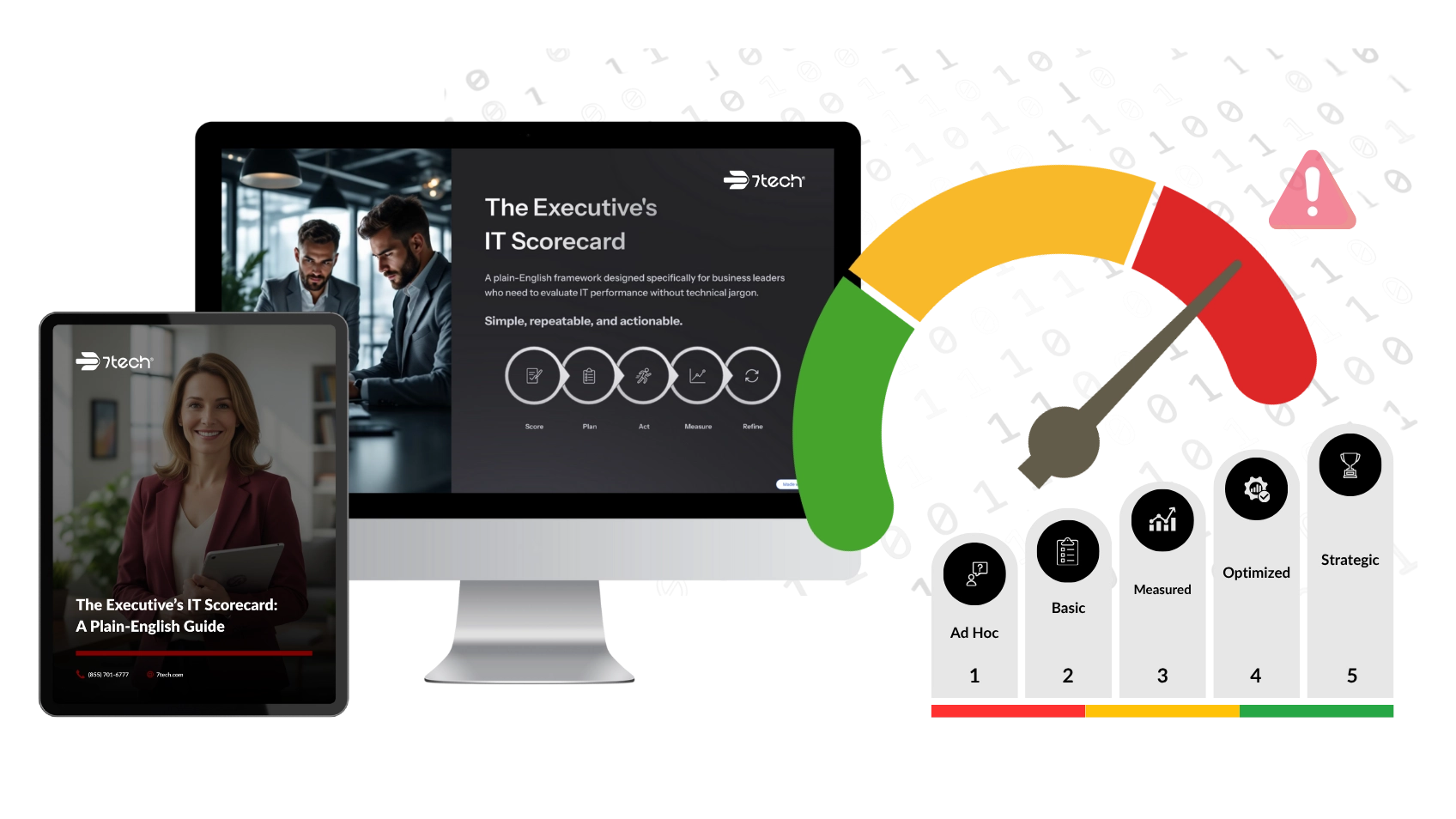
For broader technology oversight, 7tech’s IT scorecard for Texas business executives offers an additional way to consider security and IT effectiveness through a leadership lens.
Can a Security Stack Assessment Help Nonprofits Reduce Costs?
Potentially. A security stack assessment may identify unused licenses, duplicate services, misconfigured existing features, or unnecessary administrative complexity.
However, it may also reveal missing safeguards that justify additional investment.
The objective is not to eliminate security spending indiscriminately. It is to ensure available resources support meaningful protection.
Nonprofit leaders should evaluate proposed spending changes against organizational risk, operational dependence, and the consequences of losing a protective capability.
When Should Your Nonprofit Bring in an IT Security Partner?
Some nonprofits maintain internal IT staff. Others rely on outside providers.
Either arrangement can be effective when the people responsible have sufficient expertise, capacity, authority, and access to the information needed.
A managed security service provider, or MSSP, can contribute specialized monitoring, detection, response, and security management capabilities.
Understanding what an MSSP does can help determine when specialized expertise complements existing IT support.
7tech provides managed security services supported by a private, US-based Security Operations Center, alongside managed IT and co-managed support for organizations with internal teams.
Outside expertise should strengthen accountability and visibility, not create another disconnected layer of vendor responsibility.
How 7tech Helps Nonprofits Connect Security Findings to Mission Priorities
7tech’s approach emphasizes clear reporting, practical remediation, and responsible use of existing investments.
Our nonprofit assessment observations demonstrate why a useful executive report should show both urgent issues and other material below-satisfactory safeguards.
For nonprofit leaders, that means understanding what requires immediate attention, what belongs in the longer-term improvement plan, and why each decision matters to the organization.
7tech supports nonprofits through managed IT services, security monitoring and response, Microsoft 365 management, backup and recovery, vulnerability management, and strategic security guidance.
We also recognize that nonprofit technology decisions affect more than equipment.
As Vinsen Faris, CEO of Meals on Wheels San Antonio, said of 7tech:
“They don’t just care about our computers; they care about the success of our mission.”
That testimonial speaks to the importance of understanding a nonprofit’s operational needs. It is not presented as evidence of the anonymized prospect assessment findings or of a specific cybersecurity incident.
Our role is to help leaders understand their existing security environment and make informed decisions about the improvements that matter.
What Should Your Nonprofit Do After a Security Stack Assessment?
A cybersecurity assessment creates value when the findings lead to action.
- Address the most consequential weaknesses. Prioritize material risks to programs, sensitive information, and essential operations.
- Review all below-satisfactory controls. Do not remove important findings from leadership visibility simply because they are not classified as urgent.
- Improve existing investments. Correct configurations and strengthen processes before automatically buying additional products.
- Assign remediation ownership. Identify who will correct each issue and how completion will be verified.
- Create a board-ready improvement plan. Document business impact, proposed actions, resource requirements, priorities, and progress.
An annual review can be a reasonable starting point for many nonprofits, with additional assessments following significant organizational or technology changes.
The goal is not perfect cybersecurity. It is a defensible, repeatable process for understanding exposure and improving protection as the mission evolves.
Frequently Asked Questions About Security Stack Assessments for Nonprofits
What is a nonprofit security stack assessment?
It reviews the cybersecurity tools, safeguards, monitoring, and response processes protecting a nonprofit’s systems and information. It identifies weaknesses, unnecessary overlap, and accountability gaps to support informed leadership decisions.
Why should nonprofits review below-satisfactory controls that are not urgent?
A below-satisfactory finding may represent an important weakness without requiring immediate remediation. Reviewing all material findings helps leadership understand the complete assessment and plan improvements according to business impact and available resources.
How often should a nonprofit review its security stack?
Annual reviews are a practical starting point for many organizations. Additional assessments may be appropriate after major technology changes, organizational growth, security incidents, or provider transitions.
Can an assessment help reduce cybersecurity spending?
Potentially. It may identify redundant products, unused licenses, or existing capabilities that need improvement. It may also identify necessary investments. The goal is better protection and responsible spending, not indiscriminate cost reduction.
Is a security stack assessment the same as an audit?
No. An audit evaluates against defined criteria. A stack assessment examines whether existing protective technologies and operating processes provide coordinated coverage and clear accountability.
Does a nonprofit need an internal IT department?
No. Organizations with internal IT teams and those using outside providers can benefit from an assessment. Outside expertise may help when specialized skills, time, or independent review are needed.
Does an assessment require replacing our IT provider?
No. Findings may be addressed through existing tools, better configurations, stronger processes, or additional support. Provider changes should follow an informed evaluation rather than be assumed at the outset.
Protect Your Donors. Safeguard Your Mission. Make Every IT Dollar Count.
Your nonprofit’s cybersecurity investments should support reliable programs, responsible stewardship, and the trust of the people you serve.
Before purchasing additional security tools or changing providers, understand what your existing environment protects, where material weaknesses remain, and who is accountable for addressing them.
7tech helps nonprofit leaders translate technical findings into practical decisions that support their missions.
Schedule Your Free IT Network Assessment
A free IT Network Assessment provides an opportunity to begin discussing your organization’s technology environment and security concerns. A comprehensive security stack assessment may require a separately scoped, more detailed review.
Schedule Your Free IT Network Assessment
Prefer to discuss your needs first? Schedule a Free 15-Minute Discovery Call to explore which type of evaluation is appropriate.
Protect the trust you’ve earned. Keep your mission moving.

Neal Juern, Founder and CEO of 7tech, helps business leaders take control of their IT and strengthen cybersecurity without the complexity. Since founding 7tech in 2012, he’s built it into a 5X MSP 501 winner and guided hundreds of executives toward smarter, safer operations through Managed IT Services and Managed Security Services that make sense to people outside the IT department. He speaks regularly to executive and nonprofit audiences across Texas.