

How Nonprofits Can Reduce Ransomware Risk After a Phishing Click
Ransomware prevention for nonprofit organizations is not just about stopping employees from clicking malicious links. A more effective strategy is reducing the likelihood that ransomware can execute, spread, or disrupt operations after the click occurs. For nonprofits in San Antonio, Austin, Dallas, and Houston, technologies such as application allowlisting and application ringfencing can help limit the impact of phishing attacks by controlling what software is allowed to run and what approved software is allowed to access.
Executive Summary
For nonprofit leaders, ransomware is not just a cybersecurity issue. It is an operational, financial, and reputational risk.
A successful ransomware attack can:
- Disrupt donor management systems
- Delay payroll and financial operations
- Interrupt service delivery
- Trigger difficult conversations with boards, donors, and stakeholders
- Damage community trust built over years
The most important question is not simply whether someone might click a malicious email. It is whether your organization has controls in place to keep that click from becoming a broader operational problem.
For leadership teams, ransomware prevention for nonprofit organizations is not only an IT concern. It is a business continuity and risk management priority.
Why Ransomware Prevention for Nonprofit Organizations Matters
If you lead a nonprofit, the concern is understandable.
Many Texas nonprofits operate with:
- Small IT teams
- Limited cybersecurity budgets
- Sensitive donor and financial information
- Heavy dependence on uninterrupted operations
Unlike large enterprises, most nonprofits cannot absorb prolonged downtime or recover easily from a major cyber incident.
Many organizations address these challenges by combining cybersecurity controls with specialized IT support for nonprofit organizations that aligns technology decisions with operational and mission-driven priorities.
The challenge is that ransomware attacks rarely begin with sophisticated hacking. They usually begin with a person.
Recognizing these realities, the Federal Trade Commission provides cybersecurity resources for nonprofits covering topics such as phishing, data protection, email security, and cyber risk management.
Why Training Alone Is Not Enough for Ransomware Prevention
Security awareness training remains important.
Employees should understand how to recognize:
- Phishing emails
- Fake login pages
- Suspicious attachments
- Social engineering attempts
Employee awareness still plays an important role. Organizations that regularly teach staff how to identify phishing email scams are generally better positioned to reduce avoidable risk. However, training alone is not a complete ransomware strategy.
Cybercriminals specifically design attacks to exploit moments of distraction, urgency, or uncertainty. Even experienced employees can still make mistakes.
Most nonprofit executives already understand this reality: Human error cannot be eliminated. It can only be reduced.
That is why mature cybersecurity programs assume that eventually someone will click.
What Happens After a Phishing Click
This is where many organizations make a critical mistake.
A phishing click does not automatically become a ransomware incident.
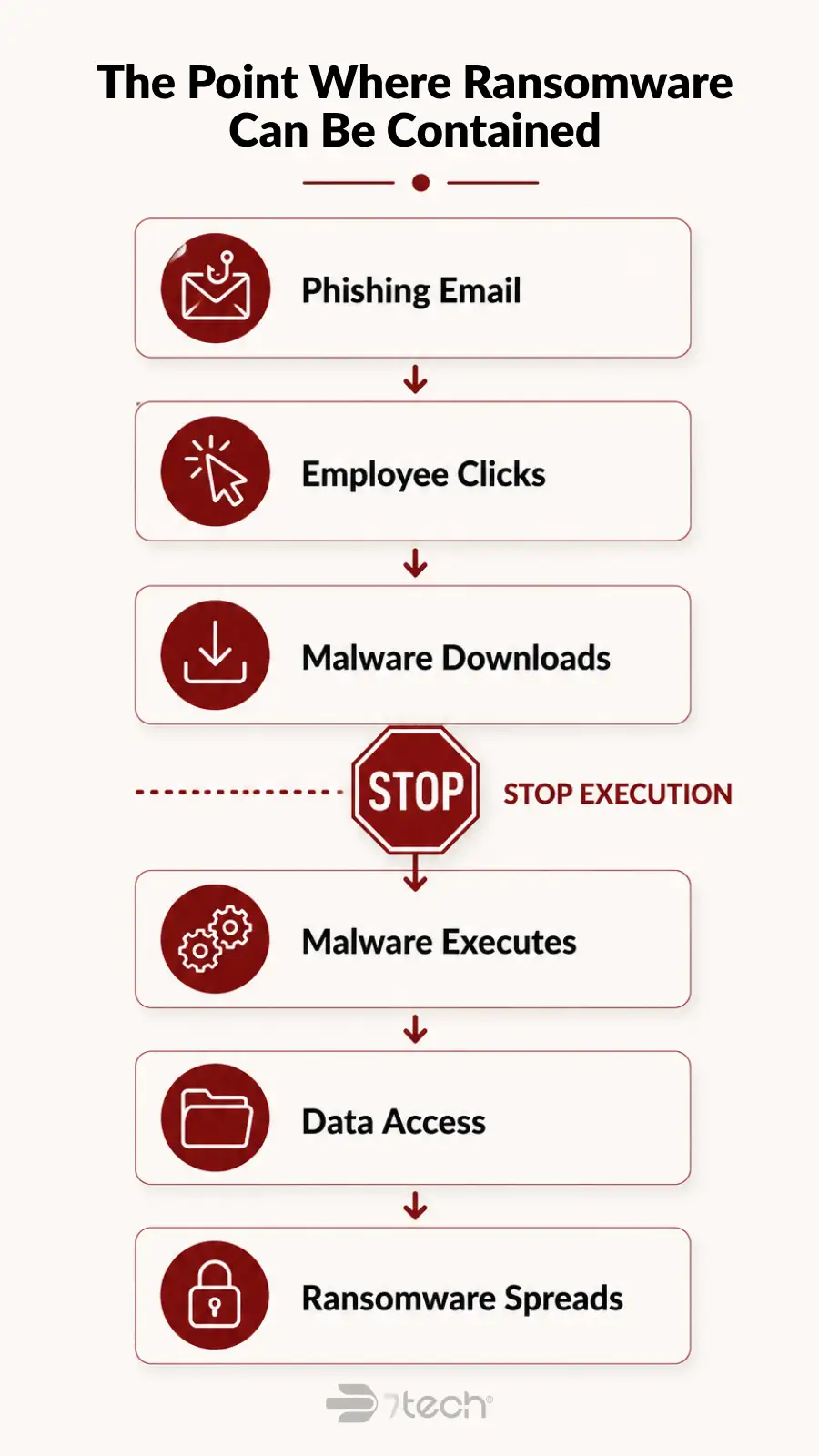
Several additional steps typically occur:
- The user clicks the link.
- Malware attempts to download.
- The malicious program attempts to execute.
- The malware attempts to access systems and data.
- The attack spreads throughout the environment.
Most cybersecurity discussions focus on stopping Step 1.
The bigger opportunity is preventing Steps 3, 4, and 5.
This aligns with guidance from CISA’s StopRansomware initiative, which recommends implementing controls that help prevent malicious code from executing and spreading throughout an environment.
If the malicious application cannot run, the incident may be contained before ransomware can execute, spread, or disrupt operations.
Why Application Control Supports Ransomware Prevention for Nonprofit Organizations
Many traditional security tools operate on a simple model:
“Identify bad software and block it.”
The problem is that attackers continuously create new threats that may not yet be recognized.
A more effective approach is to decide what software is permitted to run in the first place.
This is one reason many ransomware prevention strategies focus on reducing what can execute, access sensitive data, or move through an environment after an initial compromise.
How a Default-Deny Approach Works
This approach follows a Zero Trust philosophy. This approach is consistent with the risk-management principles outlined in the NIST Cybersecurity Framework 2.0, which emphasizes governance, protection, detection, response, and recovery as part of a mature cybersecurity program.
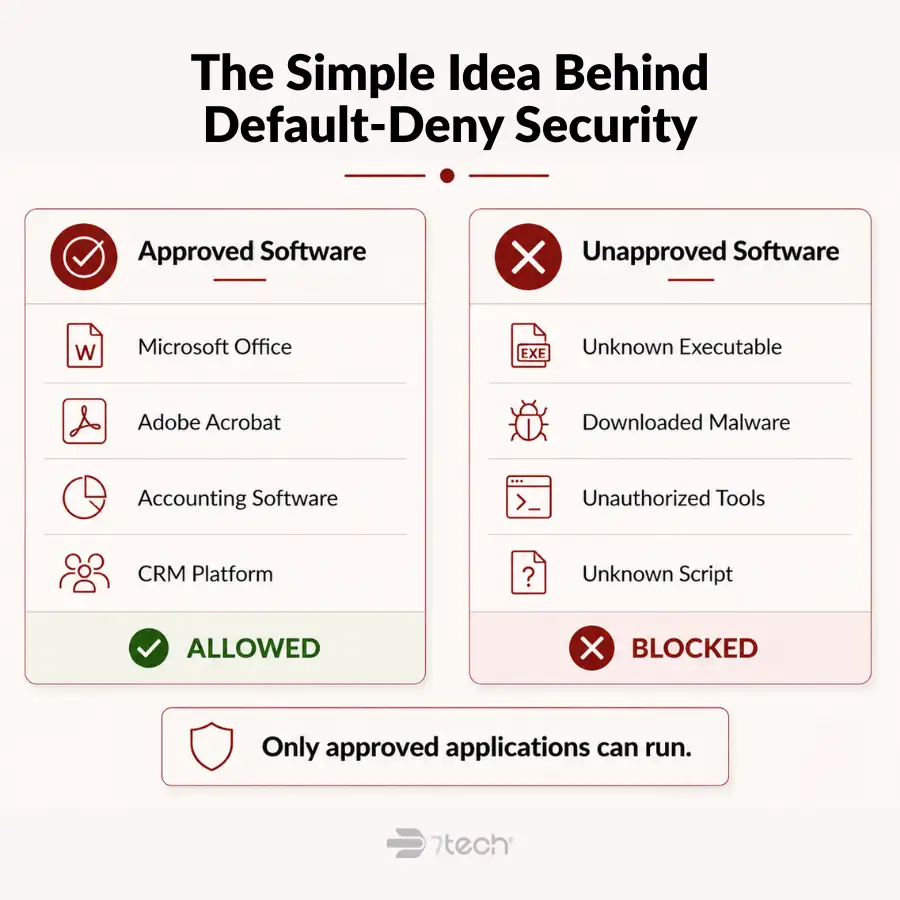
Instead of trying to identify every possible threat, organizations establish a default-deny model:
- Unapproved applications are blocked.
- Approved applications are allowed.
- Access is restricted to only what is necessary.
This shifts the conversation from chasing threats to controlling execution.
For executives, this approach is often easier to understand: You are not trying to predict every attack. You are deciding what is permitted inside your environment.
Two Controls That Can Help Reduce Ransomware Impact
Two controls often used in this strategy are application allowlisting and application ringfencing. 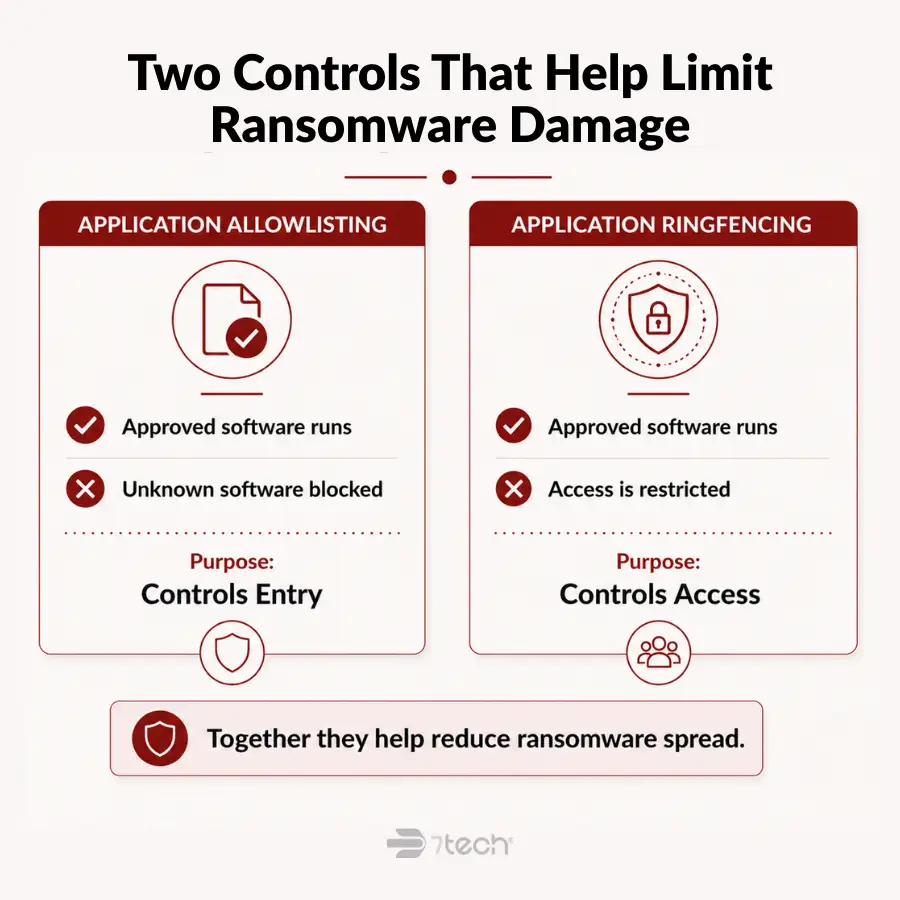
Application Allowlisting
Application allowlisting restricts systems to approved software only.
When ransomware attempts to execute:
- The system checks whether the application is approved.
- If it is not approved, execution is denied.
Think of allowlisting as a guest list for your computers. If the software is not invited, it does not get inside.
Application Ringfencing
Application ringfencing controls what approved applications are allowed to do.
Even legitimate software can create risk if its behavior is not constrained. Ringfencing helps reduce that risk by restricting approved applications from:
- Accessing sensitive files
- Launching other applications
- Reaching protected areas of the network
- Communicating with unauthorized resources
Think of ringfencing as restricting movement inside the building after someone enters.
In simple terms, allowlisting controls entry, while ringfencing controls what approved software can access once it is running.
Together, these controls can materially reduce the likelihood that a successful phishing click turns into a broader ransomware event.
Why This Matters More for Texas Nonprofits
Nonprofits throughout San Antonio, Austin, Dallas, and Houston face unique challenges.
They must balance:
That is why ransomware prevention for nonprofit organizations should focus not only on awareness training, but also on technical controls that limit execution and spread.
For nonprofit executives, cybersecurity is ultimately about trust and continuity.
A ransomware incident can create operational disruption long before it becomes a technical problem.
Questions Leaders Should Ask About Ransomware Prevention for Nonprofit Organizations
Use these questions with your IT team or cybersecurity provider:
Application Control
- Do we block unknown applications by default?
- Can unapproved software run on our endpoints?
Ransomware Containment
- If an employee clicks a malicious link, what prevents ransomware from executing?
- How do we limit the spread of an attack?
Access Restrictions
- Are approved applications restricted from accessing sensitive resources unnecessarily?
- Do we follow least-privilege principles?
Operational Resilience
- Could we continue serving our mission if a workstation became compromised?
- How quickly could we isolate an affected device?
Executive Visibility
- Do leadership and board members receive meaningful cybersecurity reporting?
- Can we clearly explain our ransomware prevention strategy to donors and stakeholders?
If those questions produce uncertain answers, it may be time for a deeper cybersecurity review.
How Better Security Support Improves Day-to-Day Operations
For some nonprofit leaders, stronger security controls and dependable IT support also improve day-to-day operational confidence:
“For 15 years, IT was the biggest headache of all. But 7tech follows through on their promises and exceeded every expectation. Their professionalism and accountability allow us to focus on our clients like never before.”
While that perspective reflects overall IT and service experience rather than ransomware prevention alone, it points to outcomes many nonprofit leaders want from their cybersecurity strategy:
- Fewer surprises
- More confidence
- Better visibility
- Stronger protection of their mission
Frequently Asked Questions
Can security awareness training alone stop ransomware?
No. Training reduces risk, but it does not eliminate human error. Effective ransomware prevention combines training with technical controls that limit execution and spread.
What is application allowlisting?
Application allowlisting permits only approved software to run on a device. Unknown or unauthorized applications are blocked by default.
What is ringfencing?
Ringfencing limits what approved applications can access or do. It helps contain threats and reduce lateral movement if an attack occurs.
Why are nonprofits attractive targets for ransomware?
Nonprofits often hold valuable donor, financial, and personal information while operating with limited cybersecurity resources, which can make them appealing targets.
Is ransomware prevention only an IT responsibility?
No. Cybersecurity is a business risk issue that affects operations, finances, reputation, and governance. Executive leadership plays an important oversight role.
What should nonprofit boards ask about ransomware?
Boards should ask how ransomware is prevented, how incidents are contained, how recovery is performed, and whether leadership receives regular cybersecurity reporting.
What Leaders Can Do to Strengthen Ransomware Prevention for Nonprofit Organizations
No nonprofit can guarantee that a phishing email will never be opened.
What leadership can control is whether that click becomes a business disruption.
Effective ransomware prevention for nonprofit organizations depends on more than trying to stop every click. It depends on limiting what can run, restricting what approved software can do, and protecting mission-critical operations when mistakes happen.
For nonprofit organizations across San Antonio, Austin, Dallas, and Houston, that shift in thinking can mean the difference between a contained incident and a broader operational disruption.
If you want a clear picture of where you stand, we can help. Get a Free Cybersecurity Assessment. We will walk through these exact questions with you, no pressure. Whether you are in San Antonio, Austin, Dallas, or Houston, we are close by.

Neal Juern, Founder and CEO of 7tech, helps business leaders take control of their IT and strengthen cybersecurity without the complexity. Since founding 7tech in 2012, he’s built it into a 5X MSP 501 winner and guided hundreds of executives toward smarter, safer operations through Managed IT Services and Managed Security Services that make sense to people outside the IT department. He speaks regularly to executive and nonprofit audiences across Texas.