Cyber Insurance Requirements for Construction Companies
Last updated: July 29, 2026
Construction cyber insurance requirements commonly include multi-factor authentication, protected and tested backups, endpoint protection, email security, user training, access controls, and incident response readiness. For construction companies, the harder issue is scope: whether those controls are actually deployed, enforced, monitored, and documented across jobsites, field devices, remote users, vendors, subsidiaries, joint ventures, and acquired entities.
The objective is not to provide the strongest-sounding answer. It is to provide an accurate, supportable answer that reflects how security controls operate across the business today.
That makes cyber insurance for contractors more than a technology conversation. It is an executive accountability issue tied to business continuity, contract obligations, financial controls, and the company’s ability to support every material application answer with evidence.
This guide focuses on application readiness, defensible answers, supporting documentation, and renewal preparation. Companies seeking broader assistance can also explore 7tech’s construction IT and cybersecurity support.
Construction Cyber Insurance Requirements at a Glance
Executive takeaway: A cyber insurance application should describe the environment that exists today, not the environment the company expects to have after its next security project.
What Cyber Insurance Requirements Do Construction Companies Commonly Face?
No single control list applies to every insurer, policy, or construction company. However, carrier applications commonly ask about controls and business practices such as: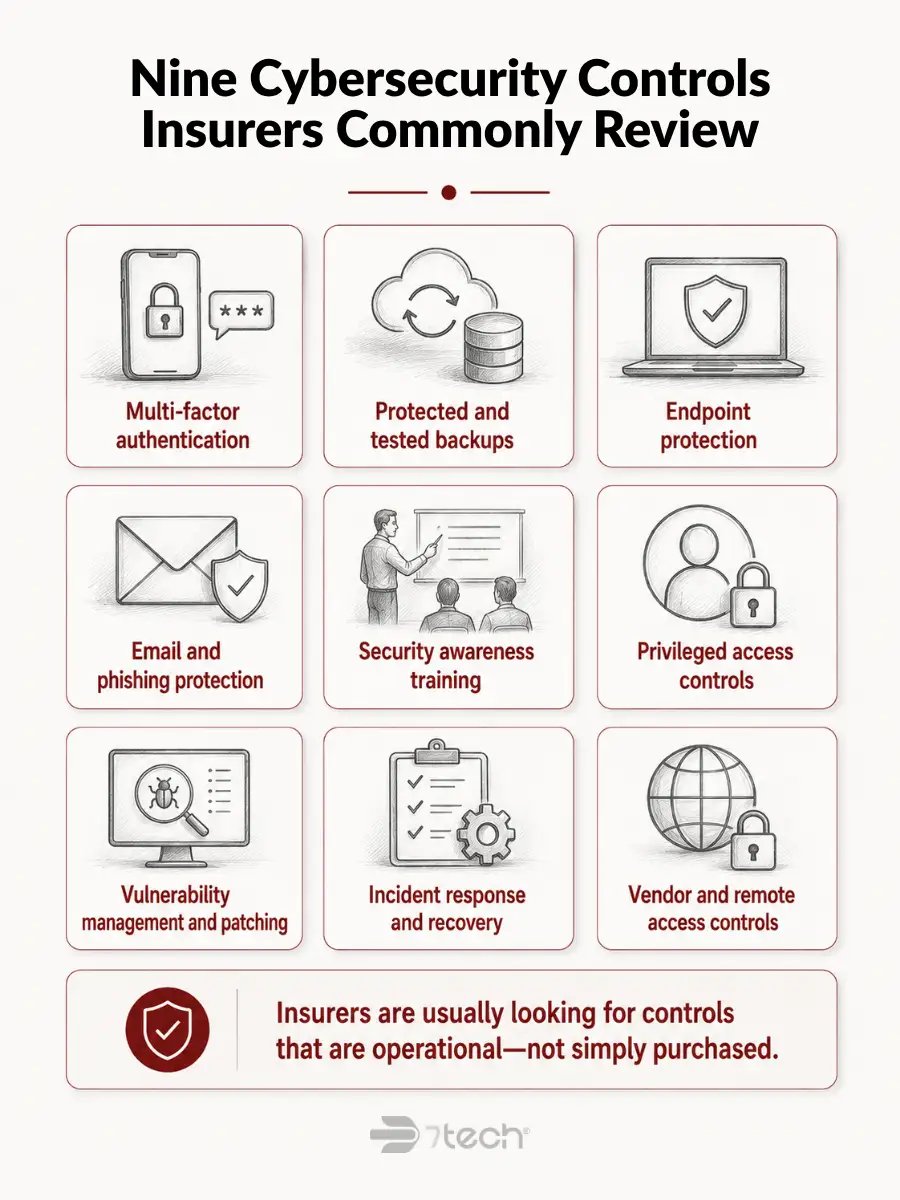
- multi-factor authentication for email, remote access, cloud services, and privileged accounts
- backups that are offline, isolated, immutable, or otherwise protected from the live environment
- regular testing of backup availability and restoration procedures
- endpoint detection or endpoint protection across workstations, laptops, and mobile devices
- email filtering and phishing protections
- security awareness training
- limited administrative rights and privileged access controls
- vulnerability management and software patching
- written incident response and recovery plans
- vendor access and remote access controls
- wire-transfer and payment-verification procedures
- prior incidents, claims, and circumstances that could lead to a claim
These control areas overlap with voluntary cybersecurity guidance such as the CISA Cybersecurity Performance Goals. CISA addresses practical baseline measures involving identity protection, backups, vulnerability management, incident response, training, third-party risk, and leadership accountability.
CISA guidance does not establish insurance requirements. The carrier’s application and policy language remain the controlling insurance documents. The guidance is useful because it helps leadership evaluate whether the controls described in an application are technically sound and consistently managed.
The distinction between ownership and implementation matters. Purchasing an endpoint security platform does not confirm that every eligible device is enrolled. Enabling MFA for corporate email does not establish that it also protects remote access, administrative accounts, field applications, or recently acquired environments.
For executives, the key question is not simply, “Do we own the tool?” It is, “Where is the control enforced, what remains outside its scope, and what evidence supports our answer?”
That is the heart of sound construction cyber risk management.
Why Cyber Insurance Requirements Vary for Construction Companies
Carrier applications and supplemental questionnaires vary by insurer, requested coverage, revenue, company size, industry, prior claims, technology environment, and the applicant’s initial answers.
Construction companies may receive more detailed questions when their operating environments include:
- temporary jobsites with changing connectivity
- field laptops, tablets, phones, and shared devices
- remote project access
- subcontractor and vendor collaboration
- shared project-management or document platforms
- multiple legal entities or operating divisions
- joint ventures
- recent acquisitions
- remote access by outside technology providers
- distributed payment and invoice-approval workflows
A contractor with one office and a centrally managed device fleet may present a different risk profile than a multi-entity company operating several jobsites, cloud platforms, acquired systems, and external project environments.
NIST guidance on telework, remote access, and bring-your-own-device environments helps explain the technical concern. Once users, devices, contractors, and business partners connect from outside a controlled office, identity protection, device security, access management, and monitoring become more important to verify.
That guidance does not determine what an insurer requires. It does help construction leaders evaluate whether protections remain consistent when employees leave the main office or outside parties access company systems.
For more context on the operational exposures behind these questions, review these cybersecurity risks in construction. The insurance-readiness issue is whether those real-world conditions are reflected accurately in the application.
How Contract and Compliance Requirements Affect Cyber Insurance
Construction cyber compliance requirements and cyber insurance requirements often overlap, but they are not the same.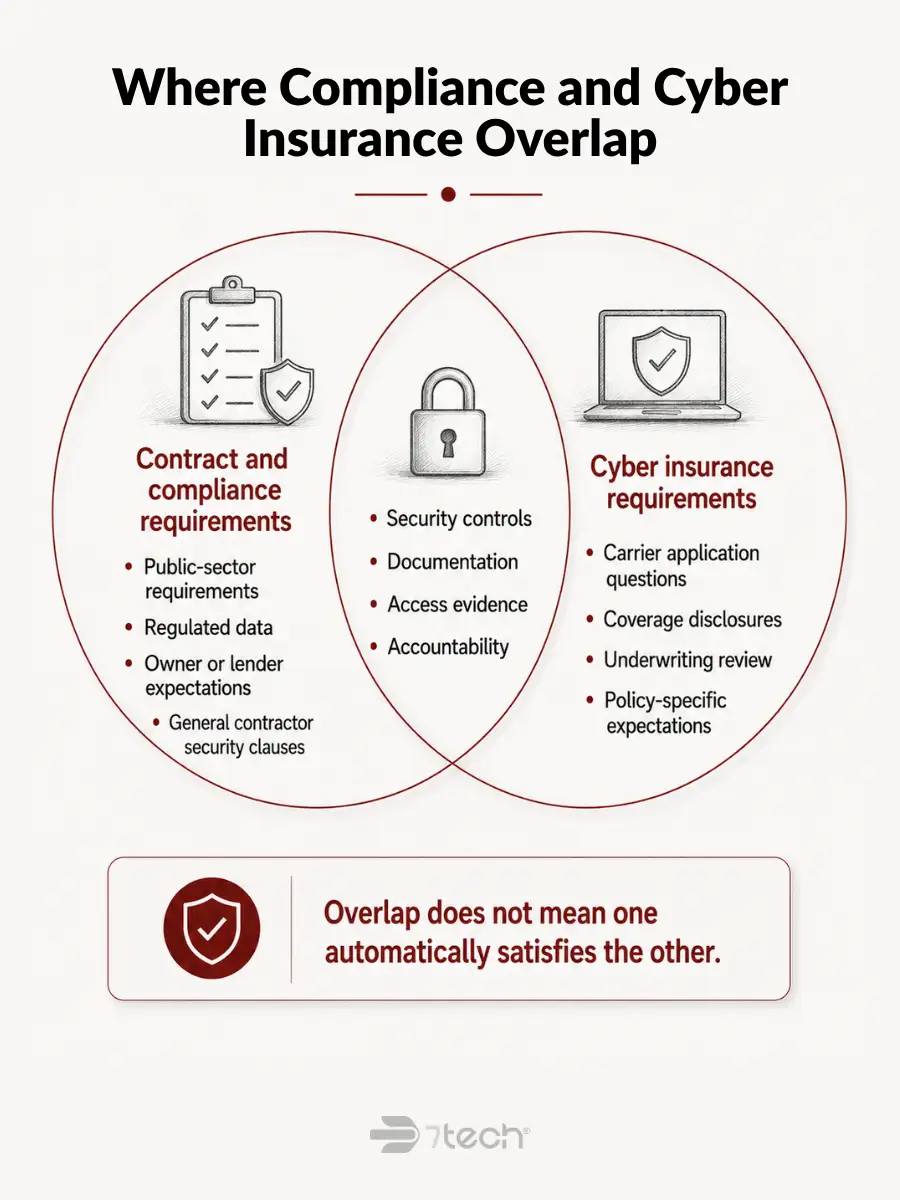
Public-sector work, regulated data, owner requirements, lender expectations, or general contractor security clauses may establish obligations involving access controls, assessments, documentation, incident reporting, or system safeguards. A carrier may ask about similar controls while evaluating a different issue: the likelihood and potential impact of an insured event.
That overlap can create efficiencies. A current asset inventory, access review, incident response plan, or backup test may support several governance processes.
However, the same document does not automatically prove that every contractual, regulatory, and insurance requirement has been satisfied. Compliance with a contract or framework does not automatically satisfy an insurer, and purchasing cyber insurance does not establish compliance with a contract or regulation.
Each requirement must be interpreted using its own language, scope, and evidence expectations.
Companies managing contract-driven obligations can use 7tech’s compliance support services and CMMC readiness support to clarify where controls, documentation, and accountability intersect without treating separate requirements as interchangeable.
When a CMMC Request Arrives Unexpectedly
If a CMMC request appears during a bid, contract renewal, subcontract review, or security questionnaire, begin by confirming what the current solicitation, contract, owner, or general contractor actually requires.
Do not assume the applicable CMMC level, assessment type, or implementation date based on a previous bid, an older presentation, or a general summary.
The official Department of Defense CMMC program guidance should be reviewed alongside the current contract language. CMMC applies within a specific defense-contracting context involving federal contract information or controlled unclassified information. It is not a universal requirement for every construction company or subcontractor.
When CMMC and cyber insurance questions appear at the same time:
- Confirm the current solicitation and contract requirements.
- Verify the applicable CMMC expectations using official guidance.
- Separate insurance questions from contractual security clauses.
- Identify controls and records that may support both processes.
- Do not treat shared controls as automatic proof of insurance readiness or CMMC compliance.
What Information Will the Insurer Request?
There is no universal construction cyber insurance application. Carriers and brokers use different forms, and supplemental questionnaires may be added based on the applicant’s profile, requested coverage, and initial responses.
An application may request information about:
- company profile, revenue, and business activities
- subsidiaries and entities proposed for coverage
- employee, user, and system counts
- prior claims, incidents, or known circumstances
- cloud platforms and email environments
- remote access methods
- privileged and administrative accounts
- vendor relationships and external access
- backup protection and recovery practices
- endpoint, identity, and email protections
- incident response planning
- sensitive records and data types
- wire-transfer, invoice, and payment-verification procedures
- contractual responsibilities and third-party dependencies
Construction companies should also be prepared to explain how the requested scope applies to field devices, temporary jobsites, project-management systems, subcontractor access, joint ventures, and acquired entities.
Remote access, mobile devices, and third-party collaboration are not unusual exceptions in construction. They are part of normal operations. That is one reason a construction cyber insurance application may become more detailed than leadership expects.
If application questions expose gaps in visibility, a cybersecurity assessment checklist can help leadership confirm what is actually deployed before answers are finalized.
Who Should Participate in the Application Review?
Cyber insurance applications should not be completed by one department in isolation. Technical, financial, operational, contractual, and legal questions may appear in the same submission.
Executive takeaway: The signing executive should not be the first person to discover that IT, finance, and operations interpreted the application differently.
How to Verify Application Answers and Prepare Evidence
The strongest applications are not the most optimistic. They are based on reasonable inquiry and information the company can support.
Before submitting an answer about a security control, confirm whether the control is: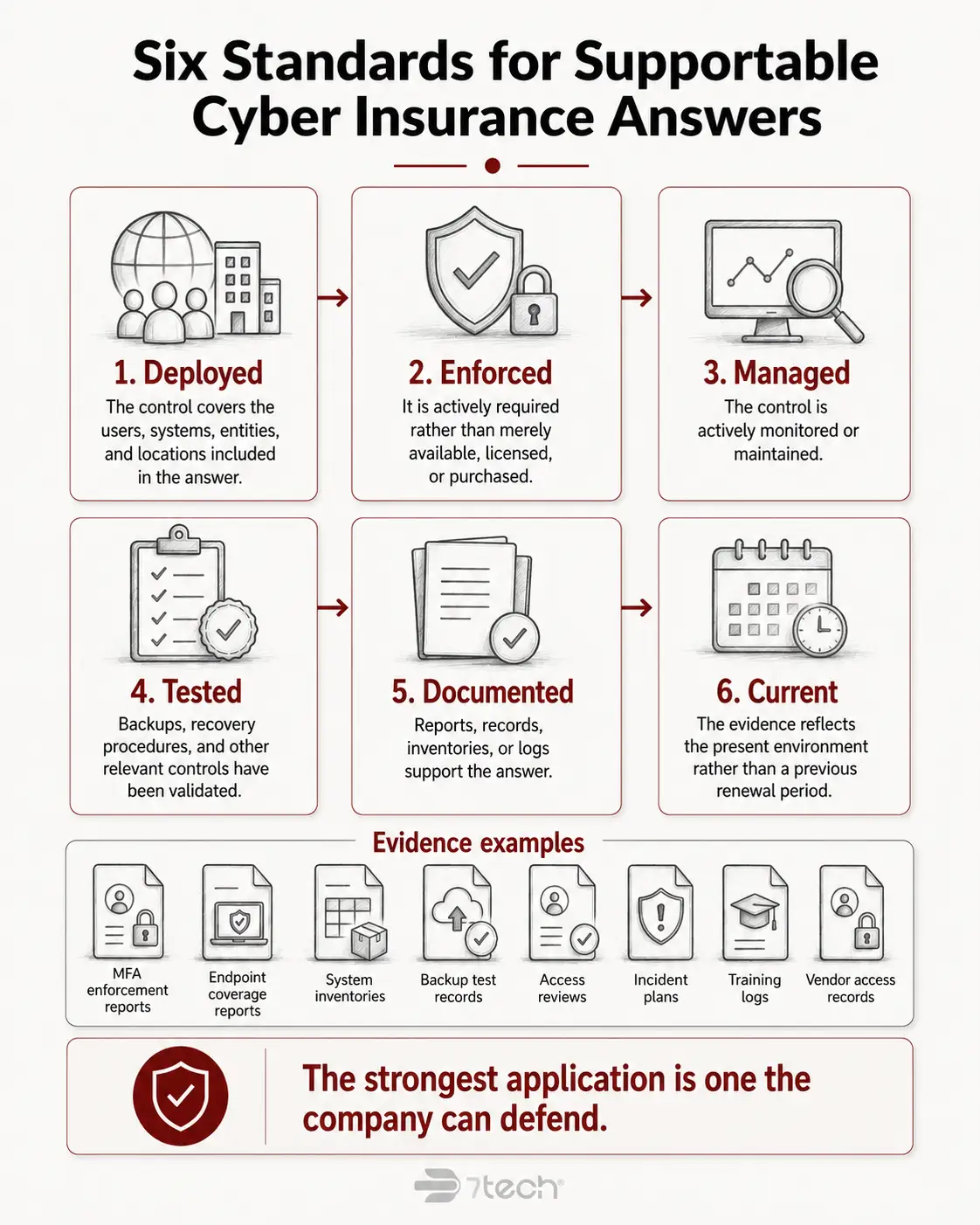
- Deployed: It covers the users, devices, systems, locations, and entities included in the answer.
- Enforced: It is actively required rather than merely available, licensed, or purchased.
- Managed: Someone is responsible for configuration, monitoring, maintenance, and exceptions.
- Tested: Recovery or response capabilities have been exercised when the answer represents that they work.
- Documented: Records exist to explain how the answer was verified.
- Current: The evidence reflects the present environment rather than a previous renewal period.
Depending on the application and carrier request, supporting records may include:
- MFA enforcement reports
- endpoint enrollment and coverage reports
- user, device, and system inventories
- privileged account lists
- backup configuration records
- backup isolation or protection documentation
- recovery test results
- access review records
- patch and vulnerability-management reports
- incident response plans and exercise records
- security awareness training logs
- vendor access records
- payment-verification procedures
- exception and remediation records
Not every insurer will request every record. The purpose of maintaining evidence is to help the company answer accurately and respond efficiently when a broker, underwriter, auditor, or signing executive asks how an answer was confirmed.
Backups Require Protection and Testing
Backup protection and backup testing address different risks.
A successful recovery test does not prove that backups are protected from unauthorized access or ransomware. An isolated or immutable backup does not prove that the organization can restore critical systems within an acceptable timeframe.
CISA recommends maintaining protected backups of critical data and regularly testing their availability and integrity as part of disaster-recovery planning. The practical lesson for construction companies is that both protection and restoration capability should be verified.
Carrier wording still controls the insurance answer. Leadership should be able to answer four questions:
- What systems and data are backed up?
- Can a compromised production account reach, alter, or delete those backups?
- When was the last meaningful restoration test?
- How long would it take to restore the systems needed for project management, accounting, payroll, and field operations?
Organizations that need ongoing validation rather than a one-time review can use managed security services to improve the visibility and reporting available for renewals, assessments, and executive review.
Construction Example Showing Why Ongoing Oversight Matters
In construction, the business value of cybersecurity oversight often comes down to operational confidence. One construction client described the impact of active monitoring this way:
“After multiple fraudulent attempts, protecting our systems and data became a serious concern. With 7tech monitoring and protecting our network, we have peace of mind and can focus on running jobs and growing our construction company. They’re reliable and have our back.”
— Conor Shullanberger, Lambda Construction
The relevance to insurance readiness is straightforward. Owning security tools is not enough. Leadership needs visibility into whether controls remain active, whether exceptions are being addressed, and whether the company can support the statements made in its application.
What to Do When a Requirement Is Only Partially Met
Partial implementation is common, especially after an acquisition, a new jobsite opening, a platform change, or a period of rapid growth.
The appropriate response is not to hide the gap or force it into a broad “yes” or “no.” The response is to define the exception and route it through the proper review process.
When a requirement is only partially met: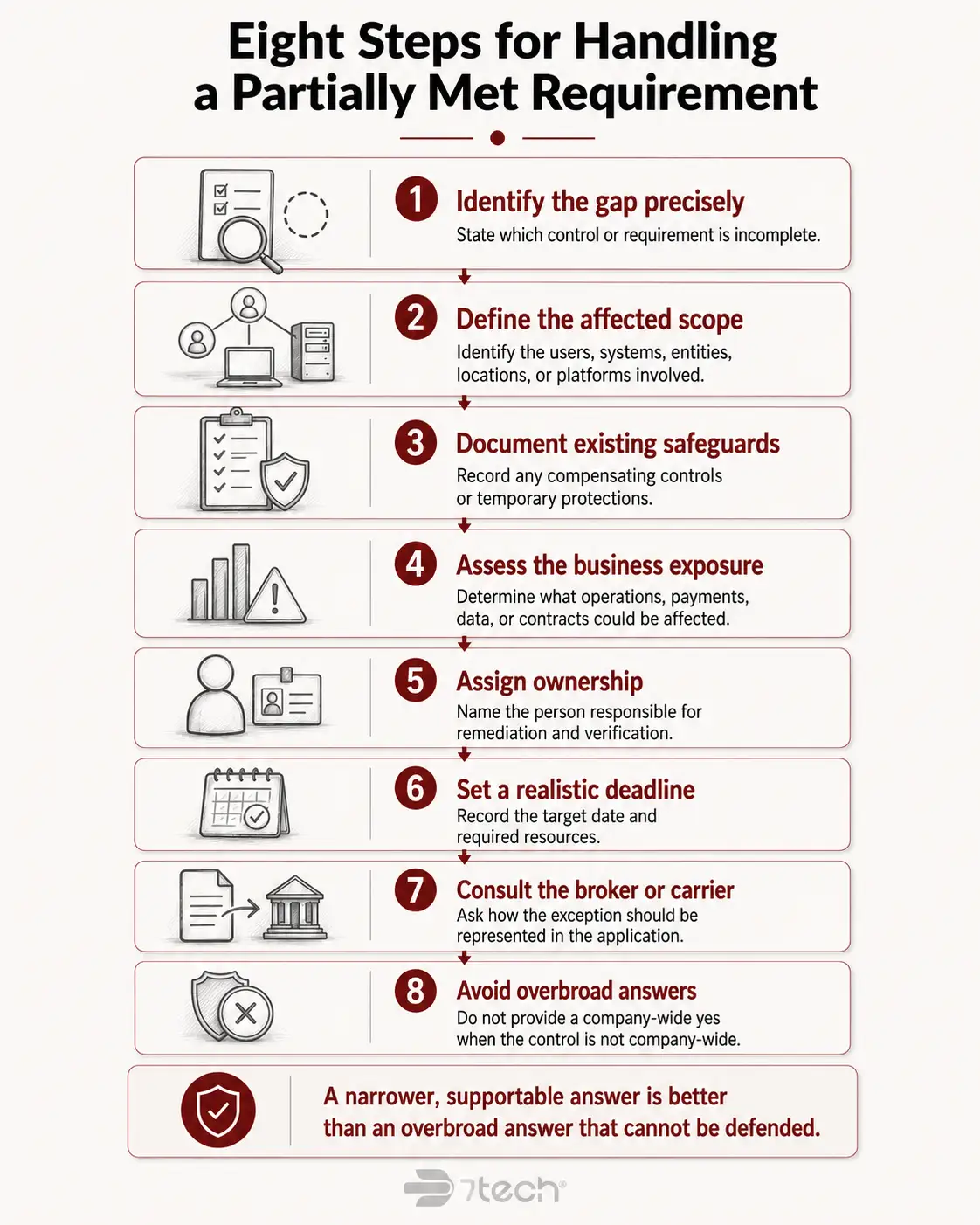
- Identify the gap precisely. State which control or requirement is incomplete.
- Define the affected scope. Identify the users, systems, entities, locations, or platforms involved.
- Document existing safeguards. Record any compensating controls or temporary protections.
- Assess the business exposure. Determine what operations, payments, data, or contracts could be affected.
- Assign ownership. Name the person responsible for remediation and verification.
- Set a realistic deadline. Record the target date and required resources.
- Consult the broker or carrier. Ask how the exception should be represented in the application.
- Avoid overbroad answers. Do not provide a company-wide “yes” when the control is not company-wide.
For example, MFA may be enforced for corporate email but not for a recently acquired field operation. In that situation, the question is not whether the company uses MFA somewhere. The question is whether the application answer accurately reflects the users and systems covered by the carrier’s wording.
A precise answer with a documented remediation plan is generally more credible than a broad statement that cannot be reconciled with the actual deployment.
What to Review Before Signing the Application or Binding Coverage
Before a signing executive approves an application or binds coverage, the review should extend beyond technical controls. Leadership should understand the coverage structure, application representations, and internal responsibilities involved.
Review:
- policy limits and sublimits
- retentions or deductibles
- coverage triggers
- exclusions
- reporting and notification obligations
- social engineering and funds-transfer provisions
- business interruption terms
- dependent or contingent business interruption provisions
- project-specific or contractual obligations
- treatment of subsidiaries and acquired entities
- treatment of joint ventures
- consistency between application answers and internal evidence
- application declarations and signature requirements
IT should validate technical controls. Finance should review payment-process answers. Operations should confirm jobsite and project-platform realities. The broker should explain carrier wording and coverage options. Legal counsel should review legal implications where appropriate.
The signing executive should confirm that the complete answer set is credible, aligned, and supportable.
This is also where executive cybersecurity oversight can provide value, particularly when application risk, security documentation, remediation decisions, and leadership reporting span several departments.
How to Stay Prepared for Renewal
Renewal readiness should not depend on copying last year’s answers. Construction environments change too frequently for that to be reliable.
Revalidate application answers after changes such as:
- opening or closing jobsites
- introducing new field workflows
- adding vendors or project platforms
- changing email or cloud environments
- acquiring a company or adding a legal entity
- forming a joint venture
- changing remote access technologies
- changing backup platforms or retention settings
- changing payment or invoice-verification procedures
- adding outside support providers
- making significant administrative-access changes
- experiencing a cyber incident or suspicious event
Construction cyber insurance readiness works best as an ongoing governance process. Periodic access reviews, restoration testing, control validation, exception tracking, and incident response updates are easier to manage throughout the year than under renewal pressure.
This discipline also supports the broader practices described in 7tech’s cyber insurance requirements guide.
Construction Cyber Insurance Readiness Checklist
Before submitting or renewing an application, confirm that leadership can answer the following questions:
- Which entities, locations, users, and systems are included in the requested coverage?
- Is MFA enforced across every service described in the application answer?
- Are endpoint and email protections deployed across the full stated scope?
- Are backups protected from production-account compromise?
- Have critical restoration procedures been tested?
- Are field devices and remote access managed consistently?
- Do vendors and subcontractors have only the access they need?
- Are privileged accounts identified, limited, and reviewed?
- Are wire-transfer and invoice-change requests independently verified?
- Have partial deployments and exceptions been documented?
- Do IT, finance, operations, the broker, and the signing executive agree on the answers?
- Can the company produce supporting evidence if the carrier requests clarification?
If several answers depend on assumptions, outdated reports, or one employee’s memory, the company is not ready to submit.
Cyber Insurance Requirements for Construction Companies FAQ
Do all construction companies need the same cyber insurance controls?
No. Carrier questions and underwriting expectations vary by insurer, requested coverage, company profile, prior claims, remote access exposure, data, third-party access, and other risk factors.
If we meet contract security requirements, does that satisfy the insurer?
Not automatically. Contract and insurer requirements may overlap, but they are not interchangeable. Each must be reviewed using its own wording, scope, and evidence expectations.
Can we answer yes if a control exists in only one part of the business?
That may be inaccurate if the question applies to the entire company or group. Define the actual scope and ask the broker or carrier how a partial deployment should be represented.
What should we do when a requirement is only partially implemented?
Document the gap, identify affected systems or users, record compensating safeguards, assign remediation ownership, and disclose the exception through the appropriate application process.
Does every subcontractor need to meet the same requirements?
Not necessarily. Expectations depend on contract terms, system access, data exposure, project structure, and the insurer’s questions. Leadership should know who has access, why they have it, and how it is controlled.
Will meeting every stated requirement guarantee claim coverage?
No. Coverage depends on the policy, exclusions, representations, disclosures, applicable law, and the circumstances of the claim. Implementing controls or completing an application accurately does not guarantee a coverage outcome.
How often should construction companies revalidate their answers?
At minimum, before each application or renewal and after significant changes such as acquisitions, new jobsites, new vendors, remote-access changes, platform migrations, or payment-process updates.
What Construction Leaders Should Confirm Before Submission
Construction cyber insurance requirements become more manageable when the company focuses on accurate answers, documented evidence, and clearly identified exceptions.
The goal is not to sound secure. The goal is to submit an application that leadership can support.
Before submission, confirm what controls are deployed, where they are enforced, which systems remain outside the deployment, how recovery processes have been tested, what evidence supports each material answer, and where gaps remain.
Then verify that the application language, broker guidance, internal evidence, and executive understanding all align.
Get Clarity Before You Sign
A practical readiness review can help leadership determine whether current controls, documentation, and oversight support the company’s insurance answers before an application is submitted or renewed.
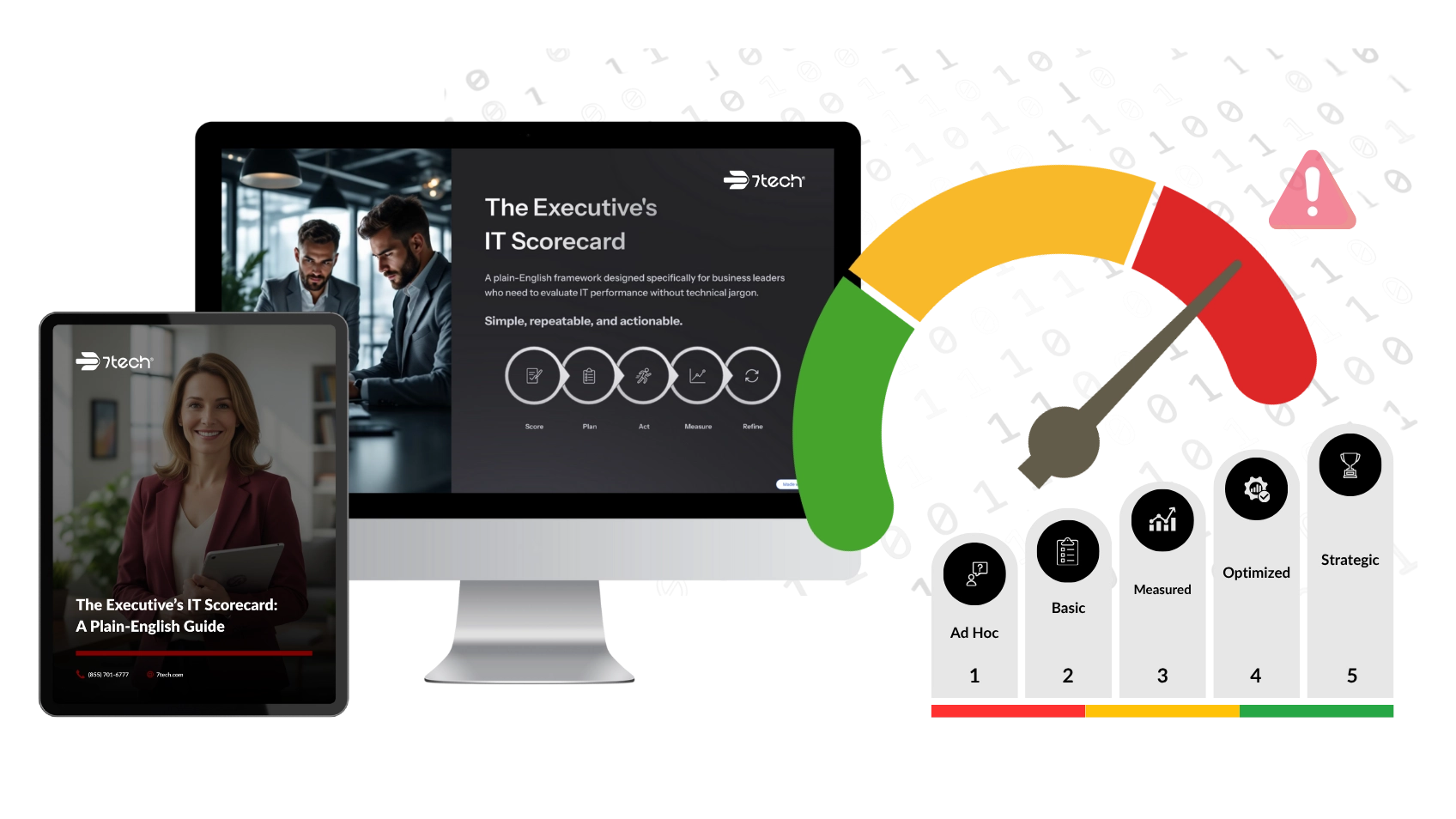
7tech’s Executive IT Scorecard provides a plain-language framework for reviewing security, performance, accountability, and hidden IT risk without requiring a technical background. It gives construction leaders a low-pressure way to identify questions that should be resolved before signing.
Request the Executive IT Scorecard here.

Neal Juern, Founder and CEO of 7tech, helps business leaders take control of their IT and strengthen cybersecurity without the complexity. Since founding 7tech in 2012, he’s built it into a 5X MSP 501 winner and guided hundreds of executives toward smarter, safer operations through Managed IT Services and Managed Security Services that make sense to people outside the IT department. He speaks regularly to executive and nonprofit audiences across Texas.