
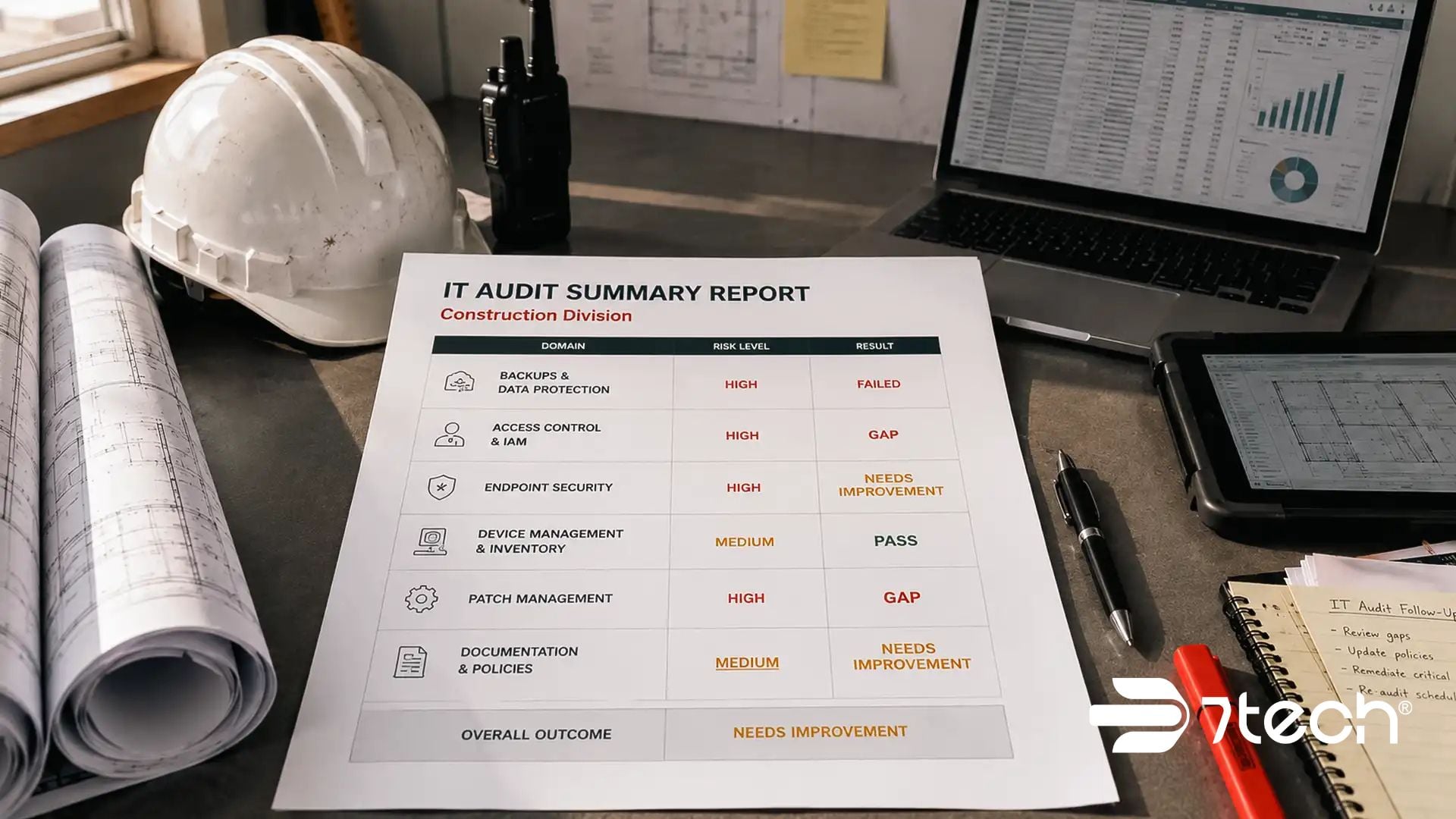
We Reviewed 47 Construction IT Audits. Here’s What Failed Most
A construction IT audit can reveal what failed most often, but frequency alone does not tell executives what should be fixed first. In 7tech’s review of assessment results from 47 distinct construction companies assessed from Q1 2023 through Q3 2025, the most frequent below-satisfactory finding and the largest concentration of immediate-attention findings occurred in different areas.
For CEOs, CFOs, COOs, CIOs, and IT leaders, that distinction changes how audit results should be interpreted, funded, and assigned.
The executive takeaway is clear: the most common failure in a construction IT audit should not automatically become the first remediation priority. A useful audit should help leadership distinguish what is frequent, what is severe, and what matters most to business operations before money and staff time are committed.
What the 47 Construction Assessments Actually Showed
The 47 assessments did not produce one universal ranking of construction IT failures. What stood out depended on how leadership looked at the data.
Across the 47 construction assessments, several routinely evaluated security and maintenance controls were consistently or overwhelmingly satisfactory. At the same time, substantial below-satisfactory findings remained across access, devices, network reliability, and recovery.
The largest concentration of immediate-attention findings appeared in Data Protection and Recovery, not in the routine controls that performed strongly.
Password Management therefore stood out for frequency. Data Protection and Recovery stood out for concentration of immediate-attention findings. Other controls showed strong or near-universal satisfactory performance.
That is the first important lesson for leadership: a raw findings count is only one view of a construction IT audit.
Why the Most Common Audit Finding Isn’t Automatically the First Priority
Password Management was below satisfactory in 36 of 36 companies evaluated for that control. If executives ranked the audit only by frequency, Password Management would immediately appear to be the top issue. 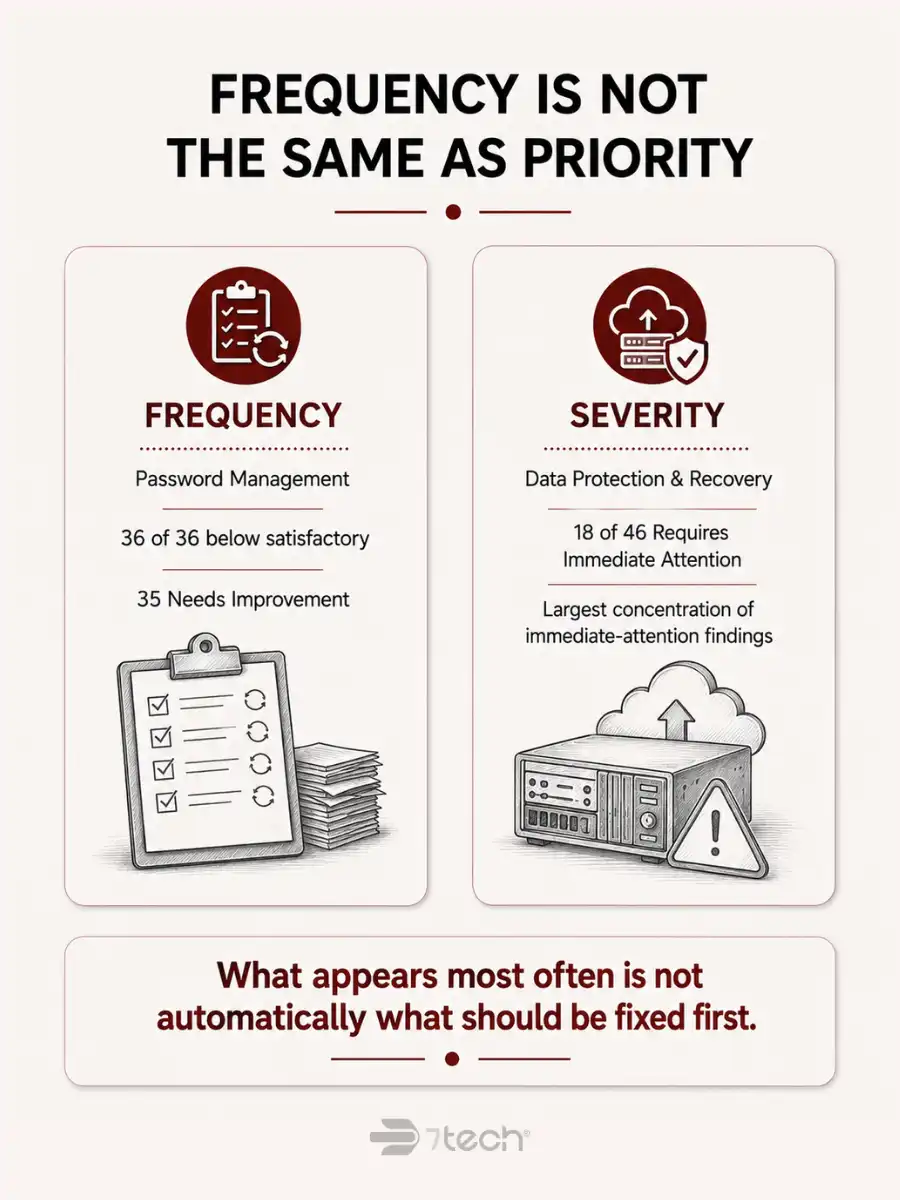
But 35 of those 36 Password Management findings were rated Needs Improvement.
Data Protection and Recovery showed a different pattern. It was below satisfactory in 26 of 46 companies evaluated, while 18 of 46 had at least one Requires Immediate Attention finding. That was the largest concentration of immediate-attention findings documented in the report.
The evidence supports a more useful conclusion than simply asking what failed most.
The most common failure in a construction IT audit should not automatically become the first remediation priority.
These 47 assessments demonstrate why finding counts and assessed severity should remain separate inputs into executive decision-making. What appeared most often was not the same as what produced the largest concentration of immediate-attention findings.
That does not mean recovery should always be fixed before password management. Nor does it establish severity as the only factor leadership should consider.
Instead, executives should separate two questions before deciding what to fund:
- How often did this weakness appear?
- How serious was it assessed to be?
Only after those questions are separated should leadership apply business context, operational dependency, remediation cost, sequencing, and accountability.
This is the difference between treating an audit as a technical punch list and using it as a management tool.
What Is a Construction IT Audit?
A construction IT audit is a structured review of the reliability, security, recoverability, and governance of the technology environment a construction company depends on to operate.
For commercial construction firms, that should extend beyond a basic cybersecurity checklist. A meaningful audit should help leadership understand whether office teams and distributed operations can reliably access systems and information, whether devices are ready for daily use, whether important locations can continue operating when connectivity fails, and whether critical information can be recovered when needed.
That broader framing aligns with the risk-management principles in the NIST Cybersecurity Framework 2.0, which emphasizes understanding, assessing, prioritizing, and communicating cyber risk. 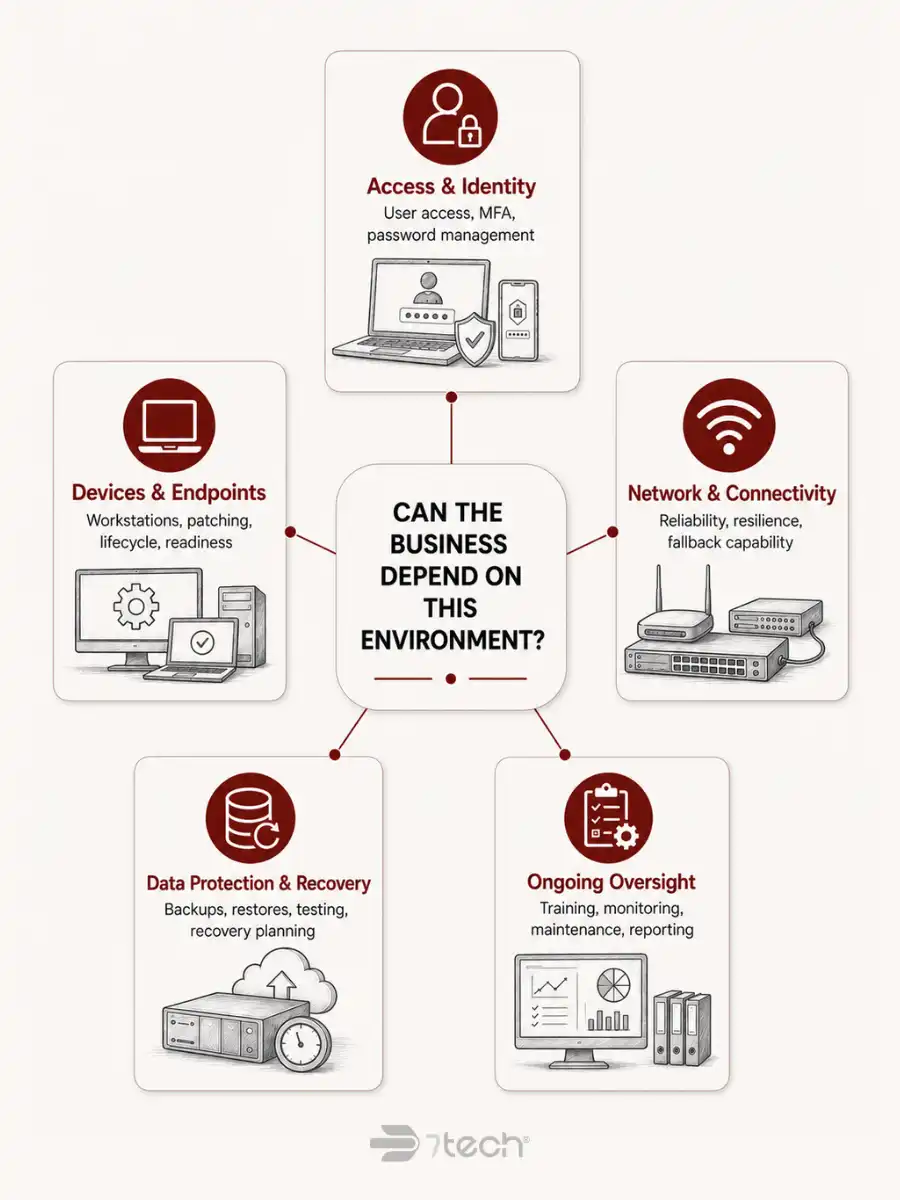
A construction IT audit is not the same as:
- help-desk troubleshooting
- a hardware inventory alone
- a vulnerability scan by itself
- a generic cybersecurity checklist with no operational context
The 47 assessed environments covered access and account protection, password-management readiness, devices and workstations, network reliability and protection, data protection and recovery, and ongoing security and maintenance controls.
That is a broader business-operating view than many executives expect when they hear the word “audit.” It moves the conversation from individual technical controls to a more important leadership question: Can the business depend on this environment?
What a Construction IT Audit Should Review
An executive-useful construction IT audit should show both where findings exist and how leadership should interpret them. That requires separating frequency, severity, operational dependency, and remediation context instead of treating every finding as equivalent.
Access and Identity Controls
This domain includes user access, onboarding and offboarding, MFA, password-management maturity, centralized visibility, and whether identity controls are actually deployed and adopted across the company.
Access and Account Protection showed at least one below-satisfactory finding in 39 of 42 companies evaluated. Password Management was below satisfactory in 36 of 36 companies evaluated.
Across the 36 construction companies evaluated for Password Management, every company received a below-satisfactory result. The assessment findings included incomplete company-wide deployment, user setup or training, and centralized management still being established.
The executive implication is important: buying a password-management tool does not mean the organization has a mature password-management program.
A control should not be considered fully operational simply because the technology exists somewhere in the environment. Deployment, user enrollment, training, adoption, centralized management, and ongoing oversight all determine whether the control is functioning as intended.
For leadership, this is also an accountability issue. If a control exists but adoption is incomplete, executives should know who owns completion and how satisfactory implementation will be verified.

Devices, Endpoints, and Field Technology
This domain covers company devices, workstation condition, endpoint controls, patching, lifecycle management, and the practical readiness of the technology employees rely on every day.
Devices and Systems had at least one below-satisfactory finding in 40 of 44 companies evaluated.
Workstations were below satisfactory in 29 of 29 companies evaluated, including 22 Needs Improvement findings and 7 Requires Immediate Attention findings. Underlying findings included aging computers, expired warranties, and devices already identified for replacement.
At the same time, several protective controls were strong:
- Windows and application updates were satisfactory in 40 of 40 companies evaluated.
- Antivirus was satisfactory in 31 of 31.
- Proactive maintenance was satisfactory in 26 of 26.
This contrast matters because endpoint security and endpoint readiness are not the same question.
A construction company can have satisfactory patching, antivirus, and proactive maintenance while still carrying material workstation and device-readiness issues. An aging or unreliable device can still disrupt estimating, project coordination, accounting, field communication, or other business workflows even when routine security controls are functioning properly.
For leadership, a construction IT audit should therefore answer two separate questions:
- Are our endpoints adequately protected?
- Are our devices reliable enough for the business to depend on?
Answering the first does not automatically answer the second.
Network Reliability and Connectivity
This area includes network resilience, office and field connectivity, fallback capability, infrastructure condition, and whether distributed teams can reliably reach systems and information.
Network Reliability and Protection showed at least one below-satisfactory finding in 21 of 32 companies evaluated.
The broader readiness framing in the assessments also considered whether important locations could continue operating when a connection failed.
That matters in construction because technology has to function across distributed environments. Office teams, project leaders, remote employees, and field operations may depend on continuous access to cloud applications, project information, communications platforms, and shared data.
Secure technology that employees cannot reliably access is still an operational problem.
A construction IT audit should therefore treat connectivity, infrastructure resilience, and fallback capability as part of business readiness rather than as isolated networking concerns.
Executives evaluating this broader exposure can also review 7tech’s perspective on cybersecurity risks in construction.

Data Protection and Recovery
This domain should review backup practices, restore capability, documentation, testing, recovery planning, and leadership confidence that critical information can actually be recovered when needed.
Data Protection and Recovery had at least one below-satisfactory finding in 26 of 46 companies evaluated.
Eighteen of 46 had at least one Requires Immediate Attention finding. This was the largest concentration of immediate-attention findings documented in the report.
That makes recovery an important audit domain to examine closely when leadership needs confidence that critical information can be restored after an outage, security event, system failure, or other disruption.
A backup existing somewhere is not the same as a demonstrated ability to recover. Executives should expect an audit to clarify backup practices, restore capability, testing, documentation, ownership, and recovery planning.
NIST guidance on cybersecurity recovery planning provides additional context on recovery planning and organizational resilience.
Security Awareness, Monitoring, and Ongoing Oversight
A construction IT audit should also examine employee training, monitoring, maintenance discipline, reporting, and the quality of leadership visibility across the environment.
Security awareness training was satisfactory in 31 of 35 companies evaluated. Proactive maintenance was satisfactory in 26 of 26.
Those results are encouraging, but they should be interpreted as context rather than an all-clear.
An audit can show strength in several routine controls while simultaneously identifying weaknesses in access, devices, connectivity, or recovery. Leadership should therefore evaluate readiness across domains instead of allowing a few strong controls—or a few weak ones—to become a verdict on the entire environment.
The better executive question is not “Did we pass?” It is “Where are we exposed, how serious is the exposure, and who owns the next action?”
How Should Leaders Prioritize Construction IT Audit Findings?
The practical lesson from the assessment data is clear: do not determine remediation order from finding frequency alone. 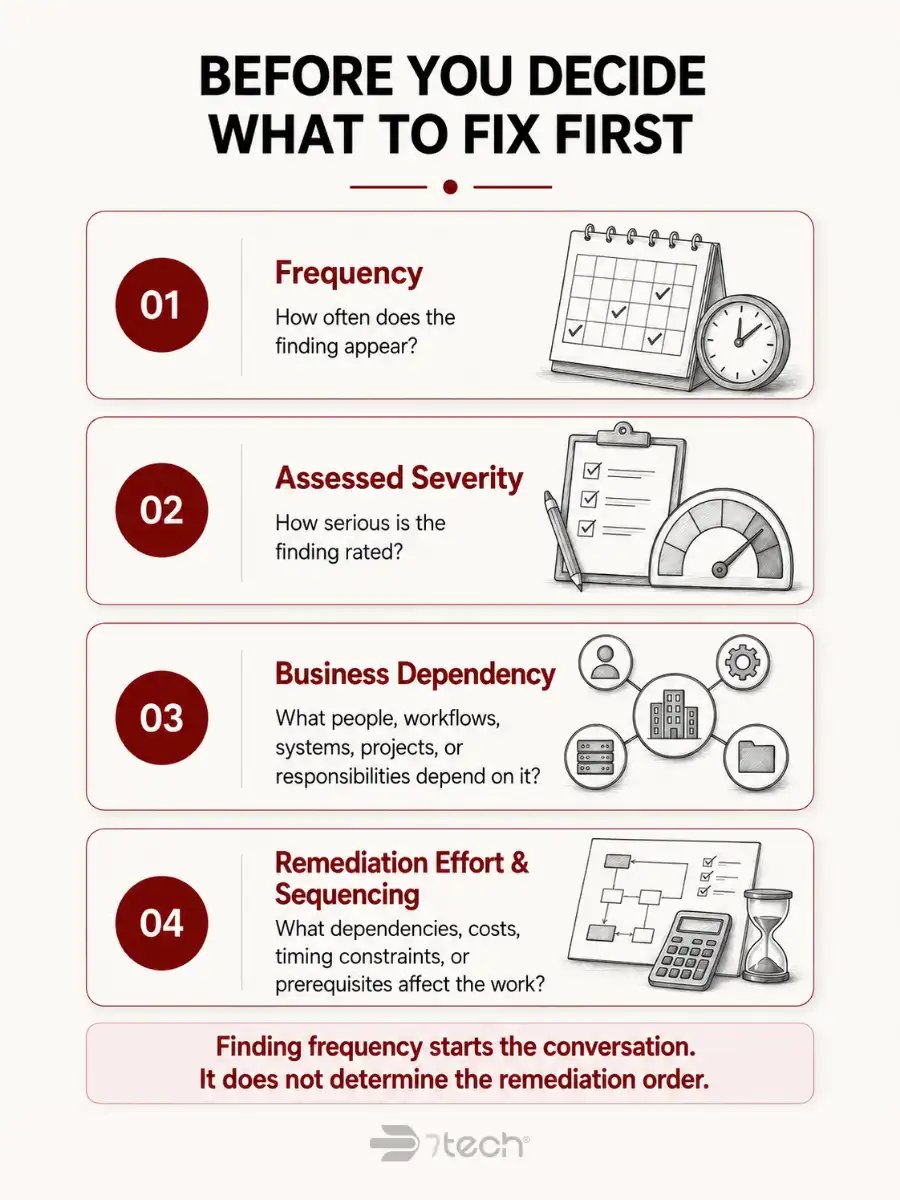
A more defensible executive review asks four questions.
- Frequency – How often does the finding appear?
- Assessed severity – How serious is the finding rated?
- Business context and operational dependency – Which people, workflows, systems, projects, or responsibilities depend on it?
- Remediation effort and sequencing – What dependencies, costs, timing constraints, or prerequisites affect what can realistically be addressed first?
The 47 assessments demonstrate why the first two questions must remain separate. A finding can dominate the frequency ranking without dominating the immediate-attention ranking.
But neither ranking completes the decision.
Leadership still needs to determine what the business depends on, which workflows or systems are exposed, what remediation work depends on other changes, who is accountable, and how the plan fits operational and budget realities.
For example, a frequently observed issue may justify a broad improvement initiative, while a less frequent but more severe finding may require immediate action because of the business process or data it affects. The correct sequence depends on context the findings count alone cannot provide.
That is where construction IT audit findings become a management decision rather than a technical task list.
Executives often pair audit interpretation with construction IT budget planning so remediation timing reflects business priorities rather than a raw findings count.
This risk-based approach is also consistent with the CISA Cybersecurity Performance Goals.
What the Findings Do and Do Not Tell Leadership
There are important limits to what these 47 assessments can establish.
They show that finding frequency and assessed severity can produce different views of what deserves attention. They do not establish a universal remediation sequence for every construction company.
Password Management’s frequency should not be minimized simply because 35 of 36 findings were rated Needs Improvement. A weakness identified in every company evaluated for that control deserves attention.
Likewise, the concentration of immediate-attention findings in Data Protection and Recovery does not prove that recovery should always move to the front of every remediation plan.
The assessments also do not measure:
- financial impact
- incident probability
- breach likelihood
- downtime
- project delays
- future incidents
Because the data represents a sample of 47 assessed construction companies, the results also should not be interpreted as construction-industry prevalence.
The defensible conclusion is narrower and more useful:
Finding counts alone should not determine remediation order.
For executives, that restraint matters. Good IT governance depends on being able to explain why one issue was funded before another, who owns the work, what the business risk is, and how leadership will know the problem has been resolved.
Better decisions come from clearer interpretation, not stronger adjectives.
A Simple Executive Decision Test for Your Last Audit
Take your most recent construction IT assessment and create three versions of the findings:
- ranked by frequency
- ranked by assessed severity
- ranked by the actual proposed remediation sequence
Then compare the three lists.
If all three are identical, leadership should ask why.
The objective is not to force the rankings to differ. The objective is to make the reasoning behind the remediation sequence visible and defensible.
For each item near the top of the proposed remediation list, an executive should be able to answer:
- Why is this issue being addressed now?
- What business process, system, project, or responsibility depends on it?
- Who owns remediation?
- What other work must happen first?
- What will demonstrate that the issue has been resolved?
The 47-company assessment results show why this comparison matters. The category that stood out by frequency was not the same category that contained the largest concentration of immediate-attention findings.
Changing the measurement changed what stood out.
That same discipline can improve how executives evaluate IT performance after an audit, particularly when technical findings must be translated into funding decisions, accountability, and operational sequencing.
When a Construction IT Audit Suggests It’s Time for Outside Help
Outside support may be worth evaluating when findings keep recurring, recovery readiness remains unclear, vendor accountability is fragmented, executive visibility is weak, or technical findings are difficult to translate into a funded remediation sequence.
The 47-assessment evidence helps explain why this can become difficult. Weaknesses can coexist across access, devices, network reliability, and recovery even when several routine security and maintenance controls are satisfactory.
That does not automatically mean an existing IT provider failed.
It may mean leadership needs a clearer operating picture, stronger accountability, deeper expertise, or a more defensible process for turning findings into an actionable roadmap.
For construction firms, the trigger for outside help is often not a single failed control. It is the inability to answer basic governance questions with confidence: What matters most? Who owns it? What should be funded first? What dependencies could delay remediation? How will leadership know the risk has actually been reduced?
For construction firms that need ongoing help converting assessment findings into an operating plan, construction managed IT services may be worth evaluating.
Before assigning accountability or changing providers, leadership can also review the questions to ask a construction IT provider to determine whether the current relationship is providing enough visibility, ownership, and strategic guidance.
Frequently Asked Questions
What is included in a construction IT audit?
A construction IT audit should examine access and account protection, password management, devices and workstations, network reliability, data protection and recovery, security awareness, and ongoing maintenance or protective controls. Strong audits evaluate cybersecurity and operational readiness together.
What is the difference between an IT audit and a cybersecurity assessment?
A cybersecurity assessment typically emphasizes security controls and exposure. A construction IT audit can be broader, examining device readiness, network reliability, recoverability, access, governance, and the operational technology dependencies the business relies on.
What were the most common construction IT audit findings in the 47 assessments?
Password Management was below satisfactory in 36 of 36 companies evaluated. Workstations were below satisfactory in 29 of 29. Access and Account Protection, Devices and Systems, Data Protection and Recovery, and Network Reliability and Protection also produced substantial below-satisfactory findings.
Which construction IT audit findings should be fixed first?
There is no universal sequence supported by this dataset. Leadership should evaluate frequency, assessed severity, business dependency, remediation effort, accountability, and sequencing before deciding what should be addressed first.
Does the most common IT audit finding represent the biggest risk?
Not necessarily. These assessments did not measure financial impact or incident probability. The most frequent finding was not the category with the largest concentration of immediate-attention findings, so frequency alone cannot establish the biggest risk.
Why should executives review severity separately from frequency?
Frequency shows how often a weakness appeared. Severity shows how the assessment rated it. Separating the two helps executives avoid assuming that the most common issue should automatically receive the highest remediation priority.
How often should construction executives review IT audit findings?
Leadership should revisit findings whenever remediation priorities, operating dependencies, budgets, or technology conditions materially change. The important governance requirement is maintaining a current, defensible view of unresolved issues, ownership, and remediation status.
Get Clarity Before You Commit to a Fix
Before leadership commits budget, staff time, or political capital to a remediation sequence, it should have a clear, non-technical view of what was found, how serious each issue was assessed to be, what the business depends on, and who is accountable for the next action.
That visibility makes it easier to distinguish what is common from what is urgent, what is technically important from what is operationally consequential, and what deserves to be funded first.
The goal is not to create more alarm around IT. It is to give leadership enough clarity to make a defensible decision.
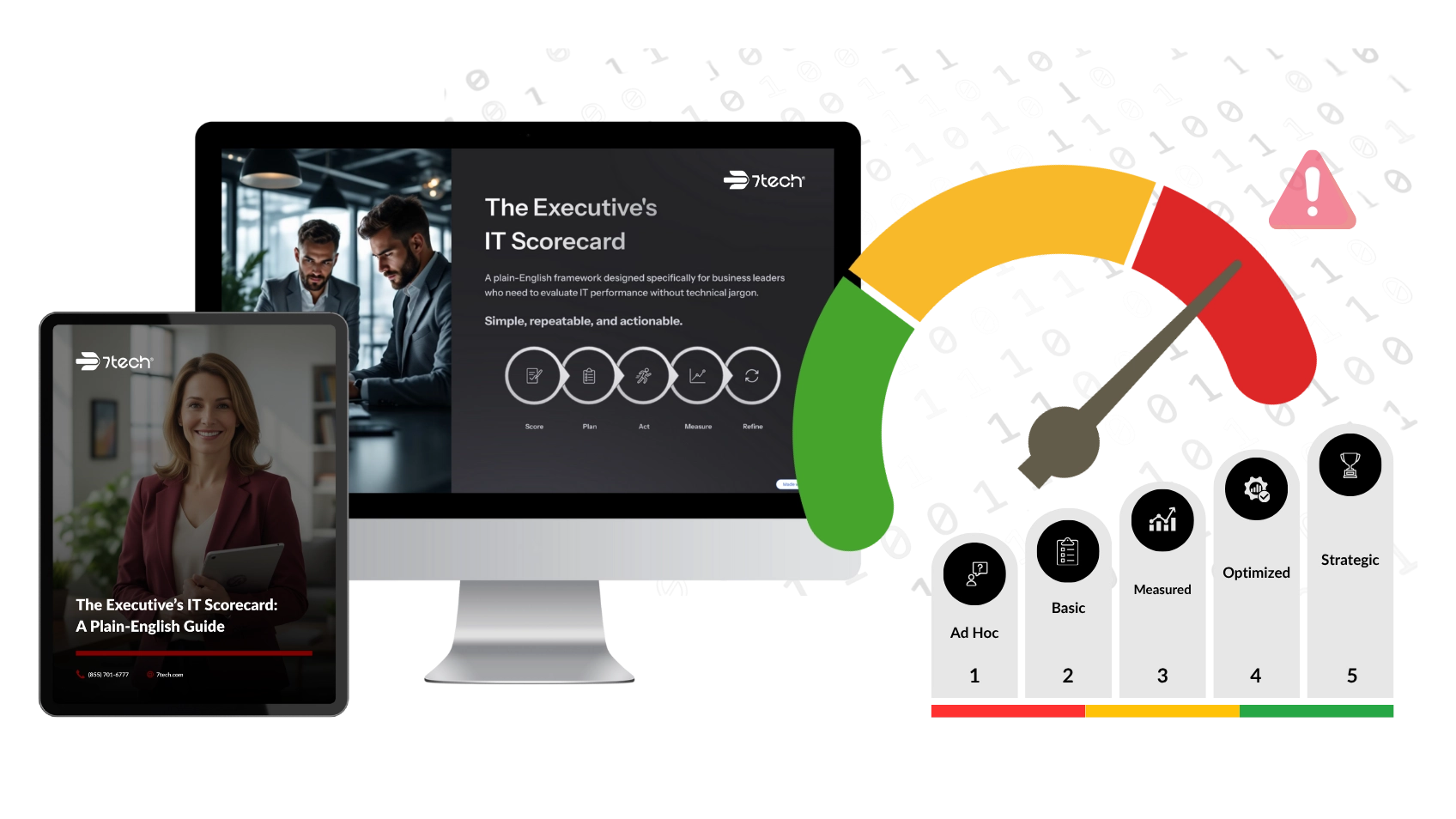
7tech’s Executive IT Scorecard is designed to give leadership a plain-language view of IT risk and operating readiness before committing to a remediation plan.
Request an Executive IT Scorecard to get a clearer view of your IT risks, dependencies, and priorities before deciding what to fix first.

Neal Juern, Founder and CEO of 7tech, helps business leaders take control of their IT and strengthen cybersecurity without the complexity. Since founding 7tech in 2012, he’s built it into a 5X MSP 501 winner and guided hundreds of executives toward smarter, safer operations through Managed IT Services and Managed Security Services that make sense to people outside the IT department. He speaks regularly to executive and nonprofit audiences across Texas.