
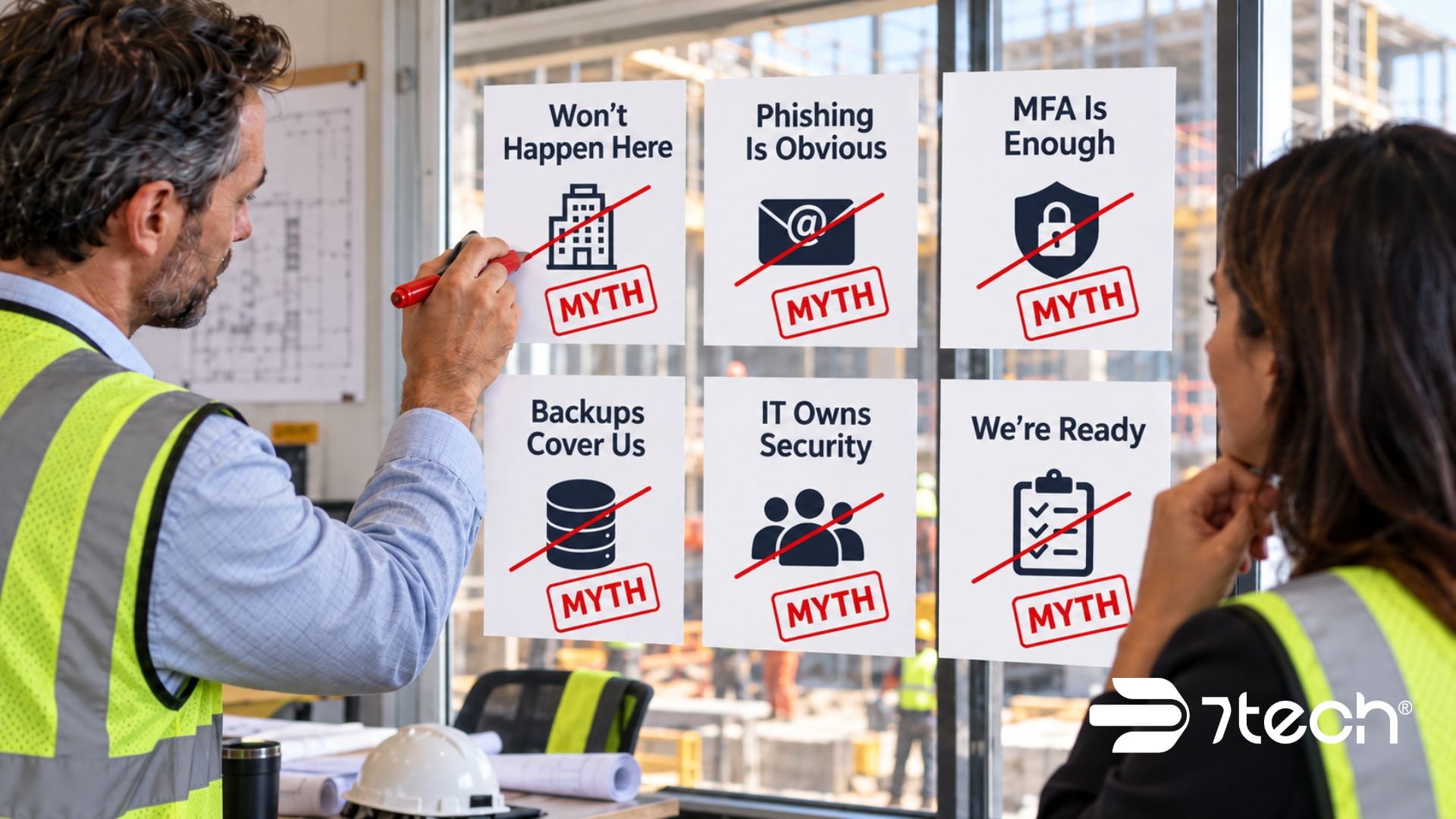
6 Construction Cybersecurity Myths That Put Your Business at Risk
Construction cybersecurity myths create risk when assumptions about phishing, MFA, backups, and incident response go untested. For contractors, the consequences can reach the jobsite quickly: delayed access to drawings, fraudulent payment instructions, unavailable project files, interrupted field-to-office communication, or downtime that keeps people from working.
Construction leaders do not need to become security experts. They need confidence that the systems and processes their teams depend on will hold up when something goes wrong. Here are six common cybersecurity myths worth checking against the way your company actually operates.
Why Cybersecurity Myths Create Risk for Construction Companies
Construction companies depend on a mix of people, systems, devices, and outside parties to keep projects moving. Estimators exchange bid information. Project managers and superintendents access files from different locations. Accounting communicates with vendors and subcontractors. Field teams rely on cloud applications and mobile devices to reach current information.
That creates a broad operating environment where a single compromised account, fraudulent request, or unavailable system can become a business problem.
The challenge is often false confidence. A company may have antivirus, backups, MFA, and an IT provider and still have gaps in account protection, recovery, monitoring, or response. Understanding the broader cybersecurity risks in construction can help leaders see where those dependencies exist.
For companies that need continuous monitoring and response beyond traditional IT support, managed security services can add layers of protection around identities, endpoints, cloud systems, email, and other parts of the environment that keep the business operating.
The six myths below focus on where construction companies can mistake having a security measure for knowing that it will work when needed.
Myth 1: “That Won’t Happen to Us”
When projects are moving and nothing serious has happened before, it is easy to assume a cyber incident is something that happens to somebody else.
Construction companies, however, depend on email, project files, accounting systems, cloud applications, vendor communication, bids, contracts, and field-to-office access every day. An attacker does not have to shut down the entire company to cause damage.
One compromised email account could be used to send fraudulent payment instructions. A stolen login could expose project information. A locked account could leave an employee without critical files when a bid is due or work is underway.
7tech construction assessment data illustrates why normal technology operation does not necessarily equal complete readiness. Updates were satisfactory in all 40 organizations evaluated for that capability, and antivirus was satisfactory in all 31 evaluated. Yet separate assessments found below-satisfactory Password Management in all 36 organizations evaluated and at least one Access and Account Protection issue in 39 of 42.
The takeaway for executives is that visible signs of healthy IT do not necessarily reveal weaknesses in identity and access protection. A construction IT audit can help validate those assumptions across the environment.
Fact: A history without a serious incident does not prove that the business is prepared for one.
Myth 2: “Employees Will Recognize a Phishing Email”
Construction phishing scams can look remarkably similar to normal project communication.
A message might appear to come from a superintendent, project manager, vendor, general contractor, subcontractor, or executive. An estimator may already be expecting a bid invitation. Accounting may routinely receive payment information. A project manager may receive links to shared files and project portals throughout the day.
That familiarity gives attackers opportunities to make fraudulent requests look routine.
Construction payment fraud deserves particular attention. The FBI’s guidance on business email compromise describes schemes involving compromised or impersonated business email accounts and recommends independently verifying requests to change account information.
Employees should pay particular attention when someone:
- Makes an unusual or urgent request
- Changes payment or banking instructions
- Requests sensitive company, employee, client, or project information
- Sends an unexpected login or file-sharing link
- Asks someone to bypass a normal approval process
For payment or account changes, verification should happen through a known phone number or another trusted channel—not through the contact information in the suspicious message.
Fact: A professional-looking message can still create an expensive operational problem.
Myth 3: “MFA Fully Protects Our Accounts”
Multi-factor authentication is an important layer of construction IT security, but it does not make an account invulnerable.
Attackers can use stolen credentials alongside techniques such as MFA fatigue or prompt bombing. A user receives repeated approval requests until they accidentally approve one or respond simply to make the prompts stop.
On a busy workday, an unexpected sign-in request can feel like another interruption. Employees need a simple rule: If you did not initiate the login, do not approve it. Report it so the activity can be investigated.
CISA’s guidance on MFA fatigue explains how repeated push notifications can be abused and describes stronger approaches to authentication.
Deployment matters too. 7tech construction assessment data found incomplete MFA deployments and broader access-protection gaps, with at least one below-satisfactory Access and Account Protection finding in 39 of 42 organizations evaluated.
Construction leaders should know where MFA is enforced, whether exceptions exist, what authentication methods are being used, and how suspicious login activity is handled. Reviewing the benefits of two-factor authentication can also help leadership understand where MFA fits within broader access protection.
Fact: MFA reduces risk, but its effectiveness depends on where it is deployed and the controls and decisions surrounding it.
Myth 4: “Our Backups Have Us Covered”
For a contractor, backup confidence should come from proven recovery.
If ransomware or another technology failure made critical information unavailable tomorrow, could your teams recover estimating files, contracts, drawings, project documentation, accounting data, photos, RFIs, submittals, and other records? How long would it take? Which systems would be restored first? Who would manage the process?
Those are construction backup and recovery questions because unavailable data quickly becomes an operational issue.
7tech construction assessment data reinforces the distinction. Cloud-to-Cloud Backup received 18 immediate-attention findings among 39 organizations evaluated, while Backup & Disaster Recovery received 6 among 34 evaluated. The readiness criteria also call for a defined recovery process and evidence from a recent recovery test.
That difference matters. A company can have backup technology in place while still lacking confidence that critical cloud data or business systems can be restored within an acceptable timeframe.
NIST guidance on ransomware risk management similarly addresses backup, response, and recovery as parts of ransomware preparedness. Construction leaders can also examine the backup assumptions construction companies make when evaluating whether their current approach supports actual recovery.
Fact: Having a backup is not the same as knowing the business can recover.
Myth 5: “Cybersecurity Is Only IT’s Responsibility”
Many of the decisions that create or reduce construction cyber risk happen during ordinary business operations.
Accounting receives payment changes. Project teams share files with outside parties. Employees access project portals from the field. HR adds and removes users. Executives approve systems and vendors. None of those activities requires employees to become cybersecurity specialists, but each can affect the company’s exposure.
The goal is to give employees clear expectations for the moments that matter: when to verify a request, when to stop and ask, what information should be protected, and who to contact when something does not look right.
CISA’s guidance for small businesses reinforces the role leadership and employees play in building a cybersecurity culture and preparing the organization to respond to incidents.
For construction executives, accountability should be clear. Leadership should understand who owns security decisions, who monitors the environment, who removes access when an employee leaves, who handles suspicious activity, and what responsibilities remain with an outside IT or security provider.
If those responsibilities are unclear, these questions to ask a construction IT provider can help uncover gaps between what leadership assumes is covered and what the provider actually manages.
Fact: IT manages many technical safeguards, but cybersecurity depends on decisions made across the business.
Myth 6: “We Know What to Do If Something Happens”
Picture a Tuesday morning when several employees suddenly cannot open project files or sign into systems. A superintendent needs drawings. Accounting is trying to determine whether payments are affected. Project managers are calling the office. Leadership needs to know whether jobs can keep moving.
Uncertainty can compound the disruption quickly.
A practical construction incident response plan should establish:
- Who reports the problem and who takes ownership
- What employees should do with affected computers or mobile devices
- How the office and field will communicate if normal systems are unavailable
- When cyber insurance, legal counsel, clients, or other outside parties should be contacted
- Which systems and project information must be restored first
- Who has authority to make time-sensitive operational decisions
The plan does not need to be complicated. It needs to be clear, current, accessible, and practiced.
Gomez Floor Covering experienced how quickly a cybersecurity problem can become an operational one. Repeated breaches and ransomware attacks ultimately caused company-wide downtime and stalled productivity.
That experience reinforces why construction business continuity planning and cybersecurity preparedness belong in the same conversation. The company’s business continuity planning for construction should account for the technology and information teams need to continue working when normal systems are disrupted.
Fact: Your recovery plan should be familiar before the day you need it.
What Should Construction Leaders Verify Now?
Construction cyber preparedness becomes more useful when leadership can verify a few business-critical controls rather than simply asking whether the company is “secure.”
- Payment verification: Can unusual or changed banking instructions be independently verified before money moves?
- Account protection: Do you know where MFA is enforced, where exceptions exist, and how suspicious authentication activity is handled?
- Recovery: Have critical backups actually been restored successfully, and do you know how long recovery would take?
- Incident ownership: Is there a clearly identified person or team responsible for coordinating the response?
- Field and office communication: Can teams continue communicating if normal email, cloud, or collaboration systems become unavailable?
- Recovery priorities: Does everyone involved know which systems, project information, and business functions must come back first?
Cyber insurance belongs in that review as well. Construction companies should understand their construction cyber insurance requirements and make sure the security controls represented during the insurance process remain in place throughout the policy period.
For leaders who cannot confidently answer the questions above, a cybersecurity assessment checklist can provide a practical framework for identifying what needs to be validated.
Frequently Asked Questions About Construction Cybersecurity Myths
What are the biggest cybersecurity risks in construction?
Common risks include phishing, payment fraud, stolen credentials, ransomware, weak access controls, inadequate backup recovery, and unclear incident response. Their impact can include inaccessible project files, fraudulent payments, downtime, and interrupted communication between field and office teams.
Why are construction companies vulnerable to phishing?
Construction teams routinely exchange bids, invoices, payment instructions, project files, and portal links with many outside parties. Attackers can imitate those familiar workflows, making fraudulent messages harder to distinguish from legitimate project communication.
Is MFA enough to protect a construction company?
MFA significantly strengthens account security, but it is one layer of protection. Its effectiveness depends on proper deployment, authentication methods, monitoring, access controls, employee behavior, and how suspicious login activity is handled.
What should construction companies back up?
Priorities depend on the business but may include drawings, contracts, RFIs, submittals, estimating data, accounting information, project documentation, photos, cloud data, and other records required to keep work moving. Recovery of critical information should also be tested.
Who is responsible for construction cybersecurity?
Responsibility is shared. IT or a security provider manages many technical controls, while executives, accounting, HR, operations, project teams, and employees make business decisions that can affect security. Leadership should establish clear ownership and escalation procedures.
What should a construction incident response plan include?
It should define response ownership, reporting procedures, communication methods, outside contacts, decision authority, recovery priorities, and responsibilities for notifying clients, vendors, insurers, or other affected parties when appropriate.
How can construction leaders tell whether their cybersecurity is working?
Look for evidence rather than assumptions. Verify access controls, MFA coverage, monitoring, payment procedures, backup restoration, employee preparedness, incident ownership, and recovery testing. A construction IT audit can help identify gaps that normal day-to-day operations may not reveal.
Cybersecurity Awareness Starts With the Facts
For construction leaders, cybersecurity awareness is useful when it protects outcomes they are already responsible for: keeping people productive, maintaining access to project information, protecting payments, and preventing avoidable disruption from affecting the work.
The common thread across these construction cybersecurity myths is unverified confidence. A company can have antivirus, MFA, backups, an IT provider, and cyber insurance while still having gaps that only become visible when something fails.
Construction leaders should be able to verify whether unusual payment requests will be challenged, whether critical files can be restored, whether suspicious activity will be detected, and whether everyone knows who owns the response when systems become unavailable.
If you are not sure how those assumptions would hold up on a real workday, 7tech can help evaluate the gaps in plain business terms and identify what deserves attention first.
Next step: Schedule a brief 15-minute conversation with 7tech to review where a preventable technology issue could interrupt your work.
Call (844) 701-6777 or visit 7tech.com.

Neal Juern, Founder and CEO of 7tech, helps business leaders take control of their IT and strengthen cybersecurity without the complexity. Since founding 7tech in 2012, he’s built it into a 5X MSP 501 winner and guided hundreds of executives toward smarter, safer operations through Managed IT Services and Managed Security Services that make sense to people outside the IT department. He speaks regularly to executive and nonprofit audiences across Texas.