
3 Common AI-Powered Cybersecurity Threats Facing Manufacturers and How to Protect Production
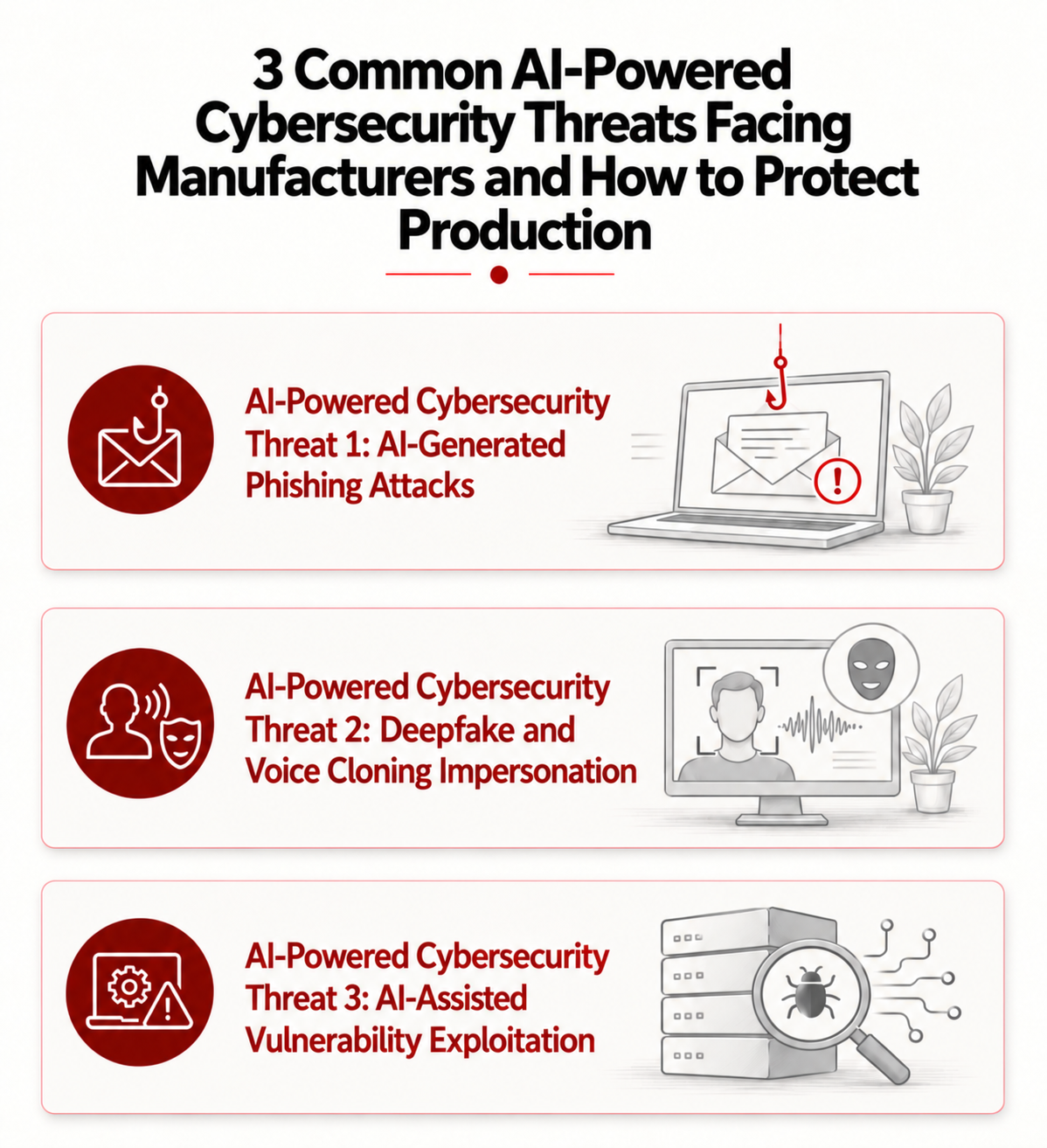
The three AI-powered cybersecurity threats manufacturers should prepare for are AI-generated phishing attacks, deepfake impersonation scams, and AI-assisted vulnerability exploitation. These attacks can disrupt purchasing, compromise financial transactions, expose proprietary designs, and interrupt the systems supporting production. Strong verification procedures, phishing-resistant multifactor authentication, disciplined patching, and security monitoring can help manufacturers reduce those risks.
Manufacturers are also exploring AI to improve production planning, quality control, and operational efficiency. A well-defined managed AI services strategy can help companies evaluate these opportunities while establishing appropriate safeguards for sensitive business and production information.
But while your team puts AI to work, criminals may be using it to target purchasing employees, engineers, financial transactions, and plant-connected systems.
A cyberattack doesn’t have to compromise an industrial robot or machine controller to disrupt production. If employees lose access to enterprise resource planning (ERP), scheduling, inventory, or shipping systems, a well-run plant can suddenly struggle to complete essential activities.
For CEOs, COOs, CFOs, and IT leaders, the stakes include production uptime, on-time delivery, premium freight expenses, proprietary designs, recovery costs, and customer commitments.
 Executive Summary: What Manufacturing Leaders Need to Know
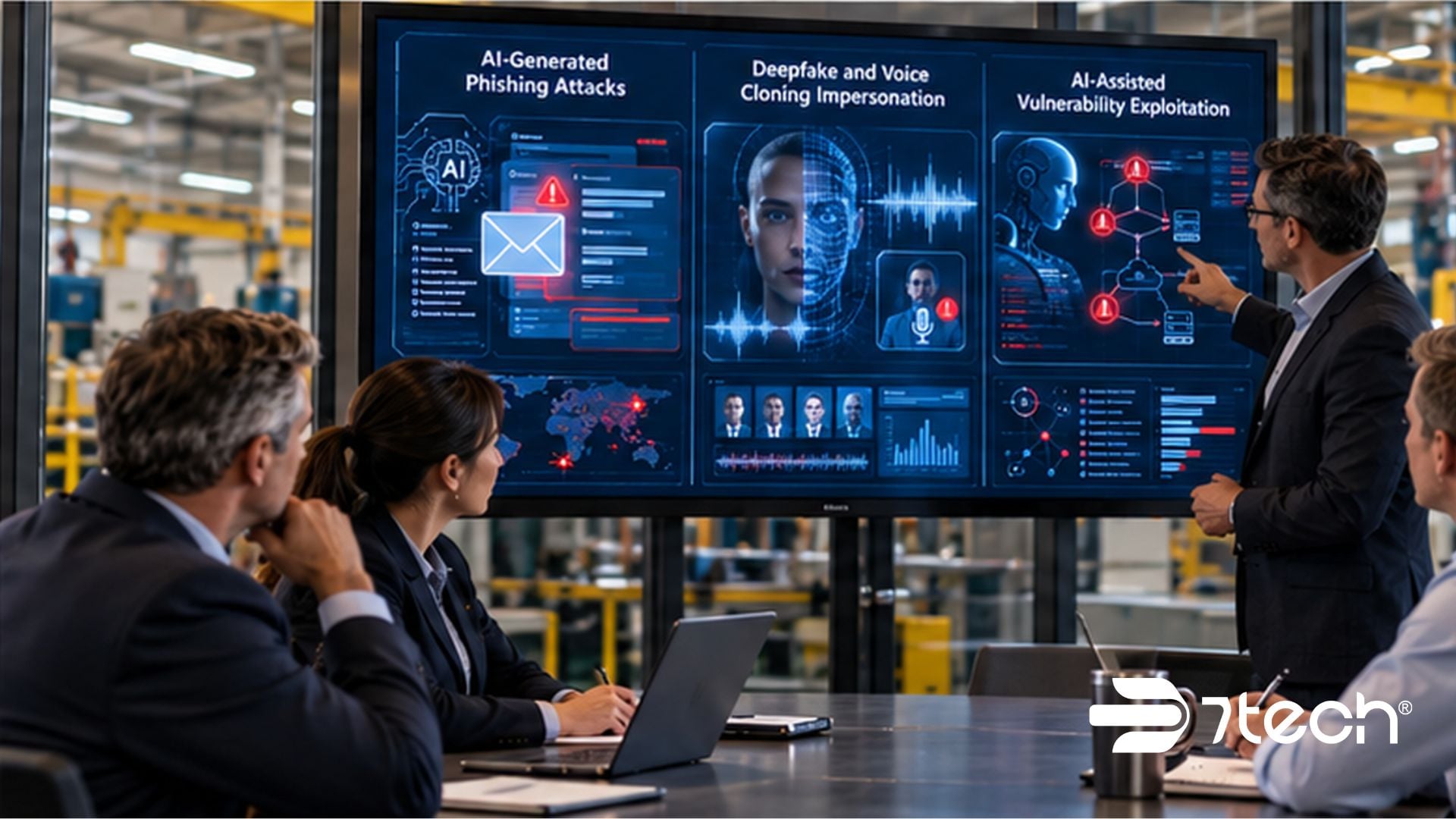
- AI-generated phishing: Convincing messages impersonating suppliers, customers, or employees can redirect payments, steal credentials, and disrupt procurement.
- Deepfake impersonation: AI-generated voices and videos can make fraudulent instructions appear to come from executives, plant managers, or financial officers.
- AI-assisted vulnerability exploitation: Criminals can use AI to accelerate research into weaknesses in outdated servers, remote-access systems, and technology supporting production.
The strongest response isn’t simply buying another security product. It’s confirming how sensitive requests are approved, who maintains critical systems, and how suspicious activity is investigated and contained.
Why Do AI-Powered Cybersecurity Threats Matter on the Manufacturing Plant Floor?
An AI-powered cybersecurity threat is an attack in which artificial intelligence helps criminals create persuasive communications, impersonate trusted individuals, research vulnerabilities, or execute parts of an intrusion more efficiently.
AI doesn’t automatically unlock protected networks. It can, however, reduce the effort required to prepare and personalize familiar attacks.
An attacker might use AI to draft a supplier-specific email, imitate an executive’s voice, research a manufacturer’s technology vendors, or interpret publicly disclosed software vulnerabilities.
The UK’s National Cyber Security Centre (NCSC) assesses that AI will almost certainly make elements of cyber intrusions more effective and efficient through 2027. Its assessment emphasizes that AI is primarily enhancing existing techniques rather than creating entirely new categories of threats.
For manufacturers, this distinction is important.
You don’t necessarily need an entirely new cybersecurity strategy. You need to confirm that existing safeguards account for the interconnected technology supporting your operation.
That includes Microsoft 365, accounting applications, ERP systems, manufacturing execution systems (MES), engineering workstations, and network infrastructure supporting plant operations.
The concern is what happens when an attack affects a dependency that production teams rely on every day.
AI-Powered Cybersecurity Threat 1: Phishing That Targets Suppliers and Production Workflows
In manufacturing, phishing often arrives disguised as routine business communication: a purchase order, freight notification, revised drawing, or invoice from a familiar supplier.
Spelling mistakes and unusual formatting were once common warning signs. They still matter, but AI-generated phishing emails can contain professional writing, accurate part numbers, and references to real business relationships.
These messages are examples of AI social engineering attacks, which manipulate people into sharing information, approving payments, or granting unauthorized access.
How Could AI Phishing Disrupt Production?
Imagine a purchasing employee receiving an email that appears to come from a longstanding components supplier.
The message references an open purchase order and explains that the next shipment cannot be released until payment goes to updated banking details.
The part numbers are correct. The deadline is tight. Production depends on those materials.
But the banking instructions are fraudulent.
If the employee processes the change without independent verification, the company could lose the payment and still face a material shortage.
Other phishing messages may target Microsoft 365, ERP accounts, engineering files, or supplier portals through counterfeit login pages and malicious attachments.
Even when operational technology (OT) is separated from office systems, compromised business applications can interrupt scheduling, procurement, inventory management, and shipping.
An attacker doesn’t need access to a machine controller to create costly disruption.
How Can Manufacturers Prevent AI Phishing Attacks?
Effective AI phishing prevention requires verification procedures built into purchasing, finance, and engineering workflows.
- Verify supplier banking changes independently. Contact the supplier using information already established in vendor records.
- Require phishing-resistant MFA where practical. Prioritize email, ERP, remote-access, and administrator accounts.
- Strengthen email security. Use filtering, appropriate domain authentication, and a simple suspicious-message reporting process.
- Train employees across departments. Purchasing, finance, engineering, and shipping teams should recognize unusual payment instructions, counterfeit login requests, and unexpected document links.
The NIST phishing guidance for small businesses reinforces the importance of employee awareness and practical account protection.
The executive takeaway: A professional-looking supplier email is not proof of authorization. Protect financial approval procedures so one fraudulent message cannot become lost cash, delayed materials, or missed production commitments.
AI-Powered Cybersecurity Threat 2: Deepfake Impersonation That Targets Financial and Operational Decisions
Some criminals now have a more convincing disguise: a familiar voice or face.
AI deepfake scams use synthetic audio or video to imitate real people. AI voice cloning scams can make fraudulent instructions appear to come from trusted executives, colleagues, or business partners.
How Could Voice Cloning Affect Manufacturing Operations?
Imagine an accounts payable manager receiving a call that sounds exactly like the CFO.
The caller explains that an urgent wire transfer must be completed before a supplier cutoff time, or a scheduled production run could be delayed.
The urgency feels legitimate because supplier shortages and production deadlines are real pressures.
But the caller isn’t the CFO.
The scam relies on familiarity and pressure, not necessarily a perfect imitation.
Manufacturing employees routinely make time-sensitive decisions involving procurement, payments, logistics, and operations. Attackers can exploit those circumstances to request fraudulent transfers, account resets, or confidential information.
Finance, procurement, human resources, plant operations, and IT support teams are all potential targets.
The NSA, FBI, and CISA address these risks in their joint guidance on deepfake threats to organizations.
A familiar voice should never override established approval procedures.
How Can Manufacturers Prevent Deepfake Fraud?
The strongest deepfake fraud prevention measures remain effective even when employees cannot identify an AI-generated imitation.
- Verify unusual instructions independently. Contact the supposed sender using previously verified information.
- Require dual authorization. Establish two-person approval for significant transfers and supplier banking changes.
- Use a separate communication channel. Initiate a new conversation instead of replying to the incoming call or message.
- Restrict account privileges. Purchasing, accounting, engineering, and plant employees should have access appropriate to their responsibilities.
- Practice realistic scenarios. Rehearse urgent supplier payments, executive requests, and unexpected account resets.
Employees should understand that pausing a suspicious transaction for verification is responsible decision-making, even when the caller claims production is at risk.
The executive takeaway: Employees shouldn’t have to determine whether a voice is real. Approval procedures should make a fraudulent voice insufficient to move money or grant access.
AI-Powered Cybersecurity Threat 3: AI-Assisted Exploitation of Manufacturing IT and Plant Dependencies
Not every AI-powered cyberattack involves manipulating an employee.
Attackers can also use AI to research vulnerabilities, analyze exposed systems, and accelerate portions of technical attacks.
A vulnerability is a weakness in software, hardware, configurations, or access controls that could permit unauthorized activity.
In manufacturing, vulnerable systems may include ERP servers, MES platforms, engineering workstations, remote-access services, and equipment management applications.
These systems may be essential to production even when they aren’t industrial controllers.
How Could AI-Assisted Vulnerability Exploitation Affect Production?
Cybercriminals have researched technical weaknesses for years. AI-assisted vulnerability exploitation can make portions of that research more efficient.
Attackers might use AI-powered vulnerability scanning and research tools to investigate exposed services, interpret security advisories, or analyze known weaknesses.
AI doesn’t automatically compromise a factory network. Successful exploitation still depends on a real vulnerability and a workable attack path.
However, the operational consequences can be significant.
A compromised ERP server could interrupt production scheduling. Unavailable engineering workstations could delay access to drawings. Disruption to shipping applications could interfere with fulfilling customer orders.
A successful intrusion may also create opportunities for ransomware to make critical systems unavailable.
Understanding how to protect a manufacturing plant from ransomware helps leaders examine safeguards that limit the impact of compromise and support recovery.
How Can Manufacturers Reduce AI-Assisted Vulnerability Exploitation?
Protecting production requires identifying critical dependencies and addressing vulnerabilities without creating avoidable operational disruption.
- Maintain systems through controlled maintenance windows. Patch supported IT systems promptly, but coordinate changes for sensitive plant environments.
- Prioritize exploitable weaknesses. Focus on exposed services and vulnerabilities known to be actively exploited.
- Inventory IT and OT dependencies. Include ERP and MES servers, engineering workstations, networking equipment, and vendor connections.
- Segment networks and restrict remote access. Limit unnecessary communication between corporate IT and production environments.
- Monitor suspicious activity and test recovery. Verify that business-critical systems and data can be restored after an incident.
Manufacturing IT and OT require different maintenance considerations.
Office applications may support routine updates, while industrial systems can have safety, availability, and vendor-support requirements. Active scanning or untested changes can interfere with sensitive industrial environments.
Understanding how to secure OT and plant operations helps manufacturers coordinate security improvements with engineering teams, plant managers, and equipment vendors.
A complete vulnerability management program should establish asset ownership, maintenance procedures, remediation tracking, and compensating safeguards for equipment that cannot be updated safely.
The executive takeaway: Security awareness cannot compensate for exposed, unpatched systems. IT and operations need a shared approach to reducing risk that respects production requirements.
How Can Manufacturers Protect Production Uptime Against AI-Powered Cyberattacks?
Understanding how to prevent AI cyberattacks begins with a practical question:
Could your team demonstrate which safeguards protect the systems behind today’s production schedule and customer shipments?
The strongest response combines verified financial approvals, secure account access, disciplined maintenance, and effective security monitoring.
| Manufacturing Priority | Recommended Safeguard | Business Outcome |
|---|---|---|
| Supplier payments | Verify banking changes and significant transactions | Reduced exposure to financial fraud |
| Critical accounts | Require MFA and appropriate permissions | Lower risk from compromised credentials |
| Production dependencies | Patch supported systems and address important vulnerabilities | Fewer preventable interruptions |
| Employee readiness | Train purchasing, engineering, finance, and operations teams | More consistent responses to suspicious requests |
| Business continuity | Monitor activity and test recovery | Improved containment and restoration capabilities |
These safeguards work best as one coordinated program.
For example, threat detection and response can help identify suspicious account or endpoint activity, while network segmentation limits opportunities for threats to spread.
Neither replaces thoughtful maintenance procedures or coordinated change management in industrial environments.
How Is Employee AI Use Different From AI-Powered Cyberattacks?
Manufacturers should distinguish between external attackers using AI and employees using AI for legitimate work.
Attacker-operated AI can support phishing, impersonation, and vulnerability research.
Employee-operated AI introduces governance risks when employees use unapproved tools or enter confidential information into systems that haven’t been evaluated.
An engineering employee might upload proprietary drawings or customer specifications to an AI platform. A purchasing employee might expose sensitive supplier agreements or pricing information.
These are different risks requiring different controls.
Manufacturers should establish policies governing approved tools, acceptable data use, and appropriate human review before expanding AI adoption.
The objective is to capture productivity benefits without creating unmanaged exposure involving intellectual property, customer information, or production data.
When Should a Manufacturer Consider Outside Cybersecurity Support?
A manufacturer’s internal IT team may be excellent at keeping systems running but still lack the time or specialized resources for continuous security monitoring, vulnerability management, and complex vendor access oversight.
That doesn’t necessarily mean the team needs to be replaced.
It may mean additional capabilities are required.
Outside expertise is worth evaluating when:
- Critical updates or remote vendor access are inconsistently managed.
- Financial verification procedures aren’t tested.
- Security alerts lack clear investigation and escalation ownership.
- Leadership cannot confidently identify which systems would disrupt production if unavailable.
- Internal IT personnel are stretched between operational support, cybersecurity, and compliance.
These are practical risks worth examining before a small incident becomes a missed customer commitment.
For manufacturers with limited internal security capacity, managed security services can provide additional monitoring, vulnerability management, and incident response expertise.
How Does 7tech Support Manufacturing IT and Cybersecurity?
7tech works with Texas manufacturers to strengthen the technology supporting production, administration, and business continuity.
Its managed IT services for manufacturers help organizations maintain dependable systems and establish clearer accountability for technology operations.
7tech also provides endpoint protection, vulnerability management, security monitoring, and layered cybersecurity controls supported by an in-house, U.S.-based Security Operations Center.
For organizations with an existing IT department, these services can supplement internal resources and provide additional security expertise without requiring the company to replace its team.
The business value of dependable technology is reflected in 7tech’s work with Watco Tanks. Its Systems & Scheduling Manager, Garrick Mullen, described the experience:
“We don’t worry about IT disrupting production anymore.”
That is the operational confidence manufacturers should expect their technology strategy to support.
Frequently Asked Questions About AI-Powered Cybersecurity Threats in Manufacturing
Which AI-powered cybersecurity threat poses the biggest risk to manufacturers?
It depends on the operation. Supplier-payment phishing can disrupt procurement, impersonation can bypass financial controls, and exploitation can interrupt critical systems. Prioritize according to potential impacts on production, customer commitments, and recovery.
Can AI-generated phishing disrupt manufacturing production?
Yes. Compromised accounts, fraudulent supplier instructions, or unavailable ERP systems can delay materials, scheduling, and shipments even when industrial controllers aren’t directly affected.
How should manufacturers verify AI voice cloning scams?
End the unexpected interaction and independently contact the person through a verified channel. Require established financial approval procedures before transferring funds or changing account permissions.
Can AI automatically compromise factory networks?
No. AI can assist vulnerability research and certain attack activities, but successful exploitation still depends on real weaknesses and access opportunities.
Do manufacturing IT and OT systems require different controls?
Yes. OT may involve safety, availability, and vendor-support requirements. Coordinate security changes with engineering and operations, using segmentation and compensating safeguards when routine patching isn’t appropriate.
How often should manufacturers review cybersecurity exposure?
Maintain ongoing monitoring and vulnerability management. Reassess after ERP integrations, new production lines, plant acquisitions, remote vendor connections, or security incidents.
Protect Your Production Schedule Before an AI-Powered Attack Tests Your Defenses
AI is making familiar cyberattacks more convincing and potentially faster.
Manufacturers can still take practical steps to reduce exposure without compromising operational efficiency.
Independent verification reduces financial fraud risk. Strong access controls and disciplined maintenance reduce opportunities for compromise. Monitoring and tested recovery procedures help organizations respond when incidents occur.
The important question isn’t whether employees can recognize every AI-generated scam.
It’s whether one fraudulent email, cloned voice, or vulnerable system could create an avoidable production disruption.
For manufacturing leaders, the first step is understanding what is protected, which operations depend on it, and where important gaps remain.
7tech’s free 27-Point IT Network Assessment gives Texas manufacturers a starting point for reviewing network security, critical systems, backups, and operational reliability.
The remote assessment provides a customized IT optimization plan in plain language. You can use the findings with your existing IT team or provider, with no obligation to change partners.
Protect production continuity with decisions grounded in evidence, not assumptions.
Claim your free 27-Point IT Network Assessment or call (844) 701-6777 to learn more.

Neal Juern, Founder and CEO of 7tech, helps business leaders take control of their IT and strengthen cybersecurity without the complexity. Since founding 7tech in 2012, he’s built it into a 5X MSP 501 winner and guided hundreds of executives toward smarter, safer operations through Managed IT Services and Managed Security Services that make sense to people outside the IT department. He speaks regularly to executive and nonprofit audiences across Texas.