
3 Common AI-Powered Cybersecurity Threats That Could Disrupt Your Nonprofit’s Mission
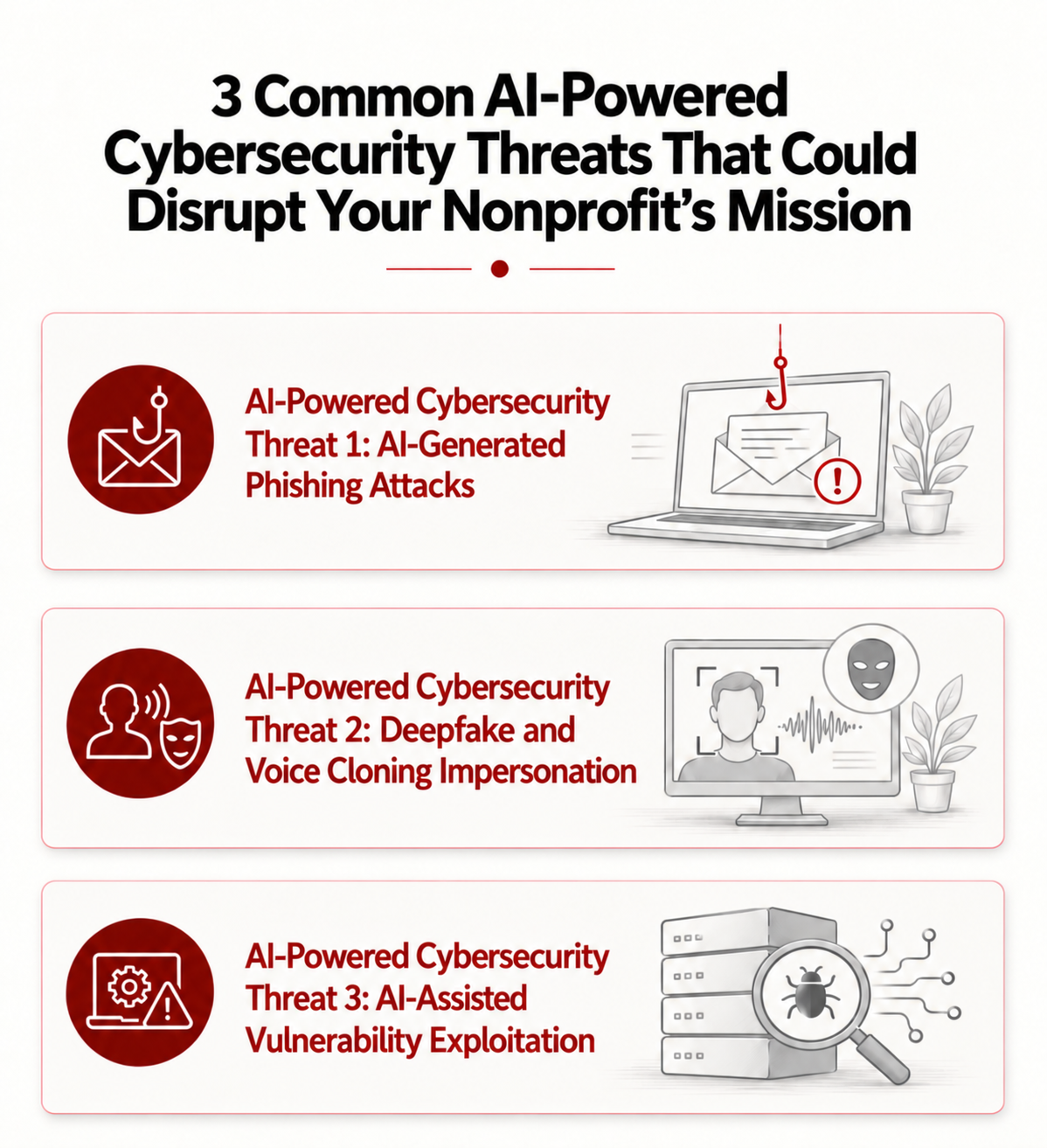
The three AI-powered cybersecurity threats nonprofit leaders should prepare for are AI-generated phishing attacks, deepfake impersonation scams, and AI-assisted vulnerability exploitation. These familiar threats are becoming more convincing and efficient, putting donor contributions, confidential client information, and community programs at risk. Independent verification, stronger account protection, timely security updates, and continuous monitoring can help protect your mission without requiring employees to become cybersecurity experts.
Nonprofits are also exploring AI to expand their impact without significantly increasing administrative costs. A thoughtful managed AI services strategy can help organizations evaluate these tools while establishing appropriate safeguards for donor records, confidential information, and daily operations.
But securing the AI tools your staff uses is only half the equation. You also need to defend against criminals using AI to target your employees, financial transactions, and systems.
For nonprofit CEOs, executive directors, and board members, the stakes extend beyond technology.
One fraudulent transfer could divert funding from essential programs. One compromised account could expose donor or client records. One unavailable system could delay services that vulnerable individuals depend on.
The objective isn’t to build an unnecessarily expensive cybersecurity program. It’s to understand which safeguards are working and where limited resources can make the greatest difference.
 Executive Summary: What Nonprofit Leaders Need to Know
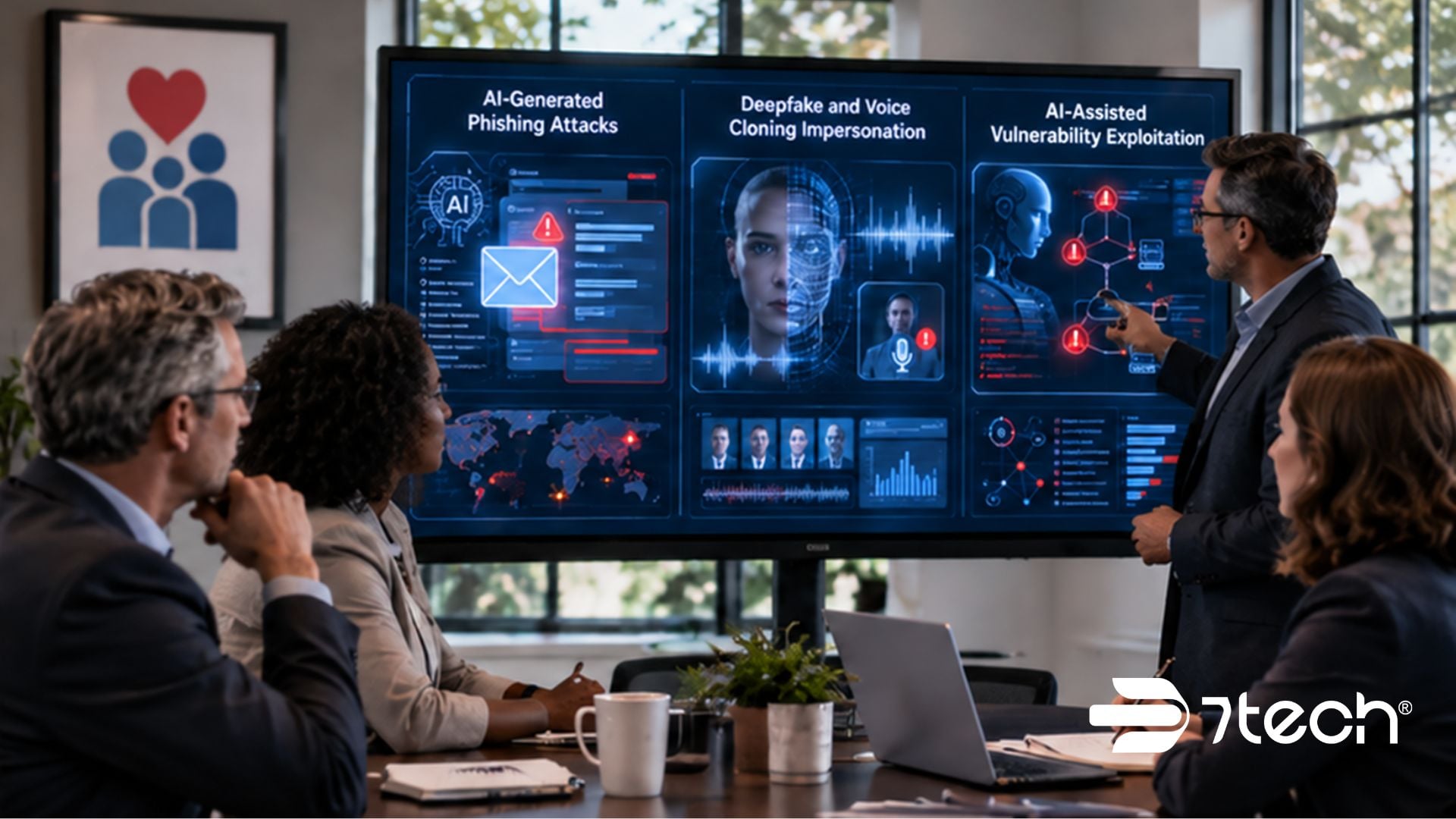
- AI-generated phishing: Convincing messages impersonating donors, grantmakers, banks, or vendors can steal credentials, redirect payments, or expose sensitive information.
- Deepfake impersonation: Criminals can use AI-generated voices or videos to imitate executive directors, board members, and financial officers.
- AI-assisted vulnerability exploitation: Attackers can use AI to accelerate research into weaknesses in outdated software, cloud applications, and connected systems.
The strongest defense combines independent verification, multifactor authentication, consistent system maintenance, and security monitoring.
For resource-constrained nonprofits, the priority is protecting the activities most essential to mission delivery.
Why Are AI-Powered Cybersecurity Threats Different for Nonprofits?
An AI-powered cybersecurity threat is an attack in which artificial intelligence helps criminals create convincing messages, impersonate trusted individuals, research vulnerabilities, or execute parts of an intrusion more efficiently.
AI doesn’t automatically unlock protected networks. It can, however, reduce the time and effort criminals spend preparing familiar attacks.
For example, an attacker might use AI to draft a persuasive grant-related email, imitate a board treasurer’s voice, gather publicly available staff information, or research software vulnerabilities.
The UK’s National Cyber Security Centre (NCSC) assesses that AI will almost certainly make elements of cyber intrusions more effective and efficient through 2027. Its assessment emphasizes that AI primarily strengthens existing attack methods rather than creating entirely new categories of threats.
For nonprofits, that distinction matters.
Your organization doesn’t necessarily need an entirely new cybersecurity strategy. It needs confidence that existing controls can withstand more convincing deception and faster-moving attacks.
This is particularly important when limited IT resources must support fundraising, program delivery, financial accountability, volunteer coordination, and confidential client records.
AI-Powered Cybersecurity Threat 1: Phishing That Impersonates Donors and Grantmakers
Phishing is an established cybersecurity threat, but AI can make fraudulent nonprofit communications considerably more convincing.
Nonprofit employees regularly receive legitimate requests involving donations, grants, invoices, community partnerships, and confidential information.
That creates opportunities for criminals to disguise malicious instructions as routine work.
Employees once relied heavily on spelling mistakes and awkward language to recognize suspicious emails. Those signs still matter, but AI-generated phishing emails can contain polished writing and accurate references to real donors or programs.
These messages are examples of AI social engineering attacks, which manipulate people into revealing information, transferring money, or granting access.
How Could AI Phishing Affect Donations and Program Operations?
Imagine a development director receiving an email that appears to come from a major donor’s representative.
The message references a legitimate pledge and asks the team to verify banking details through a new sign-in link.
The communication is professional, friendly, and accurately references the organization’s fundraising campaign.
But the link leads to a counterfeit login page designed to steal account credentials.
A similar message could impersonate a grantmaker requesting financial records, a payroll provider sending an urgent account notice, or a community partner sharing confidential documents.
The consequences could extend beyond email access.
A compromised fundraising account might expose donor records. Fraudulent payment instructions could divert money from essential programs. Unavailable systems could interfere with services employees provide to the community.
How Can Nonprofits Prevent AI Phishing Attacks?
Effective AI phishing prevention focuses on verification rather than relying on whether a message appears legitimate.
- Verify payment changes independently. Confirm unusual donor, vendor, or grant-related financial requests using trusted contact information already on file.
- Require multifactor authentication (MFA). Protect email, fundraising applications, financial platforms, and remote-access accounts. Prioritize phishing-resistant methods where practical.
- Strengthen email protection. Use filtering, appropriate domain authentication, and simple suspicious-message reporting procedures.
- Train employees with relevant scenarios. Practice grant approvals, donation record requests, payroll changes, gift card scams, and confidential client information requests.
The NIST phishing guidance for small businesses reinforces the importance of employee awareness and practical security measures.
Nonprofit teams can strengthen everyday verification practices with 7tech’s guidance on phishing scam prevention.
The nonprofit leadership takeaway: A professional-looking donor or grantmaker email is not proof of authorization. Simple verification procedures can help protect funding, sensitive information, and hard-earned donor trust.
AI-Powered Cybersecurity Threat 2: Deepfake Scams That Impersonate Nonprofit Leaders
What would happen if an employee received an urgent financial instruction from someone who sounded exactly like the executive director or board chair?
AI deepfake scams use synthetic audio or video to imitate real people. AI voice cloning scams can make fraudulent calls or recordings appear to come from familiar leaders.
A recognizable voice can make an unusual request appear credible, particularly when it references urgent community needs.
How Could Voice Cloning Put Nonprofit Funds at Risk?
Imagine a nonprofit finance manager receiving a call that sounds like the board treasurer.
The caller explains that an emergency payment must be completed immediately to secure an important program partnership.
The request seems plausible, and the employee wants to help the organization fulfill its mission.
But the caller isn’t the treasurer.
This is what makes AI impersonation scams dangerous. They exploit the trust and urgency that nonprofit employees bring to their work.
An attacker doesn’t necessarily need a flawless imitation. The message only needs enough credibility to influence a rushed decision.
Finance, development, human resources, and program teams deserve particular attention because they handle contributions, employee information, financial approvals, and confidential client records.
The NSA, FBI, and CISA address these risks in their joint guidance on deepfake threats to organizations.
How Can Nonprofits Prevent Deepfake Fraud?
Effective deepfake fraud prevention relies on established procedures that work even when employees cannot recognize an AI-generated imitation.
- Use independent callbacks. Confirm unusual requests through verified contact information.
- Require dual authorization. Apply two-person approval to significant transfers, unusual disbursements, and changes to banking details.
- Verify through a separate channel. Start a new communication rather than replying to the suspicious call or message.
- Limit access to sensitive information. Give employees and volunteers only the permissions required for their responsibilities.
- Encourage employees to pause. Staff should know that saying, “I need to verify this first,” demonstrates responsible stewardship.
These procedures should apply regardless of the caller’s title or the urgency of the request.
Even a convincing imitation of the executive director should not override established financial controls.
The nonprofit leadership takeaway: Recognizing someone’s voice is no longer dependable proof of identity. Consistent authorization procedures protect donated funds and the people your nonprofit serves.
AI-Powered Cybersecurity Threat 3: AI-Assisted Exploitation of Outdated Nonprofit Systems
Not every AI-powered cyberattack begins with a suspicious email or phone call.
Criminals can use AI to accelerate research into vulnerabilities in software, cloud applications, remote-access systems, and connected devices.
A vulnerability is a weakness in technology or its configuration that could permit unauthorized activity.
Examples include outdated operating systems, missed security updates, exposed remote-access services, and poorly secured cloud accounts.
How Could AI-Assisted Exploitation Disrupt Nonprofit Services?
Attackers might use AI-powered vulnerability scanning and research tools to investigate exposed systems, interpret public security advisories, or analyze known weaknesses.
That doesn’t mean AI can automatically compromise a nonprofit network.
Successful exploitation still depends on actual technical weaknesses, available access, and the attacker’s capabilities.
However, the consequences of compromise can extend far beyond technology.
A compromised donor database could expose personal information and damage donor confidence.
An unavailable case-management platform could interrupt client services. A disrupted financial application could delay payroll, reporting, or grant administration.
These problems can be especially challenging when an organization depends on a small internal IT team or aging technology.
A successful intrusion can also create opportunities for ransomware to make essential systems and data unavailable.
Understanding ransomware prevention for nonprofit organizations helps leadership evaluate safeguards that protect important information and support mission continuity.
How Can Nonprofits Reduce AI-Assisted Vulnerability Exploitation?
The priority is establishing a dependable process for identifying and addressing significant security weaknesses.
- Keep essential systems updated. Include employee computers, fundraising systems, case-management platforms, cloud applications, servers, and networking equipment.
- Prioritize dangerous vulnerabilities. Focus on internet-facing systems and weaknesses known to be actively exploited.
- Check systems regularly. Identify forgotten devices, outdated applications, and insecure configurations.
- Control account access. Promptly remove permissions when employees or volunteers leave. Restrict sensitive records to authorized users.
- Monitor suspicious activity and test recovery. Confirm that essential records and systems can be restored after an incident.
A vulnerability scan alone isn’t a complete protection plan.
Someone must own remediation, prioritize findings, and verify that important weaknesses have been corrected.
The nonprofit leadership takeaway: Employee awareness cannot compensate for outdated systems. Protecting your mission requires careful people, dependable technology, and clear accountability.
How Can Resource-Constrained Nonprofits Reduce AI Cybersecurity Risks?
Understanding how to prevent AI cyberattacks doesn’t require an unlimited technology budget.
It requires identifying which safeguards protect your most important programs, financial resources, and confidential information.
A useful question for nonprofit executives and board members is:
Can we demonstrate that our most important cybersecurity protections are in place and working?
| Nonprofit Priority | Recommended Safeguard | Mission-Focused Outcome |
|---|---|---|
| Financial verification | Independently confirm sensitive payment requests | Reduced risk of donated funds being diverted |
| Account protection | Require MFA and appropriate permissions | Better protection for donor and client information |
| System maintenance | Apply updates and correct critical vulnerabilities | Reduced risk of preventable service interruptions |
| Employee readiness | Provide relevant security awareness training | More consistent responses to suspicious requests |
| Monitoring and recovery | Investigate unusual activity and test backups | Stronger continuity for essential programs |
These safeguards work best as one coordinated plan instead of a collection of disconnected products.
For example, continuous monitoring helps organizations investigate suspicious activity after preventive safeguards are bypassed.
Access restrictions can also limit the information or systems a compromised user can reach.
Nonprofit executives should focus on whether these protections are implemented and maintained, not simply whether they appear on a technology inventory.
How Is Employee AI Use Different From AI-Powered Cyberattacks?
Nonprofit leaders should distinguish between two separate cybersecurity concerns.
Attacker-operated AI introduces external threats involving phishing, impersonation, and vulnerability exploitation.
Employee-operated AI introduces governance risks when employees or volunteers process confidential information using tools that haven’t been approved or evaluated.
An employee might use AI to summarize sensitive case notes, analyze donor lists, or draft correspondence containing private information.
Those activities can create confidentiality risks when the nonprofit lacks clear rules about approved applications and acceptable data use.
For nonprofit executives and board members, AI governance for nonprofits helps establish who approves AI tools, who oversees their use, and how organizational risks should be managed.
A practical AI policy for nonprofits translates those responsibilities into instructions employees and volunteers can follow.
Policies should identify approved tools, define restrictions on sensitive information, establish human review requirements, and explain how staff should report mistakes.
The objective isn’t to stop innovation.
It’s to let nonprofit teams use AI productively without unnecessarily exposing donor records, client information, or confidential program data.
When Should a Nonprofit Consider Outside Cybersecurity Support?
Nonprofit CEOs and executive directors shouldn’t need to become cybersecurity specialists.
They should, however, receive clear answers about what is protected, who manages important risks, and how the organization will respond when something goes wrong.
Outside support may be worth evaluating when:
- Critical systems aren’t consistently updated.
- Employees lack reliable financial verification procedures.
- Security alerts don’t receive appropriate investigation.
- Leadership cannot explain whether essential information and systems could be restored.
- Internal IT responsibilities exceed available staff capacity.
These are reasons to investigate potential gaps, not proof that an incident is imminent.
For nonprofits with limited internal resources, managed security services can provide specialized monitoring, investigation, and cybersecurity support without requiring the organization to build an entire security operation in-house.
How Does 7tech Help Nonprofits Protect Their Mission?
7tech works with Texas nonprofit organizations to strengthen the technology supporting fundraising, service delivery, administration, and business continuity.
Its IT support for nonprofit organizations combines system management, cybersecurity protection, and practical guidance for organizations balancing limited resources with growing responsibilities.
7tech also provides security monitoring, vulnerability management, and endpoint protection supported by an in-house, U.S.-based Security Operations Center.
For nonprofits with existing IT personnel, these capabilities can supplement internal resources. For organizations without dedicated IT staff, 7tech can provide fully managed support.
The objective is to create greater confidence that technology won’t become an unnecessary obstacle to serving the community.
That outcome is reflected in 7tech’s work with STARRY, a nonprofit organization whose CEO, Richard Singleton, described the experience:
“Their professionalism and accountability allow us to focus on our clients like never before, increasing our level of service and dependability.”
For nonprofit executives balancing mission delivery, donor stewardship, and limited resources, that’s the value cybersecurity and IT support should help deliver.
Frequently Asked Questions About AI Cybersecurity for Nonprofits
What is the biggest AI cybersecurity threat facing nonprofits?
There is no single highest risk for every nonprofit. AI-generated phishing, executive impersonation, and exploitation of outdated systems can threaten donor funds, confidential information, and program continuity.
Can trained nonprofit employees still fall for AI phishing?
Yes. AI-generated messages can appear professional and reference legitimate donors or programs. Training should emphasize independent verification and unusual requests, not just spelling mistakes.
How can employees verify a suspected AI voice cloning scam?
End the unexpected interaction and independently contact the person through a verified channel. Require established approval procedures for significant transactions and access changes.
Can AI automatically compromise a nonprofit’s network?
No. AI can assist vulnerability research and certain attack activities, but successful exploitation still depends on actual weaknesses or access opportunities. Updates, restricted permissions, and monitoring reduce exposure.
Will existing cybersecurity tools protect nonprofits from AI-powered threats?
That depends on their configuration, maintenance, and monitoring. Security tools should support reliable employee procedures and a clearly defined incident response process.
How often should nonprofits review cybersecurity risks?
Maintain ongoing monitoring and vulnerability management. Reassess after major technology changes, staff transitions, security incidents, or changes to the confidential information your organization handles.
Protect Your Mission Before an AI-Powered Cyberattack Interrupts It
Your donors contribute because they believe in your mission. Your employees and volunteers show up because people depend on the services you provide.
Cybersecurity helps protect both commitments.
Independent verification reduces exposure to fraudulent payments. Timely updates address important weaknesses. Strong account protection and monitoring help organizations respond to suspicious activity.
The goal isn’t to make every nonprofit employee an expert at recognizing AI-generated scams.
It’s to establish safeguards that protect your funding, your people, and your programs when a convincing attack gets through.
For nonprofit executives, the first step is understanding which protections are working and where limited resources can make the greatest difference.
7tech’s free 27-Point IT Network Assessment provides Texas nonprofit leaders with a starting point for reviewing network security, essential systems, backups, and operational efficiency.
The remote assessment provides a customized IT optimization plan in plain language, helping leaders discuss findings with their teams and boards.
You can use the recommendations with your existing provider or internal staff. There is no obligation to change partners.
Protect donor trust. Protect the people you serve. Keep your mission moving.
Claim your free 27-Point IT Network Assessment or call (844) 701-6777 to learn more.

Neal Juern, Founder and CEO of 7tech, helps business leaders take control of their IT and strengthen cybersecurity without the complexity. Since founding 7tech in 2012, he’s built it into a 5X MSP 501 winner and guided hundreds of executives toward smarter, safer operations through Managed IT Services and Managed Security Services that make sense to people outside the IT department. He speaks regularly to executive and nonprofit audiences across Texas.