
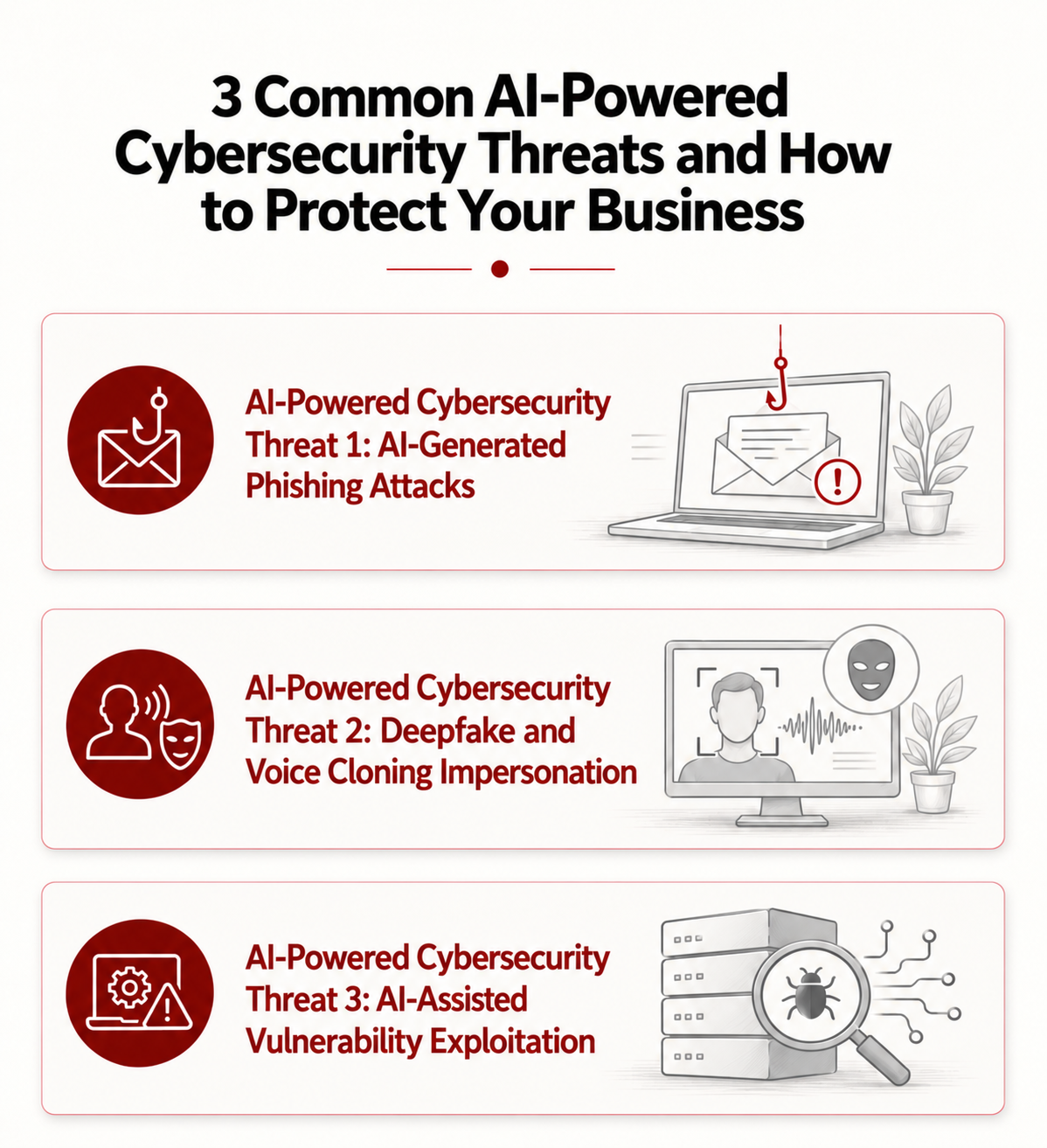
3 Common AI-Powered Cybersecurity Threats and How to Protect Your Business
The three most common AI-powered cybersecurity threats businesses should prepare for are AI-generated phishing attacks, deepfake impersonation scams, and AI-assisted vulnerability exploitation. Artificial intelligence makes familiar cyberattacks more convincing and can help criminals identify weaknesses faster. Businesses can reduce their exposure through stronger verification procedures, multifactor authentication, timely software patching, and continuous security monitoring.
As businesses embrace AI to improve productivity and operations, cybersecurity needs to evolve alongside that adoption. A well-defined managed AI services strategy helps organizations establish appropriate governance, protect sensitive information, and adopt AI tools with greater confidence. But securing the AI your business uses is only half the equation. You also need to defend against criminals using AI to target your employees, systems, and data.
The real danger isn’t that AI has created unstoppable new threats. It’s that familiar attacks can now arrive in more convincing disguises, with less effort required from the people behind them.
For CEOs, CFOs, and IT leaders, the concern is straightforward: a fraudulent payment, compromised account, or exploited system can interrupt operations, expose sensitive data, and undermine customer trust.
Executive Summary: What Business Leaders Need to Know
- AI-generated phishing: Fraudulent emails and messages can appear polished, personalized, and legitimate.
- Deepfake impersonation: AI-generated voices and videos can make fraudulent requests seem to come from trusted people.
- AI-assisted exploitation: Attackers can use AI to accelerate vulnerability research and potentially exploit known weaknesses.
The most effective response combines human verification, controlled access, consistent patching, and ongoing threat monitoring. The first step is understanding where those safeguards may be missing.
What Makes AI-Powered Cybersecurity Threats Different?
An AI-powered cybersecurity threat is a cyberattack in which artificial intelligence helps a criminal create, personalize, research, or execute part of an attack.
AI doesn’t automatically give attackers access to a protected network. Nor does every cybercriminal use sophisticated AI tools. What AI changes is the effort required to carry out certain activities.
For example, attackers can use AI to draft persuasive messages, imitate someone’s voice, analyze publicly available information, or assist with vulnerability research.
These capabilities can make established attack methods more efficient without making them fully autonomous.
The UK’s National Cyber Security Centre (NCSC) assesses that AI will almost certainly make elements of cyber intrusions more effective and efficient through 2027. Its assessment emphasizes that AI is largely enhancing existing attack techniques rather than creating entirely new categories of cyber threats.
The distinction matters because businesses don’t necessarily need an entirely new cybersecurity strategy. They need to confirm that existing safeguards can withstand more convincing deception and faster-moving attacks.
The joint U.S. guidance on deepfake threats to organizations from the NSA, FBI, and CISA emphasizes organizational verification, employee awareness, and preparation for AI-enabled impersonation.
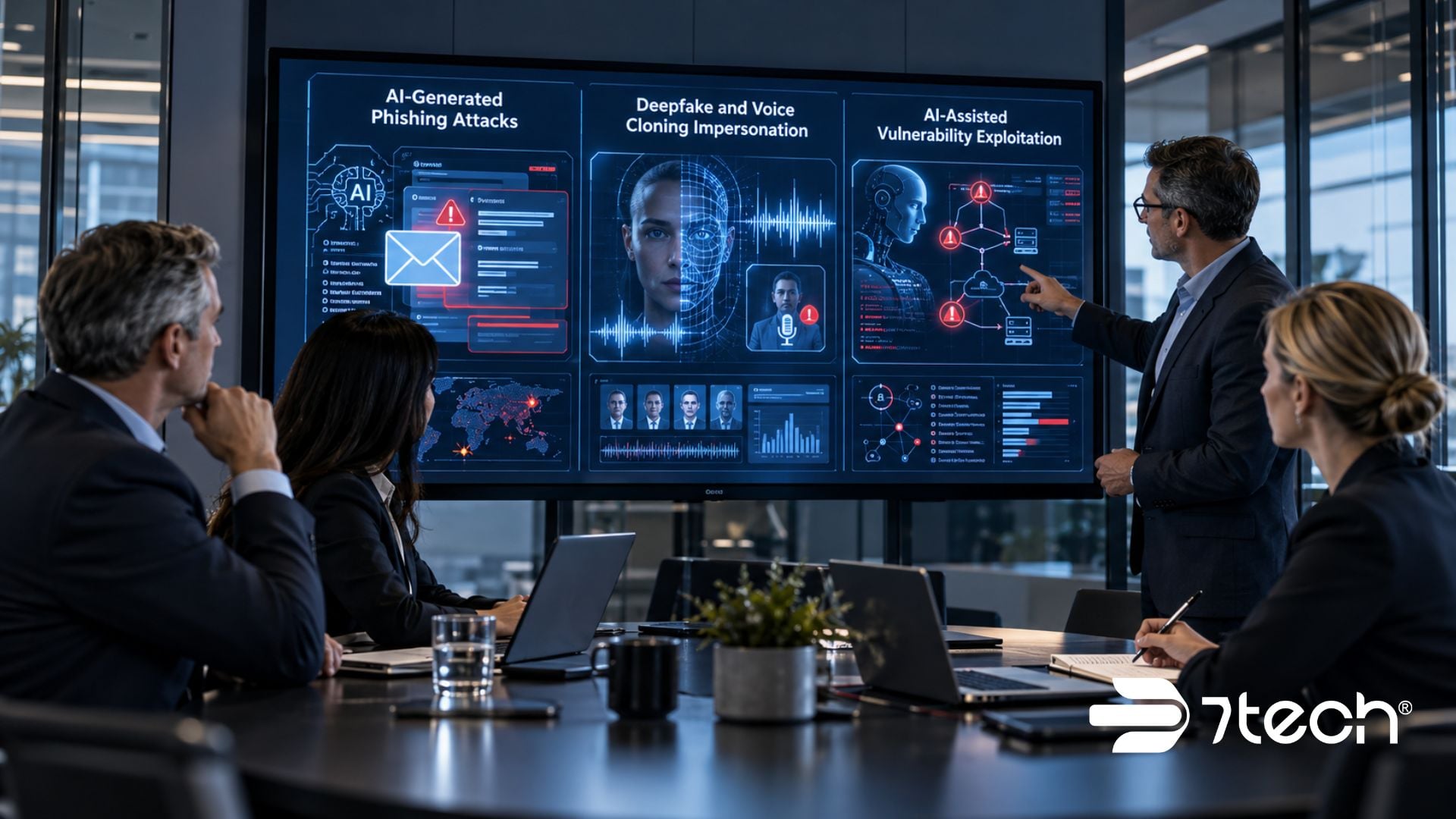
AI-Powered Cybersecurity Threat 1: AI-Generated Phishing Attacks
Phishing remains a familiar threat, but AI gives it a more convincing disguise.
Previously, employees were often taught to recognize suspicious emails by looking for poor grammar, spelling mistakes, or unusual formatting. Those warning signs still matter, but they are no longer reliable enough on their own.
AI-generated phishing emails can contain professional language, accurate business terminology, and personalized references to employees or vendors.
These messages are one form of AI social engineering attacks, which manipulate people into disclosing information, transferring money, or granting unauthorized access.
Consider a finance employee receiving an email that appears to come from a familiar supplier. The message references an outstanding invoice and requests payment to an updated bank account.
Everything looks routine. The wording is polished, the timing seems reasonable, and the sender appears legitimate.
But the payment instructions are fraudulent.
AI phishing attacks can also target login credentials, payroll information, and sensitive business records. A carefully worded message may direct an employee to a counterfeit sign-in page or pressure someone into bypassing normal approval procedures.
How to Prevent AI Phishing Attacks
The strongest AI phishing prevention strategy focuses on validating the request rather than judging how convincing a message looks.
- Verify payment changes independently. Contact the vendor using an established phone number, not information contained in the suspicious email.
- Require multifactor authentication (MFA). An additional authentication factor can help protect accounts when passwords are stolen. Phishing-resistant MFA provides stronger protection against credential phishing.
- Strengthen email protection. Use filtering, domain authentication, and suspicious-message reporting capabilities.
- Train employees to question unusual requests. Even professionally written messages deserve scrutiny when they involve money, credentials, or confidential information.
The NIST phishing guidance for small businesses reinforces the importance of employee awareness and practical protective controls.
Businesses can also reinforce these procedures through 7tech’s guidance on phishing scam prevention.
The executive takeaway: A correctly spelled email is not a verified request. Build approval procedures that employees can follow even when the message appears completely legitimate.
AI-Powered Cybersecurity Threat 2: Deepfake and Voice Cloning Impersonation
Some cybercriminals now have a more sophisticated disguise: a familiar voice or face.
AI deepfake scams use synthetic audio or video to imitate real people. AI voice cloning scams can make a fraudulent phone call or recorded message sound like a trusted executive, colleague, or business partner.
Imagine an accounts payable manager receiving a call that appears to come from the company’s CFO.
The caller sounds familiar and explains that an urgent wire transfer must be completed before a supplier deadline.
An employee who trusts the voice may assume the instruction is legitimate.
That’s exactly what makes AI impersonation scams dangerous. They target the trust employees place in familiar people and established business relationships.
Like a shapeshifter from a Halloween story, the impersonator doesn’t need to become the real person. The disguise only needs to be convincing enough to influence a decision.
Finance, human resources, and operations departments are particularly important places to examine because they routinely approve payments, change account information, and handle sensitive records.
How to Prevent Deepfake Fraud and Voice Cloning Scams
Effective deepfake fraud prevention depends on procedures that remain reliable even when a caller sounds authentic.
- Use independent callbacks. Confirm sensitive instructions through a previously verified phone number or communication channel.
- Require dual authorization. Establish two-person approval for high-value payments and changes to banking information.
- Verify requests through a separate channel. A message received by phone should be confirmed through an independently initiated communication.
- Limit account privileges. Employees should have only the access required for their roles, reducing the potential impact of a successful impersonation.
- Practice suspicious-request scenarios. Employees should know how to challenge an unusual instruction without fear of delaying legitimate business.
The NSA, FBI, and CISA recommend organizational processes that help personnel recognize and respond to synthetic-media threats.
These procedures matter even when a deepfake cannot be identified visually or audibly. A convincing imitation may fool an employee, but it should not automatically override a required financial approval or account-access control.
The executive takeaway: A recognizable voice is no longer sufficient proof of identity. A well-defined approval process offers more dependable protection than asking employees to detect every deepfake.
AI-Powered Cybersecurity Threat 3: AI-Assisted Vulnerability Exploitation
Not every AI-powered cyberattack depends on deceiving an employee.
Some criminals use AI to support technical research, identify weaknesses, and accelerate parts of an attack.
A vulnerability is a weakness in software, systems, or configurations that could allow unauthorized activity. Common examples include outdated applications, missing security updates, exposed remote-access services, and improperly configured systems.
Attackers have searched for these weaknesses for years. AI-assisted vulnerability exploitation can make portions of that research and analysis more efficient.
For example, an attacker might use AI-powered vulnerability scanning and research tools to help identify exposed systems, interpret technical documentation, analyze publicly disclosed vulnerabilities, or develop code related to an identified weakness.
That does not mean an AI tool can automatically break into any business network. Actual exploitation still depends on the vulnerability, the environment, available access, and the attacker’s capabilities.
However, the risk is becoming more concrete.
In its May 11, 2026 AI Threat Tracker, Google Threat Intelligence Group reported identifying a threat actor using a zero-day exploit that researchers believed was developed with AI.
The NCSC also assesses that AI-assisted vulnerability research and exploit development will become increasingly significant through 2027, particularly for systems that have not received available security updates.
For business leaders, the implication is clear: delays in vulnerability management may leave systems exposed as attackers gain more efficient ways to find and investigate weaknesses.
It’s the cybersecurity equivalent of discovering an unlocked door. The attacker’s tools may change, but the underlying weakness is what creates the opportunity.
How to Reduce AI-Assisted Vulnerability Exploitation
Protection starts with knowing which systems are exposed and maintaining a disciplined process for correcting weaknesses.
- Keep software updated. Apply security updates to operating systems, applications, network devices, and business-critical platforms.
- Prioritize critical vulnerabilities. Give particular attention to internet-facing systems and weaknesses known to be exploited.
- Conduct regular vulnerability assessments. Identify outdated systems, exposed services, and configuration problems before they become incidents.
- Restrict unnecessary access. Use least-privilege permissions and appropriate network segmentation.
- Monitor for suspicious activity. Continuous monitoring can help identify signs of exploitation that preventive controls may miss.
Effective vulnerability management is not simply a matter of running a periodic scan. It requires an accurate inventory of systems, ownership of remediation tasks, and a process for confirming that identified weaknesses have been addressed.
Understanding your organization’s network security threats and vulnerabilities is an important starting point.
The executive takeaway: Security awareness cannot compensate for unpatched systems. Employees need dependable procedures, while IT teams need the visibility and resources to maintain technical safeguards.
How to Reduce Your Exposure to AI-Powered Cybersecurity Threats
Understanding how to prevent AI cyberattacks starts with a practical question: Can your organization demonstrate that its most important safeguards are working?
The three threats differ in how they work, but the business response follows a consistent pattern: protect identities, verify sensitive actions, maintain systems, and monitor for compromise.
| Priority | Practical Safeguard | Business Outcome |
|---|---|---|
| 1. Verify | Independently confirm payment, access, and account-change requests | Reduced exposure to impersonation and fraud |
| 2. Protect accounts | Require MFA and appropriate access permissions | Lower risk from compromised credentials |
| 3. Maintain systems | Patch software and prioritize exploitable vulnerabilities | Reduced technical attack exposure |
| 4. Prepare employees | Provide security awareness training and reporting procedures | More consistent responses to suspicious activity |
| 5. Monitor continuously | Detect and investigate unusual system and account behavior | Faster identification and containment of potential threats |
These controls should work together rather than operate as disconnected initiatives.
For example, threat detection and response helps businesses identify suspicious behavior after an attacker bypasses an initial safeguard. Meanwhile, a zero trust architecture limits implicit trust and requires appropriate verification of access.
CISA’s guidance on multifactor authentication for businesses emphasizes requiring MFA for critical accounts, including remote access and administrative access. These basic safeguards remain essential even as attacks become more sophisticated.
Business leaders should also distinguish between two related but different categories of risk.
Defending against attacker-operated AI means protecting employees, accounts, and technology from malicious activity such as phishing, impersonation, and vulnerability exploitation.
Securing employee use of AI means establishing appropriate rules for the AI tools employees use, the information those tools can access, and how that information is handled.
Organizations exploring AI internally should understand how adopting AI securely in your business supports responsible use. They should also consider shadow AI risks in business when employees use unauthorized or unapproved AI applications.
These governance challenges deserve attention, but they are distinct from the three attacker-driven threats examined here.
Businesses can pursue practical business uses for AI tools while maintaining security standards designed to protect critical operations and sensitive information.
A balanced approach enables productivity without assuming every new technology or every AI-generated communication can be trusted.
When Should Your Business Bring in Outside Cybersecurity Help?
Business leaders don’t need to become cybersecurity experts. They do need confidence that their teams can explain how risks are identified, who owns each safeguard, and what happens when something fails.
Outside support may be valuable when:
- Security updates are inconsistent or no one can confirm whether critical vulnerabilities have been addressed.
- Employees lack clear approval procedures for payments, credential resets, or sensitive data requests.
- Security tools generate alerts without reliable investigation and response.
- Leadership cannot determine which systems are exposed or whether important business data can be recovered.
These are practical gaps worth evaluating before an incident, not reasons to assume a breach is inevitable.
For businesses without sufficient internal resources, managed security services can provide ongoing expertise and operational support.
7tech helps organizations strengthen cybersecurity through a private, U.S.-based Security Operations Center, proactive threat monitoring, vulnerability management, and layered security controls.
Its approach combines threat prevention, detection, and response with practical support for organizations that need stronger protection without building an entire security operation internally.
7tech has supported Texas businesses since 2012, including manufacturers, construction firms, nonprofits, and organizations with regulatory compliance requirements.
Whether an organization has an internal IT team or relies on an outside provider, the objective is the same: give leadership greater visibility into risk and a more accountable approach to protecting business operations.
A cybersecurity risk assessment can help establish which improvements deserve priority before resources are committed to additional tools or services.
Frequently Asked Questions About AI-Powered Cybersecurity Threats
What is the biggest AI cybersecurity risk for businesses?
There is no single biggest risk for every business. AI-enhanced phishing, impersonation fraud, and vulnerability exploitation deserve attention because they can affect financial approvals, account security, sensitive information, and business continuity.
Can AI-generated phishing emails bypass employee awareness training?
Yes. Employees may miss convincing phishing emails if training relies heavily on spelling errors or suspicious formatting. Effective training also emphasizes independent verification, unusual request patterns, and prompt reporting.
How can a business verify a suspected AI voice cloning scam?
End the suspicious interaction and contact the person through a previously verified channel. For sensitive financial requests, require a second authorized approver before completing the transaction.
Can AI automatically exploit any business network?
No. AI may accelerate vulnerability research and assist certain attack activities, but successful exploitation depends on exploitable weaknesses and other technical conditions. Patching, access restrictions, and monitoring remain essential.
Are existing cybersecurity tools enough to stop AI-powered cyberattacks?
That depends on how they are configured, maintained, and monitored. Tools alone cannot replace employee verification procedures, timely remediation, access management, or an established incident response process.
How often should businesses review their exposure to AI-powered threats?
Review exposure continuously through monitoring and vulnerability management, with formal reassessments after major technology changes, security incidents, or significant changes in business operations.
Know Where Your Business Stands Before an Attack Tests Your Defenses
AI is changing the speed and sophistication of familiar cyber threats, but businesses still have practical ways to reduce their exposure.
Reliable verification procedures can help prevent fraud. Consistent patching and limited access can reduce opportunities for exploitation. Ongoing monitoring can improve visibility when suspicious activity occurs.
The important question isn’t whether your business can recognize every AI-generated disguise. It’s whether your safeguards can protect critical operations when a convincing attack reaches your organization.
Start with clarity, not assumptions.
7tech’s free 27-Point IT Network Assessment helps Texas business leaders understand whether their systems are protected, whether critical data can be recovered in an emergency, and where potential compliance or operational exposure may warrant attention.
The assessment is conducted remotely and provides a customized IT optimization plan in plain language. You’ll have a clearer picture of where things stand and what deserves attention, without an obligation to change providers.
Know what’s verified and what’s assumed before an incident forces the question.
Claim your free 27-Point IT Network Assessment or call (844) 701-6777 to learn more.

Neal Juern, Founder and CEO of 7tech, helps business leaders take control of their IT and strengthen cybersecurity without the complexity. Since founding 7tech in 2012, he’s built it into a 5X MSP 501 winner and guided hundreds of executives toward smarter, safer operations through Managed IT Services and Managed Security Services that make sense to people outside the IT department. He speaks regularly to executive and nonprofit audiences across Texas.