5 Ways Manufacturers Can Use AI to Strengthen Disaster Preparedness
AI for manufacturing disaster preparedness planning can help manufacturers document critical processes, create response playbooks, identify operational dependencies, translate technical findings, and keep recovery plans current. Its strongest role is accelerating the planning process—not replacing leadership judgment, technical testing, or evidence that production systems can actually recover when the business is under pressure.
Most manufacturers know they should have a disaster recovery and business continuity plan.
Far fewer have one that is current, tested, and detailed enough to use when production is actually under pressure.
That is not always because leadership does not care.
Often, the hardest part is simply turning everything the operation depends on into a usable plan.
Manufacturing environments are complex. Recovery may involve ERP, MES, plant connectivity, engineering files, cloud applications, vendors, remote access, shipping systems, employee communications, cybersecurity controls, and the people who understand how those systems fit together.
Trying to capture all of that from a blank page makes preparedness work easy to postpone.
That is where AI can be useful.
Not as the strategist.
Not as the final authority.
And certainly not as proof that your recovery plan will work.
AI is most useful as a starting point – helping your team organize information, document processes, surface questions, and turn scattered operational knowledge into something leadership can review.
How Can Manufacturers Use AI for Disaster Preparedness?
Manufacturers can use AI in five practical areas:
- Document critical processes faster
- Build response checklists and recovery playbooks
- Surface operational dependencies and preparedness gaps
- Translate technical information into business decisions
- Keep recovery documentation current as the operation changes
Each use can make preparedness work faster and more structured.
None eliminates the need to test what the plan claims.
Used this way, AI in manufacturing risk management and AI for operational resilience can help organize preparedness work without transferring responsibility for operational decisions to the technology.
1. Document Critical Manufacturing Processes Faster
One of the biggest obstacles to preparedness is getting operational knowledge out of people’s heads and into a format others can follow.
For manufacturers developing a more mature manufacturing disaster recovery planning process, manufacturing IT services can help connect written recovery procedures to the systems, users, vendors, and plant dependencies those procedures rely on.
Manufacturers are especially vulnerable to this because critical knowledge often sits with a small number of people.
That may include:
- How to restore access to an ERP or production system
- Which vendor to contact if plant connectivity fails
- How shipping continues if EDI is unavailable
- What happens when a key server goes down
- Which systems need to come back first after an outage
- Who owns communication during a disruption
- Which manual workarounds are available if a system is offline
AI can turn rough notes, meeting transcripts, or scattered bullet points into a first draft of a documented process.
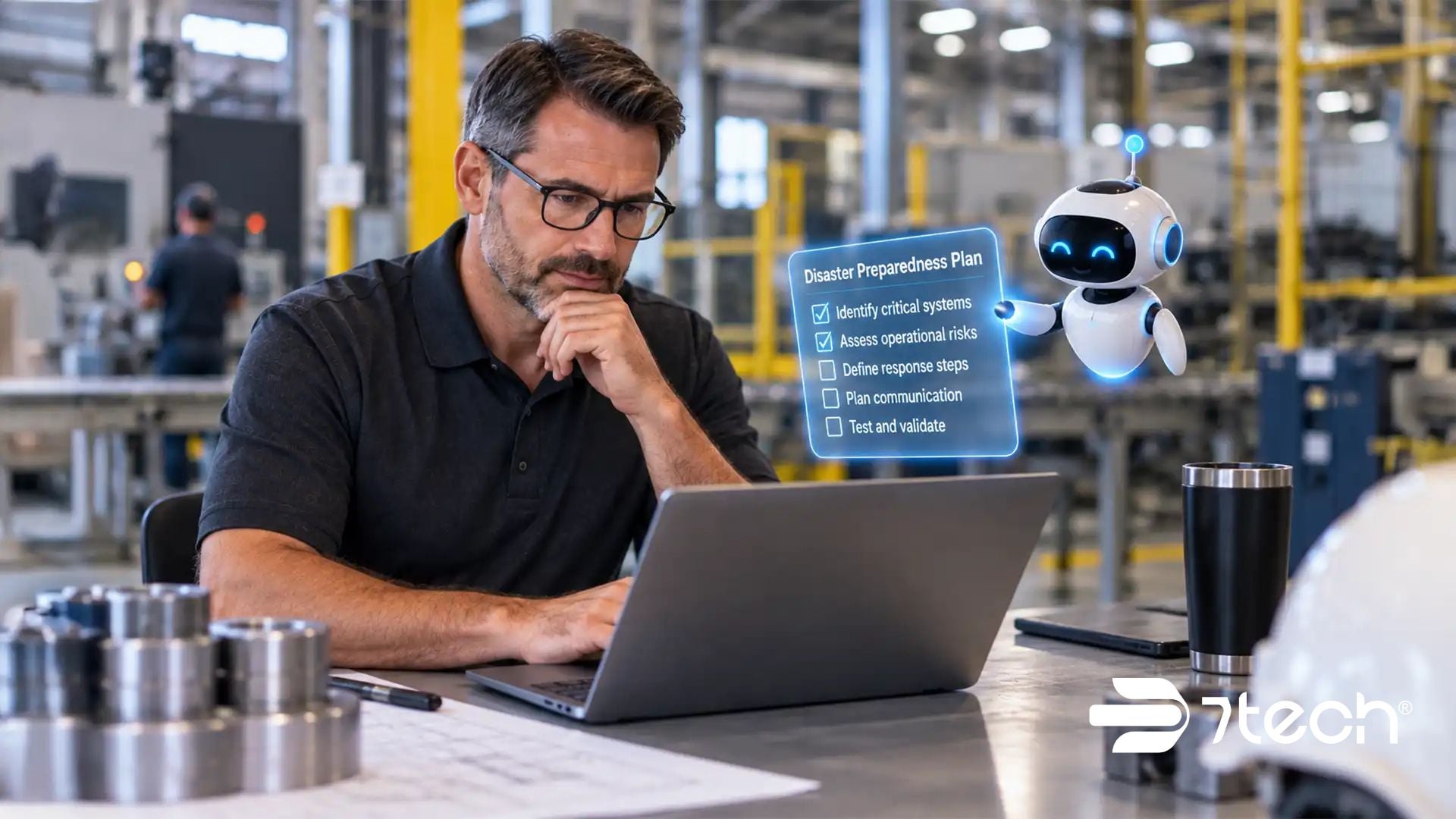
For example, a plant manager and IT lead could describe what happens when a production application becomes unavailable. AI could organize those notes into a structured procedure with responsibilities, dependencies, decision points, and escalation steps.
That does not make the document finished.
The people who actually understand the operation still need to review it.
But refining a draft is usually easier than creating one from scratch – especially when the process crosses production, IT, operations, vendors, and leadership.
There is also an executive benefit.
If only one person knows how to restore access, contact the right vendor, or keep a critical process moving, the business has already identified a continuity risk.
When production is waiting, documented knowledge is far more useful than knowledge trapped in one person’s head.
That broader approach is consistent with contingency planning guidance from NIST, which emphasizes identifying critical systems, dependencies, priorities, and recovery requirements rather than treating contingency planning as a single-system exercise.
2. Build Manufacturing Response Checklists and Recovery Playbooks
A recovery plan is easier to use under pressure when it is broken into clear actions.
AI can help manufacturers create first drafts of response checklists and playbooks for scenarios such as:
- Ransomware
- Internet or network outages
- ERP or MES downtime
- Loss of access to engineering files
- Severe weather
- Power-related disruptions
- Vendor outages
- Cyber incidents
- Shipping or EDI failures
- Loss of access to cloud applications
For manufacturers, these manufacturing recovery playbooks can become part of a broader manufacturing business continuity checklist covering the people, systems, vendors, and communications required to keep the operation moving.
For example, AI could help create a first draft of a plant outage checklist that asks:
Who needs to be notified?
Which systems should be checked first?
Can production continue manually?
Which customer commitments may be affected?
Who communicates with vendors?
When should leadership escalate the incident?
Who decides whether production continues, slows, or stops?
That structure helps teams think in terms of decisions rather than documents.
A useful manufacturing playbook should also make ownership clear. During a disruption, ambiguity costs time.
Operations should know what it owns.
IT should know what it owns.
Vendors should know when they are expected to act.
Leadership should know which conditions require a business decision.
AI can help organize that structure.
But it does not inherently know which systems are production-critical, what recovery sequence the plant requires, how long a manual workaround is sustainable, or what customer and compliance obligations apply.
Use AI to create the first draft.
Let leadership, operations, IT, and the people closest to production determine the final playbook.
For ransomware scenarios, preparedness should also connect written procedures to actual ransomware protection for manufacturing plants rather than assuming the playbook itself provides technical protection.
NIST provides additional guidance on recovery playbooks and testing, including the importance of planning, prioritization, realistic recovery scenarios, testing, and continued improvement.
Manufacturers also need to account for plant-floor realities that differ from standard office IT. CISA guidance for industrial control system incident response provides additional context for incident response in ICS and operational technology environments.
3. Surface Manufacturing Dependencies and Preparedness Gaps
One of the hardest parts of disaster planning is knowing what you have not thought about.
AI can be useful because it can generate questions that force the team to examine the operation from different angles.
For example:
What happens if our ERP is unavailable for eight hours?
What parts of production depend on internet connectivity?
Which systems could prevent us from shipping even if production is still running?
What manufacturing processes depend on one person’s knowledge?
What should we verify before claiming that our backups are recovery-ready?
Which vendors could become single points of failure?
What could prevent production from restarting after a cyber incident?
Leadership teams can extend that exercise with additional questions manufacturing leaders should ask about preparedness when they want to challenge assumptions beyond the scenarios already documented.
Those questions can expose dependencies that are easy to miss during normal operations.
A production line may continue running, for example, while labeling, inventory transactions, quality documentation, or shipping systems are unavailable.
The problem may not appear immediately.
It may surface hours later when finished goods cannot be processed, recorded, or moved.
That is why manufacturing disaster preparedness should not stop with the question, “Can production run?”
Leadership should also ask:
Can we receive materials?
Can we record production?
Can we access specifications?
Can we complete quality processes?
Can we label and ship?
Can we communicate with customers and suppliers?
AI can help surface those scenarios.
What it cannot do is tell you which scenarios create the greatest financial, operational, contractual, or customer exposure without accurate context.
Leadership still has to determine where the real risk lives.
For plants that depend on connected equipment and control environments, securing OT and plant operations should be considered alongside traditional IT recovery. Reviewing network security threats and vulnerabilities can also help expose connectivity and access dependencies that may affect recovery.
This is especially important for ERP and MES disaster recovery, because restoring one application does not automatically prove that the systems, network connections, interfaces, and shop-floor processes around it will function as expected.
4. Turn Technical Information Into Manufacturing Business Decisions
Manufacturing leaders do not need to become backup engineers, network architects, or cybersecurity analysts.
They do need to understand what technical findings could mean for production.
That distinction matters.
A backup report may be technically accurate but still leave a COO wondering:
Can we actually restore the ERP before first shift?
A vulnerability report may be detailed but leave the CEO asking:
Could this issue shut down production or affect a customer requirement?
A network diagram may be complete but leave leadership wondering:
Which connection is a single point of failure for the plant?
AI can help translate technical documentation into more usable language.
It can summarize reports, identify questions leadership should ask, and organize findings around operational impact.
For example, instead of simply reviewing a technical backup report, leadership could use AI to help frame questions such as:
- Which systems have the longest recovery times?
- Which recovery assumptions have not been tested?
- Which systems would affect production first?
- Where are we dependent on one vendor, server, connection, or employee?
- Which gaps could delay shipping or customer commitments?
- Which findings require action now, and which can be planned?
The objective is not to make executives more technical.
It is to make technical information easier to turn into operational decisions.
For leadership, that means moving from “What does this report say?” to “What happens to the business if this fails?”
That is the question disaster preparedness ultimately needs to answer.
A formal manufacturing IT audit process can help leadership move from questions to evidence by evaluating where systems, dependencies, controls, and operational assumptions may require closer review.
Preparedness priorities also need to compete with other technology investments. A manufacturing IT budget planning process can help executives connect resilience gaps to planned spending instead of waiting for an outage to create an unplanned expense.
5. Keep Recovery Documentation Current as Manufacturing Changes
Manufacturing environments rarely stay still.
New equipment is installed.
Applications are added.
Cloud systems replace older platforms.
Vendors change.
Employees leave.
Plants expand.
Customers introduce new requirements.
Security controls evolve.
The recovery plan that was accurate a year ago may no longer reflect the operation you are running today.
AI can make documentation maintenance easier.
For example, it can help:
- Compare older procedures with new operational notes
- Standardize documentation written by different teams
- Identify references to retired systems or former employees
- Turn recent operational changes into updated drafts
- Summarize changes between versions
- Create review checklists for leadership and IT
- Flag areas that may require new validation after a system or vendor change
That matters because preparedness documents tend to age quietly.
Nobody notices until someone actually needs them.
AI can reduce the administrative burden of keeping those documents current.
But human ownership remains essential.
Only your team can decide what is accurate, approved, and appropriate for the operation.
A current-looking document is not necessarily a current recovery capability.
For manufacturers incorporating AI into these workflows, choosing AI tools for manufacturing should include governance and data-handling considerations. Organizations should also define how employees adopt AI securely in business so sensitive operational, customer, employee, or security information is not introduced into inappropriate tools.
Unmanaged use can create a separate problem. Understanding shadow AI in business helps leadership account for AI tools employees may be using outside approved workflows.
Where AI for Manufacturing Disaster Preparedness Planning Stops
This is where manufacturers need to be disciplined.
AI can help you think.
It can help you write.
It can help you organize.
It can help you ask better questions.
But it cannot validate whether your operation is actually prepared.
No matter how polished the output is, AI cannot:
- Test whether backups can actually be restored
- Confirm that an ERP will recover within the time the business requires
- Verify that plant systems will reconnect correctly after an outage
- Determine whether manual workarounds will hold up during a real disruption
- Coordinate operations, IT, vendors, and leadership during an active incident
- Confirm that a recovery sequence reflects real production dependencies
- Verify that employees know what to do when normal systems are unavailable
- Replace experienced judgment and accountability
These limits do not make AI less useful.
They establish the point where drafting ends and validation begins.
AI can improve the recovery plan. It cannot prove the recovery capability.
That boundary is consistent with NIST’s Generative AI risk management profile, which emphasizes governance, evaluation, human oversight, and risk management when organizations use generative AI.
Turn Recovery Assumptions Into Claims You Can Prove
Better recovery documents still matter.
Clear plans help the team understand what should happen when something goes wrong.
But AI can give manufacturers something more useful than a better-written plan.
It can help produce a shorter list of recovery claims that still need evidence.
A recovery plan describes what should happen.
It does not prove that each step will work.
Your plan may say backups are ready.
It may say a critical system can return before production starts.
It may state that employees can switch to a manual process during an outage.
It may assume a backup connection will keep a plant online.
It may promise a specific recovery time.
Each statement is a recovery claim until evidence supports it.
For manufacturing backup and recovery planning, that distinction matters because successful backup jobs do not automatically prove that applications, access, infrastructure, and operational workflows can be restored together.
The backup assumptions manufacturers should question provide a useful companion for examining where backup success may be mistaken for broader recovery readiness.
Ask One Question About Every Critical Recovery Claim
Take five important statements from your current recovery plan.
For each one, ask:
What evidence proves this works?
Then look beyond the words in the document.
If the plan says backups are ready, check whether restoration has been tested.
If it lists a manual process, determine whether the people involved have actually practiced it.
If it promises a recovery time, check whether a test supports that target.
If it depends on a vendor, confirm that the escalation path and responsibilities are understood.
If it assumes employees can continue remotely, verify the systems and access required to make that possible.
You may find strong evidence behind some claims.
Other claims may exist only in the document.
That gives leadership a clearer preparedness priority list.
Use an approved AI tool to pull the recovery claims from your current plan.
Then compare those claims with the evidence your team actually has.
Use the unproven claims to decide what your team should validate next.
A cybersecurity assessment checklist can provide another structured way to move from assumptions toward verification when recovery claims depend on security controls or cyber readiness.
The goal is not to dismiss the planning work.
The goal is to know where the document ends and the evidence begins.
When an IT Problem Becomes a Production Problem
In manufacturing, a technology problem rarely stays confined to the system where it started.
The impact can spread into production, schedules, shipping, labor costs, and customer commitments.
A network issue becomes a production issue.
A production issue becomes a schedule issue.
A schedule issue can become overtime, premium freight, delayed shipments, or missed customer commitments.
Eventually, an IT problem becomes a business problem.
That is why executives should evaluate technology risk in terms of operational consequences.
The question is not simply:
“How quickly can IT fix this?”
It is:
“How long can the operation tolerate this failure before it affects production, customers, or revenue?”
That changes how recovery priorities are set.
Effective manufacturing downtime planning should therefore consider both the technical failure and the operational cost of waiting. Understanding the broader cost of IT downtime helps connect recovery priorities to labor, schedules, shipping, customer commitments, and revenue.
Manufacturers can also reduce exposure before a recovery plan is needed by reducing manufacturing downtime from IT and network issues and addressing opportunities for reducing unplanned downtime in manufacturing.
Where a Manufacturing-Focused IT Partner Fits
As manufacturing businesses grow, the technology underneath the operation usually becomes more complex.
More users.
More applications.
More vendors.
More cloud dependencies.
More security requirements.
More systems that production depends on.
The recovery model needs to mature along with that complexity.
A manufacturing-focused IT partner can help map the systems and dependencies behind the operation, test recovery processes, verify backups, identify single points of failure, and translate technical gaps into business priorities.
That is the part AI cannot perform for you.
A qualified partner can also help answer practical questions such as:
- Which systems are truly production-critical?
- What has actually been tested?
- Which recovery targets are assumptions?
- Where does one failure affect multiple business processes?
- Which dependencies could stop production or shipping?
- Which issues require technical remediation rather than better documentation?
For organizations with growing operational complexity, IT support for manufacturing companies can provide another layer of technical capacity around the systems production depends on.
At 7tech, our role is not to replace the leadership team or the people who know the operation best.
It is to help determine whether the technology, cybersecurity, and recovery model underneath the business can support what happens when things do not go according to plan.
AI can help build the draft.
The real test is whether the plan can keep the operation moving.
Frequently Asked Questions About AI for Manufacturing Disaster Preparedness Planning
Can AI create a complete manufacturing disaster recovery plan?
AI can create a useful first draft, but operations, IT, and leadership still need to verify system dependencies, responsibilities, recovery procedures, manual workarounds, and actual recovery performance.
Can AI determine whether our backups are recovery-ready?
No. AI can review documentation and help identify questions, but backup readiness requires actual restoration testing and evidence that recovered information can be used by the systems and people who need it.
How can manufacturers use AI during business continuity planning?
Manufacturers can use AI to document processes, generate scenarios, create checklist drafts, summarize technical findings, identify questions, and maintain recovery documentation as systems, vendors, and operational requirements change.
For a broader framework beyond AI-assisted documentation, business continuity planning for manufacturing addresses the larger operational planning process.
What manufacturing systems should be considered in disaster planning?
The answer depends on the operation, but common dependencies include ERP, MES, plant networks, engineering files, cloud systems, EDI, shipping applications, identity systems, remote access, backups, communications, and critical third-party vendors.
Why are manual workarounds important in manufacturing recovery planning?
Manual processes may allow production or related operations to continue temporarily when systems are unavailable. They should be documented and validated because a workaround that has never been practiced may not perform as expected during a real disruption.
How often should manufacturers review their recovery plans?
Review the plan whenever significant systems, vendors, personnel, plants, production processes, customer requirements, or security controls change. Regular testing should also drive updates when actual results differ from documented assumptions.
What is the biggest risk of using AI for disaster preparedness?
The biggest risk is confusing a polished plan with proven readiness. AI can make recovery documentation clearer, but it cannot demonstrate that backups, systems, people, vendors, and workarounds will perform correctly during a real outage.
Strengthen the Plan Before You Need It
If you are already experimenting with AI for manufacturing disaster preparedness planning, use it where it is strongest:
Documenting.
Organizing.
Questioning.
Summarizing.
Updating.
Then use what AI surfaces to determine where your team should focus its preparedness work next.
Do not stop when the document looks complete.
Look for the assumptions inside it.
Identify the claims that matter most to production.
Then determine which ones you can actually prove.
That is also the foundation of effective business continuity planning for manufacturing: identifying what operations depend on, understanding the consequences of failure, and validating the recovery capabilities leadership expects to be available.
7tech helps manufacturers identify critical technology dependencies, evaluate recovery assumptions, strengthen cybersecurity, and determine where the systems underneath the operation deserve a closer look.
If you want a clearer view of where your current preparedness strategy may have gaps, schedule a free 15-minute discovery call with 7tech.
Call (844) 701-6777 to get started.

Neal Juern, Founder and CEO of 7tech, helps business leaders take control of their IT and strengthen cybersecurity without the complexity. Since founding 7tech in 2012, he’s built it into a 5X MSP 501 winner and guided hundreds of executives toward smarter, safer operations through Managed IT Services and Managed Security Services that make sense to people outside the IT department. He speaks regularly to executive and nonprofit audiences across Texas.