

How to Evaluate IT Support for Manufacturing Companies
In manufacturing, IT problems quickly become production problems. When systems go down, production lines stop, orders cannot be fulfilled, and revenue loss compounds with every hour of downtime. This makes evaluating IT support fundamentally different for manufacturing companies—you are not evaluating ticket handling, you are evaluating operational continuity.
This guide outlines the specific evaluation criteria manufacturing leaders should use when assessing IT support vendors, with attention to the capabilities that differentiate providers who understand production environments from those who offer generic support. For authoritative context, see guidance from the National Institute of Standards and Technology and CISA on manufacturing cybersecurity.
Key evaluation criteria: Understanding of plant-critical systems (ERP, SCADA); ability to prioritize production-impacting incidents; clear vendor coordination; proactive monitoring that prevents problems; and cybersecurity that protects without disrupting operations. Schedule a discovery call to discuss your manufacturing environment.
Why Manufacturing Companies Evaluate IT Support Differently
In most industries, an IT outage means lost productivity. In manufacturing, that same outage can mean a production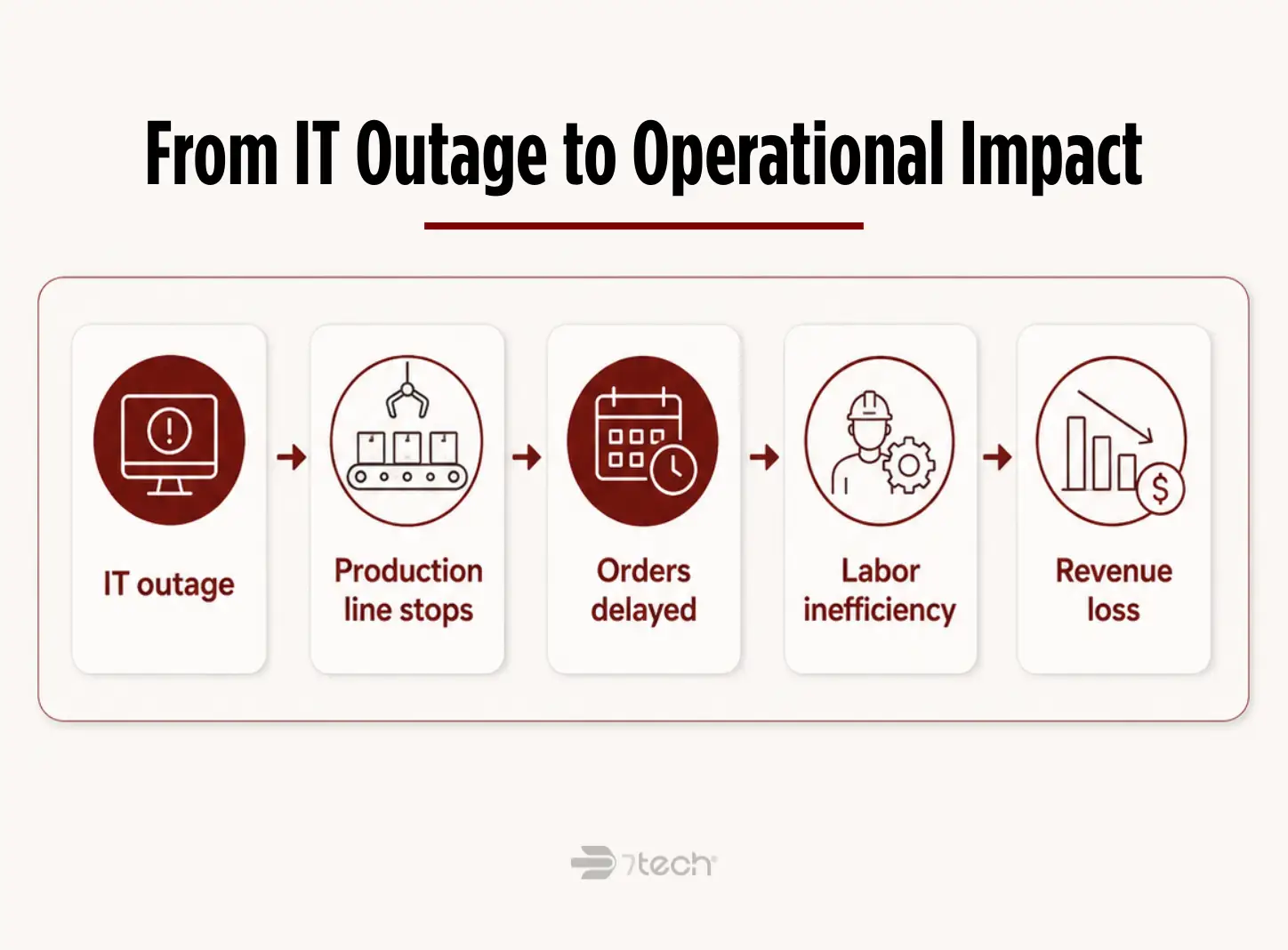
line stops entirely, orders cannot be fulfilled, and the financial impact compounds with every hour of downtime. This fundamental difference changes how manufacturing leaders must evaluate IT support providers.
Generic IT support vendors measure success by ticket resolution times and user satisfaction scores. These metrics matter, but they do not capture what manufacturing executives actually need to protect: the ability to keep production running, meet delivery commitments, and maintain labor efficiency. When an ERP system goes down on the plant floor, it is not an inconvenience—it is a production-stopping event that affects every downstream operation.
Manufacturing IT evaluation must start from this operational reality. The question is not “How fast can they answer support tickets?” but rather “How quickly can they resolve issues that are stopping production, and do they understand the dependencies between IT systems and manufacturing operations?”
What Manufacturing Leaders Are Really Trying to Protect
When manufacturing executives evaluate IT support, they are implicitly evaluating their ability to protect several critical business outcomes: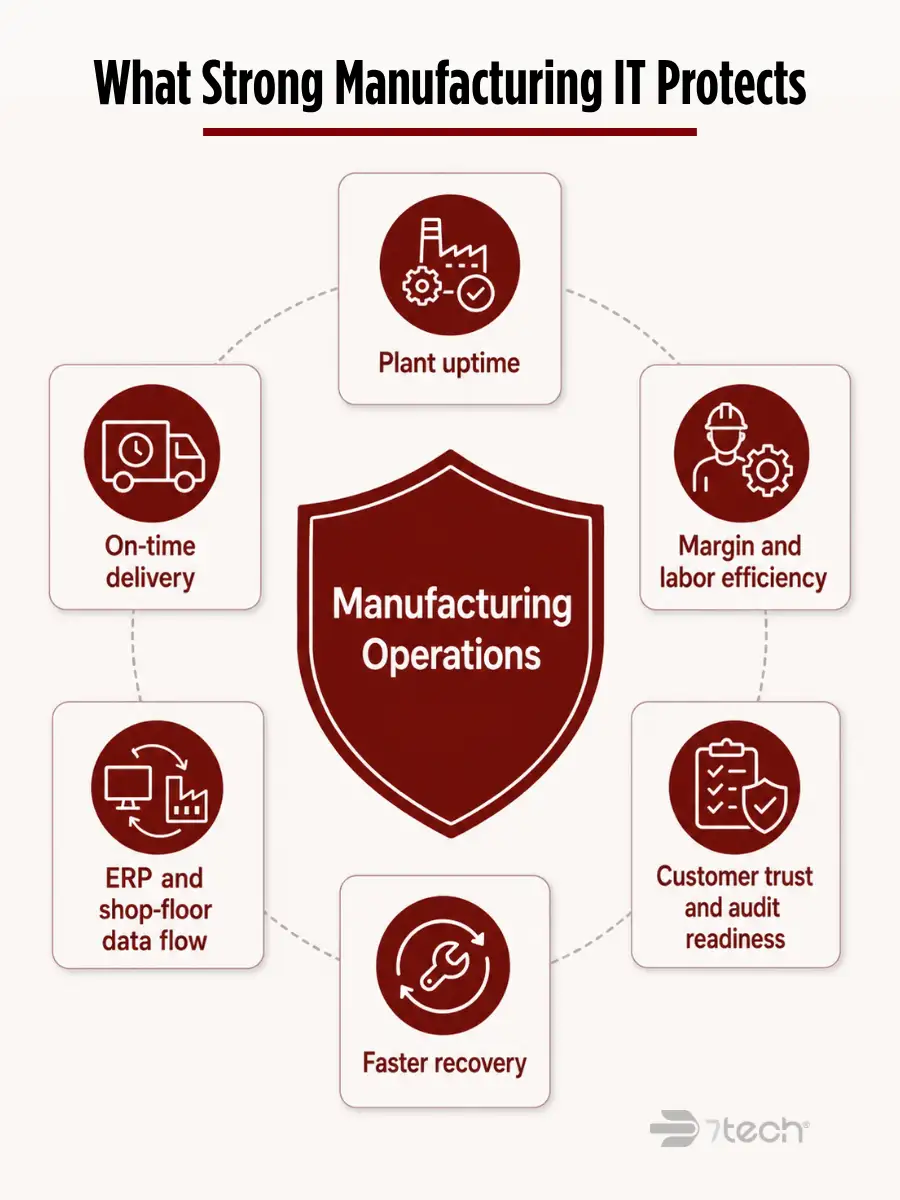
- Plant uptime and availability: Every hour of unplanned downtime costs manufacturers significantly in lost production, overtime labor, and potential contractual penalties with customers.
- Schedule adherence and on-time delivery: IT systems increasingly drive production scheduling, quality tracking, and shipping coordination. When these systems fail, the ability to promise and deliver on time commitments is compromised.
- Margin and labor efficiency: Understanding managed IT services pricing helps make informed decisions. Modern manufacturing relies on IT systems to optimize labor deployment, track material usage, and maintain quality standards. IT failures directly erode operational margins.
- Reliable ERP and shop-floor data flow: The integration between enterprise systems and plant-floor equipment (SCADA, PLCs, and automated systems) is where manufacturing IT differs most from other industries.
- Customer trust and audit readiness: Manufacturing customers increasingly audit their suppliers on IT and cybersecurity practices. Executives need IT support that does not become a liability during customer reviews.
- Faster recovery when systems fail: Given the complexity of manufacturing IT environments, the ability to recover quickly from failures is often more important than preventing every failure.
These concerns represent what manufacturing leaders are trying to protect. Effective IT evaluation criteria should directly address each of these operational outcomes.
What Manufacturing Companies Should Look for in IT Support
With operational priorities established, here are the specific criteria manufacturing leaders should use when evaluating IT support providers: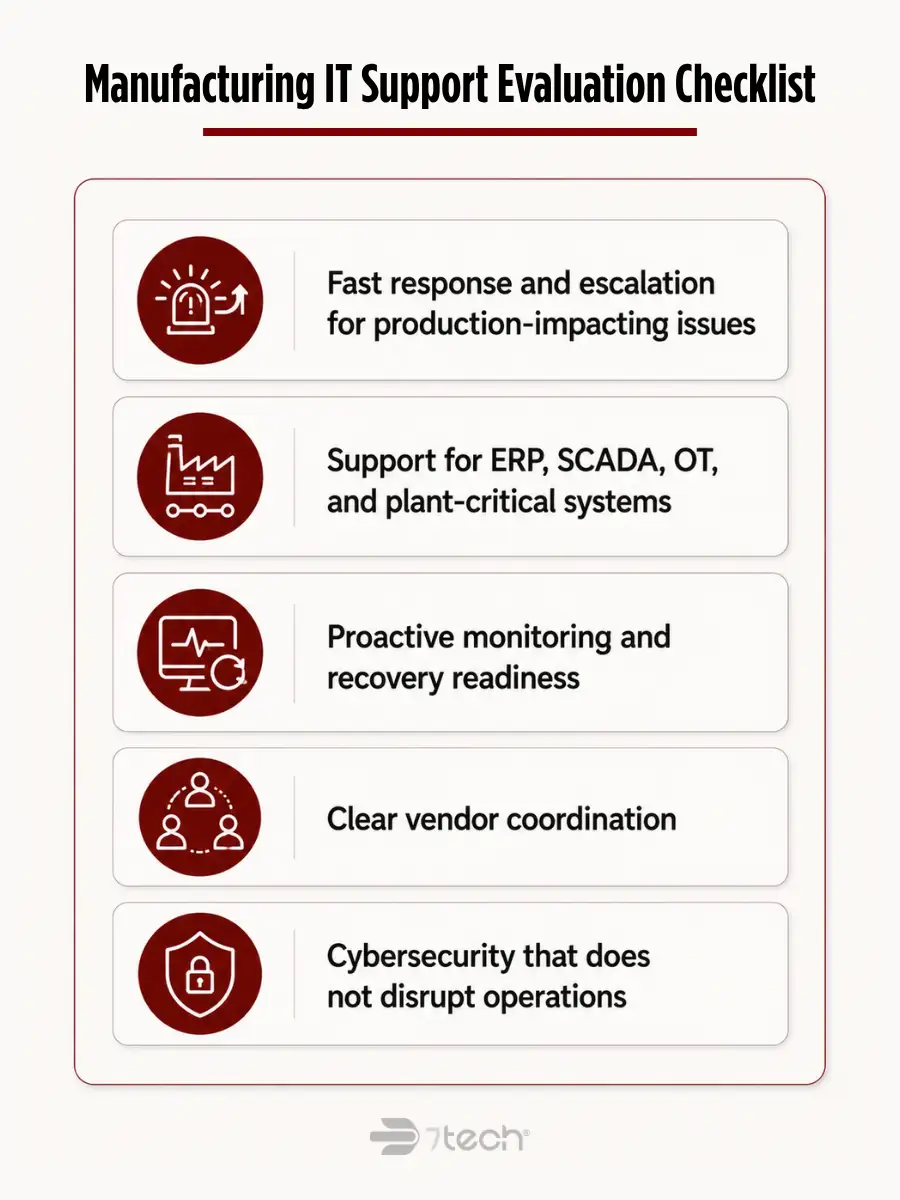
- Fast response and clear escalation paths for production-impacting issues: Ask how the provider categorizes issue severity and what escalation paths exist for problems affecting production. The provider should be able to articulate exactly who handles critical issues and how quickly they engage.
- Support for plant-critical systems: The provider must demonstrate understanding of securing plant operations, ERP systems (SAP, Oracle, Microsoft Dynamics), shop-floor control systems, and operational technology (OT) that other IT providers rarely encounter. This includes knowing the difference between IT infrastructure and the systems that control manufacturing processes.
- Proactive monitoring and recovery readiness: Look for providers who monitor systems before they fail, not just after. Ask about backup verification, disaster recovery testing, and how they ensure recovery procedures actually work when needed.
- Clear vendor coordination: Manufacturing IT environments involve multiple third parties—like construction companies need specialized support—internet service providers, software vendors, printer and device manufacturers, and specialist automation providers. Your IT support provider should coordinate these relationships, not force you to manage them yourself.
- Cybersecurity awareness that does not disrupt operations: Security measures that lock down systems too aggressively can impede production. The right provider balances security with operational needs, implementing controls that protect without creating new problems on the plant floor. Review ransomware protection for manufacturing as part of this evaluation. Refer to the NIST Cybersecurity Framework and CISA manufacturing security guidance for authoritative standards.
These criteria provide a practical checklist. Any prospective IT support provider should be able to demonstrate capability in each area—not just offer generic assurances.
How to Tell Whether an IT Provider Can Support a Manufacturing Environment
Beyond surface-level criteria, manufacturing executives need to assess deep capability. Here is how to determine whether a provider truly understands manufacturing IT environments:
- Experience with manufacturing workflows and dependencies: Ask the provider to describe manufacturing clients they have supported and the specific systems involved. Look for evidence they understand how production scheduling, quality control, and shipping systems interact.
- Understanding of uptime, delivery, and recovery priorities: A provider who treats every support request with equal priority does not understand manufacturing. They should be able to articulate how they prioritize production-impacting issues differently from general IT support requests.
- Ability to support compliance and data protection needs: Many manufacturing sectors (defense contractors, aerospace suppliers, food and beverage producers) face specific regulatory requirements. The provider should demonstrate familiarity with compliance frameworks relevant to your industry.
- Capability to support growth, multiple sites, and limited internal IT staff: Manufacturing companies frequently operate across multiple locations with lean internal IT teams. Your provider should be equipped to act as a full IT department or seamlessly supplement internal staff without creating gaps.
These capability questions often reveal the difference between providers who have manufacturing experience and those who simply claim to understand it.
Questions to Ask Before Choosing an IT Support Provider
These seven questions provide a practical evaluation framework for direct use with current or prospective IT providers:
- How do you handle production-impacting incidents? Look for answers that include specific response times for critical issues, clear escalation paths, and understanding of the business impact when production systems go down.
- What does after-hours support actually look like? Manufacturing often runs outside standard business hours. The provider should clearly describe their availability, response procedures, and whether they have staff who understand manufacturing operations at all times.
- Who coordinates with our ERP, ISP, printer, and software vendors? You should not have to manage multiple vendor relationships. The provider should take responsibility for coordinating with the various parties involved in your IT ecosystem.
- How do you help us recover from outages faster? Look for evidence of disaster recovery planning, regular testing, and understanding of the specific recovery challenges manufacturing environments present. Reducing manufacturing downtime requires these capabilities.
- How do you support both daily IT needs and cybersecurity risk? The provider should balance operational support with security. Ask how they handle the tension between making systems accessible for production and protecting them from threats.
- What does success look like in a manufacturing environment? This open-ended question often reveals whether the provider has actual manufacturing experience or is offering generic IT support with manufacturing marketing.
- How do you handle the intersection of IT and operational technology? Manufacturing increasingly blends traditional IT with operational technology. Your provider should understand this intersection and not treat them as separate domains.
These questions are designed to be taken directly into conversations with IT providers. The answers reveal much about their actual manufacturing experience.
For a broader set of evaluation questions, see our resource on questions to ask your IT provider.
Signs You May Have Outgrown Generic IT Support
Manufacturing executives often realize they need specialized IT support only after experiencing recurring problems. Here are signs that generic IT support may no longer serve your operational needs:
- IT issues keep turning into operations problems: If the production team regularly experiences IT-related disruptions that affect output, your current provider does not understand manufacturing priorities.
- Team relies on workarounds too often: When staff develop informal workarounds to compensate for IT limitations, it signals that the IT environment is not keeping pace with operational needs.
- Vendor coordination is slow or unclear: Juggling multiple IT vendors without a single point of accountability creates administrative overhead and slows problem resolution.
- Recovery takes too long when something breaks: If disaster recovery is theoretical rather than tested and practical, a system failure could mean extended production downtime.
- Support is reactive, not proactive: Generic IT support often waits for problems to arise. Manufacturing operations benefit from providers who monitor systems, identify issues before they affect production, and maintain infrastructure proactively. Explore strategies for reducing unplanned downtime to understand what proactive support looks like.
- One person holds too much system knowledge: If your IT support depends heavily on a single individual, you face business continuity risk. Manufacturing requires team-based support with redundancy.
These signs indicate a gap between what generic IT support provides and what manufacturing operations require. Recognizing the gap is the first step toward finding a provider who understands production environments.
How 7tech Aligns With What Manufacturers Should Look For
7tech’s approach to manufacturing IT support is built around the operational priorities that matter to production-focused executives:
- Responsive support for production-impacting issues: Our support model recognizes that not all IT issues carry equal operational impact. We prioritize issues affecting production systems and maintain clear escalation paths for time-sensitive situations.
- Proactive work that helps prevent repeat problems: Beyond resolving immediate issues, we analyze recurring problems and implement fixes that prevent them from happening again. This approach reduces the cumulative time your team spends dealing with IT disruptions.
- Backup and network improvements that support smoother operations: We design and maintain infrastructure with manufacturing workflows in mind, ensuring that network reliability and backup systems support operational continuity rather than creating additional management burden.
- Clear communication and follow-through: Our experience spans diverse verticals, including nonprofit organizations. Manufacturing executives need IT partners who communicate in business terms, not technical jargon. We provide clear explanations of issues, resolution steps, and preventive measures.
Our support model is designed specifically to help manufacturers keep operations moving. We understand that in manufacturing, IT is not separate from production—it is integral to maintaining output, meeting commitments, and protecting margins.
“We don’t worry about IT disrupting production anymore. If you’re a manufacturing company that needs things running without interruption, I’d recommend 7tech.” – Garrick Mullen, Watco Tanks
For more detail on our manufacturing IT services, visit our dedicated page.
Choosing IT Support That Helps Manufacturing Run More Predictably
The goal of IT support for manufacturing is not more technology—it is fewer disruptions, faster recovery, and clearer accountability. When evaluating providers, focus on their ability to contribute to operational predictability rather than their technical capabilities in isolation.
The right IT support helps manufacturing run with less avoidable chaos. It provides the foundation for production consistency, delivery reliability, and margin protection that executives are ultimately accountable for delivering.
TL;DR
Evaluating IT support for manufacturing requires criteria that go far beyond generic IT support assessment. Key evaluation criteria include:
- Understanding of plant-critical systems (ERP, SCADA, OT)
- Ability to prioritize production-impacting incidents with clear escalation paths
- Clear vendor coordination to reduce your administrative burden
- Proactive monitoring that prevents problems before they affect production
- Cybersecurity that protects without disrupting operations
Use our IT scorecard for Texas business executives as a complementary evaluation tool. Ask prospective providers specific questions about manufacturing experience, recovery capabilities, and how they handle the IT/operational technology intersection. The right provider contributes to operational predictability—not just technical uptime.
See how 7tech approaches manufacturing IT support to determine whether your current provider meets these criteria. Schedule a discovery call to discuss your environment.
Frequently Asked Questions
How fast should manufacturing IT support respond?
Manufacturing IT support should offer differentiated response times based on issue severity. Production-impacting issues should receive priority response—often within 30 minutes or less—rather than generic “best effort” response times that do not account for operational impact.
What is the difference between generic IT support and manufacturing-focused support?
Generic IT support focuses on resolving user issues and maintaining system availability. Manufacturing-focused support understands production workflows, plant-critical systems, and the operational consequences of IT failures. It prioritizes issues differently and coordinates with operational technology teams.
How do I know if my current IT provider understands manufacturing?
Ask specific questions about their experience with ERP systems, production scheduling software, and shop-floor technology. Ask how they prioritize production-impacting issues and whether they understand the difference between IT infrastructure and operational technology.
What should I look for in an IT provider’s disaster recovery plan for manufacturing?
Look for recovery time objectives that account for production downtime costs, tested backup procedures that actually work, understanding of manufacturing-specific recovery challenges, and clear communication protocols for production-impacting events. Review our guide on reducing unplanned downtime in manufacturing for more context.
Can manufacturing IT support help with compliance like CMMC?
Yes, many manufacturing IT providers support compliance requirements including CMMC (Cybersecurity Maturity Model Certification) for defense contractors, industry-specific security standards, and customer audit requirements. For authoritative guidance, review the NIST Cybersecurity Framework and CISA resources for manufacturers. Ask providers about their specific compliance experience in your sector.
Does 7tech provide IT support for manufacturing companies?
Yes. 7tech provides managed IT services and cybersecurity support for manufacturing companies across Texas and nationwide. Our team understands production environments, plant-critical systems, and the operational priorities that matter to manufacturing executives. Learn more about our manufacturing IT services.
For more insight into manufacturing IT budgeting and how to plan your IT spend, visit our dedicated resource.
Ready to Evaluate Your Current IT Support?
Need a second opinion on your current IT support? Schedule a 15-Minute Discovery Call to talk through your manufacturing environment.

Neal Juern, Founder and CEO of 7tech, helps business leaders take control of their IT and strengthen cybersecurity without the complexity. Since founding 7tech in 2012, he’s built it into a 5X MSP 501 winner and guided hundreds of executives toward smarter, safer operations through Managed IT Services and Managed Security Services that make sense to people outside the IT department. He speaks regularly to executive and nonprofit audiences across Texas.