

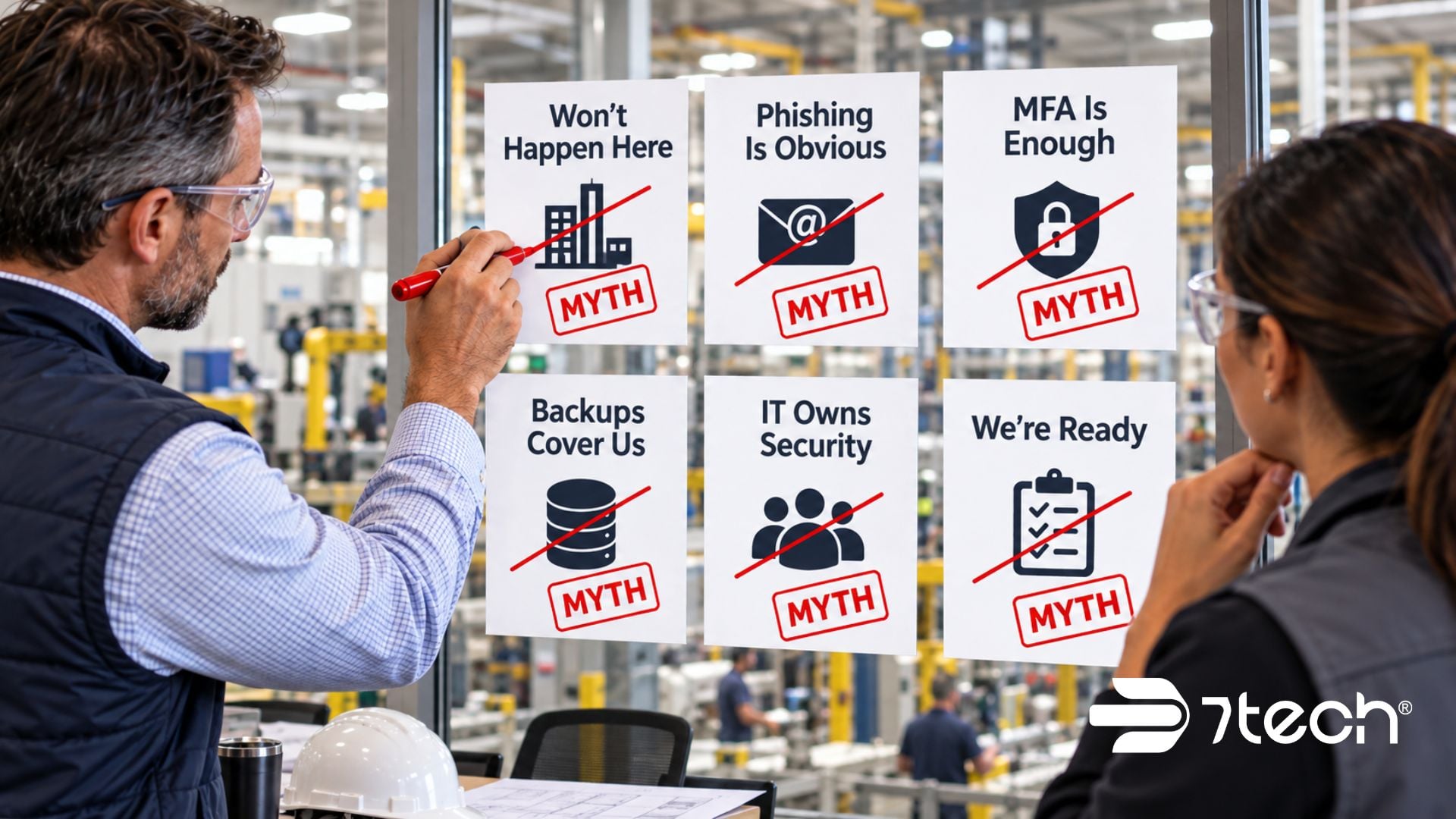
6 Manufacturing Cybersecurity Myths That Put Your Business at Risk
Manufacturing cybersecurity myths can create a false sense of security by convincing business leaders that risks to their systems and operations are already under control. The most dangerous assumptions involve who gets targeted, whether employees can recognize phishing, what MFA actually protects, whether backups guarantee recovery, who owns cybersecurity, and how prepared the business is for an incident.
October is Cybersecurity Awareness Month, making it a useful time to separate manufacturing cybersecurity myths and facts. The goal is not to make every manufacturing executive a security expert. It is to make sure the assumptions behind your risk decisions reflect the systems, people, vendors, and technology your operation depends on.
For manufacturing leaders, the real question is straightforward: Are your cybersecurity controls proven, or do they simply feel reassuring?
Why Cybersecurity Myths Create Operational Risk for Manufacturers
Modern manufacturing depends on connected technology. ERP systems, cloud applications, engineering files, email, remote access, shop-floor devices, vendors, and plant networks increasingly depend on one another.
That interdependence means a cybersecurity problem may not stay inside IT.
An unavailable system can interrupt scheduling. A compromised account can expose sensitive information or create another path into the environment. Ransomware can affect production and recovery. A poorly coordinated response can extend downtime while leadership, operations, and IT determine what to do next.
NIST’s manufacturers guide to cybersecurity similarly frames cybersecurity around the systems, information, and connections manufacturers rely on to operate.
For manufacturers that need continuous security monitoring and response beyond traditional IT support, layered security can provide greater visibility across identities, endpoints, networks, cloud systems, and other technology dependencies.
The six myths below focus on a central executive question: Would your cybersecurity assumptions hold up during a real production day?
Myth 1: “A Cyberattack Won’t Happen to Us”
Most manufacturing leaders know cyberattacks happen. The dangerous assumption is believing they happen to somebody else.
Perhaps your company has never experienced a serious incident. You may not believe you have the kind of data attackers want. Or previous cybersecurity investments may have created confidence that the major risks are already under control.
Attackers do not need a personal reason to target a manufacturer. An exposed account, stolen password, unpatched system, phishing email, or vulnerable remote connection can create an opportunity.
Manufacturers also have something attackers understand well: a strong incentive to keep production moving. When production schedules, customer commitments, proprietary information, and critical systems are at stake, disruption creates business pressure.
Watco Tanks experienced the operational consequences of unreliable technology firsthand. The steel tank manufacturer dealt with recurring server failures, viruses, and network instability that disrupted operations and slowed production. After working with 7tech, the company reported a more stable environment, with Systems & Scheduling Manager Garrick Mullen saying,
“We don’t worry about IT disrupting production anymore.”
The experience illustrates the larger issue for executives: technology and security risks ultimately matter because of what they can do to the operation.
Manufacturers evaluating their exposure can use a manufacturing IT security assessment to identify gaps that may not be visible during normal day-to-day operations.
Fact: Past experience is not proof of future protection. Every manufacturer has cyber risk worth understanding.
Myth 2: “Employees Will Recognize a Phishing Email”
Phishing in manufacturing is harder to identify when the message looks like normal business communication.
A fraudulent email may appear to come from an executive, supplier, customer, Microsoft 365 notification, shipping partner, or another person employees regularly work with. AI has also made polished, convincing messages easier to produce, making grammar and spelling less useful as warning signs.
Manufacturing employees should pay particular attention when a message asks them to:
- Change supplier payment or banking instructions
- Share sensitive customer, employee, or engineering information
- Sign in to a new or unusual portal
- Open an unexpected document
- Approve an unusual executive request
- Reset a password through an unfamiliar link
The concern extends beyond the front office. A compromised account can provide another foothold into an increasingly interconnected manufacturing environment.
Federal cybersecurity agencies have published joint federal guidance on preventing phishing intrusions, reinforcing the need for technical controls alongside employee awareness.
Employees need a reliable verification habit: when a request falls outside the normal process, confirm it through another trusted channel before acting.
That can be particularly important for supplier payment changes, sensitive information requests, unexpected credential prompts, and unusual access requests.
Fact: A professional-looking email can still be a cyberattack.
Myth 3: “MFA Fully Protects Our Accounts”
Multi-factor authentication is an important manufacturing security control, but account protection does not end once MFA is enabled.
Attackers can attempt MFA fatigue, sometimes called prompt bombing, by repeatedly sending authentication requests and hoping a busy or frustrated employee eventually approves one.
Consider an employee trying to resolve production questions while emails, calls, system alerts, and vendor requests are piling up. Repeated authentication prompts can start to feel like another interruption that needs to be cleared.
CISA guidance on MFA fatigue and number matching explains this attack method and describes stronger authentication practices.
Manufacturers should establish a simple expectation: If you did not initiate the login, do not approve the prompt. Report it so the activity can be investigated.
MFA should also operate alongside access management, security monitoring, endpoint protection, employee awareness, patching, and processes for responding quickly to suspicious activity. This layered approach becomes particularly important when organizations are securing OT and plant operations, where an access or security issue can have consequences beyond ordinary office IT.
Fact: MFA is an important layer of protection within a broader manufacturing cybersecurity strategy.
Myth 4: “Our Backups Have Us Covered”
For manufacturing leaders, the meaningful backup question is straightforward: How long until we can run again?
Imagine arriving Tuesday morning and discovering that critical files or business systems are unavailable.
Can they be restored? Has the restoration process been tested? How long will recovery take? Which systems come back first? Can production, planning, quality, shipping, purchasing, and customer service continue operating while recovery is underway?
A backup existing somewhere does not establish an operational recovery capability.
7tech manufacturing assessment data illustrates the difference. Traditional Backup & Disaster Recovery was satisfactory in all 8 companies evaluated for that capability, while Microsoft 365 Cloud Backup was below satisfactory in 7 of 12 companies evaluated. All seven received an immediate-attention finding.
That evidence shows why backup and disaster recovery for manufacturers should be evaluated system by system. Strong protection in one part of the environment does not prove that every critical workload can be recovered.
NIST guidance on ransomware readiness and recovery reinforces the need to prepare for response and recovery as part of broader ransomware risk management.
The operational consequences make that preparation especially important in manufacturing. Downtime can create idle labor, missed production schedules, catch-up overtime, delayed shipments, premium freight, and dissatisfied customers.
Manufacturers assessing their ransomware exposure should consider both how to protect a manufacturing plant from ransomware and how quickly critical operations can be restored if preventive controls fail.
Fact: Having backups is not the same as knowing you can recover the operation.
Myth 5: “Cybersecurity Is Only IT’s Responsibility”
IT can manage security tools, patch systems, administer accounts, monitor threats, and respond to alerts. Many of the decisions that affect manufacturing cyber risk, however, happen throughout the business.
Finance can encounter fraudulent payment requests. Engineering handles valuable intellectual property. HR manages sensitive employee information. Operations depends on critical systems remaining available. Vendors may require remote access. Executives can be attractive targets because of their authority and access.
OT and IT security also create shared dependencies between teams that may historically have operated separately.
Leadership sets expectations. IT builds and manages controls. Operations helps determine which systems are critical to production. Employees learn how to recognize and report unusual activity. Vendors receive appropriate access. Everyone involved understands what happens when something goes wrong.
This is what cyber resilience for manufacturers looks like at an organizational level: clearly assigned responsibilities supported by appropriate technical controls.
Manufacturing leaders should also understand what their internal team or provider actually owns. The scope of IT support for manufacturers should be clear about monitoring, security, access, recovery, escalation, and support for critical operations.
Fact: IT manages many security controls, but cybersecurity resilience depends on the entire organization.
Myth 6: “We’ll Figure Out What to Do If Something Happens”
It is Tuesday morning.
Employees suddenly cannot open critical files. Planning cannot reach an important system. Someone reports a strange message appearing on several computers.
Then the questions begin.
Should employees shut their computers down? Who contacts IT? Does production continue? Which systems should be isolated? How will teams communicate if email is unavailable? Who contacts the cyber insurance carrier? Does a customer need to be notified? Who has authority to shut down a system that operations depends on?
Those decisions become much harder when the manufacturing incident response plan exists mainly in people’s heads.
Manufacturing adds another layer of complexity because IT, operations, leadership, vendors, quality, finance, and outside security or insurance resources may all have roles in the response.
A practical incident response plan should identify:
- Who owns the response and escalation process
- Which systems and production dependencies are most critical
- How affected devices and networks should be handled
- How teams communicate if normal systems are unavailable
- Which outside resources need to be contacted
- Who has authority to make operational decisions
- What needs to be restored first
- How recovery will be validated before normal operations resume
NIST’s manufacturing guidance on cyber response and recovery specifically addresses restoring manufacturing operations following a cyber incident and the unique considerations involved in operational technology environments.
For manufacturing leaders, the practical test is whether those decisions have already been made. Response ownership, system priorities, communication methods, outside contacts, shutdown authority, and recovery responsibilities should be established before an incident puts the plant under pressure.
Fact: Your cyber recovery plan should be familiar before the day production depends on it.
What Should Manufacturing Leaders Verify Now?
Manufacturing security best practices become more useful to executives when they can be translated into a short set of questions about operational readiness.
- Exposure: Do we know which accounts, systems, networks, remote connections, and vendors could create meaningful operational risk?
- Access: Where is MFA enforced, who has privileged or remote access, and how quickly can inappropriate access be removed?
- IT and OT dependencies: Do we understand which business and plant systems depend on one another and where segmentation is required?
- Monitoring: Would suspicious activity be identified quickly enough to limit its operational impact?
- Recovery: Have critical systems and cloud data actually been restored successfully?
- Response: Does everyone know who owns an incident and who has authority to make time-sensitive decisions?
- Continuity: Can essential production and business functions continue while technology recovery is underway?
The answers should be supported by evidence. A cybersecurity assessment checklist can help leadership identify controls worth validating, while manufacturing IT audits can provide a more specific view of technology and security gaps affecting the operation.
Frequently Asked Questions About Manufacturing Cybersecurity Myths
What are the biggest cybersecurity risks for manufacturers?
Common plant cybersecurity risks include phishing, stolen credentials, ransomware, weak access controls, insecure remote access, inadequate network segmentation, untested recovery, and unclear incident response. Their business impact can include production downtime, delayed shipments, overtime, lost productivity, and customer disruption.
Why are phishing attacks still effective in manufacturing?
Modern phishing can imitate suppliers, executives, customers, shipping partners, cloud platforms, and other familiar contacts. Manufacturing employees also work in time-sensitive environments, making believable requests harder to scrutinize when production and customer demands are competing for attention.
Is MFA enough for manufacturing security?
MFA significantly improves account security, but it is one layer. Manufacturers also need appropriate access controls, monitoring, endpoint protection, network security, employee awareness, patching, and processes for responding to suspicious authentication activity.
Do backups protect a manufacturing plant from ransomware?
Backups are critical to recovery, but their existence alone does not guarantee operational resilience. Manufacturers need to know which systems are protected, how quickly they can be restored, whether recovery has been tested, and which production dependencies must return first.
Why does OT and IT security need to be coordinated?
Business systems and plant operations increasingly depend on connected networks, remote access, vendors, and shared technology. Security decisions affecting one environment can therefore create operational consequences elsewhere. Clear ownership and appropriate segmentation help manage those dependencies.
What should a manufacturing incident response plan include?
The plan should define ownership, escalation procedures, communication methods, system priorities, outside contacts, decision authority, isolation procedures, and recovery responsibilities. It should also account for how production continues or safely pauses while technology is being restored.
How can manufacturing leaders tell whether cybersecurity is working?
Look for evidence: MFA coverage, access reviews, monitoring, segmentation, vulnerability remediation, successful backup restoration, tested response procedures, and clear accountability. A manufacturing IT security assessment can identify gaps that normal operations may not expose.
The Real Takeaway on Manufacturing Cybersecurity Myths
Manufacturing cybersecurity is ultimately about protecting the operation your leadership team is already responsible for.
Production needs dependable systems. Operations needs visibility into technology dependencies. Finance needs to protect margin. IT needs the resources and authority to manage risk. Customers need confidence that your company can protect information and deliver as promised.
The danger behind manufacturing cybersecurity myths is unverified confidence. A company can have MFA, backups, monitoring, antivirus, and an IT provider while still carrying gaps that only become visible when a system fails or an attacker finds them first.
Manufacturing leaders should be able to answer practical questions with evidence: Where are we exposed? Which technology failures could interrupt production? How quickly could we detect a problem? What can we recover? Who owns the response? How long can the operation tolerate disruption?
If you are not sure how those assumptions would hold up during a real production day, 7tech can help evaluate the gaps in plain business terms and identify what deserves attention first.
Next step: Schedule a brief IT and security conversation with 7tech to review where a preventable technology issue could interrupt your operation.
Call (844) 701-6777 or visit 7tech.com.

Neal Juern, Founder and CEO of 7tech, helps business leaders take control of their IT and strengthen cybersecurity without the complexity. Since founding 7tech in 2012, he’s built it into a 5X MSP 501 winner and guided hundreds of executives toward smarter, safer operations through Managed IT Services and Managed Security Services that make sense to people outside the IT department. He speaks regularly to executive and nonprofit audiences across Texas.